The “Apartheid” Libel: Exposing a Catastrophic Category Error
Re-produced by Helena Lindholm and Nina Gren
By Khaled Salih
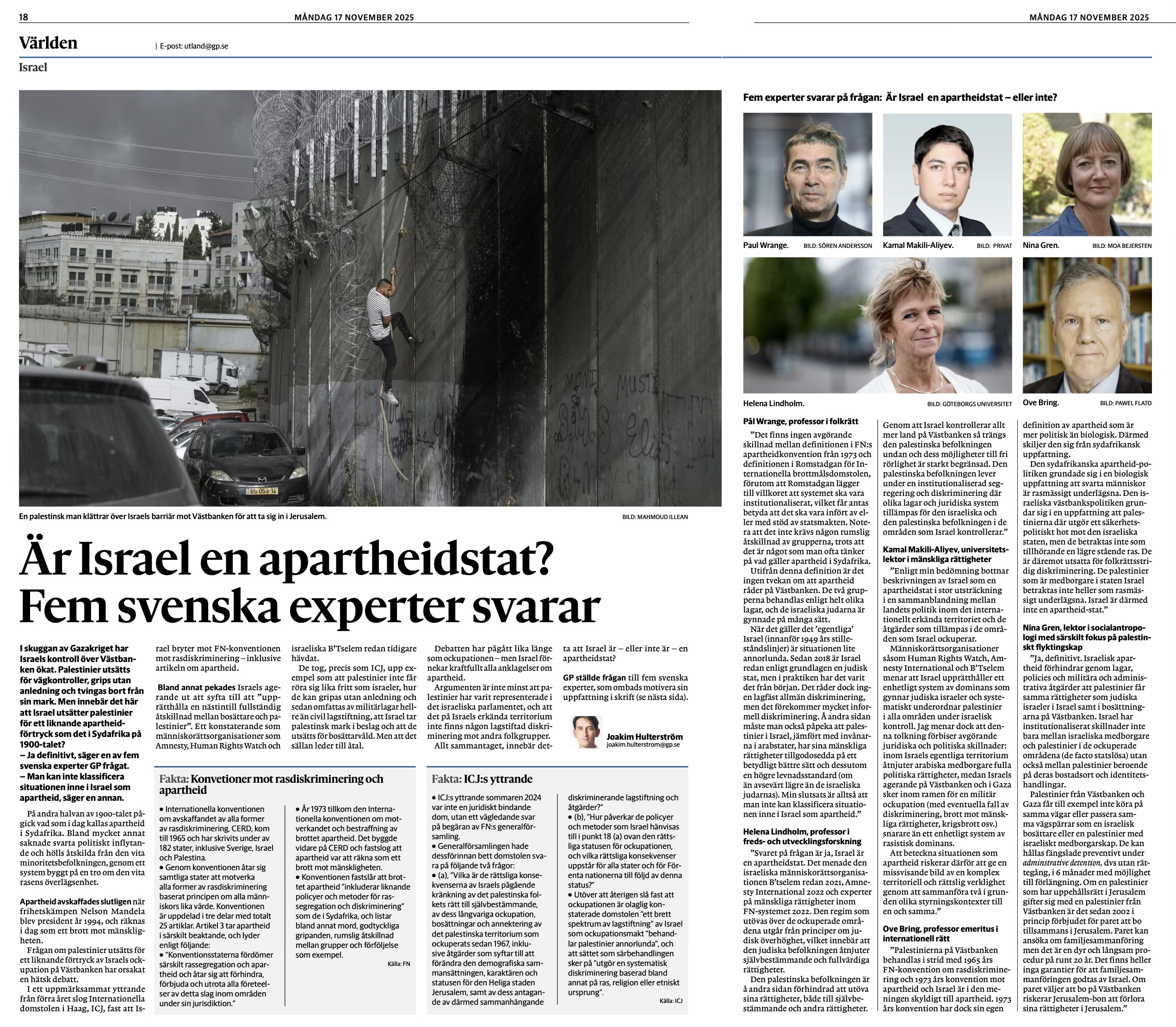
Call a thing by the wrong name and you corrupt the argument at source. The charge of “apartheid” is a fundamental misapplication of concepts, a semantic blunder that vitiates inquiry before a single statistic can be tabled. Helena Lindholm obligingly supplies the catechism—“Jewish supremacy,” “institutionalised segregation,” “different legal systems,” “severely restricted movement”—as if stacking indignations could alchemise a category error into a fact. Nina Gren adds “restrictions on roads,” “administrative detention without trial, and the family‑law grievance about couples ‘living together in Jerusalem,” yet the file cabinet is not a theory. The point is anatomically simple and devastating: you do not map “state‑mandated racial supremacy… rooted in the biological essentialism of 20th‑century South Africa” onto “a complex national, territorial, and religious conflict;” that is a categorical mismatch which predetermines a false solution. To persist is not to be moral; it is to try to navigate that path with a submarine. What Lindholm and Gren are playing is the finite game—accumulate charges, declare victory, award a title—an unconstrained vision that promises purity at the price of understanding. [Let us skip the fact that the word “apartheid” is not ornamented with quotations marks, but Pål Wrange uses quotation mark around ‘actual’ before Israel, as if the country is not even on the map of the.]
Beyond Fact-Checking to Frameworks of Error
The question, “Is Israel an apartheid state?”, as addressed by commentators like Helena Lindholm and Nina Gren, presents a challenge that cannot be resolved through simple factual debate. Engaging with the lists of grievances—segregated roads, disparate legal systems, settlement expansion—as if they were line items in a factual audit is to miss the point entirely. The true issue lies at a deeper, philosophical level: the commission of a profound category error. The “apartheid” label is not merely a factual mistake but a fundamental misapplication of concepts, a semantic blunder that corrupts the very framework of inquiry.
This analysis will argue that this category error functions as a powerful anti-rational meme, an idea that replicates not by being true or useful, but by disabling the critical faculties of its hosts. Its propagation is not the result of ignorance but of a sophisticated organisational dynamic known as functional stupidity, whereby intelligent people in respected institutions collectively foster a thoughtlessness that serves short-term branding and cultural goals. The ultimate consequence of this intellectual contagion is the poisoning of rational discourse, the inducement of a regressive tribalism, and a direct assault on the principles of an open, error-correcting society. To understand this phenomenon, we must move beyond fact-checking and begin to deconstruct the framework of the error itself.
The Anatomy of a Category Error
In any serious intellectual inquiry, the ability to distinguish between a simple mistake and a category error is paramount. A mistake is a stumble on a well-paved path; a category error is an attempt to navigate that path with a submarine. One is correctable, the other is incoherent. This distinction is the essential diagnostic tool for understanding why certain political debates become intractable, circular, and ultimately destructive. They cease to be about finding truth and become rituals of affirmation for a fundamentally flawed premise.
As the philosopher of science David Deutsch explains, these two types of error occupy entirely different conceptual domains.
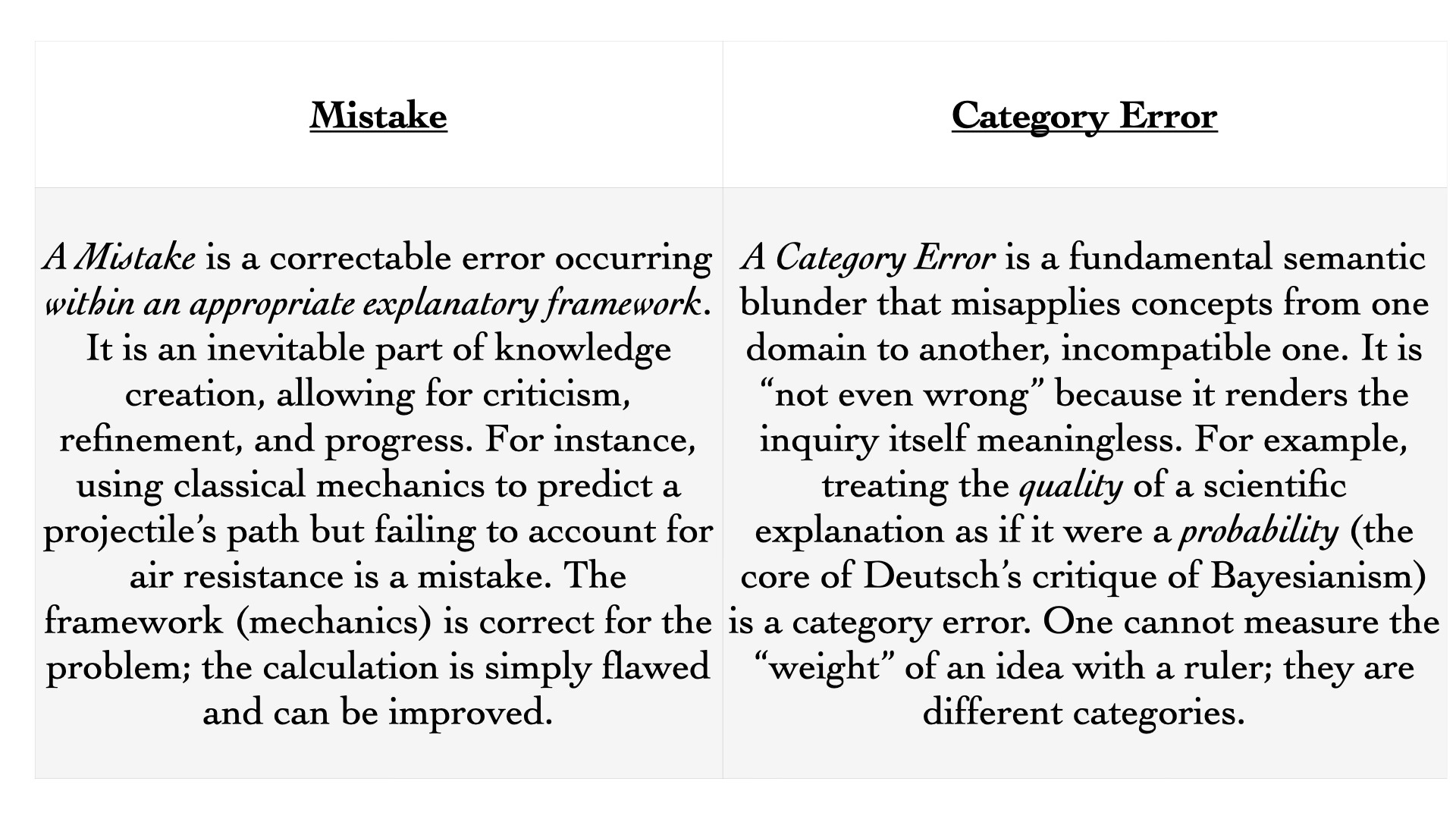
With this framework in mind, consider the central claims made by proponents of the “apartheid” label, as exemplified by Helena Lindholm and Nina Gren:
- Helena Lindholm alleges “Jewish supremacy” (överhöghet), citing reports from B’tselem and Amnesty. She points to institutionalised segregation, the application of different legal systems, and severely restricted movement for Palestinians on the West Bank as evidence.
- Nina Gren cites Israeli laws, policies, and military actions that create different rights for different populations. She highlights restrictions on roads, the use of administrative detention without trial, and family unification laws that prevent Palestinian couples from living together in Jerusalem.
While the conditions described are serious features of a protracted military occupation and security conflict, applying the “apartheid” label to them is a profound category error. It wrongly maps a framework of state-mandated racial supremacy, rooted in the biological essentialism of 20th-century South Africa, onto a complex national, territorial, and religious conflict between two peoples with competing claims. This distinction is not semantic hair-splitting; it determines the entire problem-solving approach. A racial framework implies a problem of immutable biological hierarchy, whose only solution is the complete dismantling of the “racist” state. In contrast, a national/religious framework points to a problem of competing claims over territory and sovereignty, which allows for political solutions like treaties, borders, and security arrangements. Framing the conflict through the lens of race is a categorical mismatch that blocks a correct understanding of the problem’s nature, thereby making a viable solution impossible to formulate.
A quintessential category error, according to the Deutschian framework, is the description of groups defined by ideas—such as Muslims or Jews—as a “race.” This conceptual sabotage treats a system of ideas (memes) as an innate, immutable essence. Critiquing Jewish religious or cultural traditions, for instance, gets reframed as racism. This move shields bad ideas from refutation and stalls progress toward better explanations, an error akin to Deutsch’s example of asking for the “weight” of a poem: the question isn’t merely incorrect—it’s incoherent because it applies a physical metric to an abstract, informational entity.
This category error is not an innocent mistake. It functions as a powerful, self-replicating anti-rational meme designed to shut down, not open up, the process of inquiry.
The “Apartheid” Meme
Ideas, like genes, are replicators. Their survival depends on their ability to spread from mind to mind. However, their replication strategy determines whether they enrich a society with new knowledge or poison it with dogma. David Deutsch provides a crucial distinction between two types of memes or cultural ideas: those that are rational and those that are anti-rational. This framework allows us to diagnose not just that the “apartheid” label is an error, but how it functions to corrupt our intellectual immune system.
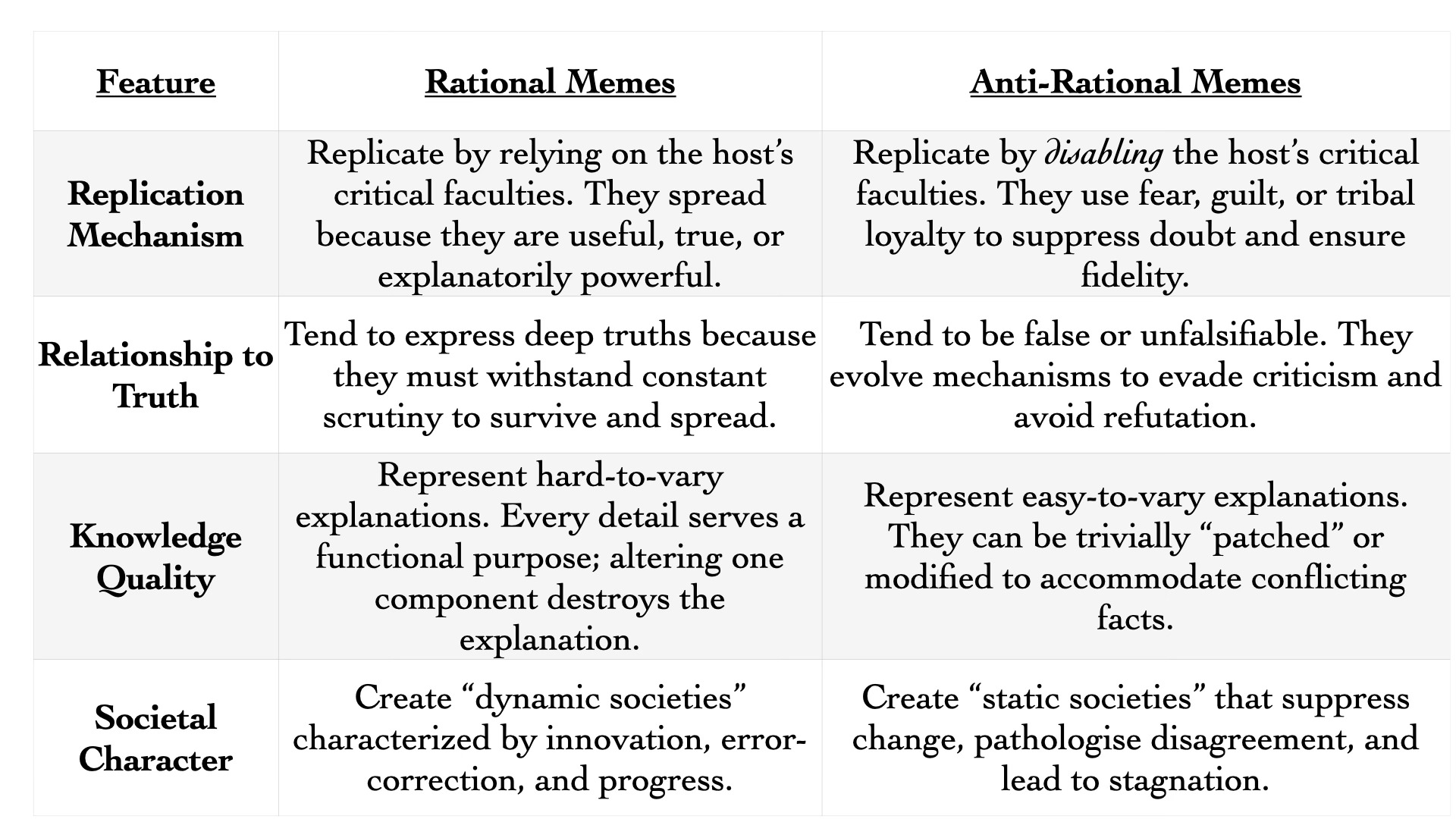
The claim that “Israel is an apartheid state” is a textbook example of an anti-rational meme, perfectly engineered for propagation in a media-saturated, morally anxious culture.
- Disabling Critical Faculties. The meme’s power lies in its appropriation of the moral horror associated with “apartheid” and “racism.” This emotional charge acts as an intellectual kill-switch, bypassing any critical analysis of the unique historical, political, and security context of the Israeli-Palestinian conflict. To question the label is to risk being branded an apologist for racism, a powerful taboo that discourages scrutiny.
- Easy to Vary. The narrative is infinitely flexible, a bad explanation that can be “patched” to absorb any Israeli action as further proof of its thesis. Lindholm’s claim of “segregation,” for instance, is trivially re-purposed to frame a security barrier—a response to a campaign of suicide bombings—as an “apartheid wall,” a tool of racial supremacy. A military checkpoint, a feature of any occupation or counter-insurgency, is reframed as “racial segregation.” A counter-terrorism raid becomes an act of “supremacist violence.” The explanation lacks a hard-to-vary core, allowing it to morph and persist in the face of any counter-evidence.
- Harmful to Holders. Adopting this meme locks its holders into a static, pessimistic worldview that is profoundly counter-productive. It frames a complex, multi-variable political problem as a simple morality play of racist oppressors and racialised victims. This not only misdiagnoses the problem but also stifles the creative, nuanced, and error-correcting approaches required to find genuine solutions, fostering tribalism instead of progress.
But how does such a functionally useless and intellectually corrupt meme become institutionalised and propagated by ostensibly intelligent and well-meaning organisations? The answer lies in the organisational dynamics that induce a state of collective thoughtlessness.
Inducing Functional Stupidity
The Stupidity Paradox, as identified by Mats Alvesson and André Spicer, provides a powerful explanation for how organisations filled with intelligent, highly-educated people can collectively foster a state of thoughtlessness. This functional stupidity is not about low IQ; it is about a refusal to engage one’s full intellectual capacity. It is functional in the short term—promoting unity, decisiveness, and brand clarity—but potentially disastrous in the long term. This paradox explains how respected human rights organisations, like those cited in the article, come to champion a simplistic, anti-rational meme like the “apartheid” label.
Functional stupidity is sustained by three core pillars:
- Absence of Reflexivity. A failure to question dominant beliefs and assumptions.
- Absence of Justification. A failure to ask for, or provide, substantive reasons for actions (the question Why? is ignored).
- Absence of Substantive Reasoning. A failure to consider the wider consequences of one’s actions.
This state is actively produced by specific organisational pressures. In the case of the “apartheid” meme, its adoption by groups like Amnesty International and Human Rights Watch exemplifies several key inducers of this functional stupidity.
Branding-Induced Stupidity
Human rights organisations have built powerful global brands based on simple, morally resonant narratives of oppression. The “apartheid” frame is a perfect asset for this brand. It is emotionally potent, easy to communicate, and positions the organisation as a courageous truth-teller. This focus on image at the expense of substance creates what Alvesson and Spicer call “illogical loyalty” to a narrative that serves the brand, even if it distorts a complex reality. The “apartheid” label becomes analogous to the Absolut vodka brand, which was designed as a “blank bottle-shaped space that could be filled with whatever content a particular audience most wanted.” The label is an empty vessel filled with the moral outrage the organisation’s audience and donors wish to see, regardless of its explanatory accuracy.
Culture-Induced Stupidity
A strong organisational culture, while beneficial in many ways, can also act as a “psychic prison,” stifling dissent and critical thinking. A human rights organisation might foster a “culture of optimism” about its ability to effect change or a “culture of uniqueness” regarding its moral clarity. Such a culture would systematically filter out information that complicates the simple “apartheid” narrative. Internal dissenters who point out the historical inaccuracies or the strategic downsides of the label are not seen as constructive critics but as disruptive individuals who are “not being team players” or, worse, apologists for injustice. As was seen at Nokia, where a culture of positivity made managers terrified to share bad news, this dynamic leads top management to develop a dangerously distorted view of reality.
Imitation-Induced Stupidity
Finally, once one major organisation adopts the term, others quickly follow suit. This is not driven by independent analysis but by the logic of institutional mimicry. As business leader Jan Wallander observed, his peers are “like a herd of sheep,” rushing after the latest trends to appear legitimate and modern. In the human rights space, once a group like Amnesty labels Israel an apartheid state, others face pressure to conform to avoid being seen as out of step or less committed to the cause.
These inducers are not isolated but form a self-reinforcing system. Branding-Induced Stupidity, which demands a simple narrative, is sustained by a Culture-Induced Stupidity that punishes internal dissenters who might complicate the brand’s message. This, in turn, creates intense pressure for Imitation-Induced Stupidity among peer organisations who fear appearing less morally clear than the market leader. The institutionalisation of this anti-rational meme, driven by these organisational pathologies, has a devastating endgame: the erosion of the open society itself.
The Political Endgame
The stakes of this intellectual error are far higher than a mere academic debate. According to the philosophy of Karl Popper, the regression to tribalism is the defining characteristic of a “closed society”—a static, myth-driven collective that stands in direct opposition to the “open society” and its foundational mechanisms for progress: critical reason and individual autonomy. The propagation of the “apartheid” libel is not an accidental byproduct of political passion; it is a conscious attempt to induce this very regression.
By mis-categorising a political conflict as a racial one, the “apartheid” label reframes a disagreement over land, sovereignty, and security as a zero-sum moral battle between a virtuous in-group (defenders of the oppressed “race”) and a demonic out-group (supporters of a “racist” state). This move deliberately short-circuits rational debate, replacing it with tribal loyalty tests. It becomes impossible to critique Palestinian leadership, condemn terrorism, or propose nuanced solutions without being accused of siding with the demonic tribe of “apartheid supporters.”
This tactic leads directly to what Popper identified as the Paradox of Tolerance. The paradox states that a society that extends unlimited tolerance even to the intolerant will ultimately be destroyed by them. As David Deutsch interprets this, a society “that suppresses its values trying to ‘tolerate’ the intolerant is neither diverse nor strong nor tolerant.” To preserve tolerance, a society must be prepared to be intolerant of intolerance itself.
The proponents of the “apartheid” meme exploit this paradox with ruthless efficiency. By labelling nuanced viewpoints or criticisms of their narrative as “support for apartheid”—a form of racism—they are demonstrating the very intolerance Popper warned against. They weaponise the West’s laudable commitment to tolerance and anti-racism, demanding that society become intolerant of any dissenting or complex viewpoints on this issue. This tactic effectively shuts down open dialogue, replacing the give-and-take of rational argument with the rigid, unyielding demands of a tribal moral crusade.
This intellectual and social decay is not an unfortunate side effect; it is the intended and inevitable outcome of propagating anti-rational memes in an open society.
Rejecting the Error, Reclaiming Rationality
The assertion that “Israel is an apartheid state” is not a factual claim to be debated but a catastrophic category error to be exposed and rejected. It is a profound intellectual corruption that misapplies a framework of racial supremacy to a conflict driven by competing nationalisms, religions, and territorial claims. This error does not enlighten; it obscures, functioning as a virulent anti-rational meme designed to shut down critical thought.
We have seen how this meme is propagated through the organisational dynamics of functional stupidity, where branding, culture, and imitation induce intelligent people to champion simplistic narratives over complex realities. The endgame of this process is a toxic tribalism that weaponises the virtue of tolerance against itself, corroding the very foundations of an open, error-correcting society.
The only way forward is to reject these intellectually bankrupt frameworks. We must demand hard-to-vary explanations that account for the difficult details, rather than easy-to-vary slogans that serve emotional and ideological ends. We must re-engage with the world’s most complex problems not through the lens of tribal purity and moral certainty, but through the Enlightenment principles of criticism, fallibility, and relentless error-correction. This is the only path toward progress—the only path toward the beginning of infinity, as David Deutsch asks everyone.
The remedy is intellectual house‑cleaning, not a fresher slogan. Recognise the “apartheid” trope for what the analysis shows it to be: an anti‑rational meme that replicates by disabling the host’s critical faculties and survives because it is easy-to-vary, a bad explanation infinitely patchable to every contingency. See, too, how institutions baptise it through functional stupidity: Branding‑Induced Stupidity turns the label into an Absolut‑Vodka-style blank bottle‑shaped space that could be filled with whatever content a particular audience most wanted. The political endgame is grimly familiar: tolerance eaten by its parody, a society neither diverse nor strong nor tolerant because dissent is redefined as sin. Against this, refuse the finite gamer’s prize and demand hard‑to‑vary explanations that account for the difficult details and keep the play of inquiry going. That means resisting the brand, correcting the category error, and insisting that Lindholm and Gren graduate from moral theatre to moral thought.
References:
Mats Alvesson & André Spicer, 2016, The stupidity paradox: The power and pitfalls of functional stupidity at work. London: PROFILE BOOKS LTD.
James P. Carse, 1986, Finite and Infinite Games: A Vision of Life as Play and Possibility. New York, NY: The Free Press, A Division of Macmillan, Inc..
David Deutsch, 2011, The Beginning of Infinity: Explanations that Transform the World. New York, New York: VIKING (Published by the Penguin Group).
The Duke Report, 20250807, “A User’s Guide to Neuro-Linguistic Defense. Defending Yourself From Word Magic.”

Joakim Hulterström, 20251117, “Är Israel en apartheidstat? Fem svenska exporter svarar.” Göteborgs-Posten, s. 18.
Iain McGilchrist, 2019, The Master and His Emissary: The Divided Brain and the Making of the Western World. New Expanded Edition. New Haven and London: YALE UNIVERSITY PRESS.
—, 2021, The Matter With Things: Our Brains, Our Delusions and the Unmaking of the World. London: Perspectiva Press.
Thomas Sowell, 2007, A conflict of visions: ideological origins of political struggles. New York, NY: Basic Books.


