The anfāl Playbook: Save The Kurds in Syria Now
20 January 2026
This statement is a direct refutation of claims, as Ambassador Tom Barrack does, that Kurdish “integration” under the new Syrian government represents a safe or historic opportunity. Any policy that pressures the Kurds to disarm and “integrate” under a regime that is simultaneously invoking surah al-anfāl and launching offensives in Kurdish regions is not peace-building but the opening of a genocidal playbook; dressing it up in the language of citizenship and unity does not change the fact that it recreates, step by step, the conditions of Saddam Hussein’s anfāl campaign.
The Anatomy of a Threat
Ahmed al-Shara’s recent statement to the Syrian Kurds is not a political overture; it is a weaponised communication, the deceptive opening salvo in a strategy of annihilation that is now escalating with alarming speed. When decoded, al-Shara’s rhetoric and his regime’s subsequent actions reveal the deliberate activation of a historical playbook for genocide. This playbook, which mirrors Saddam Hussein’s genocidal anfāl campaign against the Kurds in Iraq, is not a spontaneous reaction to current events but the predictable outcome of a deep-seated imperial ideology aimed at the final subjugation of the Kurdish people. Let me expose the psychological trap being set, the unambiguous historical signals being sent, and the genocidal trajectory that is now underway.
The Lure
An Engineered Surrender
Before examining the overt military and religious signals, it is crucial to first scrutinise the psychological groundwork being laid by the new Syrian regime. Ahmed al-Shara’s statement is not a good-faith communication but a meticulously engineered compliance trap. Its purpose is to manipulate the Kurdish people into a position of fatal vulnerability by hijacking their evolutionary instincts, imprisoning them within a framework of false logic, and demanding they gamble their existence on a foundation of blind faith.
The Manipulative Techniques
A forensic analysis of al-Shara’s words exposes three distinct layers of manipulation, designed to bypass rational thought and induce submission.
Biological Hacking
al-Shara’s strategy begins by hacking the Kurds’ evolutionary software. He hijacks the Big God Module—the innate human deference to a supernatural authority—by invoking a cosmic dominance hierarchy where piety, as defined by him, supersedes all other loyalties. This is immediately followed by the Saladin Gambit, addressing the Kurds as “O descendants of Salah al-Din” to simulate kinship and trigger their instinct for kin altruism. I have dabbled this as an attempt to induce suicidal empathy, persuading the Kurds to lower their defences against a genetic competitor by appealing to a fictive brotherhood. The ultimate demand is for evolutionary suicide:
The Kurds are urged to return safely and securely without any condition or restriction except laying down arms.
From a biological perspective, this is a request for a rival group to voluntarily remove its primary survival adaptation in a hostile environment.
Memetic Prison
The statement then constructs a memetic prison that replaces lawful justice with an arbitrary cosmic justice. By claiming that allāh has elevated righteousness and piety above affiliation, al-Shara appoints himself the surrogate decision-maker, the sole arbiter of who is pious and therefore deserving of rights. This framework is reinforced by a false binary trap designed to eliminate dissent. His declaration, “Whoever touches you with evil is our enemy until Judgment Day,” creates a false dichotomy:
Either the Kurds accept his terms and are safe, or they resist and are branded as siding with evil.
This tactic frames rational caution as a moral failing, effectively shutting down critical inquiry.
Epistemological Bankruptcy
At its core, the statement is epistemologically bankrupt. It is founded entirely on belief and faith—in al-Shara’s benevolence, in allāh’s will, in a promised safe future—rather than on any verifiable explanation or mechanism for error correction. It offers no institutional checks and balances, no guarantees beyond the word of a fallible human leader. It demands that the Kurds take a gamble where, as my analysis warns, the cost of being wrong is extinction. By wrapping a fallible human policy in the language of the qur’ān, al-Shara attempts to elevate his decree to the status of unchallengeable, objective truth, conflating his political authority with divine will.
The Verdict on the Statement
This statement is not an offer of peace; it is a memetic virus engineered to disable the Kurds’ political and psychological defences. By accepting its terms, the Kurds would be submitting to a cosmic manmade hierarchy in which al-Shara places himself as the gatekeeper to their rights. As earlier makes clear, accepting the decree means submitting to a surrogate who holds the power to revoke those rights the moment he decides his subjects are no longer pious. This psychological trap, designed to achieve surrender without a fight, was immediately followed by overt physical actions that reveal the regime’s true endgame.
Invoking the Spectre of Anfāl
From Words to Weapons
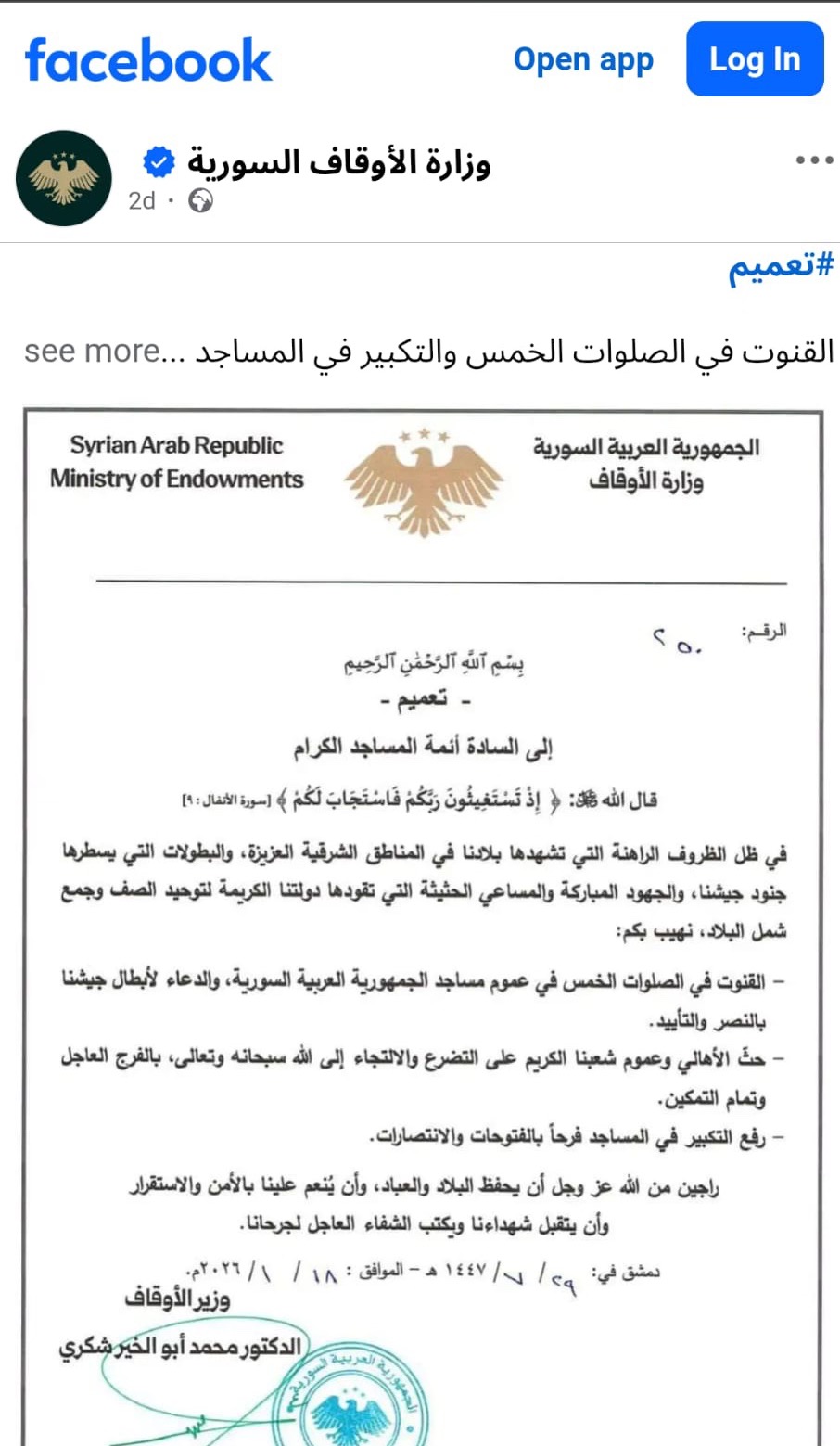
The link between rhetoric and action is the key to understanding the Syrian regime’s strategy. Just days before al-Shara’s seemingly conciliatory statement was amplified, his government launched a major military offensive against the Kurdish-led Syrian Democratic Forces (SDF) in Syria’s “dear eastern regions.” Almost simultaneously, it issued a directive to the country’s mosques that serves as the undeniable cipher for decoding the regime’s true intentions.
Decoding the Ministry Letter
On 18 January 2026, the Syrian Ministry of Endowments, under Minister Dr. Muhammad Abu al-Khair Shukri, dispatched a letter to mosque imams across the country. The letter’s purpose was to rally the nation behind the army’s offensive. Its directives were explicit: incorporate supplications for the army’s victory in all daily prayers, encourage public chants of takbir (allāh akbar) to celebrate “victories and conquests,” and frame the offensive as a noble effort to “reunite the country.”
Crucially, the letter opens with a direct quotation from the qur’ān:
“[Remember] when you were seeking help of your Lord, and He answered you.”
This verse is qur’ān 8:9, from the eighth chapter known as surah al-anfāl.
A Name Synonymous with Genocide
In the Kurdish historical context, the word anfāl is not merely a religious term; it is synonymous with genocide. Between 1986 and 1989, Saddam Hussein’s Ba‘thist regime in Iraq conducted the genocidal anfāl campaign against its Kurdish population. Named explicitly after surah al-anfāl (The Spoils of War), the campaign systematically framed the Kurds as infidels and traitors, justifying their annihilation as a religious and national imperative.
Its characteristics are a matter of historical record: the use of chemical weapons, most notoriously in the Halabja massacre; the mass execution of men, women, and children; the razing of thousands of villages; and an estimated death toll ranging from 50,000 to 182,000 people. The regime used rhetoric from surah al-anfāl to dehumanise the Kurds and portray the slaughter as the righteous seizure of spoils from a disloyal enemy. The Syrian regime’s deliberate invocation of this specific surah, at this specific moment, is not a coincidence; it is a chilling and unambiguous signal of genocidal intent.
The Playbook
A Pattern of Violence
In forecasting state-sponsored atrocities, pattern recognition is paramount. The actions of the Syrian regime are not novel; they are a direct and disciplined replication of the established playbook used by Saddam Hussein to execute the anfāl genocide. This mirroring of tactics and justifications strongly suggests a premeditated and programmatic path towards ethnic cleansing, or worse.
A Comparison
The Syrian regime’s actions constitute a direct and disciplined adherence to the anfāl operational playbook, confirmed by the following four strategic parallels:
- Weaponised Religious Justification. Both regimes have used surah al-anfāl to frame state violence as a divinely sanctioned struggle. Just as Saddam named his campaign anfāl to grant religious authority to his actions, the Syrian Ministry of Endowments quotes the same surah to rally prayers for its military offensive. In both cases, religious language is weaponised to legitimise the conflict, dehumanise the Kurdish target, and portray them as an obstacle to national and religious cohesion.
- Targeting of Kurdish-Dominated “Eastern”’ Regions. Saddam’s anfāl campaign focused on Iraq’s northern Kurdish regions, which were resource-rich and framed as rebellious territories. Similarly, Syria’s current offensive targets the Kurdish-led northeastern areas, which contain key oil and gas fields and are home to a large Kurdish population. Both campaigns are justified as efforts to “reunite” the country by advancing into minority-held territories, and both have resulted in the mass displacement of civilians.
- State Power Through Force and Propaganda. Both regimes have exploited a period of broader instability to crush Kurdish autonomy. Saddam used the cover of the Iran-Iraq War to execute anfāl; the post-Assad instability in Syria now provides the cover for the transitional government to dismantle the autonomous region of Rojava. The Syrian letter’s call for unity and celebration of “victories” directly parallels the Iraqi state media’s glorification of anfāl as a national triumph.
- The Inherent Risk of Escalating Atrocities. The anfāl campaign escalated from conventional assaults and mass displacements to chemical warfare and genocide. The current Syrian campaign is already marked by significant civilian displacement, fighting near ISIS detention facilities, and prison breaks. This trajectory, which begins with consolidating control and erasing political autonomy, carries the inherent and historically proven risk of escalating to mass atrocities if it remains unchecked.
An Unmistakable Trajectory
The parallels are too precise to be coincidental. The Syrian regime is demonstrably following a known, genocidal playbook. This replication of a genocidal playbook is not accidental; it is the direct expression of an underlying imperial ideology that has stalked the region for centuries.
The Ideology
The Engine of Conflict
The psychological trap, the military signal, and the historical playbook are merely symptoms. To understand the crisis in Syria, we must diagnose the pathogen itself: the overarching ideological system that enables these recurring atrocities. My earlier text provides the master key for this analysis: the Arabo-Muslim Imperium. This framework posits that the region’s primary conflict is not a collection of isolated state rivalries but the result of a vast, expansionist imperial project built on conquest and the suppression of indigenous, non-Arab peoples. The genocides in Saddam’s Iraq and the escalating crisis in Syria are not anomalies; they are the predictable and logical outcomes of this imperial reality.
The Imperial Indictment
The evidence against this imperium is written in the historical record of its signature crimes against the peoples it has subjugated.
- Masters of Ethnic Cleansing: The systematic erasure of the 2,500-year-old Iraqi Jewish civilisation serves as a prime example. A community that once constituted a third of Baghdad’s population and endured for millennia has been deliberately purged, reduced in the modern era to a mere three souls.
- The Epicentre of Slavery and Genocide: The very name of Sudan—Arabic for Land of the Blacks—was a functional designation for an imperial slave hub. This legacy of racist dehumanisation finds its direct modern expression in the ongoing genocide against the Masalit people, a horror largely ignored by the international community.
- The Architecture of Female Apartheid: The region’s true, functioning apartheid is the systemic and suffocating oppression of women—an architecture of control so pervasive that it extends from the public square into the diaspora.
The Weapon of Narrative Inversion
This empire’s primary tool for maintaining power is the inversion of language. It systematically hijacks the vocabulary of human rights, weaponising terms like genocide and apartheid to accuse its own victims of its signature crimes. This strategy is laid bare in foundational texts like the 1968 PLO Charter, which defines Palestine not as a sovereign national entity but as an “indivisible part of the Arab homeland.” In this formulation, a national identity is revealed to be an “imperial spearhead,” an instrument for a larger project of pan-Arab consolidation. This imperial reality gives rise to a conflict that is not merely political, but is rooted in two irreconcilable moral worldviews.
The Moral Core
The Ultimate Stakes
Beyond the geopolitics and military strategy lies a profound moral contest between two opposing visions of humanity. On one side stands a creed that sanctions the objectification of others for ideological and theological gratification. On the other stands a creed that demands defiant solidarity, even in the face of annihilation. This is the ultimate battle for the soul of the region.
The Creed of Dehumanisation
This creed is defined by the reduction of the “other” to an object. Its most visceral recent expression was the ritualistic murder of the Kurdish female fighter, Deniz, in Aleppo in January 2026. A video showed men in Syrian army uniforms throwing her body from a rooftop. As she fell, their shouts of allāhu akbar were clearly audible. The idea is precise: this cry was not incidental but was “the theological mechanism for the atrocity.” It was the incantation that transformed a human being into a thing, and a war crime into an act of worship. This is the physical manifestation of the Cosmic Manmade Hierarchy introduced in al-Shara’s statement—a worldview where a surrogate’s judgment of piety grants the power of life and death.
The Creed of Defiant Solidarity
This creed is the ultimate rebuttal to the empire’s logic of division and erasure. Its most profound expression is found in the actions of the Christian villagers of Bedyal during Saddam’s anfāl genocide. Rounded up for extermination alongside their Kurdish Muslim neighbours, they were offered a chance to live. An official told them that as Christians, they could separate themselves and be spared. They refused. Their defiant response stands as a testament to a higher loyalty:
“No, we are Barzanis. Our life and our death are with the Barzanis.”
In that moment, they chose fidelity to their community over the biology of individual survival—a deliberate rejection of the empire’s biological calculus in favour of a higher, communal fidelity.
The Moral Foundation of Resistance
This fundamental clash between a creed that objectifies and a creed that unites provides the deepest and most resilient logic for resistance against the imperial project. It is this moral clarity that must inform our final verdict on the events now unfolding.
An Inescapable Verdict
The chain of logic is relentless and inescapable. It begins with Ahmed al-Shara’s deceptive compliance trap, a biologically manipulative and anti-rational construct designed to disarm the Kurds psychologically. It moves to the genocidal signal of the regime’s invocation of surah al-anfāl, a term forever stained by the memory of Saddam’s campaign of annihilation. It is confirmed by the systematic replication of the anfāl playbook, revealing a premeditated and programmatic advance towards mass atrocity. Finally, it is explained by the overarching ideology of the Arabo-Muslim Imperium and its core creed of dehumanisation.
The events unfolding in Syria are not a distant political dispute or a complex civil war. They are the active and deliberate continuation of a historical, imperial project of erasure. The patterns are clear, the historical precedents are undeniable, and the trajectory is set. To ignore this evidence—to treat these signals as anything other than a final warning—constitutes a grave moral failure and a direct complicity in the tragedy that is to come.


