The Anatomy of Extremism: Quassim Cassam’s Framework
24 February 2026
The Fighter Pilot’s Edge
In the unforgiving theatre of modern aviation, success relies not merely on reflexive action, but on a disciplined cognitive framework. Elite fighter pilots rely on a system defined by Hasard Lee as the ACE Helix—Assess, Choose, Execute. Of these pillars, the Assess phase forms the foundational bedrock of any high-stakes intervention. In volatile environments, our biological urge to react immediately—the amygdala hijack—frequently triggers cognitive tunnelling, leading operators to solve the wrong problem entirely. To prevent catastrophic failure, elite operators are trained to wind the clock: forcing a deliberate physical and mental pause to build an accurate mental model before engaging.
When we transition this operational doctrine to the study of extremism, a glaring deficiency emerges. As a society, we are rushing to Choose and Execute deradicalisation policies without first properly Assessing the true mechanics of the extremist mind.
Quassim Cassam’s Book
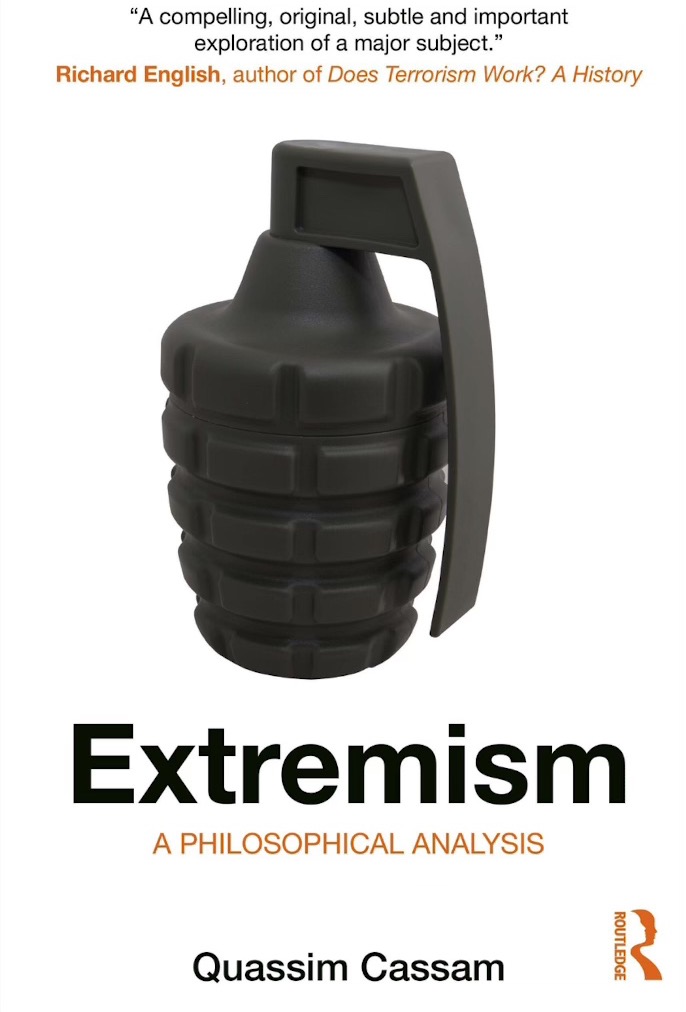
The idea to delve into Cassam’s book came as a suggestion from a friend who shares my deep interest in this subject matter. This brings me to the target of our assessment: Quassim Cassam’s widely read book, Extremism: A Philosophical Analysis. In his lucid, empirical, and highly academic attempt to dissect the phenomenon, Cassam categorises extremism into a tripartite framework: methods extremism (how they act), ideological extremism (what they believe), and psychological extremism (the extremist mindset). Cassam’s detailed taxonomy and prominence in the discourse make his work the perfect focal point for a rigorous strategic audit.
Why Audit Cassam?
I have a deep, overarching interest in understanding the true mechanics of extremism. Because extremism represents an existential threat to the Open Society, we simply cannot afford to rely on flawed diagnostics or taxonomic illusions. The ultimate danger is not that we will encounter an insoluble problem, but that we will render ourselves incapable of solving soluble ones. Extremism embodies this fundamental challenge: the rise and institutionalisation of bad philosophy and anti-rational memes that actively inhibit or forbid the creation of knowledge. If we fail to diagnose this correctly, we risk allowing our dynamic culture to revert to the fragility of a Static Society—a culture whose primary purpose is to prevent change, suppress criticism, and extinguish its members’ creativity in the name of stability. I have decided to put Cassam’s book to the ultimate test to see if his framework genuinely provides the operational alpha required to understand and dismantle extremism, or if it merely catalogues a list of symptoms.
The Four Analytical Scalpels
In my upcoming four-part series, I will deploy four distinct analytical scalpels to critically scrutinise Cassam’s thesis. Each article will strip away the descriptive veneer to expose the underlying machinery of the extremist phenomenon:
Scalpel 1: The Inductivist Trap & The Category Error
This critique will expose Cassam’s reliance on inductively based lists of symptoms—like anger, purity, and victimhood—as a failure to provide a hard-to-vary explanation. It will argue that Cassam makes a fatal category error by treating extremism as a psychological mindset (wetware/feelings) rather than diagnosing it properly as an anti-rational meme (software) that survives by disabling a host’s critical faculties. The sole objective of all rational inquiry is the creation of Good Explanations. A Good Explanation is one that is fundamentally hard-to-vary; its details must be so strictly constrained by the problem it solves that if it were refuted, its defenders would have nowhere to go. Furthermore, Cassam’s inductive list of symptoms falls victim to the fallacy of empiricism—the widespread error that knowledge is derived merely from observation. As Karl Popper argued, theory must come first; observation does not generate theories, it merely filters them.
Scalpel 2: The Paradox of Tolerance & The Closed Society
Continuing the Popperian audit, this piece will critique Cassam’s boundary of tolerance and his framing of rotten compromises. It will reveal how the extremist’s obsession with purity and victimhood is not merely a psychological quirk, but a functional regression to the tribal certainty of the Closed Society, designed to legitimise harm and shield the dogma from rational refutation. These anti-rational memeplexes replicate by disabling the critical faculties of their hosts. They function by forbidding the methods of criticism and error correction, enforcing falsehoods through a chilling effect where dissent is shunned. Thus, the extremist mindset is not an intellectual vice, but the necessary software of a static society designed to block all paths to progress.
Scalpel 3: The Ontological Poverty of Extremism
Applying James Carse’s theory of Finite and Infinite Games, this article will exposes Cassam’s view of violent extremism as merely a tactical method. It will argue that extremist violence is actually a Terminal Move designed to permanently end play and impose an unheard silence. It will expose the extremist as a Master Player trapped in the pathology of seriousness, terrified of the open horizon.
Scalpel 4: The Neurobiological Reality
The final scalpel will discard Cassam’s philosophical taxonomy in favour of biological reality. Using Angus Fletcher’s Narrative Cognition and Nicholas Wright’s Predictive Modelling, this piece will show that extremist rigidity is not an intellectual vice, but a catastrophic hardware failure. It will reveal how the brain’s predictive error updating is blockaded, reducing the mind to a frozen, zero-error state that logical counter-narratives are mechanically powerless to fix.
The Conclusion
This four-part series promises to strip away the academic theatre that so often clouds the study of radicalisation. I invite you to follow the series as we move beyond merely describing the fever of extremism, and finally learn how to identify and dismantle the virus itself.
Ultimately, this series is grounded in a rational assertion of true optimism: the recognition that while problems like extremism are an inevitable and permanent feature of existence, they are entirely soluble. All evils are caused by insufficient knowledge. The choice before us is stark. We can either succumb to the pessimistic, anti-rational memes of a static society, or we can embrace our role as universal explainers, reinforce our traditions of criticism, and embark on the open-ended journey of knowledge creation. This is the only sustainable path. This is the beginning of infinity.
Note:
For this endeavour to analyse Cassam’s boo, Quassim Cassam, 2021, Extremism: A philosophical analysis. London:Routledge. https://doi.org/10.4324/9780429325472, I have used the following articles distilling the scalpels:
Khaled Salih, 20251217, “Forging the Tools of Thought: An Introduction to Two Forthcoming Essays.” https://khaledsalih.substack.com/p/forging-the-tools-of-thought-an-introduction
—, 20251219, “A Memorandum on the Solvability of Human Problems.” https://khaledsalih.substack.com/p/a-memorandum-on-the-solvability-of
—, 20251221, “The Two Worlds: A Unified Framework for Analysing Ideas,” https://khaledsalih.substack.com/p/the-two-worlds-a-unified-framework


