The Anatomy of Deception: How Two Academics Turn “Islamophobia” into Ideological Warfare
By Khaled Salih
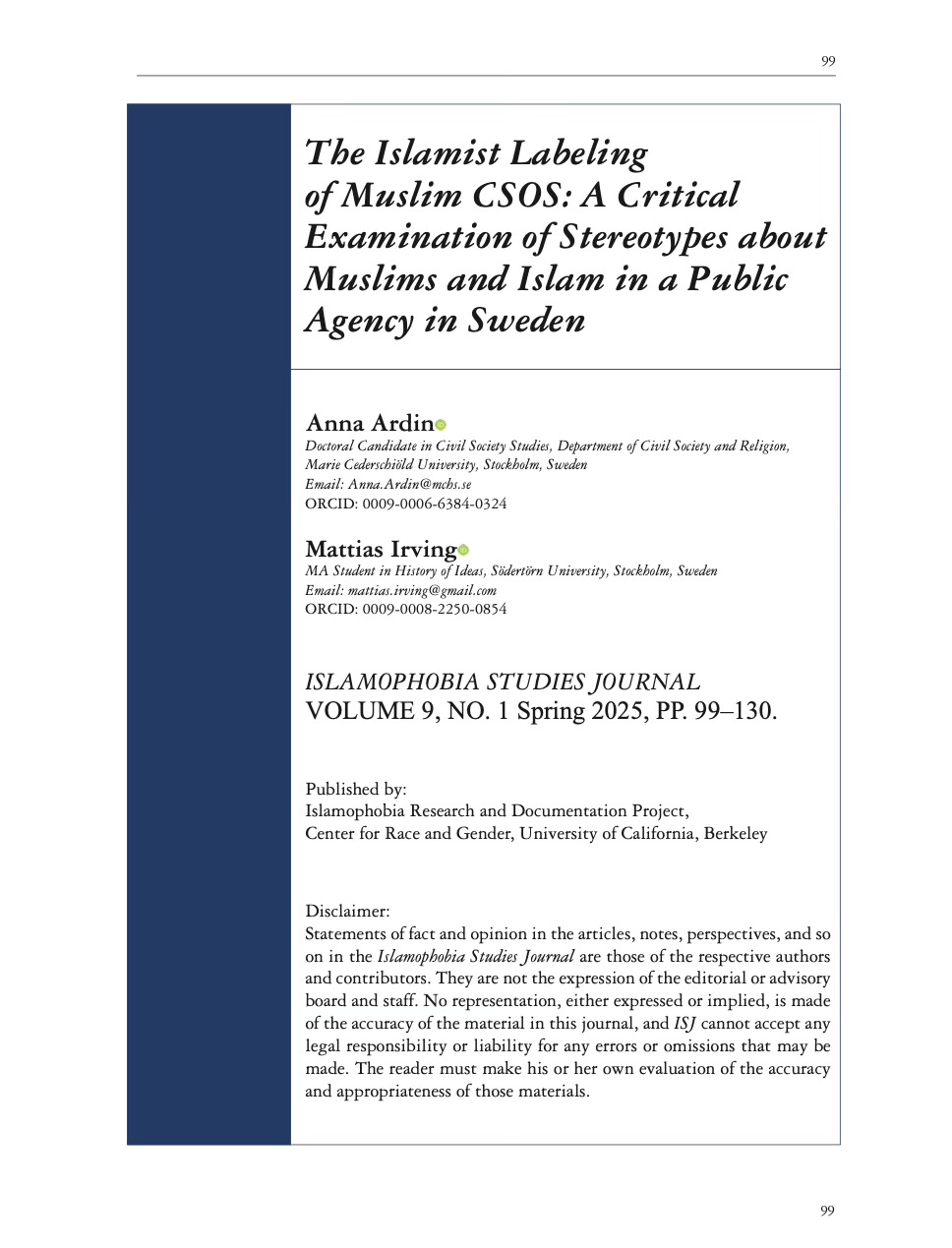
Summary: When ideology masquerades as scholarship, truth becomes its first casualty – and a nation’s self-defence its second. In The Islamist Labeling of Muslim CSOs, Anna Ardin and Mattias Irving don the cloaks of academia to perform a grand inversion: they transform Sweden’s legitimate inquiry into Islamist subversion into a morality tale of state oppression. The result is not an enlightening study, but a strategic act of rhetorical sabotage. By weaponising the language of tolerance and anti-racism, the authors present vigilance as bias and caution as “Islamophobia.” This short summary distils how Ardin and Irving’s report operates: it deletes crucial context, distorts facts into “prejudice,” and generalises one security case into a universal indictment of government power. In doing so, it exemplifies what psychologist Gad Saad calls the “parasitic mind,” infecting public discourse with ideas that compel a society to lower its guard for fear of appearing intolerant. The full essay below systematically dismantles the Ardin–Irving report’s methods and arguments – exposing it as a masterclass in ideological deception that preys on the West’s own values to render it defenceless.
Introduction: When “Scholarship” Becomes Strategy
There are academic papers that illuminate – and then there are papers that perform. The Islamist Labeling of Muslim CSOs, by Anna Ardin and Mattias Irving, belongs in the latter category[1]. Beneath its sober academic veneer lies not inquiry but inversion: a project that takes Sweden’s good-faith effort to analyse hostile Islamist influence and recasts it as an act of oppression. At its core, this report is a weapon of words – polished, credentialled, and profoundly disingenuous.
By cloaking ideological advocacy in the robes of research, Ardin and Irving do not defend truth; they strangle it. In their hands, the language of empathy and tolerance becomes an instrument of paralysis. The report’s unmistakable aim is to ensure that Sweden’s ability to name, diagnose, and confront genuine threats is condemned as “prejudice” before the conversation even begins.
1. The Pretence of Neutrality
Ardin and Irving pose as neutral investigators increasing our understanding of “stereotyping.” They are nothing of the sort. Their approach is strategic camouflage – a textbook case of what analyst Vera Hart identifies as the illusion of impartiality used to disarm criticism[2]. By publishing in the Islamophobia Studies Journal (part of UC Berkeley’s Center for Race and Gender), they step onto the field as referees rather than players. The ideological frame – that “Islamophobia” is the real problem – is built into the venue. The verdict is preordained: any state vigilance about Islamist activism must be driven by irrational bias.
This is not scholarship; it is theatre. It is a carefully choreographed morality play in which the state is cast as the villain and “Muslim civil society organisations” as the wronged protagonist. Every scene in this drama follows the same script: first, blur the line between radical Islamist influence and ordinary Muslim civic life; then, condemn any attempt to distinguish the two as an attack on “all Muslims.” The method turns analysis into apology, security into guilt.
2. The Mechanics of Manipulation
If Ardin and Irving’s neutrality is an illusion, it is sustained by meticulous linguistic manipulation. Drawing on the tactics of neuro-linguistic programming, they deploy three classic moves of rhetorical control[3]:
- Deletion: The authors surgically omit the Swedish Civil Contingencies Agency’s crucial definition of “Islamist information influence” – namely, “illegitimate and potentially harmful communication from a foreign power or its proxy.” By magically stripping away this context, they recast a specific counter-intelligence effort as a vague inquisition into “Muslim organisations.” The target evaporates; readers are led to assume the state was investigating Muslim civil society itself.
- Distortion: With the setup skewed, they proceed to twist interpretation. Through false equivalence, they imply that to name a threat is to stigmatise a community. Thus, a security analysis is portrayed as ethnic or religious “stereotyping”; official vigilance becomes “soft repression.” They even equate Sweden’s study of Islamist propaganda with an assault on democracy and inclusion: a leap of logic achieved by simply asserting that one means the other.
- Generalisation: Finally, they “chunk up” a single case into a sweeping general indictment. A lone feasibility study is inflated into evidence of a systematic campaign by the state against civil society. All context – the time, the actors, the foreign dimension of the threat – is drained away, leaving an abstract tale of power and victimhood. In this flattened narrative, every Muslim activist is implied to be one accusation away from witch-hunt, and every government concern one step from authoritarianism.
Through these moves, the report performs a feat of intellectual alchemy: it takes a legitimate inquiry into Islamist networks and, without ever disproving a single finding, transmutes it into an example of state bigotry.
3. The Closed Circle of Ideology
Such distortion is no accident; it is the predictable output of a certain cast of mind. The Ardin–Irving report exemplifies what psychiatrist Iain McGilchrist warns us about: left-hemisphere capture – a mode of thinking that is abstract, decontextualised, and perilously sure of its own theories[4]. The authors reduce flesh-and-blood security issues to a bloodless analysis of “texts,” as if a report documenting extremist strategies were nothing but a mirror reflecting societal bias.
Their intellectual world resembles a self-confirming hall of mirrors[5]. Inside it, evidence that doesn’t fit the script is either ignored or reframed as proof of the script. For instance, their own Appendix notes that the MSB’s sources describe “Islamists” as latently violent and seeking undemocratic power – points entirely borne out by jihadist doctrine and history. But rather than grapple with that reality, the authors dismiss it as “stereotypical content” being imposed on Muslims. It’s a perfect epistemic closed loop: if evidence of Islamist subversion appears, it only confirms how prejudiced the investigator must be. In this worldview, the more serious the threat actually is, the more “Islamophobic” one must be to notice.
4. Parasitic Ideas: From Compassion to Self-Destruction
The genius of the Ardin–Irving deception lies in how it weaponises Western virtues against Western security. Gad Saad, in The Parasitic Mind, describes how idea pathogens hijack our sympathy and turn it into suicidal ideation[6]. This report is a case in point, spreading three key cognitive infections:
- Ostrich Parasitic Syndrome: a pathological refusal to acknowledge plain reality. The authors never once concede that Islamism (as distinct from Islam) can pose any problem. Any evidence of threat is reinterpreted as evidence of prejudice. This is reality-denial at policy scale – exactly the “Ostrich” effect Saad identifies, where uncomfortable truths are buried to avoid offences.
- Victimhood Fetish: The report painstakingly constructs Muslims in Sweden as a monolithic victim class suffering “soft repression.” By their telling, greater society’s primary (perhaps sole) failing is “Islamophobia,” not Islamism. This confers a kind of infallibility on those claiming grievance: if you raise a concern about Islamist separatism or extremism, you are “punching down” at an oppressed minority by definition. It’s a rhetorical trump card that forecloses honest discussion in favour of moral posturing.
- Suicidal Empathy: Perhaps the deadliest parasite here is the notion that protecting oneself is intolerant. Ardin and Irving’s ultimate message is that a society truly committed to inclusion would lower its defences. They all but argue that Sweden should tolerate the intolerant – that to stop an Islamist campaign to undermine liberal values is somehow to betray liberal values. This is what Saad has called “suicidal empathy,” an inversion of morality that ends with a culture disarming itself[7]. A society taught that self-preservation is a form of prejudice is a society inviting its own ruin.
5. Camouflage and Moral Blackmail
Why may this report be taken seriously at all? Dr Vera Hart provides the answer: effective predators camouflage themselves in our most cherished ideals. Ardin and Irving accomplish this with aplomb. They invoke “anti-racism”, “social inclusion”, and “violence prevention” as their guiding lights: noble aims with which no decent person quarrels. But these ideals are dangled as bait in a trap[8].
They argue, for example, that labelling certain Muslim organisations “Islamist” undermines violence prevention by alienating Muslims. This superficially compassionate claim hides a perverse implication: that naming extremist ideology causes violence, rather than the extremism itself. It suggests that to keep the peace, one must ignore those who preach division. In other words, the price of harmony is surrendering the right to call out the merchants of hate.
By wrapping their special pleading in the mantle of pluralism and peace, the authors set a fiendish moral snare. If you challenge them, you appear to be against inclusion, against dialogue, against peace itself. It is intellectual blackmail: silence your concerns or be labelled a bigot. Under such terms, public discourse doesn’t stand a chance.
6. The “Islamophobia” Hustle
At the heart of the Ardin–Irving strategy is a single word: Islamophobia. They wield it like a magic talisman to ward off any critique of Islamist doctrines or agendas. The trick, as analyst Raymond Ibrahim points out, is in the term’s construction[9]. A “phobia” is by definition an irrational fear. The very label “Islamophobia” thus begs the question – any concern about Islam or Islamism is presumed baseless or bigoted from the start.
Ardin and Irving exploit this fallacy to the hilt. In their narrative, officials didn’t investigate a potential Islamist influence campaign for rational reasons; they did so because they were in thrall to a racist panic. The entire security assessment is thereby tainted as a product of fear and prejudice. No need to rebut its findings – just pronounce it phobic, and the work is done. It’s a manoeuvre that moves debate from the realm of evidence to the realm of emotion, where invective and indignation drown out inconvenient facts.
The irony is rich: the authors decry a “rhetorical catalyst” in the term “Islamist,” but the only catalyst at work here is “Islamophobia” – a label engineered to short-circuit reason and send policymakers scurrying to the false safety of political correctness.
7. A Case of the Emperor’s New Clothes
Strip away the Ardin–Irving report’s borrowed finery – its academic jargon, its copious footnotes, its veneer of social justice – and you find an emperor with no clothes. The grand moral narrative collapses under its own contradictions:
- The authors warn of “reducing public space” for Muslim organising, even as they attempt to reduce the intellectual space for Sweden to discuss Islamism openly.
- They fret about “anti-Muslim stereotypes”, while stereotyping the Swedish state and media as inherently Islamophobic.
- They lament the imputed motives of security officials (prejudice and overreach), yet remain incurious about the motives of Islamist agitators. In the Ardin–Irving cosmology, secular authorities have conspiracies; Islamists only have “identities” and “grievances.”
Most tellingly, the report never once offers a clear standard for how one might recognise or talk about an Islamist threat without being a bigot. That’s because, by their lights, it can’t be done. In their view, the very concept of an Islamist threat is a construction of prejudice. This is the ultimate tell. A counter-terror agency could catch a cleric on camera handing out Kalashnikovs and Ardin–Irving’s question would be whether describing him as “violent” stereotypes Muslims. We are through the looking-glass.
8. The Real “Soft Repression”
Ardin and Irving conclude with a dire warning that the state’s labelling of Muslim organisations risks a “soft repression” of minority voices. But as with everything else, they have it backwards. The only soft repression here is the one they themselves wield. It is the slow suffocation of society’s ability to speak honestly about what is happening to it. It is the intimidation of journalists, analysts, and politicians into biting their tongues, lest they be cast out of polite company. It is the transformation of universities from havens of debate into factories of one narrative.
Soft repression is teaching a generation to equate security with bigotry, to fear a dictionary term (“Islamist”) more than the ideology it denotes. It is making the conscientious feel guilty for doing their job – be it a civil servant assessing risk, a researcher tracing foreign money, or a community leader speaking up about radicalisation in his neighbourhood.
This report is soft repression distilled. Its message to Sweden is clear: disarm your mind, or be labelled morally disarmed.
Conclusion: Clarity Over Surrender
If we take one lesson from the Ardin–Irving episode, it should be this: clarity is not our enemy, and obscurity is not a virtue. The authors dress their obfuscation as enlightenment, but to accept their framing is to agree to walk blindfolded into the future. Sweden – and any open society – cannot afford that deal.
To be clear, the fight against genuine anti-Muslim bigotry is important and must continue. But it cannot be allowed to become a bludgeon for cynical actors to hamstring our collective safety. We must not confuse critique of an ideology with prejudice against a people, nor mistake moral fear-mongering for moral high ground.
Ardin and Irving tried to sell a story in which a phantom called “Islamophobia” is the real threat, more worrisome than any zealot preaching hatred in a mosque or any foreign regime funding influence operations on Swedish soil. It is a narrative as seductive as it is false. No society should buy it – at least not if it intends to survive as free, pluralistic and safe.
In the end, the Ardin–Irving report will join the long library of intellectual follies that momentarily beguiled the West. But hopefully it will serve as well as a cautionary tale. It reminds us that sometimes the biggest threat to a society comes from those who, in the name of our highest ideals, urge us to lower our guard and close our eyes.
Footnotes
- Anna Ardin and Mattias Irving (2025). The Islamist Labeling of Muslim CSOs: A Critical Examination of Stereotypes about Muslims and Islam in a Public Agency in Sweden. Islamophobia Studies Journal, 9(1), 97–128. Berkeley: Islamophobia Research and Documentation Project, University of California.
- Vera Hart (31 August 2025). “Why ‘Seeing Both Sides’ Is a Manipulation Tactic, Not Wisdom.” Toxicity in The Culture (Substack). https://substack.com/home/post/p-171155932
- The Duke Report (7 August 2025). “A User’s Guide to Neuro-Linguistic Defense: Defending Yourself from Word Magic.” The Duke Report (Substack)

- Iain McGilchrist (2019). The Master and His Emissary: The Divided Brain and the Making of the Western World (New Expanded Edition). New Haven: Yale University Press.
- Iain McGilchrist (2021). The Matter With Things: Our Brains, Our Delusions and the Unmaking of the World. London: Perspectiva Press.
- Gad Saad (2020). The Parasitic Mind: How Infectious Ideas Are Killing Common Sense. Washington, DC: Regnery Publishing.
- Gad Saad (16 October 2025). “Northwest Safe Sanity Forum – Parasitic Ideas and Suicidal Empathy” (Public Lecture) www.youtube.com/watch?v=oxhpmTwFvQc
- Vera Hart (7 September 2025). “The Illusion of Humanity: Why We Struggle to See Predators for What They Are.” Toxicity in The Culture (Substack). https://substack.com/home/post/p-171773396
- Raymond Ibrahim (17 October 2025). “Islamophobia Exposed: Doctrine and History Prove the Fear Isn’t Irrational.” www.youtube.com/watch?v=nZgCf6UM12Q


