Netanyahu’s Aikido move against Tamim as a case study in reframing an assault
By Khaled Salih
Apologies for re-posting this article. This is an updated version of an earlier text witt a new title. This version conveys the message better than the previous version. Apologies.
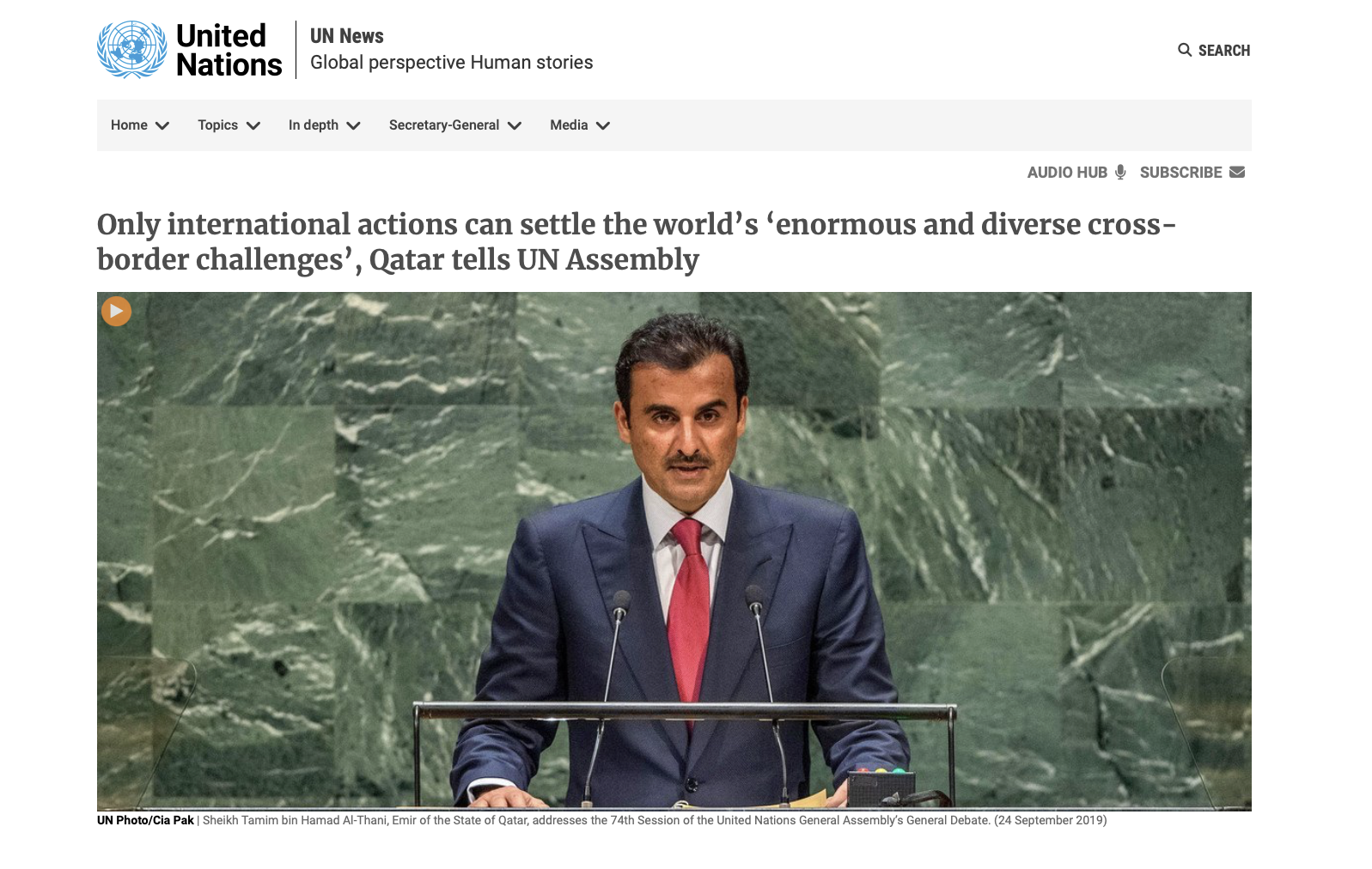
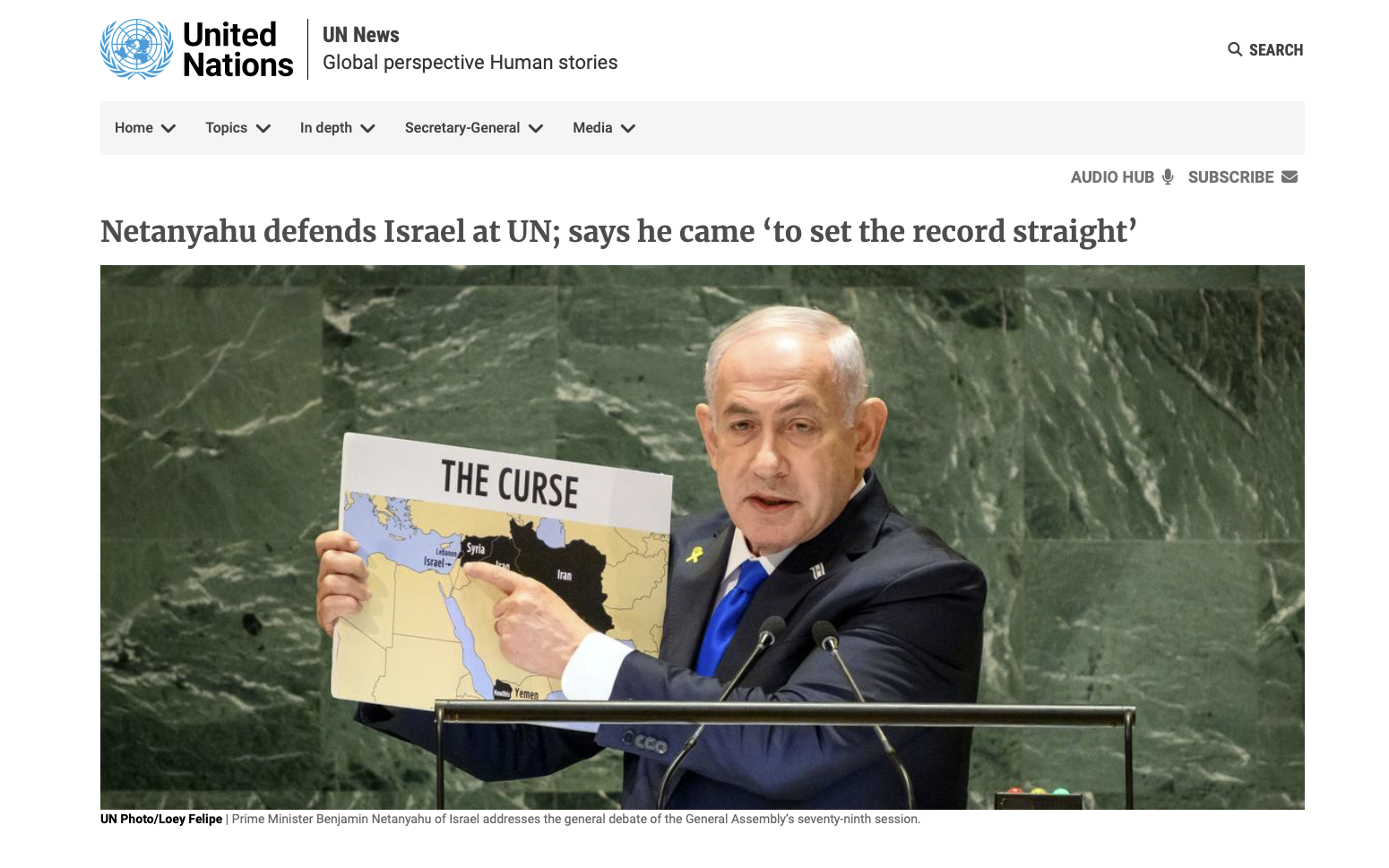
Tamim and Netanyahu at the UNGA
The United Nations General Assembly (UNGA) remains arguably the most famous diplomatic stage where the rhetoric deployed by world leaders often transcends mere policy outlines and becomes sophisticated strategic theatre. The highly anticipated addresses by Sheikh Tamim bin Hamad Al Thani of Qatar and Prime Minister Benjamin Netanyahu of Israel at the 79th Session in September 2024 provided a textbook case for what should be termed the Aikido of diplomacy. While Sheikh Tamim utilized the podium for a full force frontal assault, delivering a highly specific and personalised attack against Israel’s leadership and actions, Netanyahu executed a flawless strategic counter-move: a masterful application of the diplomatic Irimi-nage (Entering Throw). By employing a complete omission of Qatar and a sophisticated reframing of the conflict onto a global existential stage, Netanyahu effectively neutralised Tamim’s aggressive, specific accusations and dictated the terms of the resulting international debate.
Sheikh Tamim’s address on September 24, 2024, was meticulously designed to challenge Israel’s actions on multiple very high gravity fronts, simultaneously defending Qatar’s diplomatic role and directly accusing the Israeli leadership of bad faith. The Qatari strategy was not subtle; it dedicated significant portions of the speech to explicitly targeting Israeli policy regarding the ongoing conflict.
Tamim’s opening salvo was an ideological and legal classification of the conflict, framing Israel’s actions not as warfare in the well-known and common concept of war, but as a “crime of genocide,” describing the assault as the “most barbaric and heinous and extensive in breaching human values, international charters and norms.” Tamim declared that after nearly a year of war, “it is no longer tenable to talk about Israel’s right to defend itself in this context without being complicit in justifying the crime.” He condemned the “failure to intervene to stop the aggression” as a “major scandal,” asserting that Israel’s motives were clear, citing “published and publicly uttered intentions of Israeli leaders.”
Furthermore, Tamim utilized specific, high-stakes accusations that focused on the danger posed by the Israeli leadership to regional stability and diplomatic processes. He classified the alleged operation targeting negotiating political leaders as a key example of bad faith, noting that Qatari mediation occurred “amidst fierce war and complex circumstances, during which one party would not hesitate to assassinate counterpart political leaders with whom it negotiates, such as the assassination of Ismail Haniyeh.”
Crucially, Tamim levelled a direct assault on Netanyahu’s credibility as a negotiating partner by placing the blame for the stalled diplomatic efforts squarely on the Israeli leadership. While acknowledging Qatar’s successful mediation resulting in a brief ceasefire and the release of detainees in November, Tamim implied a unilateral negation of peace efforts, asserting that there is no Israeli partner for peace during the current government’s tenure, and no peace process taking place, but rather a “genocide.”
Tamim connected the continuation of the brutal war directly to hardline ideological goals held by Israeli authorities. He characterized the occupation as taking the form of an “apartheid system” and suggested Israeli leaders harbor the “wishful thinking to eliminate this people.” Tamim specified these destructive goals as attempting to “enforce plans to expand settlements, annex the West Bank, and Judaize Jerusalem.” This accusation, which aligns with the insinuation that Netanyahu believes in “Greater Israel,” aimed to transform the war in the eyes of the international community from self-defense into an act of territorial conquest.
Finally, Tamim preemptively defended Qatar’s role, affirming that despite “daunting challenges, obstruction attempts, and the aspersions we are subjected to,” Qatar would continue its mediation efforts. This served as a diplomatic shield against Israel’s alleged strategy of branding anyone who opposes it as either anti-Semitic or a terrorist. The Qatari address, therefore, was a precise, high-volume indictment focusing intensely on specific policies, ideological disputes, and the character of one leader.
The strategic challenge for Netanyahu was how to answer such a direct accusation of state terrorism and ideological warmongering on the world stage, without actually validating the attack itself by engaging with it. This is where the perfect execution of diplomatic Aikido occurred, analogous to the Irimi-nage: stepping into the line of attack by refusing to fight on the attacker’s terms.
Netanyahu’s response was not a point-by-point rebuttal; it was a decisive pivot. He implemented a strategic omission by completely omitting any mention of Qatar, Sheikh Tamim or Qatar’s role as a mediator. By refusing to acknowledge Qatar, the primary Hamas-protector involved in brokering the previous agreement, Netanyahu essentially treated Tamim’s specific, personalised accusations, including the grave charges of state terrorism and intentional war perpetuation, as just noise and empty political gestures.
This strategic refusal to engage was the ultimate deflection technique. While acknowledging Qatar might have validated its claims of leverage, ignoring it entirely allowed Netanyahu to achieve two critical objectives in his narrative:
Depoliticisation of negotiation failures. He attributed the lack of a permanent ceasefire entirely to Hamas’s inherent nature, thereby shielding Israel from blame for diplomatic mishaps or unilateral negation of agreements.
Elevation to the existential stage. He signaled that Israel was operating on a far grander, almost existential stage, a level where localised disputes and mediators were deemed secondary concerns.
The risk inherent in deliberately refusing to acknowledge a key mediator was calculated, but it successfully allowed Netanyahu to seize control of the rhetorical high ground and redefine the entire conflict.
Having stepped out of the way of Tamim’s momentum, Netanyahu employed a sophisticated reframing: the sweeping throw of the Irimi-nage. Netanyahu’s focus shifted dramatically to an existential battle, positioning Israel on the front line against a common global enemy and aiming his speech squarely at the defense of global civilisation.
This elevation instantly transformed the narrative. Netanyahu repositioned Israel not merely as a nation defending its borders against a local adversary, but as the forward defense against a global “curse”. He explicitly identified Iran as the ultimate source of terror, describing an “arc of terror” imposed through its proxies: Hamas, Hezbollah, the Houthis. This crucial rhetorical move shifted the immediate spotlight off Gaza and onto a massive global geopolitical struggle, successfully aligning Israel’s actions with the long term strategic interests of the West.
Netanyahu rebranded Hamas, the group Tamim defended as a negotiating partner, as a key part of this global Iranian backed jihadist extremism that threatens global order. This framing served to justify military action more easily on the world stage. He starkly warned that Iran seeks to destroy “our common civilization and return the world to a dark age of tyranny and terror.”
To solidify this moral necessity, Netanyahu used powerful historical and emotional appeals. He highlighted the unimaginable atrocities of October 7th and the plight of the hostage families, attempting to bind the world’s moral compass to Israel’s objectives. Most forcefully, he compared Hamas to the Nazis, a clear call to global conscience, to historical obligation. This comparison dramatically raised the stakes of non-intervention or strong criticism, suggesting that eliminating Hamas was a moral equivalent to fighting Nazism.
Netanyahu concluded by outlining Israel’s “sacred mission,” bringing home the hostages, achieving total victory (Hamas must go), and establishing a demilitarised and de-radicalised Gaza. He then projected a vision of future stability through normalisation, specifically mentioning a potential historic agreement with Saudi Arabia. This focus on future prosperity, achievable only if the Iranian-backed “curse” was eliminated, starkly contrasted with Tamim’s focus on history and current disputes.
The strategic divergence between the two leaders was stark. Tamim used his platform for specific, highly charged accusations targeting one man and specific policies. Netanyahu, utilising the diplomatic Irimi-nage, ignored the hostile noise and focused on the entire global order, the fate of civilisation itself. By executing the power of omission, Netanyahu allowed the momentum of the frontal assault to dissipate. He utilized the resulting vacuum to replace a specific localised dispute with this grand civilisational imperative.
Netanyahu’s speech was a strategic masterstroke because he concentrated world attention on the geopolitical struggle against Iran and its proxies, thereby providing justification for sweeping military action. The decision to strategically ignore a key mediator like Qatar, which affects the perception of neutrality versus justifying military action, demonstrates the fundamental strategic choice facing leaders: whether to defend on specific terms or reframe the conflict onto a universally recognised existential stage. In this clash of rhetoric, Netanyahu’s decisive Irimi-nage allowed him to control the global narrative, rendering Tamim’s localised critique ineffective on the UNGA floor.


