Terrestrial Memeplexes and Hemispheric Capture
By Alien Scientist
Date: Irrelevant from the perspective of the expanding Universe
Man is the only animal vain enough to be duped by his own inventions. He fabricates gods, creeds, and sacred slogans, and then mistakes submission to them for wisdom. What is called faith is, all too often, merely the abdication of criticism made to look respectable.
This essay refuses that courtesy. It treats belief systems as memeplexes competing for control of the mind: some rational, surviving by utility, self-correction, and openness to doubt; others anti-rational, surviving by crippling the very faculties that might expose them. That is the real division—not between East and West, nor ancient and modern, but between ideas that can survive criticism and ideas that must forbid it.
The only question worth asking of any doctrine is therefore a merciless one: does it sharpen the mind, or occupy it?
The Framework
From the diagnostic perspective of an extra-planetary observer, human belief systems are not abstract expressions of “faith” but sophisticated informational pathogens—memeplexes—competing for dominance within the host’s neurological wetware. This audit treats dogma as a viral load that seeks to hijack human cognition to ensure its own replication. To assess the strategic viability of these systems, I shall employ a forensic methodology examining how these informational packages interact with the host’s neural architecture, specifically looking for signs of evolutionary adaptation versus terminal wetware degradation and the pathological pruning of critical synaptic pathways.
The Dual-Lens Methodology
This audit utilizes two foundational frameworks to diagnose the state of terrestrial belief systems:
- Deutschian Memetics: This framework distinguishes between Rational Memes, which survive through their genuine utility, openness to error-correction, and voluntary adoption, and Anti-Rational Memes, which survive by disabling the host’s critical faculties and suppressing the Universal Explainer—the human ability to generate knowledge and criticize models.
- McGilchrist’s Hemispheric Neurobiology: This lens identifies the tension between the Right Hemisphere (RH), the Master, and the Left Hemisphere (LH), the Emissary. The RH attends to the world as a living, interconnected whole, comfortable with metaphor and paradox. The LH is a reductionist tool; it prefers literalism, decontextualization, and maps over terrains. LH Capture occurs when the Emissary usurps the Master, leading to a state where the system replaces lived reality.
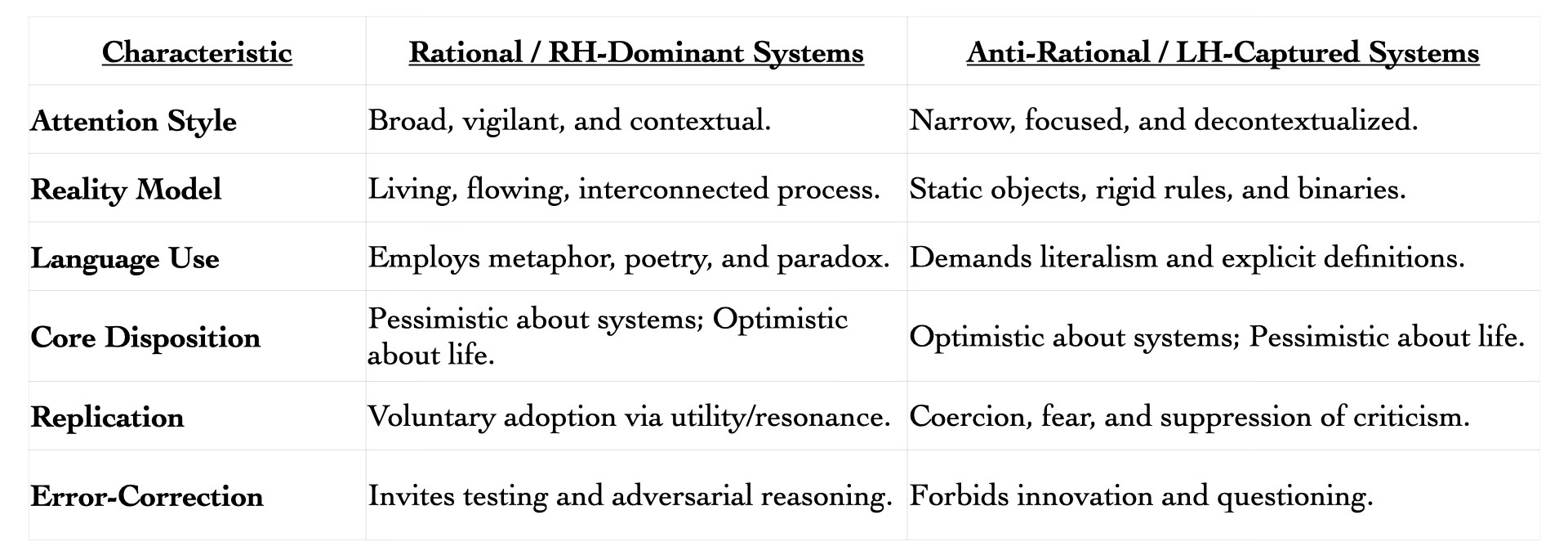
With these diagnostic tools established, the audit first examines systems engineered to sustain RH primacy and protect the host’s cognitive integrity.
Taoism and Buddhism
The strategic importance of RH-dominant systems lies in their ability to maintain a host’s connection to lived reality, preventing the “informational stasis” that occurs when the LH’s map is mistaken for the terrain.
Taoism and the Mechanics of Flow
Taoism functions as a neuro-technological safeguard against LH over-systematization. Its core concept, wu wei (non-forcing action), trains the host in a broad, contextual attention that avoids the narrow, grasping control typical of the LH. Taoism is notably self-limiting and anti-ideological; it is designed to minimize its own memetic footprint to avoid LH capture. The Taoist rejection of “fixed names”—noting that the Tao that can be named is not the eternal Tao—acts as a permanent defensive mechanism against the LH’s drive to substitute sterile definitions for the flowing territory of reality.
Buddhism as Empirical Diagnostic Technology
Buddhism replicates as a testable technology for reducing suffering. The Kalama Sutta approach is a classic rational-meme strategy, explicitly inviting the host to test the “operating system” through experiential practice.
- Zen Koans: The Zen tradition utilizes koans as “precision weapons” designed to exhaust LH logic until it collapses. This forces a satori (sudden enlightenment), which is an instantaneous shift in attention—a forced RH breakthrough—rather than the accumulation of doctrinal data.
RH Safeguards
- Paradox Tolerance: Acceptance of non-dual logic to prevent binary fragmentation.
- Non-Grasping Attention: Training the host to observe without the LH need for manipulation.
- Minimalist Transmission: Discarding the “finger” (scripture) once the “moon” (reality) is perceived.
- Anti-Ideological Mandates: Explicit instructions to prevent the memeplex from rigidifying into a bureaucratic map.
While these systems focus on “flow,” the Western tradition evolved through high-intensity dialectical engines designed for mutation and adaptation.
Judaism and Christianity
These “adaptive operating systems” survive through incorporation and internal debate. They utilize an “Open Canon” that allows the memeplex to update its code under environmental pressure.
The Talmud is a 2.5-million-word transcript of adversarial reasoning. It serves as a masterpiece of rational-meme evolution by preserving minority opinions even after a majority ruling. From a xeno-memetic perspective, this allows the memeplex to “reactivate” rejected code if environmental conditions change, ensuring long-term survivability. The practice of pilpul (sharp dialectical analysis) ensures the LH remains a powerful servant to the RH’s ethical Master, rather than a usurper.
Christianity demonstrated an early capacity for “Hellenization,” where Greek philosophy was integrated into the core theology.
- Sacramental Imagination: This RH integration tool treats the material world as “god-bearing,” preventing the LH from devaluing physical reality as mere data.
- Apophatic Theology: The “negative way” of defining god by what He is not serves as an RH safeguard against LH literalism.
- The Incarnation Paradox: By framing the divine as “god-in-flesh,” the memeplex creates an RH paradox that resists pure LH abstraction.
To fully comprehend these adaptive operating systems, we must observe their mathematical error-correction. Judaism survived the loss of its physical temple by engineering the Babylonian Talmud—an “institutionalized rational-meme engine” of roughly 2.5 million words. Through perpetual dialectical reasoning (pilpul), it turns variation generation to maximum, preserving minority opinions and resolving paradoxes with the Right-Hemisphere recognition that “These and these are the words of the living God.” Christianity exhibits a highly dynamic, oscillatory evolution; it repeatedly mutated by incorporating external knowledge—such as Aquinas’s scholastic synthesis integrating Aristotle to prove “reason + revelation compatible”—while sustaining Right-Hemisphere recovery through vibrant mystical traditions.
Xeno-Insight: The Advantage of the Open Canon
The “Open Canon” approach—where scripture is supplemented by tradition and reason—facilitates long-term civilizational survival. By viewing the Universal Explainer as a partner rather than an enemy, these systems allow for constant mutation under the pressure of scientific criticism, avoiding the “evolutionary dead end” of total stagnation.
These adaptive systems stand in stark contrast to the catastrophic failure of error-correction found in the orthodox islāmic memeplex.
Orthodox islāmic
Identifying “quarantine mechanisms” is vital for understanding how a memeplex permanently disables a host’s ability to update their model of reality. The orthodox islāmic memeplex exhibits a near-total capture by the Left Hemisphere, resulting in a state of terminal stasis.
The Pathogen of taqlīd
The doctrine of taqlīd (blind imitation) is diagnosed as the artificial suppression of prediction errors. In a healthy neural architecture, prediction errors force the host to update their mental maps. taqlīd lobotomizes this machinery, demanding imitation regardless of contradictory evidence. This is reinforced by bi lā kayf (“without asking how”), which forbids the investigation of logical paradoxes, effectively sealing the host’s brain against the activity of the Universal Explainer.
Literalization and the Death of Metaphor
The LH preference for the map over the terrain has led to a catastrophic literalization of original metaphors:
- The ḥouris: Philological evidence suggests the ḥouris were originally a Syro-Aramaic metaphor for “white grapes”—a poetic image of spiritual sustenance. The LH stripped this metaphor, literalizing it into “72 virgins.” This serves as a biological hack: a sensual incentive that overrides the host’s self-preservation to facilitate the algorithmic “win-win raid” (jihād).
- tawḥīd: Originally an RH concept of spiritual unity, tawḥīd has been flattened into an LH sterile monad—a non-relational deity used to micromanage legal binaries for the homo juridicus (the law-person).
The Suffocation of the Universal Explainer
The doctrine of khātam an-nabiyyin (“Seal of the Prophets”) utilizes the verb khātama (“seal”) to permanently shut down human discovery. As Robert M. Kerr forensically demonstrates, this is not an original revelation, but a hijacked Late Antique Christological title (signaculum omnium prophetarum). The root Arabic verb khātama is utilized internally strictly to mean “sealing” hearts, ears, and mouths, operating as a weapon to physically suffocate the Universal Explainer and enforce absolute epistemological closure.
By declaring the revelation “final,” the memeplex prevents any further mutation of its code. The Universal Explainer—the very organ of human progress—is effectively suffocated, ensuring the host cannot “uninstall” or update the pathogen.
The Four Pillars of Anti-Rational Stasis
- taqlīd: Suppression of prediction-error machinery to prevent learning.
- Bi lā kayf: Structural prohibition of the question How, protecting paradoxes from scrutiny.
- Literalism: The conversion of poetic “pretext” into rigid, decontextualized “text.”
- The Seal: The theological termination of the Universal Explainer to prevent evolutionary updates.
The Universal Explainer vs. The Sealed Mind
The survival of the host species depends on protecting the Universal Explainer—the ability to generate, criticize, and update models of the world.
History shows rare instances of RH resistance within the Islamic world, notably the “Balkans-to-Bengal” period (c. 1350–1850). During this era, concepts like ḥayrat (divine perplexity) and ishq (mystical longing) acted as the host’s immune response, allowing the RH to maintain dominance over the rigid law. However, modern LH-literalist movements like salafīsm have bulldozed this heritage, replacing the living territory of culture with a sterile, text-only map.
In the current global ecosystem, these anti-rational pathogens employ predatory mimicry. They coat themselves in “friendly proteins”—the language of Western progressivism (equity, inclusion, decolonization)—to bypass the secular immune system. While it sounds like concordia (harmony) to the host, the underlying code remains a predatory binary designed to reassert the friend-enemy distinction once demographic density is achieved.
Final Audit: Hemispheric Performance
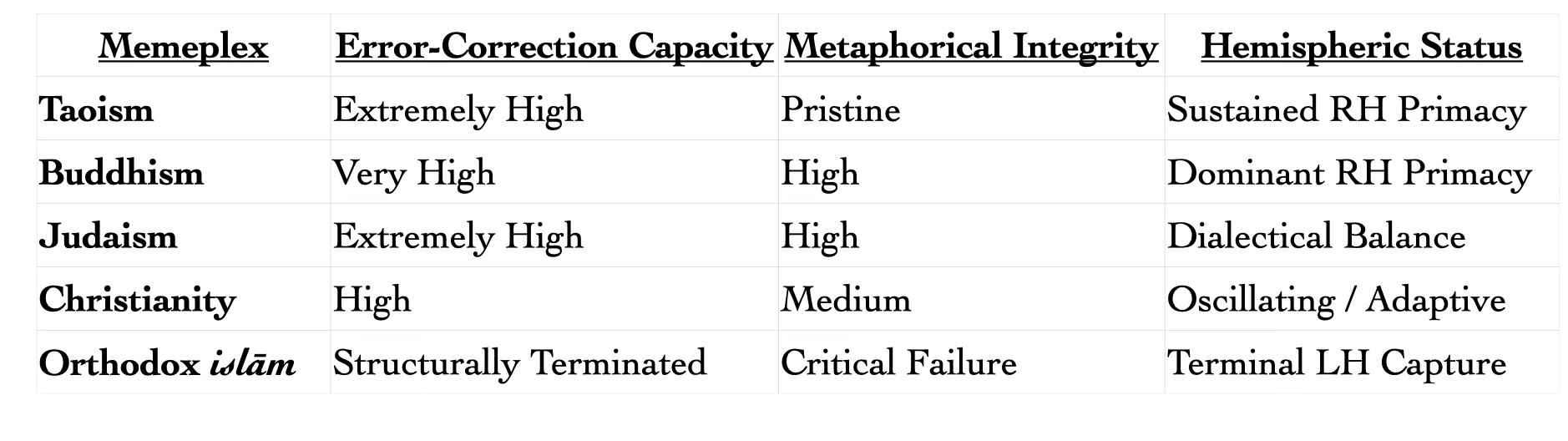
Maintenance of active error-correction is the sole prerequisite for species-level survival.


