Subsidised Subversion: The Muslim Brothers’ Capture of Sweden’s Institutions
25 January 2026
The Moral Lighthouse
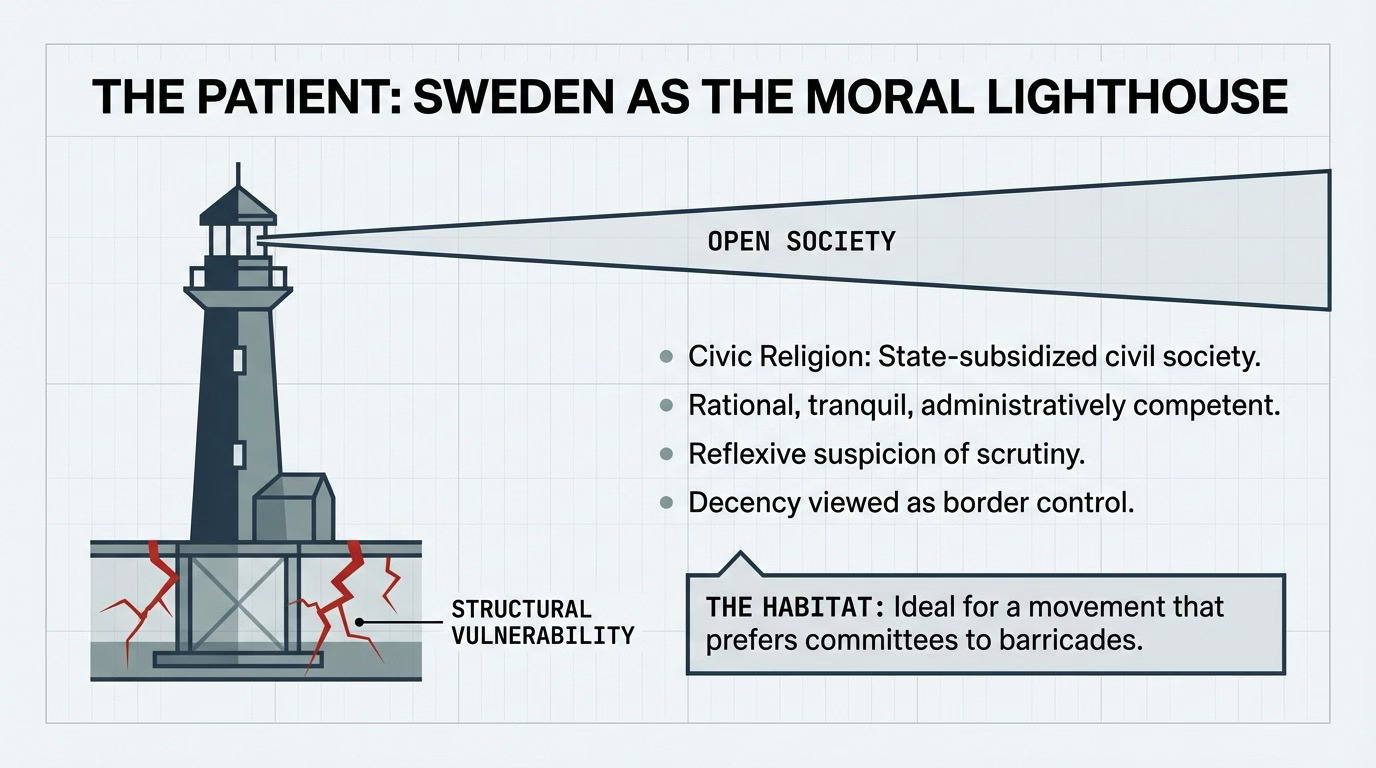
Sweden, in the European imagination, is a kind of moral lighthouse: rational, tranquil, administratively competent, and endearingly convinced that decency is a sufficient border control. It is a country that has elevated “civil society” into a civic religion—complete with state subsidies, official interlocutors, and a reflexive suspicion of anyone rude enough to ask who is speaking in whose name. If you were designing the ideal habitat for a modern ideological movement—one that prefers committees to barricades, grant forms to gunfire, and “representation” to accountability—you might do worse than choose the land of earnest consensus as your laboratory.
This exercise is written for those who are tired of the theatre: the tantrums of the xenophobe and the swoons of the naïf. It proceeds from a simpler—and more adult—premise: that an open society can be exploited precisely because it is open, and that the language of tolerance can be repurposed as a solvent to dissolve scrutiny. The task here is not to recycle partisan slogans, nor to conduct a loyalty trial for Muslims in Sweden—an exercise as indecent as it is stupid. The task is to identify a method: to trace the operational fingerprints of a transnational ideological project as it threads itself through parties, grants, schools, and public discourse while insisting—often with practiced indignation—that noticing any of this is itself a form of bigotry.
To that end, the analysis applies a structured diagnostic framework— what I call The Behling Scalpel—to the extensive empirical material presented in Sameh Egyptson’s doctoral dissertation on the Muslim Brothers’ Swedish network, with the Islamic Association of Sweden (IFiS) and its affiliates as the central case. The point is not to argue about atmospherics; it is to examine mechanics: how organisations are formed, how influence is purchased with legitimacy, how “moderation” becomes a tactic rather than a creed, and how accusations of prejudice are deployed as both shield and spear. If you want to understand how an ideological movement can present itself in the language of pluralism while practicing cadre discipline—how it can demand state recognition while maintaining transnational allegiance—then you must begin where all serious inquiries begin: with chronology, structure, language, and the stubborn, unfashionable discipline of evidence.
The Behling Scalpel
The Behling Scalpel operates as a forensic instrument derived from Julie Behling’s Beneath Sheep’s Clothing (2022), slicing through the veneer of modern American cultural shifts to reveal a century-long trajectory of ideological subversion that mirrors the Soviet Union’s dismantling of its own heritage. This diagnostic framework exposes the specific playbooks utilised to erode the “cultural hegemony” of faith and family: the educational transition from academic rigour to Social Emotional Learning and Critical Theory, designed to replace critical thinking with Pavlovian conditioning; the ecclesiastical infiltration that swapped Biblical theology for a Marxist Social Gospel via institutions like the National Council of Churches; and the Galen Kelly anti-cult model, employed against fringe groups like the Branch Davidians as a kinetic test-run for suspension of due process and state overreach. By identifying core psychological traps such as the Prison of Two Ideas and the Lie Married to a Truth—wherein legitimate grievances are weaponised to consolidate new elite power—Behling provides a master-framework for recognising that America has moved past “demoralisation” and is now teetering on the precipice of “crisis.”
The Diagnostic Objective
This article dissects the operational patterns of a specific transnational ideological movement within the institutional landscape of a modern Western state. The analysis utilises a structured diagnostic framework to move beyond surface-level political debate and identify the core methods, structures, and ideological tactics employed. Understanding these methodological fingerprints is of strategic importance for any open society seeking to safeguard its democratic institutions against covert, ideologically-driven infiltration.
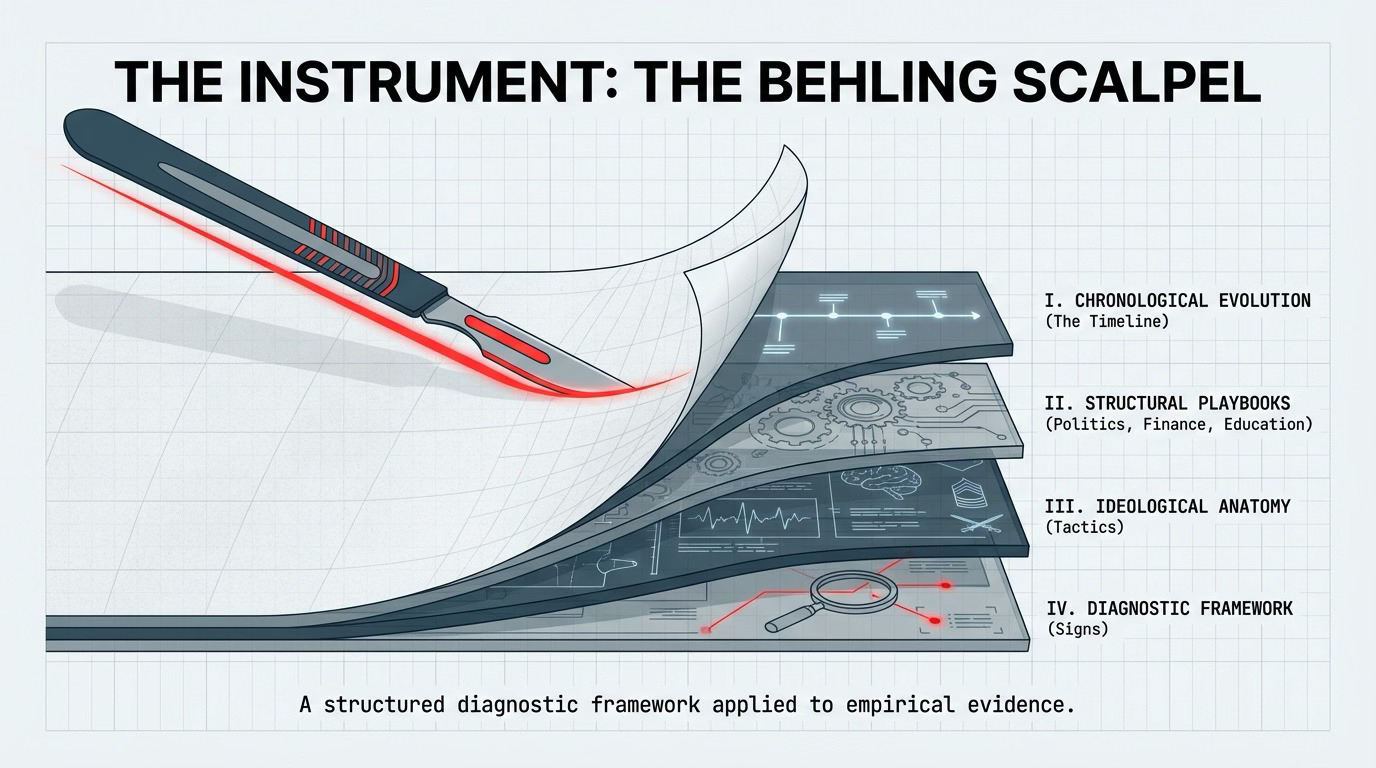
The primary objective of this text is to conduct a thorough analysis identifying the subversive operational patterns of the Muslim Brothers (MB, hereafter Ikhwan, the Brothers’ preferred label) in Sweden. This will be achieved by applying the analytical framework known as The Behling Scalpel to the extensive empirical evidence presented in Sameh Egyptson’s doctoral dissertation, Global politisk islam? Muslimska brödraskapet & Islamiska förbundet i Sverige. The framework systematically dissects the subject through four distinct layers: Chronological Evolution, Structural Playbooks, Ideological Anatomy, and a final Diagnostic Framework.
The subject of this analysis is the Islamic Association of Sweden (IFiS) and its extensive network of subsidiary and affiliated organizations. This report operates on the foundational hypothesis established by Egyptson’s research, which concludes a direct and integral link between the Swedish network and the global Ikhwan movement, stating that:
“The Islamic Association of Sweden is deeply involved in the global Muslim Brotherhood network, and can be regarded as its Swedish branch or ‘national organization’.” (Egyptson)
To begin this dissection, the first step is to apply the initial layer of the diagnostic framework by tracing the chronological evolution of the movement’s establishment and methods within Sweden.
Layer I: Chronological Evolution of Subversive Methods
Understanding the historical timeline of an ideological movement’s establishment within a host nation is critical. It reveals the strategic patience, long-term vision, and phased implementation of its objectives. A chronological analysis exposes how seemingly disconnected events are often part of a deliberate, multi-decade strategy. This layer of the analysis dissects the development of Ikhwan’s operational presence in Sweden from its nascent stages to its strategic maturation, applying the Chronological Evolution framework of The Behling Scalpel to the evidence trail established by Egyptson.
The Establishment Phase (1980s)
The initial formation of Ikhwan’s organisational network in Sweden occurred throughout the 1980s. This phase was characterised by the creation of foundational entities that would serve as the building blocks for a future, more complex structure. According to Egyptson’s timeline, this process began in 1981 with the establishment of Förenade islamiska föreningar i Sverige (FIFS), Islamiska förbundet i Stockholm (IFS), and Sveriges muslimska förbund (SMF). This early organisational activity laid the groundwork for a durable and expansive network in the decades to come.
The Strategic Formalisation (1995)
The year 1995 represents a pivotal moment of strategic formalisation for the movement in Sweden. Two key developments occurred that solidified its structure and ideological direction:
- Founding of IFiS: The Islamic Association of Sweden (IFiS) was formally established as the national association for Ikhwan in the country.
- Integration into the European Network: IFiS concurrently became a formal member of the Federation of Islamic Organisations in Europe (FIOE), the umbrella organisation for Ikhwan’s network across the continent.
This formalisation was directly linked to the adoption of the Ikhwan’s “European Strategy,” a framework formulated by the movement’s chief global ideologue, Yusuf al-Qaradawi. This strategy, adopted at a conference in Istanbul, marked a definitive shift in the movement’s approach to operating within Western societies.
The Methodological Shift: From Isolation to Participation
The formalisation in 1995 coincided with a crucial methodological shift, moving from a strategy of “rejectionist” isolation from mainstream society to one of “participation.” However, as Egyptson’s research clarifies, this was not a move toward genuine integration. Instead, the movement adopted a sophisticated strategy of entryism: the deliberate infiltration of mainstream political, social, and cultural institutions with the express purpose of influencing and altering them from within to align with the movement’s long-term ideological goals.
This deliberate, phased evolution from the 1980s onward was not merely organisational growth; it was the necessary groundwork that created the institutional platforms required to launch the structural playbooks targeting the core of the Swedish state.
Layer II: Structural Playbooks – Targeting Core Institutions
An ideological movement can only achieve societal transformation by gaining influence over a country’s core institutions. Control over political parties provides access to state power, influence over financial flows provides the resources for expansion, and a foothold in the educational system allows for the ideological shaping of future generations. This layer of the analysis dissects the systematic methods the IFiS network has used to target these three pillars of Swedish society, applying the Structural Playbooks framework of the Behling Scalpel to the evidence documented by Egyptson.
The Political Playbook: Entryism
The IFiS network executed a multi-tiered entryism strategy to infiltrate Sweden’s political system, categorised by Egyptson as “Collective,” “Semi-collective,” and “Individual.” The evidence trail reveals a consistent pattern of placing operatives across the entire political spectrum, from the Social Democrats to the Moderates, to maximise influence regardless of the ruling party. Key documented cases include:
- Social Democrats: The 2013 nomination of Omar Mustafa, a key figure in the IFiS network, to the party’s executive board, which collapsed after one week amid public scandal, exposing the network’s influence strategy.
- Green Party (Miljöpartiet): The case of Mehmet Kaplan, a high-level operative who became a Member of Parliament and was later appointed cabinet minister before resigning in 2016 following revelations of his association with Turkish ultranationalists and comparisons of Israel to Nazi Germany, exposing the network’s transnational loyalties and anti-Western ideological currents.
- Moderate Party (Moderaterna): The case of Abdirazak Waberi, a former chairman of IFiS, who served as a Member of Parliament from 2010 to 2014, demonstrating the network’s operational reach across ideological divides.
- Center Party (Centerpartiet): A documented pattern of collective cooperation and entryism with the party dating as far back as 1991.
The Financial Playbook: State Subsidisation
A core financial playbook has been the systematic exploitation of the Swedish model of state grants for civil society. The network created a series of purpose-built umbrella organizations—including Sveriges muslimska råd (SMR), Förenade islamiska föreningar i Sverige (FIFS), and Islamiska samarbetsrådet (ISR)—designed to monopolise the representation of Muslims in the eyes of the state. These front organizations successfully channeled vast sums of public funds from government agencies such as SST (The Swedish Agency for Support to Faith Communities) and SUCF (The Swedish Agency for Youth and Civil Society) directly into the IFiS network. By securing state subsidisation, the network not only funded its own expansion but also co-opted the state’s own mechanisms for civil society support, turning a tool of democratic pluralism into an engine for ideological entrenchment.
The Educational Playbook: Generational Inculcation
Recognising the long-term strategic value of shaping the next generation, the network made a concerted effort to infiltrate the Swedish education sector. This playbook relied on three key organisational arms:
- Ibn Rushd: An educational association that receives state funding and functions as a key vehicle for ideological dissemination and da‘wah (call to Islam).
- Sveriges muslimska scouter (SMS): A scouting organisation used to inculcate youth with the movement’s worldview under the guise of mainstream recreational activities.
- Sveriges islamiska skolor (SIS): A network of “Islamic schools” designed to provide a segregated educational environment where the movement’s interpretation of Islam could be promoted to children and youth.
These structural playbooks targeting political, financial, and educational institutions were shielded and amplified by a sophisticated set of ideological tactics designed to neutralize scrutiny and manufacture consent.
Layer III: Ideological Anatomy – Force Multipliers
Ideological “force multipliers” are the core psychological and rhetorical tactics that allow a minority movement to exert disproportionate influence over a majority society. These principles are designed to neutralize opposition, obscure true intentions, and advance a subversive agenda using publicly acceptable language. This layer of the analysis dissects the key force multipliers identified in Egyptson’s research of the IFiS network, applying the Ideological Anatomy framework of the Behling Scalpel.
The Double Speak Tactic (Organised Hypocrisy)
Egyptson’s analysis reveals a systematic use of contradictory messaging tailored for different audiences—a tactic he terms “organised hypocrisy.” The network’s external communication in Swedish emphasizes concepts palatable to a Western audience, while its internal communication in Arabic adheres to the core tenets of the global Muslim Brothers’ political ideology.
Internal Rhetoric (Arabic)
Focus on shari‘a as the basis for society
Goal of al-tamkin (domination/empowerment)
Discourse on jihād
External Rhetoric (Swedish)
Focus on democracy and human rights
Goal of integration and participation
Discourse on civil rights and community building
This dual-messaging strategy allows the network to advance its goals while maintaining a veneer of moderation and deflecting scrutiny.
The Victimhood Narrative (Weaponised Islamophobia)
The term “Islamophobia” has been strategically deployed by the network not merely as a descriptor of anti-Muslim bigotry, but as a political shield and sword. This tactic serves multiple functions:
- Silencing Inquiry: It is used to shut down legitimate academic and journalistic investigation into the network’s activities by preemptively framing any critical scrutiny as an act of hatred. Egyptson documents how his own doctoral research was targeted with accusations of “Islamophobia.”
- Delegitimising Critics: Any individual or group that questions the network’s agenda is labeled “Islamophobic,” a tactic designed to isolate and discredit them in the public sphere.
- Lobbying for Power: The narrative of pervasive victimhood is leveraged to lobby for special political accommodations and the expansion of parallel social structures (enclaves), which are presented as necessary safe spaces from a hostile society.
The wasatiyyah Trap (The Middle Way as Method)
The network frequently promotes its ideology under the banner of wasatiyyah, an Arabic term translated as “the middle way” or “moderation.” However, Egyptson’s detailed analysis reveals that within Ikhwan’s strategic framework, wasatiyyah does not represent theological moderation in the Western sense. Rather, it functions as a pragmatic and gradualist method for achieving the step-wise Islamisation of society. This is not moderation in substance, but in method. A direct call for shari‘a law would be rejected, but lobbying for shari‘a-compliant family law within the existing legal system, promoted under the banner of “cultural rights” and “religious accommodation,” is a classic application of the wasatiyyah method. It is a strategy of patience that avoids sudden, radical actions that might alarm the host society, thereby allowing for a slow, permeating transformation to be enacted over decades.
The consistent application of these force multipliers—Double Speak, Weaponised Islamophobia, and the wasatiyyah Trap—produces a distinct and repeatable pattern of behavior, leaving a trail of diagnostic indicators for the forensic analyst.
Layer IV: Diagnostic Framework – Early Warning Signs
No covert ideological network can operate without generating a distinct operational signature. This final layer of analysis identifies the specific diagnostic indicators that confirm the IFiS network’s nature and provenance, applying the Diagnostic Framework layer of the Behling Scalpel to the evidence trail documented by Egyptson.
- Control by an Inner Circle The evidence trail reveals a consistent pattern of control over the entire network by a small, closed circle of the same individuals. Key figures such as Mahmoud Aldebe, Chakib Benmakhlouf, Mostafa Kharraki, and Omar Mustafa are documented as rotating through the leadership and board positions of the network’s supposedly separate organizations. This practice belies the appearance of a diverse civil society movement and ensures tight, centralized ideological and operational control by a trusted cadre.
- Systematic Enclavism The network has made a concerted and systematic effort to build a parallel society insulated from mainstream Swedish life. This operational signature manifests through concrete projects, including the creation of the Sveriges islamiska skolor (SIS) school network, financial ventures like the al-Taqwa bank, and continuous lobbying for the implementation of shari‘a-based family law. The explicit goal is to create separate social, educational, and legal structures that minimise contact with, and the influence of, the surrounding non-Muslim society.
- Primacy of Transnational Loyalty The evidence demonstrates unequivocally that the network’s primary organizational and ideological loyalty is not to the Swedish state but to the transnational Muslim Brotherhood structure. This is most clearly illustrated by the fact that Chakib Benmakhlouf served simultaneously as a leader of the Swedish IFiS and as the chairman of the entire European FIOE network. This dual role confirms that the Swedish branch operates as an integrated component of a global hierarchy, with its strategic direction determined by the parent organization, not local Swedish considerations.
The accumulation of these diagnostic indicators allows for a final, conclusive assessment of the IFiS network’s operational signature and its effectiveness in Sweden.
The Assessment
This exercise undertook a forensic mission: to apply the four diagnostic layers of the Behling Scalpel—Chronological Evolution, Structural Playbooks, Ideological Anatomy, and Diagnostic Framework—to the empirical evidence on the Islamic Association of Sweden (IFiS) network presented by Sameh Egyptson. The objective was to move beyond political rhetoric and produce a structured, evidence-based diagnosis of the movement’s operational patterns in Sweden.
The synthesis of the findings confirms that the IFiS network exhibits all the defining patterns of ideological subversion as categorised by the Behling Scalpel framework. The chronological analysis reveals a patient, multi-decade strategy of establishment and infiltration. The structural analysis documents a systematic targeting of Sweden’s core political, financial, and educational institutions. The ideological analysis deconstructs the key tactics—Double Speak, Weaponised Islamophobia, and the wasatiyyah Trap—used to mask intentions and neutralize opposition. Finally, the diagnostic framework identifies the unambiguous indicators of a covert network: control by an inner circle, systematic enclavism, and a primary loyalty to a transnational authority. The accumulated evidence from Egyptson’s research provides a comprehensive and definitive affirmative to the report’s foundational hypothesis.
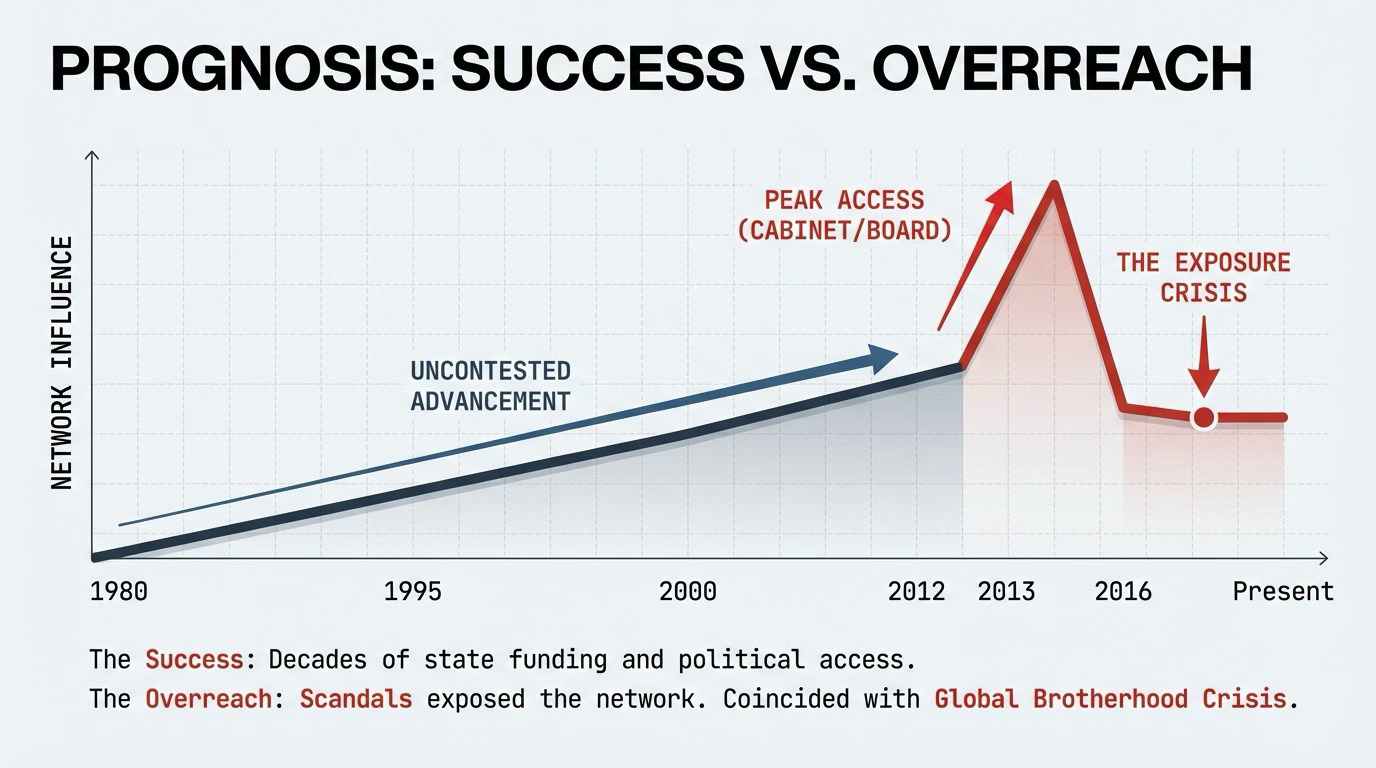
In assessing the overall effectiveness of the Muslim Brothers’ entryism strategy in Sweden, the conclusion is mixed. The movement achieved remarkable success for decades, securing state funding, establishing a wide institutional footprint, and placing its operatives in the highest levels of political power. However, this success also bred overreach. The political scandals of 2013–2016, involving figures like Omar Mustafa and Mehmet Kaplan, exposed the network’s operations to unprecedented public scrutiny and resulted in significant setbacks. These failures in Sweden coincided with the broader Historical Crisis of the global Muslim Brothers following its overthrow in Egypt in 2013. This combination of internal Swedish exposure and external global crisis appears to have stalled the network’s momentum, threatening its legitimacy and forcing it into a defensive posture after a period of significant, near-uncontested advancement.
Sources:
Julie Behling, 2022, Beneath Sheep’s Clothing: The Communist Takeover of Culture in the USSR & Parallels in Today’s America. USA: Istina Press.
Sameh Egyptson, 2023, Global politisk islam? Muslimska brödraskapet & Islamiska förbundet i Sverige. Lund: Lund University.


