Salman Rushdie and the wounded imagination
From Britain’s cosmopolitan rise to Its fractured decline
Note: This is my third article on British Imagination. The first one was published as “The Tragedy of the British Imagination,” here. The second one called “Beyond Kings and Queens,” here. For Iain McGilchrist’s hemisphere hypotheses. Check here, here, here, and here.
By Khaled Salih

Salman Rushdie, the master of metaphor and complex narrative
Blood pooled on the stage, the audience frozen in shock, and yet Ralph Henry Reese lunged forward, grabbing the attacker’s legs as fellow supervisor Patrick Haskin hurled himself across the assailant’s body. In those frantic seconds during a 2022 lecture in New York, the two men helped stop the stabbing of novelist Salman Rushdie, an act of instinctive courage that has now earned them the Carnegie Hero Medal.
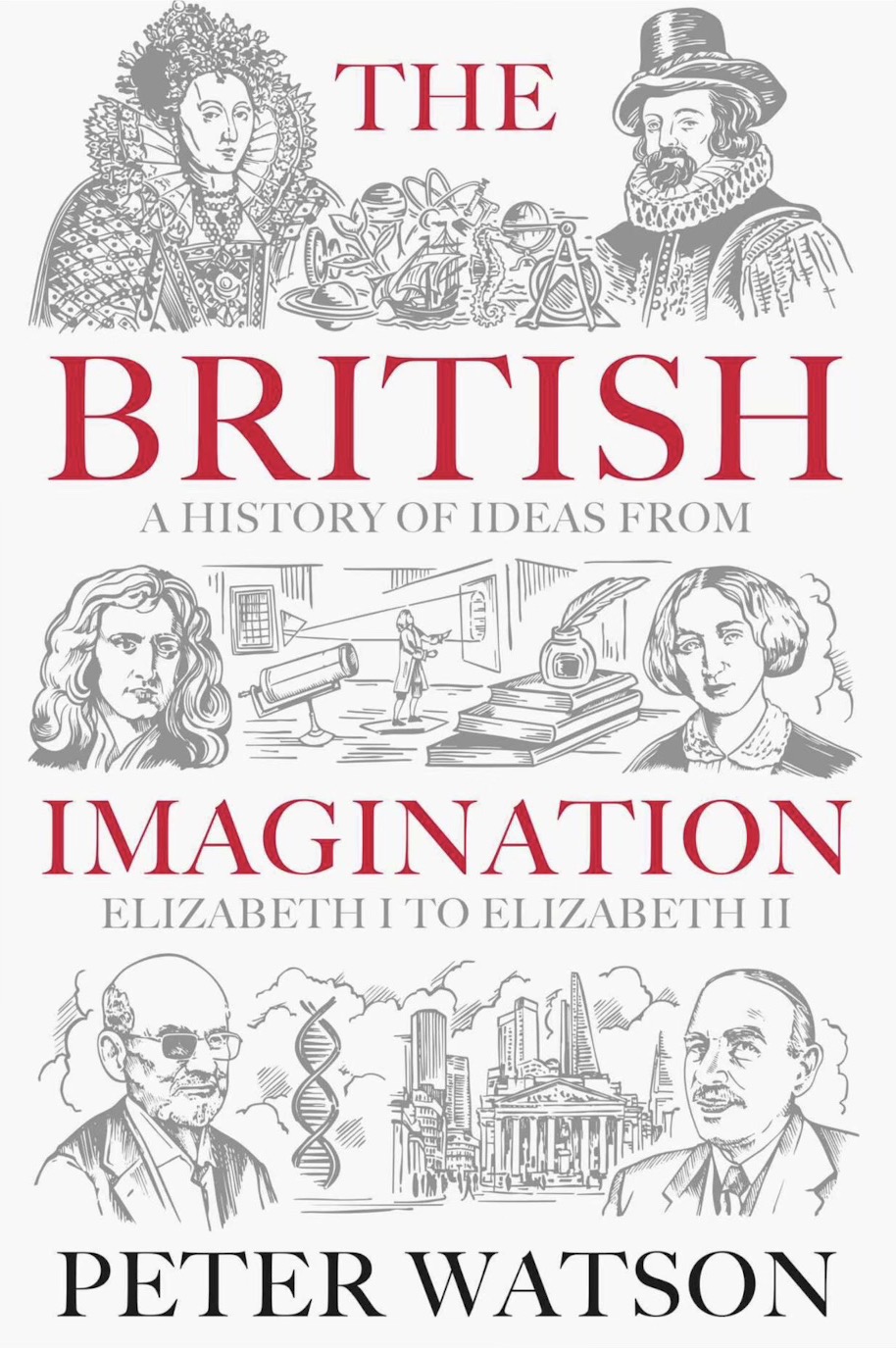
Peter Watson’s The British Imagination: A History of Ideas from Elizabeth I to Elizabeth II immediately establishes a monumental scope, arguing that the history of Britain is “arguably the most important ‘national’ history precisely because it has been the most intertwined with, and influential upon, other histories worldwide” across political, economic, social, and cultural dimensions. Drawing heavily on external reports, the book posits that British history offers the “best single avenue of inquiry” into the large processes of “globalisation.” He emphasises the unique position the British occupy in human history as the originators of industrialism and the creators of the first “world market” and “world system.” This narrative extends beyond local affairs, moving onto nothing less than a “planetary scale” that “extends itself into Oceanic, American and global dimensions.” By setting the historical parameters from Elizabeth I to Elizabeth II, Watson prepares the reader for a comprehensive intellectual journey charting the country’s ascent from a territory once conquered by the French in 1066 and mired in turbulent wars, to an influential global power, exploring how ideas forged within its borders came to profoundly shape the modern world.
What emerges from Watson’s initial chapters is a captivating depiction of England’s sense of its “gathering greatness” as ideas began to flourish like never before. The intellectual history unfolds against a backdrop of fundamental cultural and political changes, such as the Elizabethan Settlement, which effectively brought the English Reformation to a close, and Queen Elizabeth I herself setting an example through her own intellectual pursuits, notably translating The Consolations of Philosophy from Latin into English. Readers are immediately plunged into the burgeoning period of English eloquence, championed by figures like Roger Ascham, whose book Toxophilus promoted vernacular rhetoric as a weapon for Protestantism, and poets like Edmund Spenser, who sought the “kingdom of our own language.” This period witnessed critical shifts toward secular and practical knowledge, epitomised by Francis Bacon’s lifelong project for the “reform of learning” and his advocacy for observation and experimentation, alongside the increasing coherence of England as a territorial and geopolitical entity, demonstrated by the first county maps of England and Wales produced by cartographers like Christopher Saxton. This rich tapestry of development, spanning the Elizabethan courtier poets and the blossoming intellectual networks in London, clearly establishes how the British imagination was rapidly expanding, setting the nation on its crucial path toward an inevitable “blue-water destiny.” After my first reading, I decided to re-read the book with help of Iain McGilchrist. Here is what I discovered.
This exercise of reading Peter Watson’s historical metanarratives of the British imagination through the neurophilosophical framework established by Iain McGilchrist reveals a profound intellectual and cognitive pattern underlying Britain’s unique global trajectory, confirming that its cultural history is fundamentally a narrative of the brain’s power struggle.
Watson’s History through McGilchrist’s Lens
The primary learning is that the four British meta-narratives identified by Watson can be mapped directly onto the dynamic tension between the brain’s hemispheres, specifically illustrating the dangers and successes of allowing the left hemisphere’s (LH) technical, fragmented approach to operate, often in service of, but eventually usurping, the right hemisphere’s (RH) holistic, contextual, and intuitive vision.
The Cognitive Engine of Exceptionalism. Watson posits that the trajectory from a “backward, dull, and frankly barbaric periphery” to the “blueprint for modernity” required an “astonishing, almost unimaginable turnaround” fuelled by an “intense, self-driven, imaginative effort.” McGilchrist provides the cognitive mechanism for this intensity: the highly evolved human brain, capable of great creative leaps (RH-driven imagination) coupled with the LH’s unique capacity for developing specialized, fragmented systems and tools.
The Shift from Mythos to Logos. The exercise highlights a powerful cultural trade-off embedded within the core narratives:
Meta-Narrative I (Providentialism). The foundational belief in Britain as the “elect nation” (replacing references to Israel with Great Britain) provided a unifying, emotionally charged, and purposeful mythos. This is predominantly a Right Hemisphere function, relying on intuition, metaphor, and a holistic, spiritual understanding necessary to ground value and purpose. The RH seeks truth through intuition and imagination.
Meta-Narrative II (Empirical Science). The rise of science, driven by Bacon’s demand for abstraction, observation, and experiment, pushed the culture heavily toward logos (the literal, de-contextualized view). The subsequent preference for clear, plain language, shorn of embellishment, and the dismissal of poetry as “ingenious nonsense” (Newton) reflects the LH’s demand for “mathematical plainness” and its mistrust of metaphor.
The Triumph of the Emissary. One central learning is that the tremendous success of the British project, specifically through the mechanisation of M-II (Science) and the systematisation of M-III (Political Economy), inevitably led to the modern predicament described by Watson’s conclusion.
The LH is the manipulator concerned primarily with control and utility. The development of systems for Political Economy (M-III) and the use of Empirical Science (M-II) to create “things of use and practice for man’s life” (Bacon), and the tendency of political economists like Petty to quantify human life, reflects the LH’s tendency to reduce reality to utility and mechanism.
This specialisation, or fragmentation, leads to the LH believing its models are superior to reality, resulting in the “Master Betrayed” scenario. The modern world, characterized by nihilism and post-modernist fragmentation, is the ruin that follows when the LH, “less aware of its own limitations,” is in control.
Comparison and Contrast of Watson and McGilchrist
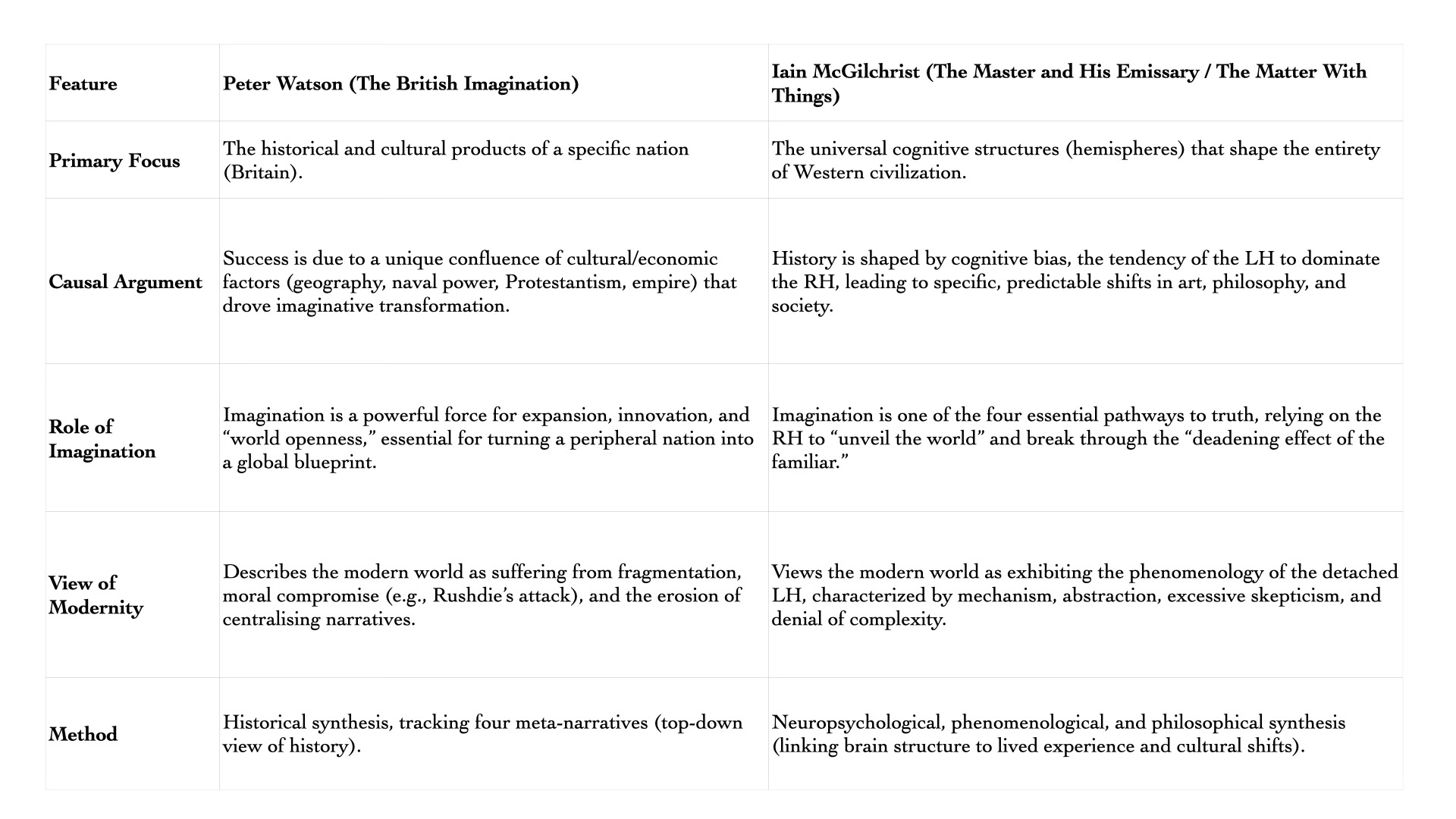
Contrasting scope and generality. Watson’s work is focused on making the case for British exceptionalism as the originator of modernity. McGilchrist’s work, conversely, is deeply skeptical of such claims of unique intellectual progress, arguing that the flaws (ratiocentric bias, obsession with abstraction) have plagued Western philosophy since Plato and that British history simply provides a particularly striking example of the universal LH triumph playing out since the Enlightenment. McGilchrist uses British figures (Locke, Newton, Darwin, Wordsworth, Mill) but places them within a universal Western cultural history.
Comparison. Both authors identify fragmentation as the ultimate danger. Watson notes that postmodern thought privileges “heterogeneity and differences as liberative forces” but criticises how this reduces “knowledge and meaning... to a rubble of signifiers.” McGilchrist provides the mechanism for this: the LH inherently seeks division, and when untethered, produces a disembodied, relativist perspective, where there is no longer any basis for discriminating truth from untruth. The rejection of “metanarratives” (M-IV, postmodernism) mirrors the LH’s inability to grasp the Gestalt or whole picture.
The British Imagination through McGilchrist’s Lens: Benefits and Downsides
Applying McGilchrist’s understanding of the divided brain to Watson’s historical framework provides a cognitive explanation for the potential benefits (when the Master is served) and the inherent downsides (when the Master is betrayed) of the British trajectory.
Potential Benefits: The Right Hemisphere in Service
The periods of British flourishing occurred when the LH’s tools were used in service of the RH’s superior understanding, a state of “fruitful hemispheric co-operation.”
Visionary Unity and Destiny. The shift towards fierce self-confidence and the “enormous conceit” that Britain was an “elect nation” was an RH-driven collective self-image. The RH provides the capacity for “ideal types” and aspirations (upwards) that provide affective meaning. This belief in Providential favour, though arguably a delusion, provided the non-rational, spiritual confidence necessary for global expansion and resilience against enemies.
Imaginative Discovery and Creativity. The emphasis on Imagination (M-I and M-IV) was crucial. Watson stresses that new knowledge requires the “prepared imagination” (Tyndall). McGilchrist argues that all genuine newness (as opposed to mere novelty) comes from the RH, which is attuned to the new and the implicit. The flourishing of the Baconian novel, which meticulously documents gathered experience (Defoe), demonstrated a successful RH attempt to capture the uniqueness and particularity of the lived world.
Institutional Independence and Liberty. The Inns of Court promoted “learning and license” and intellectual dissent, independent of dogmatic universities. This reflects the RH’s role in flexibility, seeking authenticity, and promoting liberal values through the frontal lobes’ ability to foster trust and take another’s perspective (“necessary distance”). Coke’s championing of English common law based on historical precedent and “sensible judgments” aligns with the RH’s reliance on context and experience rather than a priori reasoning (LH).
Inherent Downsides: The Left Hemisphere Triumphant
The long-term consequences, accelerating in the modern era, illustrate the corrosive effects of the LH view, which is “both literally more limited in what it can see, and less capable of understanding what it does see, than the right.”
Mechanistic Exploitation and Lack of Awe. The pre-eminence of Empirical Science (M-II) and its marriage to Empire (M-IV) allowed the LH to treat the world as a resource for exploitation, stripping it of “depth, colour and value.” This led to a loss of the sense of awe or wonder and the dismissal of nature as a mechanism (e.g., the modern scientist lecturing that humans are “hugely complicated machines”).
Abstraction and Dehumanisation. Political Economy (M-III) promoted rational economy and rational administration (Smith, Bentham, Mill), which rely on the LH tendency to categorise, generalise, and abstract. This abstraction led to the dehumanisation seen in empire, classifying other peoples as “barbarians” (Mill) or reducing human value to calculation (Petty’s political arithmetic). This disconnect is the origin of the “Spectator” theory of knowledge, where reality exists “wholly apart from the act of knowing,” leading to alienation.
Modern Crisis of Meaning. Watson notes that modern thought is marked by fragmentation, anxiety, and a distrust of universal discourses (“metanarratives”). McGilchrist links this directly to the LH’s tendency toward hyper-skepticism and self-enclosure. The experience of fragmentation, dissolution of character, and loss of cohesive narrative (postmodernism) parallels the experience of schizophrenia, which McGilchrist attributes to LH over-reliance. The ultimate intellectual crime is the LH attempting to solve the world’s problems through “piecemeal strategies” rather than a true shift in paradigm.
The Attack on Imagination. The cultural shift away from Providentialism and mythos resulted in the attack on “metaphor.” Watson highlights the attack on Salman Rushdie, a master of metaphor and complex narrative. McGilchrist argues that the suppression of metaphor and intuition, favouring sterile rationalism, is fundamentally pathogenic and destructive of life. The near-fatal assault on Rushdie, following decades of a fatwa, serves as a visceral symbol of the conflict between the LH’s violent literalism and the RH’s rich, ambiguous creative power.
In conclusion, the juxtaposition of these two readings demonstrates that the British imagination, in successfully architecting the modern world, became the prime example of the Western “Master Betrayed.” The very tools (empirical science, political systems) that led to its global pre-eminence and “metaphysical empire” were born of the hemisphere (LH) whose function, when unchecked, leads to fragmentation, loss of meaning, and eventual self-destruction. The essential lesson is that wisdom lies in rebalancing attention, acknowledging that the left hemisphere is a wonderful servant, but a very poor, and occasionally dangerous, master.
Sources:
Peter Watson, 2025, The British Imagination. A History of Ideas from Elizabeth I to Elizabeth II. London: Simon & Schuster.


