Royalty’s Last Gasp: The Special Relationship and the Collapse of the Post-War Illusion
29 April 2026
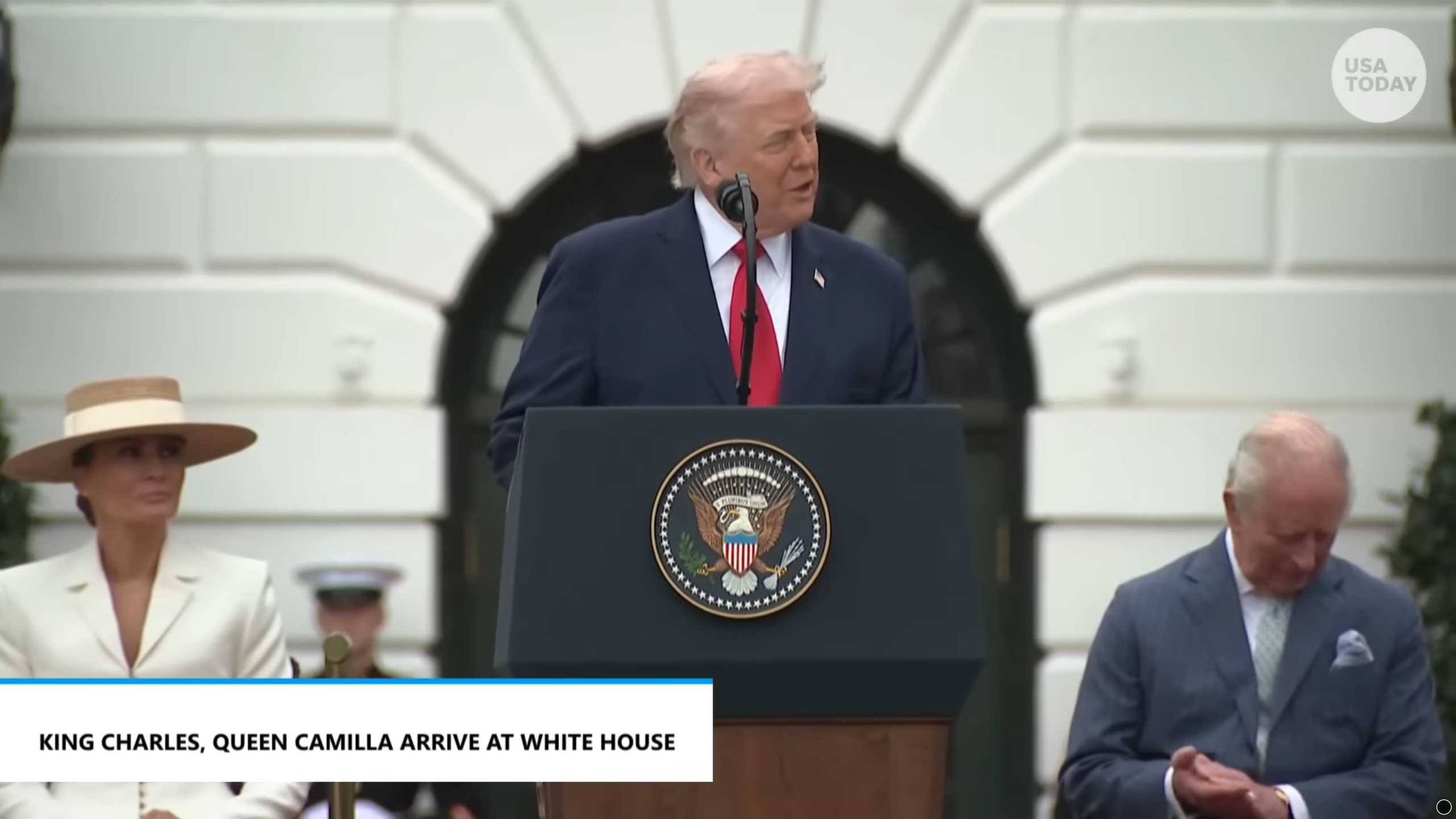
King Charles forcing himself to clap, while looking away
When you step onto the grand stage of history and examine the recent state visit in Washington, you must look beyond the polished pageantry and polite fictions peddled by the mainstream media. To the casual observer, the arrival of King Charles III and Queen Camilla in the American capital appears as little more than the familiar ceremonial theater of the so-called “Special Relationship.” Yet, viewed through the cold, uncompromising lens of geopolitical realism, these events reveal something far more consequential: a high-stakes structural duel between two divergent systems.
We are witnessing the latest chapter in a fundamental clash between a fading British imperial architecture—clinging desperately to relevance through sophisticated soft power and psychological operations—and a resurgent, transactional Sovereign American System under President Donald Trump. The King’s visit is not a nostalgic tribute to shared heritage. It is a calculated deployment of royal soft power by a British establishment in strategic distress, aimed at an American president who wields hard power with the explicit intent of dismantling the remnants of the post-war British-influenced global order.
The British monarchy must never be mistaken for a harmless collection of ribbon-cutting figureheads. It functions as a deeply briefed intelligence and influence operation, carefully calibrated to preserve the globalist framework and the financial primacy of the City of London. Queen Elizabeth II exemplified this role with remarkable skill. She received daily top-secret intelligence briefings, weekly national security updates, and intimate involvement in nuclear contingency planning. From the aftermath of the Suez Crisis with Eisenhower through to Obama, she deployed her personal charm and institutional gravitas to repair transatlantic rifts and keep the United States anchored to the post-war liberal architecture.
She largely succeeded—until Donald Trump. During his first term, Trump offered the Queen a notably cool reception when she attempted to steer trade and alliance dynamics in London’s favor. Now, her son King Charles III—less seasoned in this subtle art but thrust into a more overtly political role—is attempting to pick up the mantle. His visit to Washington operates, in part, as an intelligence-gathering mission. With President Trump having curtailed or conditioned intelligence sharing within the Five Eyes alliance, particularly regarding kinetic operations involving Iran and Venezuela, London finds itself strategically blinded. The King and his entourage are left to engage in elaborate interpersonal diplomacy, reading body language and off-the-record signals to gauge the fallout from America’s renewed assertiveness.
The British establishment is gripped by profound strategic panic. A recent House of Lords report, Adjusting to New Realities: Rebalancing the UK-US Partnership, offers a blunt admission: Britain is now merely a “middle power” whose global influence depends almost entirely on the continuation of the post-war “rules-based order” and the liberal free-trade system. That system, in turn, cannot endure without consistent American enforcement. This vulnerability was laid bare in the King’s address to a joint session of Congress, where he urged American lawmakers to resist the growing calls for the United States to become more “inward-looking.”
To buttress their fading architecture, the King orchestrated a sophisticated psychological operation—what might be called the “Magna Carta PsyOp.” He labored to reframe American liberty not as the product of a violent, sovereign break from British rule in 1776, but as a gentle outgrowth of the “British Enlightenment” and English Common Law. He tethered the United States symbolically to the fields of Runnymede and drew a false equivalence between the American Bill of Rights and the English Declaration of Rights of 1689. The King knows full well that American constitutionalism—rooted in natural rights, popular sovereignty, and a written supreme law—fundamentally diverges from Britain’s unwritten, precedent-based parliamentary system. Yet he wagered that Congress’s historical sentimentality would override such distinctions, allowing him to bind the American presidency emotionally to an imagined shared inheritance.
Beneath the ceremonial velvet, however, the post-war liberal order is fracturing under the weight of physical reality and American hard power. For decades, the British system has thrived in the “world of appearances”—diplomatic protocols, norms, summits, and soft power maneuvers that rarely produce decisive sovereign outcomes. President Trump, by contrast, operates exclusively in the domain of tangible results: leverage, enforcement, and outcomes.
While media pundits obsess over diplomatic rhetoric around the Strait of Hormuz, Trump has applied uncompromising hard power. His enforcement of a de facto blockade has pushed Iran’s oil storage facilities toward capacity; once full, Iranian wells will be forced to shut in, inflicting potentially permanent damage on their export infrastructure. Paired with his readiness to deploy 100% tariffs as a primary tool of statecraft, this approach signals a profound shift: alliances are no longer “special” or sentimental obligations, but strictly transactional arrangements judged by their net benefit to American interests.
The British establishment long sought an “Iron Lock” on American policy through asymmetric dependencies—most notably via programs like AUKUS and the F-35 joint strike fighter. Yet, as the House of Lords report acknowledges, this strategy has bred an “alibi mentality” in London, accelerating the atrophy of genuine British military capabilities and leaving the UK dangerously exposed.
Trump has neutralized much of this leverage with surgical precision. He remains perfectly capable of gracious hospitality—tea at the White House, praise for “Anglo-Saxon courage,” and warm state dinner toasts—while conceding not a single structural advantage. When the King attempted to characterize the relationship as a “partnership born out of dispute,” Trump firmly recentered it on the decisive American victory of 1776. The United States, in this framing, is not a wayward son returning to the fold, but the undisputed senior partner in any transaction.
The clearest evidence of this new reality came in the Pharma Damage Limitation Deal. Facing the credible threat of 100% tariffs on pharmaceutical imports, the United Kingdom was compelled to accept an arrangement that included a roughly 25% increase in prices paid by the NHS for innovative treatments. This was not a negotiation between equals or “special partners.” It was a disciplined exercise in damage control, dictated by raw American economic dominance.
Veteran architects of the old order, such as former Ambassador Lord Kim Darroch—who once privately dismissed the first Trump administration as “inept” and “dysfunctional”—understand that the game has fundamentally changed. Stripped of reliable soft power, intelligence dominance, and control over global chokepoints, the United Kingdom is scrambling for fallback options, including speculative overtures toward China as a counterweight.
The imperial architecture has cracked. The sentimental “Special Relationship,” as traditionally understood, effectively died the moment the United States reasserted its hard power independently of British approval. In the end, sophisticated narratives, royal charm, and appeals to shared history cannot withstand the revival of a confident, sovereign American System grounded in tangible strength rather than inherited obligations.
The pageantry continues, but the underlying power dynamic has shifted decisively. History is not written by those who host the most elegant state dinners, but by those who control the decisive levers of hard power—and today, those levers rest firmly in American hands.


