Revenge Without Remainder, Reasons Without Rigour: Unmasking Mansour’s Finite Game
By Khaled Salih
21 November 2025
HUSSEIN ABOUBAKR MANSOUR has named a genuine malady in our public talk: he shows how terms like “Nazi” and “genocide” undergo a “complete functional inversion” and become “liturgical triggers” that license cruelty rather than describe reality. He sketches the “Imago Nazi” and installs a Tarantino aesthetic of “revenge without remainder,” all under a “post‑Christian” sky where “Vengeance is mine… says the Lord” has been abandoned, so “unforgiveness” hardens into identity. Fine diagnosis. But explanations worthy of adults must be hard‑to‑vary: his asserted origin story—pinned on “Third World intellectuals,” perfected by Islamists and “imported” by the “American university”—could be swapped for Frankfurt, Foucault or Nietzsche without touching the mechanics, which marks it as a bad explanation dressed as a bold one. Keep the bird’s‑eye view: the sanctification of cruelty is an old human trick; what is new is the aesthetic regime and the global speaker‑system that amplifies it.
Acknowledging a Powerful Diagnosis, Demanding a Deeper Explanation
Mansour’s concept of “moral sadism” offers a compelling and timely diagnosis of a prominent pathology in contemporary public discourse. His observation that moral language is now routinely used not to describe reality but to performatively license cruelty is both sharp and disturbingly accurate. While his diagnosis of these symptoms is incisive, his explanation of the underlying causes is ultimately unsatisfactory. The strategic purpose of this analytical attempt is to apply a rigorous, multi-lens analytical methodology to explicate Mansour’s argument, identify its critical limitations, and construct a richer, more grounded explanation of the phenomenon he identifies. This analysis will move beyond critique to offer a more robust framework for understanding the complex dynamics of modern moral conflict.
Mansour’s Thesis: A “Hard-to-Vary” Critique
Before a theory can be critiqued, one must understand it on its own terms. However, the quality of any theory rests on its explanatory power. In this section I shall first summarise Mansour’s core argument and then apply the “Hard-to-Vary” criterion from David Deutsch to test its robustness as a high-quality explanation.
The Core Argument: “Moral Sadism” and the “Imago Nazi”
Hussein Abubakr Mansour’s central thesis can be synthesised into several key propositions:
- The Functional Inversion of Moral Language. Terms like “Nazi,” “Genocide,” and “Fascist” have undergone a “complete functional inversion... from descriptive to performative operation.” They no longer describe specific historical realities but function as “liturgical triggers” that designate an enemy as being outside the bounds of moral protection.
- The Rise of Moral Sadism. This linguistic shift enables “moral sadism,” which he defines as the sanctified and often “eroticised” pleasure taken in the suffering and punishment of a designated enemy. Cruelty becomes a form of virtue-signalling, proving one’s moral commitment.
- The Shift from Imago Dei to Imago Nazi. Modern identity has shifted from a positive construct based on participation in a divine good (Imago Dei) to a negative one defined by opposition to absolute evil (Imago Nazi). A person’s identity is constituted “through opposition to the negative image,” meaning their virtue is demonstrated “through the intensity of [their] hatred for the properly designated enemy.”
- The Tarantino Aesthetic. Quentin Tarantino’s films provide the “aesthetic regime” for moral sadism. They perfect a model of “revenge without remainder, satisfaction without cost,” where unlimited, pornographic violence against designated villains is presented as a purely cathartic and triumphant act, free of moral or psychological consequences.
- A “Post-Christian” Pathology. The phenomenon is rooted in a post-Christian condition. The loss of a transcendent God who holds the sole right to final judgment (“Vengeance is mine... says the Lord”) means that judgment becomes immanent and must be executed now. This makes permanent “unforgiveness” a structural component of modern identity.
- The Asserted Origin. This negative theology was not a Western invention but was first developed by “Third World intellectuals” in the postcolonial world, perfected by Islamists, and then imported and universalised by the “American university.”
Applying the Deutsch Criterion: Is the Explanation Good or Merely Convenient?
According to the Hard-to-Vary criterion, a good explanation is one where all details are tightly constrained and serve a functional purpose; changing any one component would destroy the entire theory. Mansour’s explanation of moral sadism fails this test at a critical juncture. While his description of the phenomenon’s mechanics is compelling, his explanation of its origins is easy to vary. His claim that this “negative moral theology” was invented by “Third World intellectuals” and imported via the American university is a component that can be modified or patched without destroying the core argument about performative cruelty or the Imago Nazi. One could just as easily substitute “Frankfurt School Marxists,” “French postmodernists,” or “Nietzschean nihilists” as the originators, and the fundamental structure of his “moral sadism” framework would remain intact. This makes it a “bad explanation,” akin to the Persephone myth, where the components are not tightly constrained by evidence but can be altered at will to fit a narrative. A more robust, hard-to-vary explanation would need to be grounded in tightly constrained, universal principles of human psychology and behaviour, which will be explored later. This explanatory weakness is not accidental; it is symptomatic of a specific cognitive style that systematically prioritises narrative convenience over analytical rigour.
The Cognitive Blind Spot
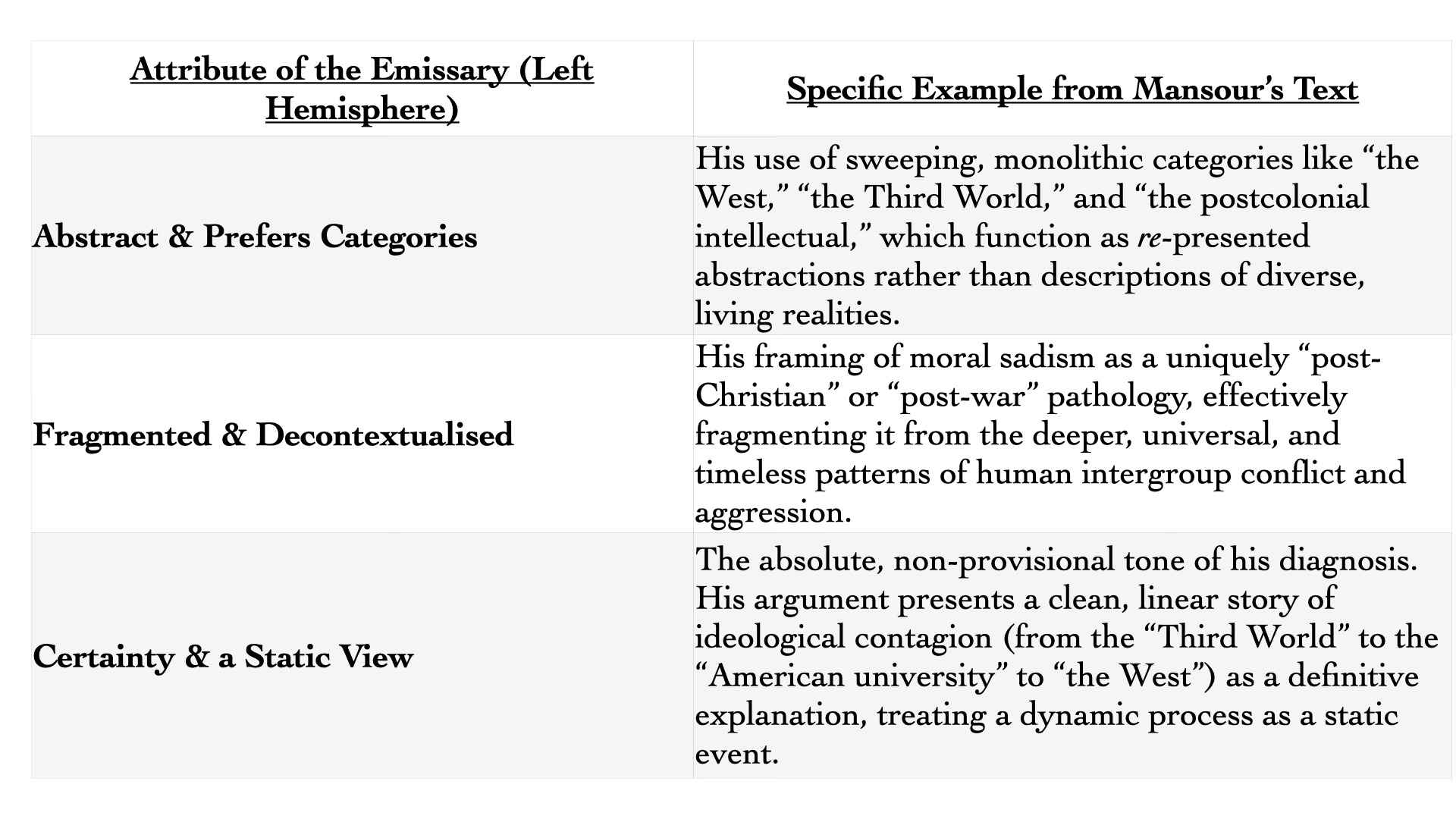
It is paramount to analyse an argument’s cognitive style, not just its content. Using Iain McGilchrist’s model of the Divided Brain, we can distinguish between the holistic, contextual Master (Right Hemisphere) and the abstracting, categorising Emissary (Left Hemisphere). While a healthy intellect integrates both, a state of Left Hemisphere Capture occurs when the Emissary’s simplified map is mistaken for the territory itself. Below, I shall argue that Mansour’s analysis, for all its precision, exhibits the tell-tale signs of this cognitive imbalance.
The World of the Emissary: Certainty, Abstraction, and Division
Mansour’s argument is constructed with the tools of the Emissary, favouring clear categories and linear causality over messy, integrated reality.
What the Master Would See: The Missing Context
A more integrated, Master’s perspective would not necessarily contradict the Emissary’s findings but would situate them within a richer, more embodied context. This holistic view would see less of a new pathology and more of a timeless human capacity for coalitionary proactive aggression (Wrangham) rooted in our constrained human nature (Sowell), now finding a new aesthetic and a new global stage. It would recognise that the desire to de-humanise an out-group and take pleasure in their downfall is a universal human potential, one that has simply found a new aesthetic (Tarantino) and a new delivery mechanism (social media) in our current environment. This perspective would contextualise, rather than simply categorise, the phenomenon.
The Finite Game
Every piece of intellectual production can be analysed as a type of game, with a specific purpose and set of rules. Using James Carse’s distinction between finite games (played to win) and infinite games (played to continue the play), we can diagnose the ultimate purpose of an argument. In this section I shall diagnose Mansour’s text as a move within a finite game—an intellectual performance engineered for definitive victory, not for the perpetuation of inquiry.
Diagnosing the Finite Play
Mansour’s work exhibits the classic features of a finite game, where the primary objective is to bring the intellectual contest to a definitive conclusion.
- The Purpose is to Win. The text’s objective is to win the argument by definitively identifying the “villain” (“postcolonial intellectuals”) and the source of the problem. By providing a clean causal narrative and a final diagnosis, it seeks to end the debate, not to open up new lines of questioning.
- It Plays Within Boundaries. Mansour establishes clear temporal and conceptual boundaries for his game—“our age,” “the post-Christian condition,” “post-war functional nihilism.” These boundaries define the field of play and strategically exclude other, broader historical, biological, or psychological contexts that might complicate his narrative.
- The Rules are Fixed. His analytical framework—tracing the pathology from a specific intellectual source to its current manifestation—operates like a fixed set of rules designed to achieve a predetermined outcome. The framework is not adapted when faced with complexity; rather, complexity is filtered out to fit the rules.
- The Reward is a Title. The implicit reward sought is the “title” of having provided the definitive explanation. Titles, in Carse’s framework, are bestowed by an audience for a past victory. The argument is structured to be recognised as a conclusive intellectual achievement, finalising the past rather than opening the future.
Imagining the Infinite Alternative
An analysis aimed at continuing the play—an infinite game—would differ fundamentally. It would play with boundaries by connecting the phenomenon of moral sadism to broader, trans-historical patterns of human behaviour. It would treat surprises and contradictions not as problems to be solved but as reasons to continue the inquiry. Its goal would not be to achieve the “title” of the final word, but to generate the “strength” to empower further understanding in others. This finite, win-oriented approach may itself be a product of a kind of institutionalised thoughtlessness that even the most critical analyses can fall prey to.
Unexamined Assumptions
Even the most incisive critiques can suffer from their own forms of thoughtlessness. The framework of Functional Stupidity, developed by Mats Alvesson and André Spicer, describes a coordinated lack of critical reflection that, while often functional, can obscure deep-seated risks and assumptions. Below, I shall apply this framework not to an organisation, but to Mansour’s intellectual project itself, to uncover its own unexamined blind spots.
The Three Pillars of Stupidity in Mansour’s Method
Mansour’s argument, despite its intelligence, exhibits the three core pillars of functional stupidity by failing to apply its critical lens to its own foundations.
- Absence of Reflexivity. The analysis lacks reflection on its own position and the sweeping, categorical nature of its claims. Mansour does not appear to question the core assumptions behind framing the issue as a uniquely “post-Christian” problem or as a simple “import” from the “Third World.” These framings are presented as self-evident rather than as contestable narrative choices.
- Absence of Justification. The text suffers from a critical absence of justification for its most provocative claim: why this negative theology originated where he claims it did. He asserts this origin repeatedly but does not provide a rigorous, evidence-based reason for it. Instead, the claim rests on the narrative authority of his telling, a classic case of substituting assertion for justification.
- Absence of Substantive Reasoning. The analysis fails to consider the wider consequences of its own argument. There is a profound irony in a framework that critiques the designation of absolute enemies (“Nazi,” “Zionist”) while simultaneously designating a new, monolithic intellectual enemy: “the postcolonial intellectual.” This new designation could itself be used to license the intellectual dismissal of an entire field of thought, thus replicating the very dynamic it purports to diagnose.
Identifying the Inducer
The primary force driving this lack of reflection appears to be Branding-Induced Stupidity. Mansour has crafted a highly compelling and memorable intellectual “brand” with phrases like “Moral Sadism” and “Imago Nazi.” Like Absolut vodka, which was designed as a “blank bottle-shaped space that could be filled with whatever content a particular audience most wanted,” these powerful phrases are so appealing that they encourage a focus on the brand narrative at the expense of a more nuanced and substantive analysis of the underlying reality. The clarity and power of the brand discourage a deeper look at the messy, contradictory evidence that might undermine it.
A Richer Explanation?
The purpose of my final analytical section is to move beyond critique and construct a more robust, integrated, and grounded explanation of the phenomenon Mansour describes. I shall be using three powerful frameworks to provide the depth and context that Mansour’s account lacks.
The Political Lens
Applying Thomas Sowell’s Conflict of Visions, we can see that Mansour implicitly operates from an Unconstrained Vision of humanity. He presents moral sadism as a novel pathology, a correctable problem caused by a bad ideology (“negative moral theology”) imported from a specific source. This implies that if we could only root out this bad idea, we could solve the problem.
A more robust analysis re-interprets moral sadism through the Constrained Vision. From this perspective, the phenomenon is not a new pathology but a predictable manifestation of humanity’s inherent and fixed limitations—our deep-seated tribalism, egocentrism, and moral fallibility. These timeless traits are simply being amplified and accelerated by new technological and social structures (social media, global interconnectedness). It is not a new disease, but an old one flaring up in a new environment.
The Biological Lens
Richard Wrangham’s framework on the duality of aggression provides a deep biological context that is entirely missing from Mansour’s historical account. Aggression is not monolithic; it comes in two forms: reactive (hot) aggression, which is an impulsive, angry response to a threat, and proactive (cold) aggression, which is premeditated, planned, and instrumental violence used to achieve a goal.
The phenomenon Mansour calls moral sadism is a textbook example of coalitionary proactive aggression. The online mobbing, the coordinated denunciations, and the campaigns to “cancel” designated enemies are not merely spontaneous outbursts of hot anger. They are planned, instrumental, and cold strategies used by coalitions to identify, isolate, and eliminate ideological rivals, thereby enforcing conformity and consolidating power. This behaviour is not a “post-Christian” invention but a core component of human moral evolution. It is the very mechanism our ancestors used to suppress reactively aggressive alpha-male bullies, and it is now re-purposed for the ideological battles of the digital age.
The Linguistic Lens
Finally, we can apply the NLP Meta-Model to Mansour’s own prose to see how his argument is constructed to create an illusion of absolute certainty.
- Universal Quantifiers. His argument is built on words that brook no exception. “The defining trait of our time…,” “the complete functional inversion of moral language…,” and “The entire meaning of Palestine is to negate Zionism.” These quantifiers create a sense of totalising, inescapable truth.
- Complex Equivalencies. He repeatedly links two different ideas to make them mean the same thing, creating a seamless narrative. For example, he states, “The postcolonial ethos is today’s global pedagogy of moral negation,” equating a diverse intellectual tradition with a single, destructive function.
- Nominalisations. He turns dynamic actions and processes into static, monolithic nouns. By referring to “post-war functional nihilism,” he transforms a complex historical and philosophical process into a singular, unchangeable “thing” that can be imported and exported like a commodity.
These frameworks, when combined, offer a far more resilient and deeply grounded explanation—one rooted in cognitive biases, political realities, and evolutionary biology—than a simple narrative of ideological contagion.
From a Finite Diagnosis to an Infinite Inquiry
While Hussein Aboubakr Mansour’s description of “moral sadism” is a valuable and powerful contribution to our understanding of contemporary discourse, his explanation for it is ultimately unsatisfactory. It is the product of a limited cognitive style that prefers abstraction over context, is structured as a finite game designed to win rather than to understand, and suffers from its own unexamined, branding-induced assumptions.
A superior, “hard-to-vary” explanation reveals that this phenomenon is not a novel pathology imported from elsewhere. It is a predictable expression of our species’ fixed moral limitations and unique capacity for coalitionary proactive aggression, now amplified by a globalised, digitally-mediated world that rewards performative cruelty with status and attention.
This multi-lens analysis should serve as a mentoring note. The goal of critical inquiry is not merely to score points in a debate by offering a definitive, winning diagnosis. It is to engage in the relentless, joyful, and infinite work of deepening understanding. By layering multiple frameworks, we move beyond the finite game of blame and enter the infinite game of forging clarity.
If we are to move from denunciation to understanding, trade the champion’s belt for stamina: stop the finite play in which “The Purpose is to Win… [and] The Reward is a Title,” with fixed “boundaries” that filter out awkward contexts; choose the infinite play that keeps questions alive. Shift from Mansour’s unconstrained vision to the constrained: treat the phenomenon as the predictable expression of “coalitionary proactive aggression,” where denunciations and cancellations are “planned, instrumental, and cold” strategies for status and control—not a novel blight imported from elsewhere. Audit the rhetoric that manufactures false certainty: the universal quantifiers (“the defining trait of our time”), the complex equivalences (“the postcolonial ethos is today’s global pedagogy of moral negation”), and the nominalisations (“post‑war functional nihilism”). And resist Branding‑Induced Stupidity: those gleaming bottles—“Moral Sadism,” “Imago Nazi”—that sell speed for thought, while minting a new enemy class (“the postcolonial intellectual”) merely repeats the very liturgy of exclusion the argument condemns. Do this, and you advance, as this essay urges, towards the infinite work of deepening understanding: a harder‑to‑vary, biologically grounded, politically modest, linguistically vigilant account that puts explanation above applause.
References:
Mats Alvesson & André Spicer, 2016, The stupidity paradox: The power and pitfalls of functional stupidity at work. London: PROFILE BOOKS LTD.
James P. Carse, 1986, Finite and Infinite Games: A Vision of Life as Play and Possibility. New York, NY: The Free Press, A Division of Macmillan, Inc..
David Deutsch, 2011, The Beginning of Infinity: Explanations that Transform the World. New York, New York: VIKING (Published by the Penguin Group).
The Duke Report, 20250807, “A User’s Guide to Neuro-Linguistic Defense. Defending Yourself From Word Magic.”

Hussein Aboubakr Mansour, 20251112, “The Age of Moral Sadism Nazis, Tarantino, Israel, Negative Morality, and the Pleasure of Punishment.”

Iain McGilchrist, 2019, The Master and His Emissary: The Divided Brain and the Making of the Western World. New Expanded Edition. New Haven and London: YALE UNIVERSITY PRESS.
—, 2021, The Matter With Things: Our Brains, Our Delusions and the Unmaking of the World. London: Perspectiva Press.
Thomas Sowell, 2007, A conflict of visions: ideological origins of political struggles. New York, NY: Basic Books.


