Releasing Kurdistanî Azad
Kurdistanî Azad is now being released on Substack in five parts.
Instead of publishing the whole work at once, we are opening it gradually, section by section, so readers can enter the argument with care, follow its movement, and decide whether they want to continue the journey with us.
Today, we are sharing the opening materials for free: the Table of Contents, the Authors’ Prologue, the Acknowledgments, and the Abbreviations.
These pages give a sense of the book’s architecture, tone, and purpose. They show what kind of work Kurdistanî Azad is: not only a historical account, but an argument about memory, dignity, self-rule, correction, and the long Kurdish struggle to become politically durable in a world that has repeatedly denied Kurdish freedom.
For readers who are considering subscribing, this first free release is an invitation to look inside before deciding. It shows what the full Substack series will offer: a serious, accessible, and carefully structured exploration of the Kurdish question across history, politics, and lived experience.
The coming parts will move through the larger story of Kurdistanî Azad — from the dream before the states, through betrayal and fragmentation, to the unfinished possibilities of the twenty-first century.
Today, we begin at the beginning.
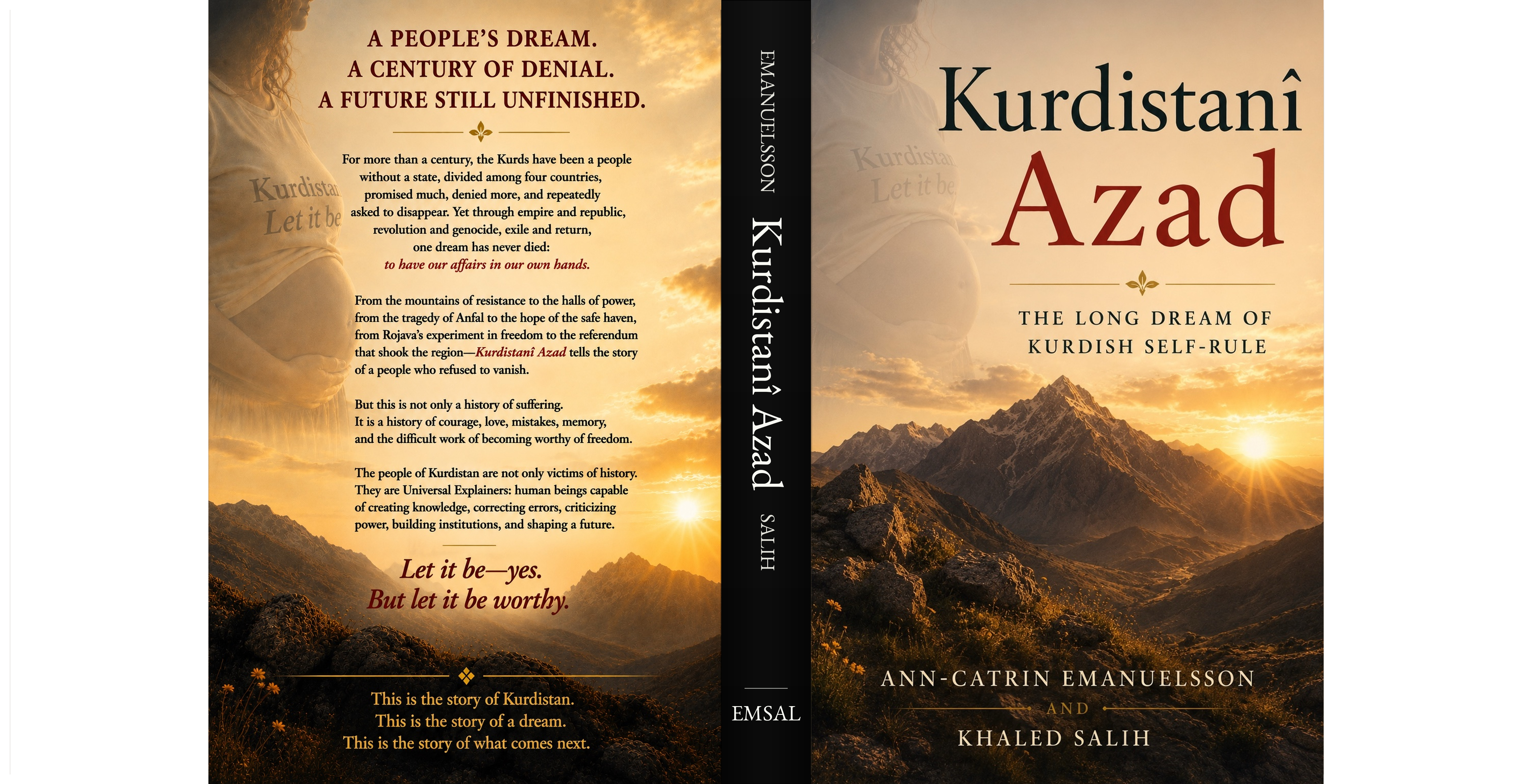
Kurdistanî Azad
The Long Dream of Kurdish Self-Rule
Ann-Catrin Emanuelsson
Khaled Salih
Dedicated to Nêchîrvan Barzanî,
whose love for his people we know,
and to every citizen of Kurdistan who wants the dream to become a home worthy of correction.
Table of Contents
Authors’ Prologue
Acknowledgments
Abbreviations
Part I — The Dream Before the States
Part I Introduction
The Dream Called Kurdistan
Beside the Empires
The Irreversible Passage
Part II — The States Against the Dream
Part II Introduction
In the Name of Civilization
Kings, Mandates, and Broken Promises
Republics, Revolutions, and Traps
Syria: Silence, Denial, and Survival
Part III — The Age of Armed Movements
Part III Introduction
Revolution as a Language of Hope
My Allāh, Your Punishment
The Nightmare
Part IV — The Dream Becomes Government
Part IV Introduction
The Safe Haven
The Kurdish Civil War
A Federal Opening
The Difficult Art of Governing
Part V — The Dream After 2011
Part V Introduction
Rojava and the Syrian Earthquake
ISIS and the Kurdish Moment
A Moment of Dignity and the Punishment of Hope
The Cage Has Adapted
The Dream in the Twenty-First Century
Kurdistan as Warning and Possibility
Recommended Reading
Chronological Glossary of Concepts and Entities
The Partridge of the Peaks
What is its crime, you ask?
Its only crime is that it demanded to live in freedom.
Does the partridge not have the right to exist?
Does it not deserve the beauty of these cliffs and peaks?
Leave it be.
Let it echo its call from the highest summit.
“We are the true rulers of these mountains.”
— Sayid Kamil Imami (Awat)
Kurdish possibility often appears in state weakness.
It narrows, and sometimes disappears, when states recover.
Some errors can be corrected.
Others destroy the conditions of correction.
Some historical moments are not fully reversible.
Some political failures do not merely cause damage;
they close the channel through which repair might have happened.
Authors’ Prologue
Kurdistan — Let It Be
In 1991, while Kurds were fleeing Saddam Hussein’s army into the mountains and toward the Turkish and Iranian borders, we were in London expecting our first child.
We were living inside two histories at once.
One of us, Ann-Catrin, was Swedish, pregnant, carrying new life in her body while watching another people’s catastrophe come closer through love, marriage, politics, and responsibility. The other, Khaled, was Kurdish, carrying the inherited memory of a homeland repeatedly denied, a people repeatedly betrayed, and a dream that had survived empire, state violence, exile, and fear.
The contrast was almost unbearable.
One Kurdish-Swedish life was growing inside Ann-Catrin, protected, hidden, carried with tenderness and expectation. At the same time, hundreds of thousands of Kurdish lives were exposed to cold, hunger, disease, soldiers, closed borders, and the memory of what Saddam Hussein’s state had already done to them.
The Kurds had survived Anfal genocidal campaign. They had survived Helebje. They had survived destroyed villages, chemical weapons, disappearances, mass graves, Arabization, and flight. Now, after the 1991 uprising, they were again moving through mountains, not knowing whether the world would protect them or abandon them once more.
During that stay in London, a gala was arranged in support of Kurdish refugees. We went.
Among the things sold there were T-shirts with a simple sentence printed across them:
Kurdistan — Let it be.
We bought two.
Ann-Catrin put hers on. She was pregnant. Khaled took a photograph of her wearing it, the words stretched across the life we were waiting for. He remembers telling her that one day, if the Kurds survived, this would make a beautiful book cover.
At the time, it was half hope, half defiance.
More than twenty years later, in 2012, that photograph became the cover of our Swedish book, Drömmen om Kurdistan — The Dream of Kurdistan.
The image stayed with us because it said something politics often fails to say. Kurdistan was not only a demand, not only a territory, not only a future state, not only a grievance against history. Kurdistan was unborn life. A possibility carried through fear. A fragile expectation. A responsibility.
The words on the T-shirt were modest:
Let it be.
But perhaps that is where every serious politics of Kurdistan begins.
Let it exist.
Let it live.
Let it speak its name.
Let it breathe.
Let it become a home.
In 2012, when we gave a copy of the Swedish book to the then-Prime Minister of the Kurdistan Region, he asked about the cover photograph. We told him the story.
We told him that our dream of Kurdistan was like delivering life.
During pregnancy, life is real before it is visible to the world. It is loved before it is secure. It is carried in expectation, but also in fear. No parent knows the future. One can hope, prepare, protect, and wait, but one cannot control what life will become.
Birth is even more precarious. The child must leave one protected environment and enter another. The transition is painful, delicate, irreversible. Breath must begin. The body must adapt. The life that was hidden must now survive in the open.
But birth is not completion.
A child who survives delivery must still be raised. It must be fed, protected, educated, corrected, and loved. It must not be treated as property. It must not be neglected by those who waited for it. It must not be sacrificed to the pride, rivalry, or impatience of adults.
So it is with Kurdistan.
The Kurdish dream has often been described through the language of revolution, martyrdom, betrayal, nationalism, self-rule, and statehood. All of those words matter. But they are incomplete unless joined to responsibility.
To dream Kurdistan is one thing.
To fight for Kurdistan is another.
To administer Kurdistan is harder still.
A people that has survived denial must build institutions that do not deny.
A people that has survived erasure must protect memory without imprisoning itself inside grievance.
A people that has survived domination must build institutions that prevent domination from reappearing in Kurdish hands.
A people that has survived betrayal must learn the difficult discipline of trust, law, criticism, and correction.
None of this is easy. A people repeatedly denied normal political development cannot be judged as if it had grown under normal conditions. If advanced states with secure borders, stable institutions, universities, courts, media, and international recognition can still protect error from correction, then Kurds should not be judged without remembering the much harsher conditions under which Kurdish politics had to develop. Kurdish leaders, parties, and movements often acted inside impossible constraints: hostile states, exile, mountain war, assassinations, patronage pressures, foreign manipulation, broken promises, and the memory of annihilation. These pressures do not excuse every error, but they explain why correction was so difficult and why moral judgment must be joined to historical understanding.
This book is about the long Kurdish struggle to place Kurdish affairs in Kurdish hands. But it is not a hymn. It is not propaganda. It is not a demand that history admire Kurds without asking hard questions of Kurdish leaders, parties, movements, and institutions. Its criticism is therefore not a withdrawal of love, but a refusal to let love become blindness.
For that reason, this book tries to distinguish condemnation from correction. It does not treat political errors as if they were always obvious from the beginning, or as if those who made them acted from comfortable conditions. Many Kurdish decisions were made under fear, scarcity, betrayal, exile, war, foreign pressure, and incomplete information. To criticize them seriously is therefore not to stand above them with retrospective certainty, but to ask what assumptions failed, what pressures distorted judgment, what institutions were missing, and how future Kurdish politics can become more corrigible.
This book therefore follows not only events, but explanations. It asks what ideas, categories, institutions, fears, myths, interests, and official vocabularies made those events possible. A border is not only a line. A census is not only a count. A schoolbook is not only a text. A treaty is not only ink on paper. Each can become an instrument through which an invisible explanation enters the visible world. To understand Kurdistan, we must therefore ask not only what happened, but what explanation made it appear necessary, lawful, civilized, revolutionary, religious, or unavoidable.
A note on “the state”
Throughout this book, we often use the phrase “the state” as analytical shorthand.
We do not mean that the state is a mystical organism, an independent mind, or a self-conscious actor floating above human beings. States do not think, fear, punish, censor, deport, assimilate, bomb, negotiate, betray, or repent, other than through the people and institutions which constitute them.
When this book says that “the state punished,” “the state denied,” “the state assimilated,” or “the state suppressed Kurdish self-rule,” it refers to concrete configurations of organized power: rulers, governments, parties, kings, presidents, ministers, parliaments, courts, bureaucracies, police, intelligence services, military commands, clerical establishments, schools, settlement authorities, and institutional networks that control or capture the machinery of rule.
This clarification matters because Kurdish history has often been shaped by institutions powerful enough to make domination appear impersonal. A village is renamed. A language is banned. A census removes citizenship. A court condemns a leader. A school teaches a child to forget. A military command empties a valley. A ministry withholds salaries. A party captures a parliament. A security service silences criticism.
None of this happens by magic. It is done by human beings acting through institutions.
So when we write “the state,” we mean organized power — not an innocent abstraction, and not a supernatural actor. The word is shorthand for the people, offices, laws, weapons, procedures, and official stories through which rule is exercised.
A note on patterns
This book follows events chronologically, but it is not only a chronology. It is also a study of recurring patterns.
Again and again, Kurdish possibility appears when surrounding states weaken, fracture, lose legitimacy, or come under outside pressure. Again and again, that possibility narrows, and sometimes disappears, when those states recover, consolidate, and regain international recognition.
Again and again, Kurdish demands are renamed by others: self-rule becomes rebellion, autonomy becomes separatism, language becomes danger, survival becomes security threat, and appeals for protection become foreign interference.
This is why naming is never neutral. A good explanation makes reality clearer and exposes itself to correction. A bad explanation protects power by changing the name of the problem. If Kurdish self-rule is called rebellion before its claim is examined, the state no longer has to answer the demand; it only has to restore order. If language is called danger, the child’s mother tongue can be treated as a security issue. If survival is called separatism, protection can be redescribed as threat. Much of Kurdish history turns on this struggle over explanation.
Again and again, outside powers discover the Kurds in moments of crisis, praise their courage, use their geography or fighters, then hesitate when Kurdish demands require enforceable guarantees.
Again and again, Kurdish plurality becomes Kurdish vulnerability when parties, regions, tribes, ideologies, or external patrons divide what history has already divided.
And again and again, the Kurdish dream survives — but survival is not enough.
The patterns followed in this book are therefore not only patterns of oppression. They are also patterns of agency, misjudgment, endurance, recovery, and responsibility. The Kurds have not merely suffered history. They have acted inside it. They have negotiated, rebelled, fought, governed, erred, rebuilt, and returned to the same question in different forms:
Who has the right to decide Kurdish affairs?
The answer, if it is to mean anything, cannot end with a flag or a slogan. It must end with institutions, law, criticism, memory, dignity, and a home.
A home is also an act of transmission. It is not inherited the way land is inherited. It must be re-understood, re-argued, re-taught, reformed, and re-earned. Language does not preserve itself. Memory does not defend itself. Institutions do not remember their purpose by magic. A people that has survived denial must not only tell its children what was done to them; it must teach them how to continue the argument, improve the inheritance, and correct what their parents could not correct.
We write from two positions joined by one life.
That double position — intimate and analytical, Kurdish and Swedish, wounded and comparative — also shapes how we understand error.
There is another pattern beneath these patterns: the difference between error and irretrievability. Some errors can be corrected. Others destroy the conditions of correction. Some historical moments are not fully reversible. Some political failures do not merely cause damage; they close the channel through which repair might have happened. Much of modern Kurdish history has been shaped by this second kind of error. A border is drawn, and then sovereignty protects it. A language is banned, and then a generation loses public words. A census removes citizenship, and then the erased person must appeal to the very machinery that erased them. A party captures institutions, and then the instruments of correction become instruments of possession. This book follows not only the injuries done to Kurds, but also the struggle to keep open the channels through which history can still be corrected.
The analysis therefore works on two levels. The first is external: states have repeatedly prevented Kurds from correcting state-errors — imposed borders, denied names, banned languages, erased citizenship, broken self-rule promises, militarized geography, and official histories that made Kurdish correction appear as rebellion. The second is internal: Kurdish actors themselves must not disable correction inside Kurdish life. A party, leader, armed movement, ministry, security service, family, tribe, or national myth can also close the Backspace Key when it treats criticism as betrayal. The Kurdish struggle is therefore not only the struggle to correct the errors imposed by others. It is also the struggle to build Kurdish institutions that actively invite correction before Kurdish errors become another form of fate.
One of us came to Kurdistan from Sweden, through love, marriage, solidarity, research, and decades of shared responsibility. The other was born into the Kurdish condition, with its language, wounds, hopes, disappointments, and obligations. Between us stand two sons, a family, a book, and a question neither of us could escape:
What does it mean for Kurdistan not only to survive, but to become a home?
A home, in this book, is not only land or shelter. It is a place where language, memory, law, criticism, safety, and belonging can live together without requiring silence.
A book worthy of Kurdistan must love Kurdistan enough to be honest with Kurdistan.
The dream is real.
The suffering is real.
The agency is real.
The mistakes are real.
The responsibility is real.
In Kurdish, Azad means free. The title of this book, Kurdistanî Azad, means Free Kurdistan. It also carries another meaning that will appear in the pages that follow: Kurdistan, daughter of Azad.
The old T-shirt said:
Kurdistan — Let it be.
This book asks what must follow.
If Kurdistan is allowed to be, what must it become?
This is a demanding standard, especially for a people forced to build political life under abnormal pressure, but any weaker standard would betray the dream itself.
The answer offered in this book must also remain criticizable. If Kurdish self-rule produced only another closed hierarchy, another official memory immune from evidence, another party-state, another silencing of women, minorities, journalists, teachers, or dissenters, then the dream would not yet have become free. It would have changed hands without changing its deepest structure. The test is not whether Kurdistan can raise a flag. The test is whether Kurdistan can build institutions that allow its own errors to be found and corrected.
A free Kurdistan would therefore not be a place without error, but a place where error can be named, tested, criticized, and repaired without fear.
Freedom, in this sense, is measured by what remains possible. Can the child learn the language? Can the citizen criticize the party? Can the journalist expose mismanagement? Can the woman refuse inherited authority? Can the court correct power? Can the people revise the institutions built in their name? A Kurdistan that cannot make these acts possible may possess symbols of freedom, but not yet the structure of freedom.
Kurdistan is therefore not only the dream of a people escaping domination by others. It is the harder dream of a people building institutions that do not dominate in their own name. Kurdistan becomes free only when the dream becomes a home, and the home keeps its Backspace Key.
The movement of this book is therefore:
denied people → survival → armed visibility → government → internal correction → home.
Conceptual Waymark
Key Terms in This Section
• Kurdistan — Let it be
• Kurdistanî Azad
• Dream as responsibility
• Condemnation vs correction
• Backspace Key
• External correction
• Internal correction
• Home
• Institutions worthy of the dream
Meaning in This Section
The prologue introduces Kurdistan not first as a map, border, party, or slogan, but as life carried through danger: a child, a family memory, a T-shirt, and a demand that a people be allowed to exist. The phrase Kurdistanî Azad means both Free Kurdistan and Kurdistan, daughter of Azad. This double meaning turns the Kurdish question into a moral test: if Kurdistan is allowed to be, what must it become?
Correction Test
The prologue distinguishes condemnation from correction. It asks the reader to judge Kurdish politics neither with contempt nor with romantic innocence, but by asking what assumptions failed, what pressures distorted judgment, what institutions were missing, and how future Kurdish life can become more corrigible.
Section Summary
The book begins from love, but refuses propaganda. It argues that Kurdish self-rule must correct two kinds of error: external errors imposed by states, borders, denial, and broken promises; and internal errors produced when Kurdish parties, leaders, institutions, families, or myths treat criticism as betrayal. The dream is real, but it becomes free only when it becomes a home with institutions capable of finding and correcting their own errors.
Acknowledgments
This book was written by two authors, but it was carried by many lives.
We first want to thank our family. Kurdistan has never been only a subject of research for us. It has entered our home, our marriage, our children, our conversations, our silences, and our sense of responsibility. The story with which this book begins — London in 1991, a pregnant mother, Kurdish refugees in the mountains, and a T-shirt saying Kurdistan — Let it be — belongs to our family’s memory. It also belongs to the wider Kurdish story: the fragile passage from survival to life, from longing to responsibility, from dream to home.
We thank the Kurdish people whose lives, wounds, courage, mistakes, songs, graves, laughter, stubbornness, and dignity form the deeper ground of this book. We have written about leaders, parties, states, movements, wars, treaties, betrayals, and institutions, but beneath all of them stand ordinary people: mothers who kept language alive, fathers who carried memory, children who learned exile before home, villagers who returned to destroyed places, Pêşmerge who faced death, refugees who rebuilt life, women who refused silence, journalists who asked dangerous questions, teachers who preserved words, and young people who still ask whether Kurdistan can become worthy of their future.
We thank those who have read parts of this manuscript, challenged us, encouraged us, corrected us, and helped us keep the book honest. A book about Kurdistan must not become a hymn. It must be written with love, but also with discipline. It must honor suffering without turning suffering into innocence. It must defend Kurdish self-rule without excusing Kurdish power from criticism. It must also remember that Kurdish errors were often made under pressures no normal political community should have had to bear. Those who pushed us to remain balanced, precise, and courageous helped strengthen the book.
We are especially grateful to friends and specialists who helped us think through the historical, political, and moral architecture of the manuscript. Their comments, questions, doubts, and objections reminded us that serious writing is itself a form of correction. We have tried to let criticism improve the book without letting it weaken the love from which the book was written. Any remaining errors, omissions, judgments, or imbalances are ours.
We thank Xanî Hejar for bringing “The Partridge of the Peaks,” by Sayid Kamil Imami (Awat), back to our attention at exactly the right moment. The partridge, hunted because it wants to live freely in its own mountains, speaks to the symbolic heart of this book. Its presence at the beginning of the manuscript gives the reader not an argument first, but a voice, a bird, a mountain, and a cry for freedom.
We also acknowledge the scholars, historians, journalists, human rights researchers, witnesses, survivors, poets, and archivists whose work made this book possible. Kurdish history has often survived because someone wrote down what power wanted forgotten. Reports, testimonies, memoirs, court documents, poems, songs, interviews, photographs, and memories have preserved what states tried to erase. We have relied on that labor with gratitude and humility.
Finally, we thank those who still believe that Kurdistan must be more than a flag, more than a party, more than a border, and more than a memory of suffering. The dream of Kurdistanî Azad belongs to every individual whose life is tied to this land and its future — beyond party, ideology, religion, ethnicity, tribe, or state. It belongs to those who want a home capable of correction: a place where persons are protected, systems can be criticized, organizations can be tested, and no ruler, doctrine, or party is allowed to become larger than the human being.
This book is offered in that spirit.
Kurdistan — let it be.
And if it is allowed to be, let it become protected, corrected, loved, and worthy of those who dreamed it.
Conceptual Waymark
Key Terms in This Section
• Gratitude
• Witnesses
• Memory work
• Love with discipline
• Correction through criticism
• Persons and systems
• Home capable of correction
• Kurdistan beyond party
Meaning in This Section
The acknowledgments place the book inside a community of family, readers, witnesses, scholars, poets, archivists, survivors, and ordinary Kurds whose lives carry the deeper history. Gratitude here is not decorative. It names the human labor that keeps memory alive when power tries to erase it.
Correction Test
This section asks whether love for Kurdistan can remain disciplined enough to accept criticism. A book about self-rule must protect persons while still allowing leaders, parties, states, movements, institutions, and inherited explanations to be tested.
Section Summary
The acknowledgments thank those who carried the book, but they also clarify the spirit in which it is offered. Kurdistan must be more than a flag, party, border, or memory of suffering. It must become a home where persons are protected, systems can be criticized, and no ruler, doctrine, or party becomes larger than the human being.
Abbreviations
CUP — Committee of Union and Progress; Young Turk ruling organization in the late Ottoman period.
RAF — Royal Air Force; British air force used in Iraq’s “air control” policy.
KDPI — Democratic Party of Kurdistan in Iran; party rooted in the Mehabad legacy, demanding self-rule and democracy.
KDP — Kurdistan Democratic Party; Iraqi Kurdish party associated with Mustafa Barzani and Barzani-led Kurdish nationalism.
PUK — Patriotic Union of Kurdistan; Iraqi Kurdish party founded by Jalal Talabani and others in 1975.
PKK — Kurdistan Workers’ Party; Kurdish movement founded under Abdullah Öcalan, originally Marxist-Leninist, launched armed struggle against Turkey in 1984.
KRG — Kurdistan Regional Government; governing authority of the Kurdistan Region of Iraq.
PYD — Democratic Union Party; main Kurdish political force in Rojava, linked ideologically to the Öcalan/PKK tradition.
YPG — People’s Protection Units; main Kurdish armed force in Rojava.
YPJ — Women’s Protection Units; all-female Kurdish armed force in Rojava.
KNC / ENKS — Kurdish National Council; coalition of Syrian Kurdish parties often critical of PYD dominance.
ISIS / IS — Islamic State; jihādist organization that seized large territories in Iraq and Syria.
SDF — Syrian Democratic Forces; multiethnic, Kurdish-led military umbrella created in 2015 to fight ISIS.
IRGC — Islamic Revolutionary Guard Corps; Iranian state military-security institution central to repression and regional power.
PMF / Hashd al-Shaabi — Popular Mobilization Forces; Iraqi militia umbrella, some factions Iran-backed, important after 2014 and in the 2017 Kirkuk crisis.
CPA — Coalition Provisional Authority; U.S.-led transitional authority in Iraq after 2003.
IGC — Iraqi Governing Council; interim Iraqi governing body after Saddam’s fall.
TAL — Transitional Administrative Law; interim constitutional framework before Iraq’s 2005 constitution.
HRW — Human Rights Watch; human rights organization documenting Anfal, Kurdish repression, and later abuses.
UN — United Nations; relevant to mandates, humanitarian crises, minority rights, and postwar international order.
UNDP — United Nations Development Programme; appears in development/governance contexts.
OSCE — Organization for Security and Co-operation in Europe; relevant to European security/human-rights frameworks.
U.S. / United States — United States; major external power in 1991 safe haven, 2003 Iraq, anti-ISIS war, and Rojava/SDF partnership.
EU / EC — European Union / European Community; relevant to diplomacy, diaspora, human rights, and Turkey-Europe relations.


