Reconstructing beginnings of early islām, muḥmmad, and the qur’ān
By Khaled Salih
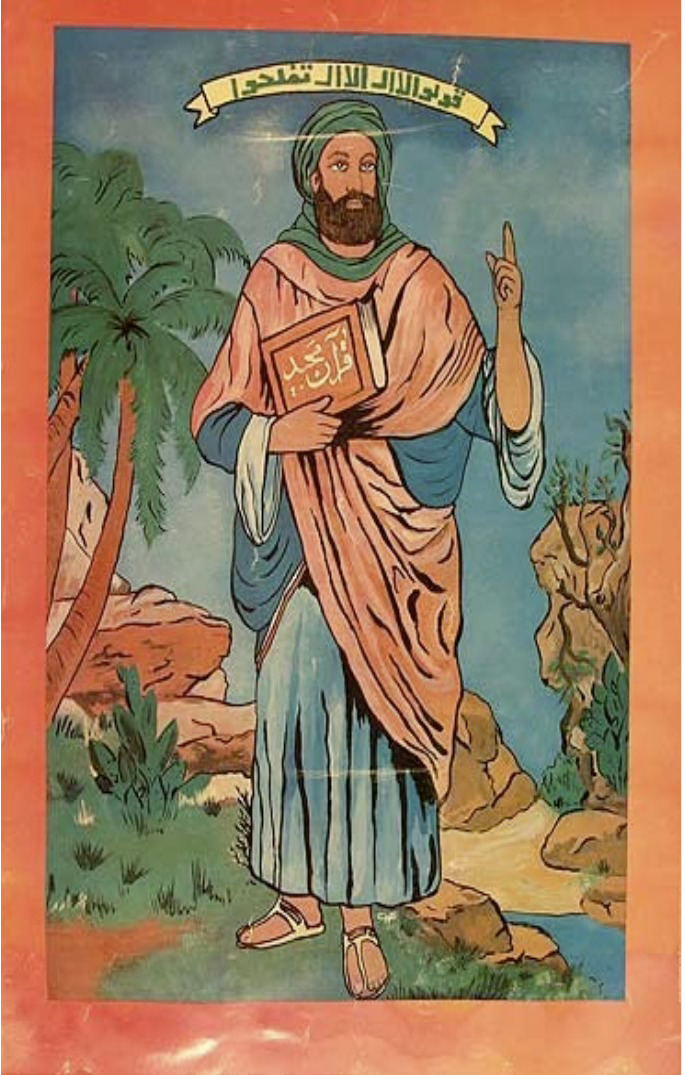
Source: Inârah
Nothing, of course, begins at the time you think it did.
—Lillian Hellman [Quoted by Neil Shubin]
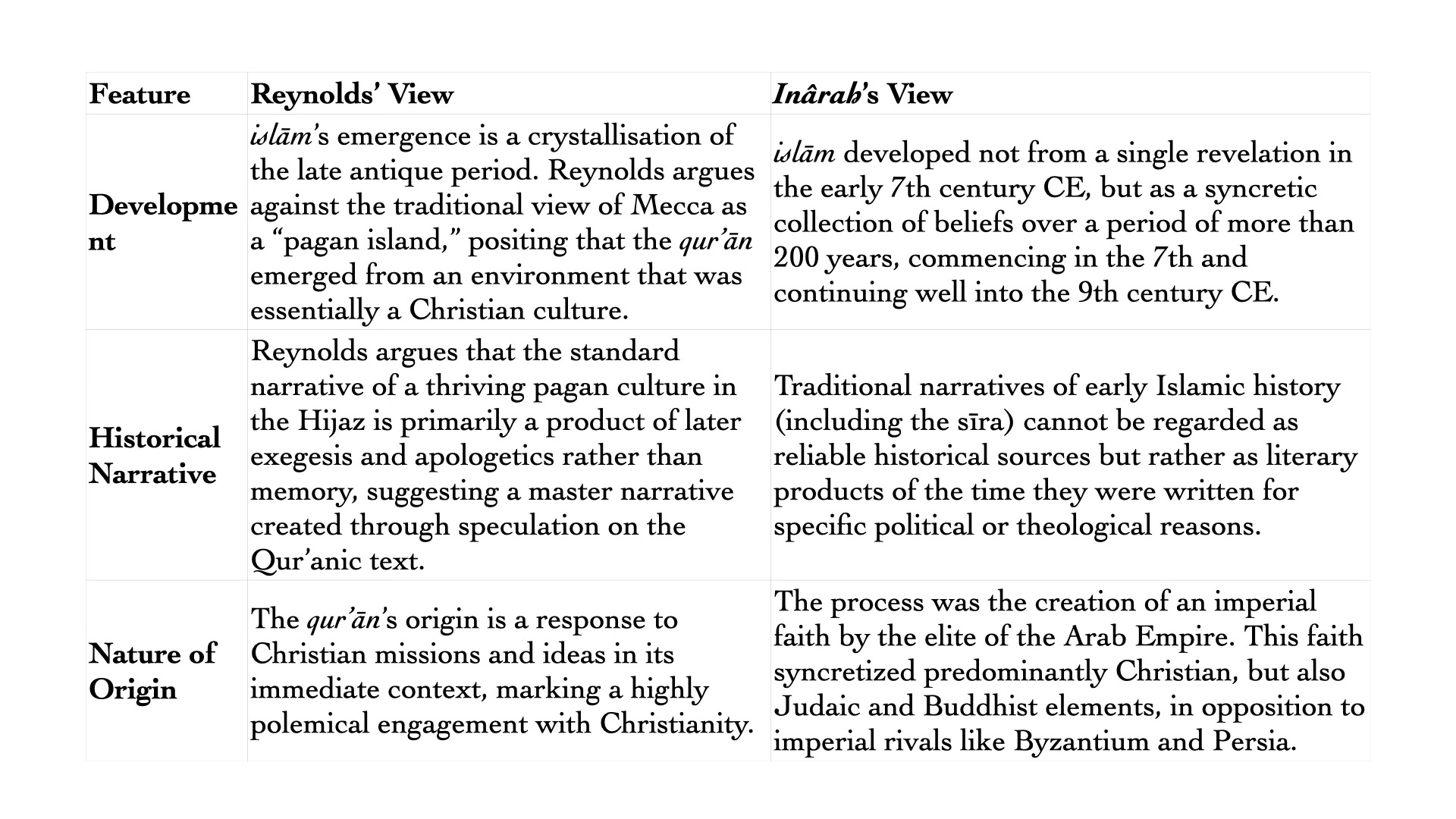
The study of Islamic origins has generated a wide range of historical-critical approaches, reflecting both the complexity of the sources and the contested nature of their interpretation. Among these, the perspectives of Gabriel Said Reynolds (see my book review here) and the Inârah, The European Institute for Islamic Research in Germany, stand out for the clarity with which they exemplify two distinct currents of revisionist scholarship. Reynolds situates the qur’ān within the broader religious and intellectual world of late antiquity, emphasizing its engagement with Christian traditions and polemics, while at the same time retaining the assumption of a historical muḥmmad. Inârah, by contrast, advances a more radical skepticism, rejecting the historical reliability of early Islamic narratives and proposing instead a long chronology in which both the figure of muḥmmad and the qur’ān’s muslim identity emerged only gradually from earlier Christian textual and liturgical materials.
Origins
1. Origins and chronology of islām
2. Origins of muḥmmad
The views on the figure of muḥmmad present the starkest contrast between the two approaches:
The research from Inârah (rooted in radiation skepticism) concludes that the traditional figure of the muḥmmad is unhistorical.
• The name muḥmmad (or mḥmṭ/mḥmd) originally did not designate a person but rather a Christological predicate.
• The term was later personified and “biographisised” (similar to how Homer was invented as the author of the Iliad and Odyssey) to grant the qur’ān authority.
• Inârah researchers hold that the supposed contemporary literary attestations of muḥmmad, muslim, or islām from the 7th and 8th centuries do not refer to an Arab prophet or followers of a new religion.
• The life story recounted in tradition is largely based on the life of Abū Muslim, and the genealogy of the prophet and his tribe, the quraysh, is unhistorical.
• Specific attestations of mḥmd or aḥmad in the qur’ān are likely later interpolations, supported by an examination of their context and content.
Reynolds, working within the premise of an historical figure (redactional context), accepts muḥmmad, though he heavily qualifies the traditional biographical accounts:
• Reynolds assumes the existence of an historical figure, muḥmmad, who proclaimed messages about allāh and himself.
• He views muḥmmad as a new messenger and prophet whose personal status is central to the Qur’anic argument. The qur’ān portrays muḥmmad as the culmination of biblical salvation history, whom Jesus announced as “good tidings.”
• Reynolds notes the use of the term ummi (prophet of the common folk, or gentile prophet) in the qur’ān, implying he was sent to those without a prior scripture in their language (Arabs/gentiles), distinguishing him from the ahl al-kitāb (people of the book).
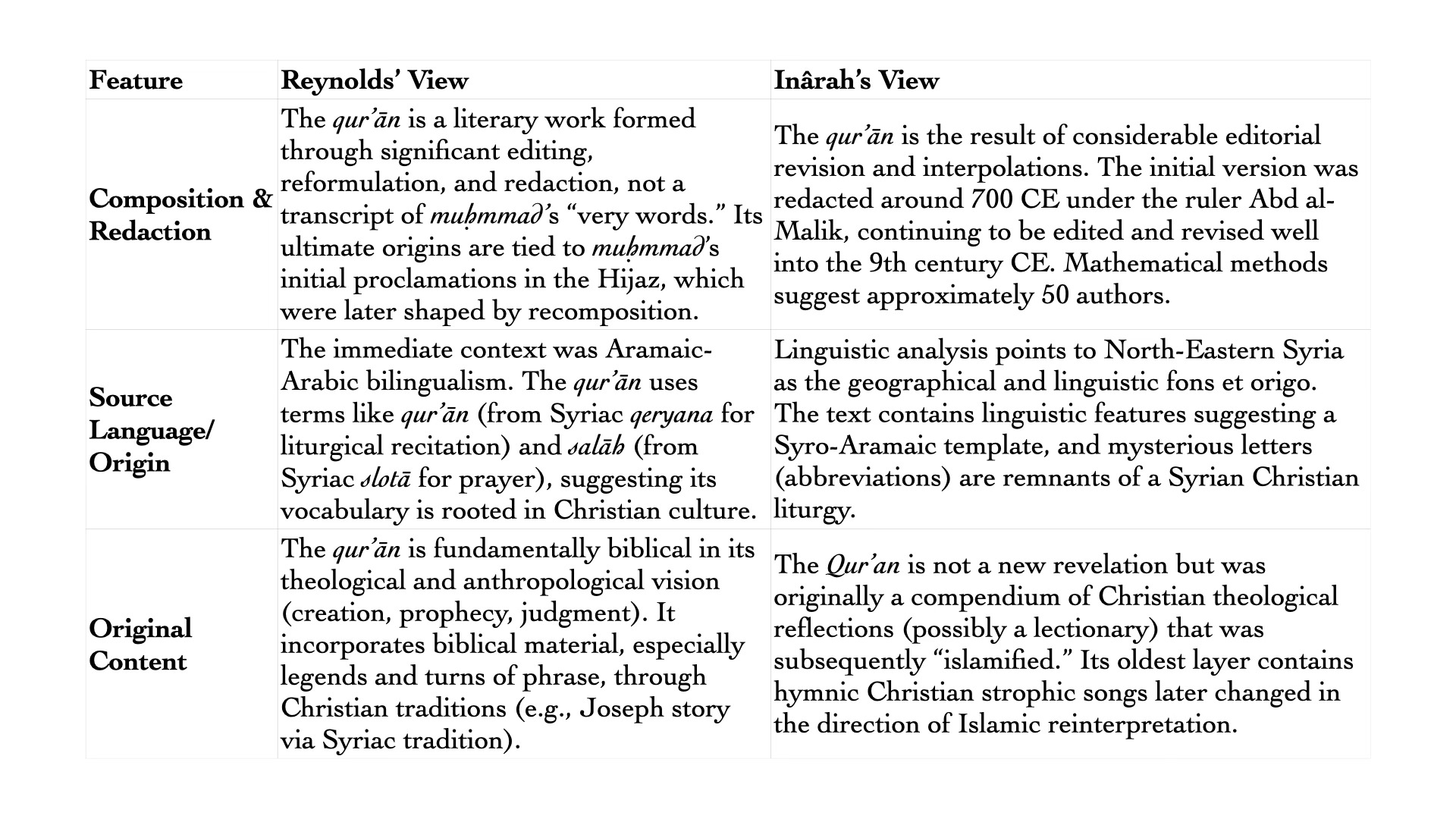
3. Origins and nature of the qur’ān
Reynolds’ omissions and different focus compared to Inârah
While Reynolds provides a strong argument for deep Christian influence and a polemical relationship in a contemporary milieu, his analysis omits, misses, or ignores several core, radical claims central to Inârah’s findings, thereby illustrating fundamentally different scholarly approaches to critical studies:
1. Absence of radical chronology and geography
Reynolds focuses on demonstrating that the qur’ān reflects an early, immediate (Hijazi) context marked by Christians, opposing traditional narratives that place Christian influence far afield in Syria or through rare travellers.
• Inârah’s North-Eastern Syria thesis: Reynolds does not incorporate or engage with Inârah’s conclusion, drawn from dialect and script geography, that the qur’ān’s linguistic and script fons et origo is definitively North-Eastern Syria. Reynolds’ work supports Aramaic/Syriac influence near the Hijaz, but maintains the Hijaz context.
• Late Abbasid chronology: Reynolds discusses the importance of redaction but generally works with an early dating reflecting the Hijaz context. He does not delve into the extensive later editorial stages detailed by Inârah, such as the initial redaction under Abd al-Malik around 700 CE or continued editing under Abbasid rule from 750 to at least 820 CE.
2. Omission of non-prophetic authorship
Reynolds’ methodology, which acknowledges significant redaction but maintains the premise of an historical muḥmmad, necessarily ignores Inârah’s most radical conclusions regarding the text’s authorship.
• Multiple authorship: Reynolds does not address the claim, supported by mathematical methods utilised by an Inârah researcher, that the qur’ān must have had about 50 authors.
• Christological predicate: Reynolds overlooks the specific Inârah argument that the name muḥmmad was merely a Christological predicate later personified to grant the text authority. For Reynolds, muḥmmad is a crucial historical figure articulating the new religion.
3. Lack of focus on earlier purely Christian textual layer
While Reynolds stresses that the qur’ān is deeply indebted to Christian vocabulary (like qur’ān and salāh) and legends (Seven Sleepers, Joseph) transmitted through Christian channels, he characterises the qur’ān as a polemical rival offering a fundamentally new message.
• Reynolds does not discuss the Inârah finding that the qur’ān’s oldest layer (about one third of the text) contained hymnic Christian strophic songs whose structure and meaning were later changed through Islamic reinterpretation.
• Reynolds views the qur’ān as a syncretistic work that appropriates the biblical tradition for its own theological frame. In contrast, Inârah views the qur’ān as a compilation that was explicitly Christian in its original form (a compendium of reflections or a lectionary) before being islamified.
In sum, Reynolds performs a thorough textual analysis demonstrating the overwhelming Christian cultural and linguistic context of the qur’ān, concluding that the text is best understood as a polemical, supersessionist argument crafted in Arabic for a Christianised audience. Inârah, starting from a similar historical-critical premise, arrives at far more extended conclusions, positing a wholesale historical and theological fictionalisation of the muḥmmad and the qur’ān‘s origins over two centuries, relocating its genesis to North-Eastern Syria, and identifying the source text as originally Christian, thus implying a complete break from traditional history that Reynolds’ work does not attempt.
The juxtaposition of Reynolds’ and Inârah’s scholarship demonstrates the diversity of approaches within contemporary revisionist studies of islām. While both reject traditional historiography in its received form, they do so in strikingly different ways. Reynolds maintains the centrality of muḥmmad as a historical figure and situates the qur’ān within the intellectual currents of late antiquity, framing it as a polemical text that nonetheless marks the emergence of a distinct religious movement. Inârah, on the other hand, calls into question not only the received biography of Muḥammad but the very foundations of Islamic chronology, treating the qur’ān as a product of extended redactional processes rooted in Christian liturgy and theology. These contrasting perspectives illustrate how muḥmmad presuppositions, whether privileging continuity with a historical core or radical skepticism toward the sources, profoundly shape the narratives scholars construct about Islam’s beginnings.
Taken together, these approaches highlight both the promise and the difficulty of reconstructing early Islamic history. The paucity of contemporary evidence, the theological agendas of later sources, and the complexities of textual transmission all ensure that the origins of islām will remain a subject of debate. Yet it is precisely in this tension between moderate and radical revisionism that scholarship advances, testing the limits of what can be known and refining the tools with which historians approach the past. By considering Reynolds and Inârah side by side, the present study underscores the necessity of engaging multiple perspectives, not to arrive at definitive answers, but to better understand the range of plausible interpretations and the methodological challenges that underlie them. In this way, the comparison contributes to a broader reflection on how religious traditions are constructed, remembered, and critically examined in the modern academy.
Sources:
Inârah, 2022. Introducing Inârah. The European Institute for Islamic Research. https://inarah.net/publications
Robert M. Kerr, 20241002, “What do the Inarah scholars know concerning the qur’an’s creation.” www.youtube.com/watch?v=Nh-OAXfz4y4
Gabriel Said Reynolds, 2025, Christianity and the Qur’an: The Rise of Islam in Christian Arabia. Yale University Press, New Haven & London.
Khaled Salih, 20250902, “Shattering the pagan Mecca myth: Islam’s Christian context.” https://khaledsalih.substack.com/p/shattering-the-pagan-mecca-myth-islams &
Neil Shubin, 2020, Some Assembly Required: Decoding Four Billion Years of Life, from Ancient Fossils to DNA. Pantheon Books, a division of Penguin Random House: New York, NY.


