Protect the Person, Criticize the Doctrine
17 May 2026
Why the Open Society Must Defend Muslims as Persons While Keeping islām Open to Rational Discussion
This is the third essay in my series on the ideas behind my upcoming book When Parochial Error Goes Global. The first essay describe how a Levantine matrix went global and how a parochial error learned to travel. The second essay applied the principle of no error is final to my own manuscript and showed how the book itself had to change through criticism.
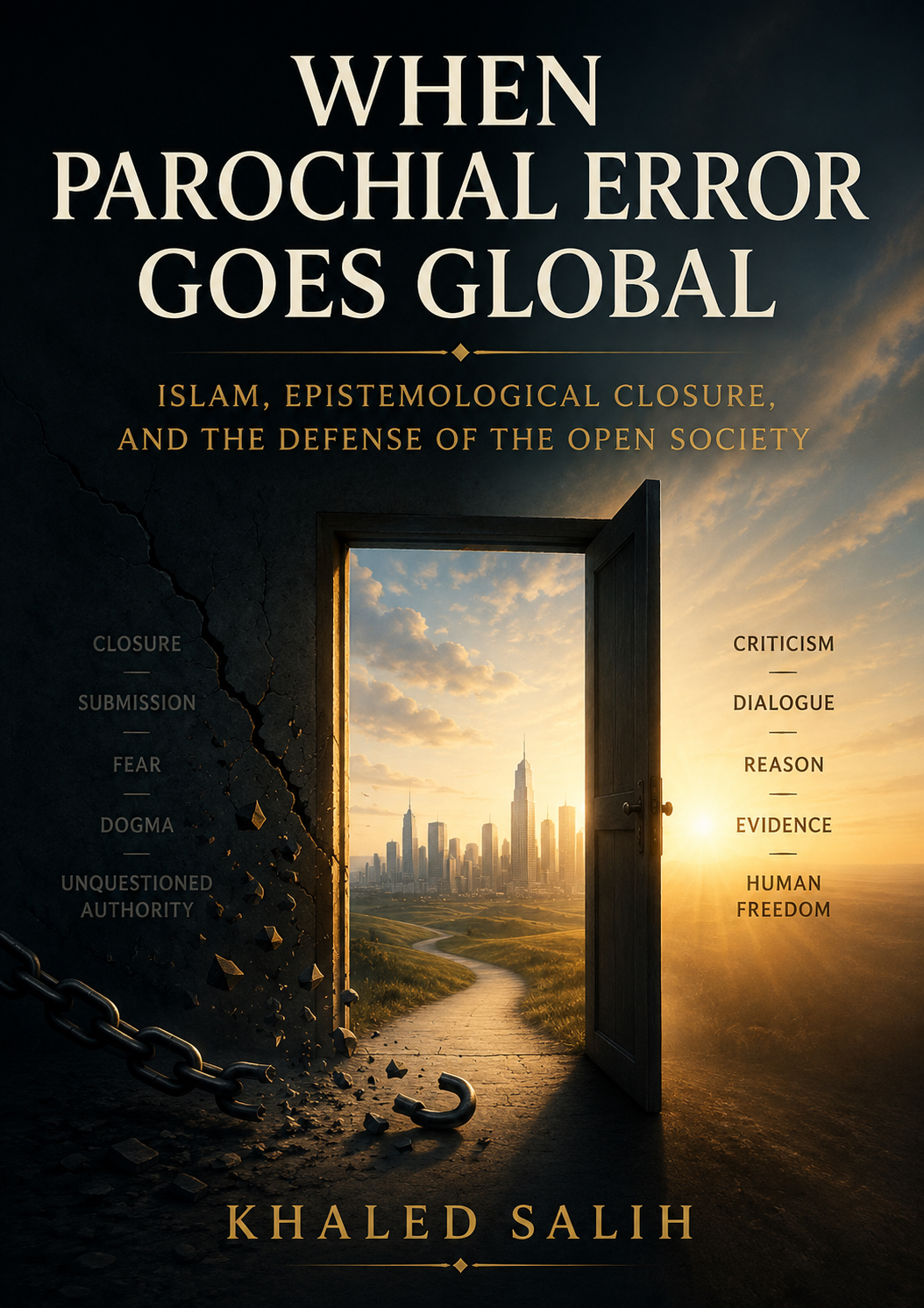
This third essay establishes the moral firewall before the harder material arrives: the person must be protected absolutely, precisely so that doctrines, organizations, and systems of authority can remain open to rational examination.
There is a distinction without which no honest discussion of islām, the Open Society, or religious criticism can survive.
It is simple. It is difficult.
And it must be repeated until it becomes impossible to miss:
The Muslim is the person.
The doctrine is not the human being.
The organization is not the individual.
This distinction is the moral and intellectual foundation of my book, When Parochial Error Goes Global: Islam, Epistemological Closure, and the Defense of the Open Society. Without it, the entire argument would collapse into one of the two errors that dominate our age.
One error says: because Muslims are human beings who must be protected from hatred, islām must be protected from criticism.
The other error says: because islām must be criticized, Muslims may be treated with suspicion, contempt, or collective blame.
Both are wrong. Both confuse the person with the doctrine. Both make the same category error from opposite directions.
The Open Society requires a harder discipline: protect the human being absolutely, and keep systems of ideas permanently open to criticism, inquiry, moral evaluation, historical examination, and rational discussion.
Popper defended democracy not because voters are always wise, but because democracy allows bad rulers to be removed without bloodshed. The same principle applies to doctrines. Free criticism matters not because critics are always right, but because it allows bad explanations to lose power without violence.
The Open Society does not abolish error. It gives error a peaceful exit.
By criticism I do not mean hostility, contempt, or the pleasure of attack. I mean the disciplined practice of testing claims, asking for reasons, examining consequences, comparing explanations, exposing authority to questions, and allowing bad ideas to lose power without violence. In this sense, criticism is not the opposite of rational discussion. It is one of its necessary forms. A society that cannot criticize cannot truly discuss, because discussion without the possibility of correction becomes politeness around protected error.
Anti-Muslim hatred is real
Anti-Muslim hatred exists.
It is ugly. It is morally indefensible. It treats individuals as representatives of a collective threat. It looks at a name, a face, a family, a mosque, a headscarf, an accent, or a background and sees not a person, but an enemy category.
That must be rejected without hesitation.
No Muslim child should be made responsible for a doctrine they did not choose. No Muslim family should be treated as a security problem merely because they are Muslim. No believer should be harassed, humiliated, or denied ordinary civil dignity. No person should be reduced to a suspicion because of ancestry, culture, clothing, name, language, or inherited religion.
The Open Society must protect Muslims as persons.
Not reluctantly. Not conditionally. Not only when they are liberal. Not only when they are secular. Not only when they reassure the majority.
Muslims are human beings. They possess conscience, agency, memory, fear, love, contradiction, intelligence, creativity, moral struggle, and the capacity for change. In David Deutsch’s language, they are Universal Explainers: beings capable of creating explanatory knowledge, criticizing inherited ideas, and correcting errors.
That is where any serious analysis must begin.
The person comes first.
But doctrines are not persons
A doctrine is not a person. A scripture is not a person. A legal tradition is not a person. A religious movement is not a person. An organization is not a person. A sacred history is not a person. A blasphemy norm is not a person. An apostasy rule is not a person. A gender code is not a person. A political-theological project is not a person.
These are systems of ideas, institutions, incentives, prohibitions, narratives, commands, punishments, loyalties, memories, and boundaries. They are not entitled to the moral protection owed to human beings.
They may be examined. They may be historicized. They may be criticized. They may be satirized. They may be rejected. They may be compared. They may be tested. They may be found wanting.
The right to criticize doctrines is not a threat to the Open Society. It is one of the conditions of the Open Society.
If ideas cannot be criticized because people identify with them, then no idea can be criticized. Every doctrine can hide behind the feelings of its adherents. Every ideology can present scrutiny as injury. Every institution can turn moral discomfort into immunity.
That is how criticism dies.
And when criticism dies, bad explanations stop dying in our place.
The person is not the error. The error must be allowed to die. That is the moral architecture of criticism.
The “islāmophobia” category error
The word “islāmophobia” often performs two very different functions.
Sometimes it names something real: anti-Muslim bigotry, harassment, prejudice, discrimination, hatred, or collective suspicion directed at Muslims as people.
That should be opposed.
But sometimes the same word is used to shut down rational discussion of islām as a doctrine, islāmic law as a system, islāmist movements as political projects, or islāmic institutions as structures of authority. It is used not only against hatred, but against inquiry, comparison, moral evaluation, historical criticism, satire, and the testimony of dissenters.
That is the category error.
It fuses the person with the system.
It says, implicitly:
To criticize islām is to attack Muslims.
To criticize islāmic doctrine is to endanger Muslim persons.
To question religious authority is to participate in hatred.
To analyze a closed system is to harm a minority.
This is false.
Worse, it is dangerous.
Because once criticism of doctrine is treated as hatred of people, the people most abandoned are often those inside the system: secular Muslims, liberal Muslims, ex-Muslims, reformers, doubters, women resisting compulsory piety, converts out of islām, artists, teachers, writers, and dissidents.
They are the first to need the distinction.
They need society to say:
You are not the doctrine.
You are not the organization.
You are not the inherited code.
You have the right to think, doubt, leave, criticize, reinterpret, refuse, and begin again.
When criticism is silenced in the name of protecting the group, the internal dissenter is left alone with the group’s most coercive forces.
That is not compassion.
That is abandonment.
Protecting the cage is not protecting the prisoner
A closed system of thought survives by making its own correction dangerous.
It teaches people what may not be asked. It trains families in what must remain unspoken. It makes dissent socially radioactive. It turns doubt into shame. It turns satire into blasphemy. It turns apostasy into betrayal. It turns historical inquiry into attack. It turns reform into suspicion. It turns women’s autonomy into communal anxiety. It turns the individual conscience into a battlefield of inherited authority.
If the Open Society responds by saying, “We must not criticize this, because people identify with it,” then the Open Society has made a catastrophic mistake.
It has protected the cage in the name of protecting the prisoner.
The humane position is the opposite.
We examine the cage because the person is not the cage. We criticize closed doctrines because the human being exceeds them. We test anti-rational systems because captured minds are not deleted.
The person can be free.
The Muslim as Universal Explainer
The deepest reason to criticize epistemological closure is not hostility to Muslims.
It is loyalty to the Muslim as a human being.
A Muslim is not a theological abstraction.
A Muslim is a person.
A person can inherit islām, inhabit islām, soften islām, reform islām, resist islām, reinterpret islām, leave islām, return to islām, ignore islām, or live with islām in partial contradiction.
No human being is fully exhausted by the doctrine around them.
This matters because closed systems often claim the person more completely than reality allows.
They say:
You belong to us.
Your identity is ours.
Your conscience is ours.
Your body is ours.
Your children are ours.
Your doubts are rebellion.
Your exit is betrayal.
The Open Society must answer:
No.
The person comes first.
The conscience comes first.
The right to correction comes first.
This is why the distinction between Muslim and islām is not a polite liberal nicety. It is a liberation principle.
The Muslim is not the property of islām. The believer is not the property of the cleric. The woman is not the property of the family. The child is not the property of the community. The dissenter is not the property of the group.
The person remains greater than the code.
Inquiry is not persecution
To criticize islām is not to persecute Muslims. To ask whether the founder should be treated as an untouchable model is not to harass Muslims. To examine the scripture historically is not to attack Muslim families. To criticize apostasy law is not hatred. To criticize blasphemy norms is not bigotry. To ask whether islāmic institutions allow genuine internal dissent is not racism.
To defend the right of secular Muslims and ex-Muslims to speak is not extremism.
To insist on rational discussion of doctrine, law, authority, and exit is not persecution.
To oppose compulsory veiling, gender segregation, religious intimidation, or social control is not intolerance.
On the contrary, these are necessary acts of moral and intellectual hygiene.
They are necessary because persons matter.
If people did not matter, doctrines could be left alone. If conscience did not matter, coercive systems would not need criticism. If freedom did not matter, exit would not matter. If truth did not matter, error-correction would not matter.
But people do matter.
Therefore doctrines must be criticizable.
The false choice
Our age offers a false choice.
Either be “sensitive” and refuse to criticize closed systems, or be “brave” and slide into contempt for the people inside them.
Both options are failures.
The first abandons the dissenter.
The second abandons the human being.
The Open Society must refuse both.
It must be capable of saying, at the same time:
Anti-Muslim hatred is real and must be resisted.
islāmic doctrine is criticizable and must not be immunized.
Muslims must be protected as persons.
islām must be tested as a system of ideas.
Organizations must be judged by their treatment of dissent, women, children, apostates, reformers, and critics.
This is not contradiction.
This is civilization.
The test of the organization
The person must be protected.
The doctrine must be open to criticism.
The organization must be tested.
This third point matters.
Religious organizations often present themselves as representatives of communities. But representation is not innocence. An organization may claim to speak for Muslims while disciplining the range of acceptable Muslim identity. It may claim to protect the group while silencing reformers, secular voices, women, ex-Muslims, liberals, converts, or dissenters.
The Open Society should not ask only:
Does this organization use acceptable public language?
It must ask:
Can members criticize the doctrine?
Can women dissent without punishment?
Can young people leave without social death?
Can ex-Muslims speak without intimidation?
Can the founder be historicized?
Can scripture be questioned?
Can blasphemy be tolerated?
Can apostasy be accepted?
Can reformers survive?
Can doctrine be discussed rationally without the discussion being redescribed as hatred?
Can the Backspace Key be used?
These are not hostile questions.
They are the minimum tests of an open civic order.
An organization that demands protection from criticism while denying criticism internally should not be treated as a neutral civil-society partner. It should be examined as a system of authority.
The Open Society has the right to ask whether a group that uses the language of pluralism actually permits pluralism inside its own boundaries.
The Backspace Key
The Backspace Key is my metaphor for error-correction.
Rational discussion is one of the ways a society keeps that key within reach. It allows claims to be tested before they harden into authority. It allows disagreement before violence, revision before rupture, and correction before catastrophe.
A healthy person, institution, or civilization must be able to delete bad explanations.
It must be able to say:
This was wrong.
This was inherited but false.
This was sacred to us, but harmful.
This rule belonged to another world.
This explanation no longer survives criticism.
A closed system disables that key.
It may allow discussion about secondary matters. It may permit internal complexity. It may even produce scholars, theologians, lawyers, poets, mystics, and philosophers. But if the foundational structure may not be corrected, then the system remains closed at the root.
The question is not whether Muslims are kind. Many are.
The question is not whether Muslims can be intelligent. Of course they can.
The question is not whether Muslim cultures have produced beauty, art, hospitality, scholarship, and courage. They have.
The question is whether the system allows root-level correction.
Can the origin be historicized?
Can the founder be criticized?
Can the book be examined?
Can the law be revised?
Can the dissenter leave?
Can the woman refuse?
Can the child grow beyond the inherited boundary?
Can the believer become an unbeliever without fear?
That is the Backspace Key test.

Why this matters now
This distinction matters because modern liberal societies are confused.
They often understand racism better than they understand doctrine. They understand discrimination better than they understand epistemology. They understand inclusion better than they understand coercion. They understand representation better than they understand dissent.
So they sometimes see a visible religious identity and assume that protecting it symbolically means protecting the person.
But what about the secular Muslim woman who fled compulsory veiling?
What about the ex-Muslim who cannot speak openly?
What about the liberal believer who fears being branded a traitor?
What about the young person who wants to leave but cannot bear the family cost?
What about the woman whose body becomes the surface on which communal honor is written?
What about the artist, teacher, writer, or cartoonist who is told that criticism is dangerous because it offends the group?
If the Open Society cannot see these people, then its compassion has become selective.
It protects the most visible symbol and loses the invisible dissenter.
That is why the person/doctrine distinction is not abstract. It is practical. It decides who is seen and who is erased.
The humane severity of rational criticism
A mature Open Society must learn humane severity.
Humane severity means refusing cruelty toward persons while refusing immunity for doctrines.
It means saying:
You are safe.
Your ideas are not.
It means the believer is protected from violence, discrimination, harassment, and collective blame.
But the belief is not protected from inquiry.
The scripture is not protected from historical criticism. The founding figures are not protected from moral evaluation. The law is not protected from comparison. The organization is not protected from scrutiny. The community is not protected from internal dissent.
That is not hatred.
That is what it means to live among free people.
The distinction
The choice before us is not between hatred and silence.
That is a false choice.
The real choice is between a society that can distinguish persons from doctrines and a society that cannot.
A society that cannot make the distinction will oscillate between persecution and surrender.
It will either attack people because it fears doctrines, or protect doctrines because it fears attacking people.
The Open Society must do better.
Its rule should be clear:
Protect the person.
Keep the doctrine open to criticism and rational discussion.
Test the organization.
Restore the Backspace Key.
Hatred says: the person is the cage.
Surrender says: the cage must be protected for the sake of the person.
The Open Society says: the person is not the cage; the cage must be criticized because the person can be free.
No person is the prison of a doctrine.
Captured minds are not deleted.
Bad explanations can die in our place.


