Parochial Error and the Escape from Epistemological Closure
7 June 2026
A civilization does not become static because its people lack brains, land, resources, or favorable geography. It becomes static when its systems of explanation lose the ability to correct themselves. Its disaster is not primarily psychological. It is not merely “bias,” “prejudice,” “tribalism,” or the provincial taste of one culture over another. Those are symptoms. The deeper failure is epistemological and informational: a Universal Explainer mistakes a local regularity for a universal law, then protects that mistake from criticism.
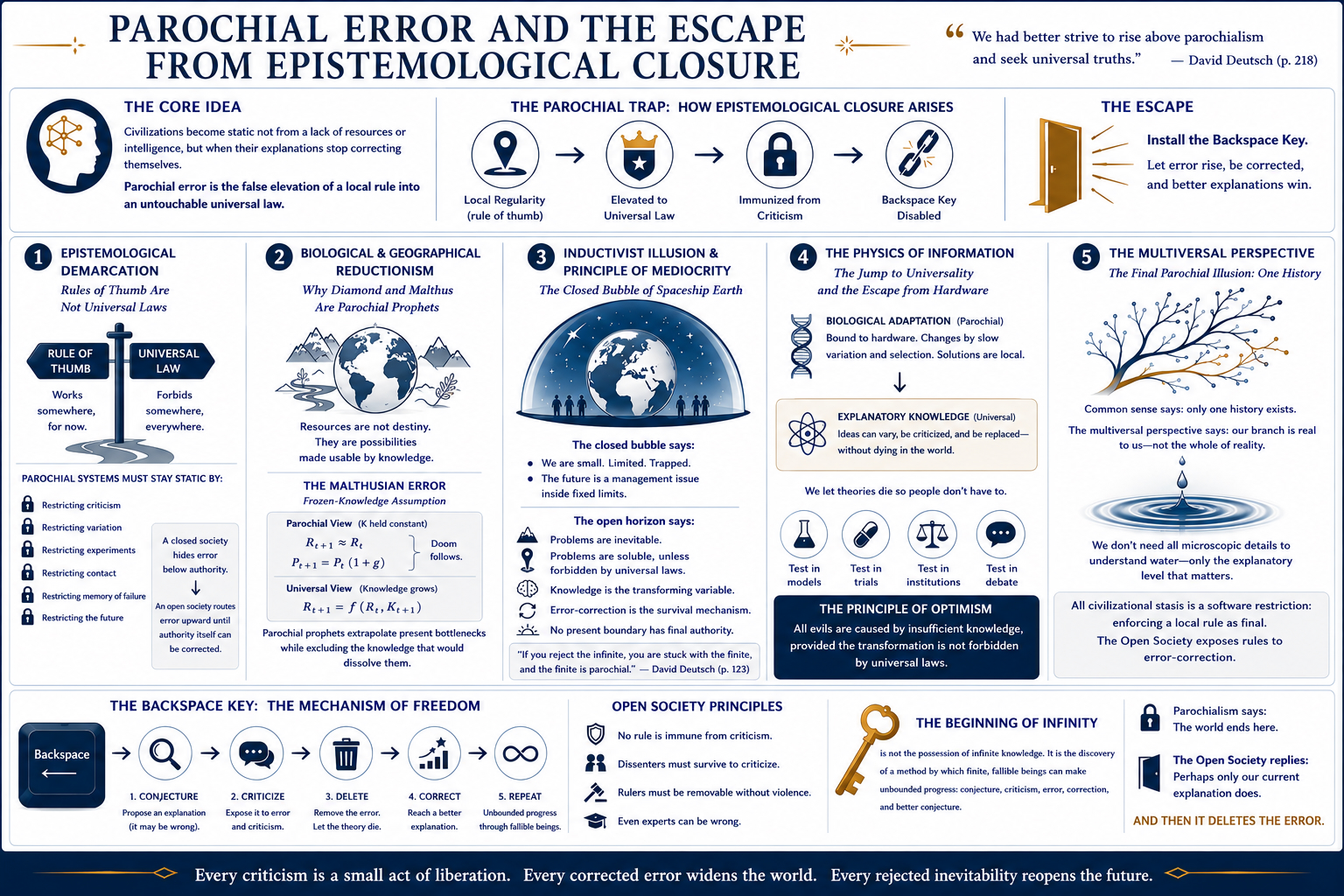
This is parochial error.
A parochial error occurs when a rule that works in a narrow domain is elevated into an unquestionable description of reality as such. The mistake is not that the rule of thumb exists. Rules of thumb are useful. The mistake is that the rule is treated as if it had infinite reach when it does not. The result is the disabling of the cognitive Backspace Key: the social and intellectual mechanism by which errors are found, criticized, deleted, and replaced.
Parochialism is therefore not a smallness of attitude. It is a smallness falsely installed as infinity.
Phase 1: The Epistemological Demarcation
Rules of Thumb Are Not Universal Laws
David Deutsch gives the exact demarcation. In The Beginning of Infinity, he writes:
“It is easy to mistake quirks of one’s own, familiar environment or perspective (such as the rotation of the night sky) for objective features of what one is observing, or to mistake rules of thumb... for universal laws. I shall refer to that sort of error as parochialism.” [page 33]
This is the critical definition. A parochial error is not merely a false belief. It is a false universalization. It is the conversion of a local adaptation into a metaphysical prison.
Deutsch has already prepared the ground [page 16], where he states that “rules of thumb are always parochial: they hold only in a narrow range of familiar circumstances.” A rule of thumb is a compression of repeated experience within a stable environment. It may be useful because the environment has not yet changed, because the range of cases is small, or because the problems it faces are tame. But its success is not universality. Its success is conditional. It is a convenience that works under familiar constraints.
The parochial error begins when that conditional rule is no longer treated as conditional.
A universal law forbids something everywhere. It has reach beyond the local circumstances in which it was first discovered. A rule of thumb merely works somewhere, for now. The difference is immense. A universal explanation survives criticism by explaining why it applies beyond the initial case. A parochial rule survives only by avoiding the cases that would expose its narrowness.
That is why parochial systems must become static. Deutsch describes anti-rational memeplexes as trapping societies in a “static, parochial system of ideas” [page 24]. The mechanism is not mysterious. A memeplex that sacralizes a rule of thumb must prevent the rule from encountering refutation.
It must restrict criticism.
It must restrict variation.
It must restrict experiments.
It must restrict contact with rival explanations.
It must restrict memory of failure.
It must restrict the future.
The static society is therefore not merely conservative in temperament. It is an error-management system designed to protect a parochial conjecture from falsifying tests.
Its rule may be: this hierarchy is natural; this ritual guarantees rain; this lineage must rule; this scarcity is eternal; this technology is forbidden; this social order is the cosmic order. Each such claim begins as a local arrangement, a practical habit, a mythic inheritance, or a historically contingent compromise. But once it is immunized from criticism, it becomes a counterfeit universal law.
The society survives not by solving problems, but by narrowing the world until the protected rule appears never to fail.
That is epistemological closure. It is not the absence of information. It is the organized prevention of error-correction.
The Open Society escapes this trap by refusing to grant final immunity to any rule, leader, tradition, theory, priesthood, bureaucracy, majority, or inherited explanation.
Its central question is not:
“Who is authorized to speak?”
It is:
“Where does error go, and can it reach the top?”
A closed society hides error below authority.
An open society routes error upward until authority itself can be corrected.
That routing system is the Backspace Key.
Phase 2: The Eradication of Biological and Geographical Reductionism
Why Diamond and Malthus Are Parochial Prophets
Parochialism becomes especially dangerous when it dresses itself as realism. It says: look at the land, the resources, the bodies, the mouths, the climate, the crops, the metals, the rivers. These are fixed. These are material. These are destiny.
That is the temptation of geographical and resource determinism. It is also their catastrophic error.
Deutsch’s criticism of Jared Diamond is not that geography is irrelevant. The criticism is that geography is assigned the wrong explanatory role. Deutsch writes:
“In early prehistory, populations were tiny, knowledge was parochial, and history-making ideas were millennia apart.” [page 224]
In such conditions, initial material differences could shape the timing and local path of development. But they could not be the deep explanation of civilization. The distribution of resources can affect details; it cannot explain the open-ended creation of new explanations.
Deutsch’s judgment is decisive:
“Marx, Engels and Diamond have it the wrong way round” [page 224].
They treat material conditions as the generator and knowledge as the by-product. But in reality, knowledge transforms what counts as a resource. Oil was not a resource for most of human history. Uranium was not a resource. Silicon was not a resource in the modern sense. A river is not “transport infrastructure” without the knowledge of boats, law, trade, maps, engineering, and institutions. A fertile plain is not an agricultural civilization without crops, tools, storage, measurement, irrigation, and error-correcting traditions.
Resources are not simply lying in the world with fixed meanings. They are physical possibilities made usable by knowledge.
This reverses the deterministic picture. Geography does not contain the future. Knowledge creates access to futures that geography alone does not specify.
Malthus makes the same parochial mistake in the form of resource prophecy. Deutsch writes that “Malthus slipped from educated guesswork into blind prophecy,” and adds: “But that was just a parochial mistake.” [page 206]
The Malthusian conjecture can be expressed in simple terms:
Population grows. Food is limited. Therefore catastrophe is inevitable.
But hidden inside that argument is a frozen-knowledge assumption. It assumes that future people will face future problems with present methods. It treats today’s agricultural productivity, today’s energy systems, today’s institutions, today’s error rates, today’s inventions, and today’s explanatory reach as if they were universal constraints.
Mathematically, the parochial structure looks like this:
Let Rt be available resources at time t , Pt population, and Kt knowledge. The Malthusian frame treats resource capacity as if it were bounded independently of new knowledge:
Rt+1 ≈ Rt
or, at best, as growing only by extrapolation from existing techniques:
Rt+1 = Rt + ∆Rknown
while population is projected forward as a compounding pressure:
Pt+1 = Pt(1 + g)
The conclusion of doom follows only if Kt is effectively held constant. But for Universal Explainers, the relevant variable is not merely resources. It is resources-as-transformed-by-knowledge:
Rt+1 = f(Rt, Kt+1)
And Kt+1 is not derivable from Kt by induction. New explanations are not contained in the past like a trend line waiting to be extended. They are created by conjecture and criticism. They can reclassify waste as fuel, poison as medicine, desert as farmland, sunlight as electricity, and scarcity as a soluble engineering problem.
The parochial prophet therefore commits a specific error: he extrapolates a present bottleneck while excluding the creation of the knowledge that would dissolve the bottleneck.
This is why pessimistic prophecy is often disguised parochialism. It mistakes the limitations of current knowledge for the limits of reality.
It says:
“No solution is visible from here; therefore no solution exists.”
But “from here” is not the universe.
It is only a local epistemic position.
The Universal Explainer is not omniscient. But it is not trapped inside present ignorance. It can create explanations that were nowhere encoded in the environment. It can criticize its own rules. It can replace its own methods. It can construct new instruments, new institutions, new sciences, new economies, and new meanings of “resource.”
Thus the ultimate parochial trap is not scarcity. It is the belief that scarcity must be interpreted using only the knowledge that made it appear insoluble.
Phase 3: The Inductivist Illusion and the Principle of Mediocrity
The Closed Bubble of Spaceship Earth
The Principle of Mediocrity appears humble. It says humanity is not special. It says our planet is not central. It says our aspirations should be scaled down to cosmic insignificance. But Deutsch identifies this as another parochial mistake. On page 39, he says that assuming humanity is insignificant is “merely a parochial error.”
The error lies in confusing spatial smallness with explanatory smallness.
Humans are small in size. Earth is small in cosmic extent. Human history is short by astronomical timescales. But none of that determines the reach of explanatory knowledge. A proof can be written on a page and apply to all prime numbers. A physical law can be discovered on one planet and describe stars. A mind can occupy a small region of space and contain explanations with universal reach.
The Principle of Mediocrity therefore smuggles in a parochial standard of importance: size, age, location, mass, and typicality. It assumes that because humans are physically local, their knowledge must be cosmically local too. This is precisely the mistake Deutsch warns against.
The “Spaceship Earth” metaphor intensifies the error. It pictures humanity as passengers on a sealed vessel with fixed supplies, fixed carrying capacity, and no meaningful outside. It is a metaphor of enclosure. Its moral is restraint under permanent finitude. Its political temptation is rationing by authority. Its epistemological assumption is that the future is a management problem inside a closed container.
The Open Society rejects this image not because constraints are unreal, but because the metaphor falsifies the nature of people. A spaceship has a fixed design. A civilization is a problem-solving system. A spaceship’s passengers consume supplies. Universal Explainers create knowledge that changes what counts as a supply, a destination, a hazard, a tool, and a possible world.
Deutsch warns [page 41] that if science were ultimately limited in the way pessimistic philosophies imply, then “progress in science cannot exceed a certain limit.” Science “would turn out to be inherently parochial – and, ironically, anthropocentric.”
This is a profound reversal. The claim that human beings are cosmically insignificant often presents itself as anti-anthropocentric. But if it declares that human knowledge must remain bounded by present human limitations, it is secretly anthropocentric. It treats current human ignorance as a cosmic law.
Deutsch’s answer [page 123] is severe: “if you reject the infinite, you are stuck with the finite, and the finite is parochial.”
The finite is not false merely because it is finite. Many finite things are real. The error is to treat the currently finite horizon as the final horizon. That is the closed bubble: the world as seen from the present, mistaken for the world as such.
The pessimistic bubble says:
Earth is all we have.
Present resources define future possibility.
Present ignorance defines permanent impossibility.
Present institutions define the limits of coordination.
Present dangers define the destiny of civilization.
The open horizon says:
Problems are inevitable.
Problems are soluble, unless forbidden by universal laws.
Knowledge is the transforming variable.
Error-correction is the survival mechanism.
No present boundary has final authority merely because it is present.
The Open Society is not optimistic because it expects comfort. It is optimistic because it refuses to confuse the local with the universal. It knows that the future is not contained in the present. It must be created.
Phase 4: The Physics of Information
The Jump to Universality and the Escape from Hardware
Before explanatory knowledge, adaptation remains tied to parochial origins. Biological evolution solves problems by incremental variation and selection, but its solutions are local. A wing, a fin, an eye, a claw, a toxin, a shell: each is an adaptation to a range of conditions. Each is powerful within its niche. Each is parochial.
Deutsch writes [page 43] that before science, human knowledge “was only a little less parochial than biological knowledge.” That is, even human cultures can remain close to the biological pattern: traditions adapted to local circumstances, transmitted with limited criticism, and protected by anti-rational memes.
The decisive break occurs when explanatory knowledge begins to have reach.
Deutsch delivers the central principle:
“The ability to create and use explanatory knowledge gives people a power to transform nature which is ultimately not limited by parochial factors, as all other adaptations are, but only by universal laws.” [page 44]
This is the physics of freedom.
People are not free because they can wish constraints away. They are free because explanatory knowledge can discover which constraints are parochial and which are universal. A cliff is a barrier to an unaided body. It is not a barrier to a bridge, a tunnel, an aircraft, or a theory of engineering. Night is a barrier to an animal’s eye. It is not a barrier to fire, electricity, radar, or astronomy. Disease is a barrier to an immune system. It is not necessarily a barrier to medicine.
The difference is information.
A biological adaptation is embodied in hardware. Its correction requires generations of selection. Explanatory knowledge can be varied, criticized, and replaced without requiring its bearer to die. That is why Deutsch’s principle of “letting our theories die in our place” is not a metaphorical ornament. It is the central mechanism of civilization.
Theories become sacrificial objects. We expose them to criticism so that people need not be exposed to catastrophe. We test bridges in models. We test drugs in trials. We test laws through institutions. We test policies through debate, experiment, repeal, and revision. We test moral claims through criticism and the testimony of those harmed by them. The Open Society is a system for transferring death from persons to conjectures.
Deutsch explains the deep reason:
“The intermediate explanations leading a scientist from one good explanation to the next need not be viable at all... This is the fundamental reason that explanatory ideas are able to escape from parochialism.” [page 114]
This matters enormously. Biological evolution cannot safely pass through nonviable intermediate organisms. But thought can pass through nonviable intermediate ideas. A scientist may entertain a wrong conjecture, criticize it, alter it, combine it, abandon it, and thereby reach a better explanation. The false step does not have to survive in the world. It only has to be available to criticism.
That is the jump to universality: once a system can represent, vary, and criticize explanations, it is no longer confined to the local path by which it emerged. It can escape its hardware. It can discover universal computation, universal grammar, universal laws, universal constructors, and universal moral principles. It can originate in a tribe and learn physics. It can originate on Earth and understand stars. It can originate in biology and become substrate-independent in its explanatory reach.
This does not mean people become gods. It means they cease to be merely local adaptations. Their bodies remain physical. Their brains remain material. Their societies remain fallible. But the knowledge they create is not bounded by the parochial conditions of its origin. It is bounded only by what the laws of physics forbid.
The Principle of Optimism follows:
all evils are caused by insufficient knowledge, provided the relevant transformation is not forbidden by universal laws.
Pessimism says the current failure is final.
Optimism says the current failure is a problem.
The first sacralizes ignorance. The second criticizes it.
Civilization advances when it installs the Backspace Key into its institutions:
open criticism, protected dissent, corrigible law, experimental science, adversarial debate, free inquiry, and the moral permission to say that an inherited rule is wrong.
A rational civilization is one that lets theories die instead of people.
Phase 5: The Multiversal Perspective
The Final Parochial Illusion: One History
The last parochial illusion is common sense itself: the belief that reality consists of one history, one line, one actual sequence, with all alternatives merely imaginary.
Deutsch writes:
“Similarly, common sense and classical physics contain the parochial error that only one history exists.” [page 140]
This is parochialism at the scale of ontology. Classical common sense universalizes the structure of familiar experience. We seem to observe one outcome. We seem to remember one past. We seem to inhabit one branch. The parochial mind turns that local appearance into a universal metaphysical law: only one history is real.
But the history we experience is not automatically the whole of reality. Once again, the familiar perspective is mistaken for the objective structure.
The multiversal perspective forces the same epistemological discipline as the Open Society: do not absolutize the local viewpoint. Do not confuse what is accessible from one branch, one scale, one instrument, one culture, one body, or one moment with what exists.
Deutsch’s point reinforces this. He writes that “we do not need most of the microscopic details in order to understand the role of water in the cosmic scheme of things, because nearly all of those details are parochial.” [page 107] Explanation requires abstraction. It requires ignoring local details that do not matter to the universal structure of the problem. To understand water, one does not need every accidental microscopic fact. One needs the explanatory level at which the relevant regularities appear.
This is not a rejection of detail. It is a hierarchy of relevance. Parochial details may be real, but they are not always explanatory. The error lies either in ignoring universal explanations or in mistaking local details for ultimate ones.
The defense against that error is the Tradition of Criticism.
Deutsch states the civilizational imperative: “we had better strive to rise above parochialism and seek universal truths.” [page 218] That sentence contains both warning and command. We are local beings with universal reach. We begin in parochial circumstances, but we are not condemned to parochial explanations. We inherit local languages, customs, fears, myths, and institutions, but we can criticize them. We inhabit one planet, but can understand galaxies. We experience one branch, but can conjecture a multiverse. We begin with rules of thumb, but can discover laws.
The Open Society is the political form of that epistemology.
It is not open because it has no standards. It is open because no standard is immune from criticism. It is not tolerant because all ideas are equal. It is tolerant because criticism requires the survival of dissenters. It is not democratic because majorities are infallible. It is democratic because rulers must be removable without violence. It is not scientific because experts are authorities. It is scientific because even experts can be wrong.
Parochial closure asks society to protect its ruling rule from error.
The Open Society asks society to expose its ruling rules to error-correction.
That is the decisive difference.
All civilizational stasis is a software restriction. It is the enforcement of a parochial error by institutions that forbid deletion, revision, and replacement.
It says:
This local rule must be treated as final.
This hierarchy must not be questioned.
This prophecy must not be tested.
This scarcity must not be reimagined.
This identity must not be criticized.
This authority must not be corrected.
The Universal Explainer shatters that closure by pressing Backspace.
Not once. Not finally. Repeatedly.
Every criticism is a small act of liberation from parochialism. Every corrected error widens the world. Every rejected inevitability reopens the future. Every institution that allows its own rules to be amended declares that no local arrangement is sacred merely because it is old, familiar, or powerful.
The beginning of infinity is not the possession of infinite knowledge. It is the discovery of a method by which finite, fallible beings can make unbounded progress: conjecture, criticism, error, correction, and better conjecture.
Parochialism says: the world ends here.
The Open Society replies: perhaps only our current explanation does.
And then it deletes the error.


