Palestinianism: An Ideology of Annihilation
By Khaled Salih
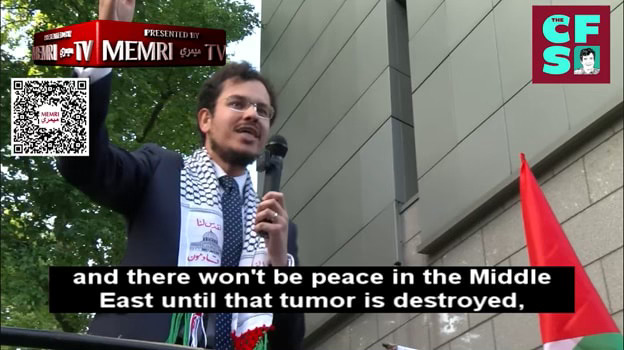
Curtesy of Memri
On August 25, 2025, a Palestinian activist named Saleem Nussibeh stood outside the Israeli embassy in London and issued a stark declaration: “Tomorrow, this will be the embassy of Palestine [...] there won’t be an Israel anymore.” He publicly screamed for the “destruction of the Zionist entity,” stating that there would be “no peace in the Middle East until the tumor is destroyed.” The crowd at the rally echoed his sentiments, chanting “Palestine is Arab” and “Intifada! Intifada!.” Such explicit calls for the elimination of a sovereign state, particularly one predominantly inhabited by a specific ethnic and religious group, raise profound questions about the nature of the Israeli-Palestinian conflict and the international community’s response to it.
The Nuances of UK Law and the Illusion of Impunity
The presence of UK police during Saleem Nussibeh’s rally, which he address directly, seemingly allowing such inflammatory rhetoric, highlights a complex interplay between legal frameworks and political realities. Under current UK hate speech laws, such as the Public Order Act, the application to political speeches calling for the destruction of a state remains legally intricate and often controversial. While these laws typically address racialist chanting and offensive messages, a key distinction often drawn in international law is between targeting a state as a political entity and explicitly calling for the physical extermination of a national, ethnic, racial, or religious group.
Nussibeh’s statements, though extreme and violent in their implications, are framed within a political context advocating for a specific geopolitical outcome, the end of Israel and the establishment of a Palestinian state. The rhetoric, while using dehumanizing metaphors like “tumor,” applies this to the “state of Israel,” not explicitly to Jews as a people. This legal distinction is crucial: calling for the destruction of a state, even if violent, does not automatically seen as calling for the extermination of a people, just as “destroy America” is not legally interpreted to “kill all Americans.” The speech does not appear to directly incite immediate physical attack against individuals, but rather advocates for the dissolution of a state entity. Law enforcement and prosecutors, therefore, might interpret the intent and likely impact as political discourse rather than direct incitement to hatred against individuals based on their identity. This perceived inconsistency in enforcement, as seen in other cases, often stems from the political views of the Israeli-Palestinian conflict and the challenge of balancing free speech with hate speech regulations in such highly charged contexts.
However, this legal formalism often obscures a more perilous practical reality. Nussibeh and his changing bodies now that Israel is the world’s only Jewish-majority state (approximately 75% Jewish), so calling for its destruction implies targeting Jews collectively. The language of Intifada invokes organized violent uprisings historically involving violence against Jews and Israelis, and slogans like “From the River to the Sea” implicitly deny space for Jewish inhabitants in the land. While not meeting the strict legal definition of genocide per se, such rhetoric qualifies as violent eliminationist speech, incitement to crimes against humanity (like ethnic cleansing and persecution), and dangerous dehumanization that creates a climate where genocidal violence could be justified.
Einat Wilf’s Palestinianism: The Ideology of Annihilation
To fully grasp the significance of Nussibeh’s words, it is essential to understand them through the lens of Dr. Einat Wilf’s analysis of the Israeli-Palestinian conflict. Dr. Wilf, a prominent Israeli intellectual and former Knesset member, argues that the ongoing conflict is not primarily a territorial dispute but is fundamentally driven by an ideology she terms Palestinianism. This is an “annihilationist ideology” rooted in the “absolute refusal of a Jewish state’s existence.” Its central tenets are: “from the river to the sea, there will be no Jewish state, and we are therefore perpetual refugees until return.”
Wilf argues that this ideology has fostered a “unique standard of Palestinian victimhood.” Unlike other refugee populations globally, who received the message to “move on” and were integrated into new lives, Arab refugees from the 1948 war were “excluded” from this norm. Their refugee status, which by any international standard would not make them refugees today, has been intentionally perpetuated by the Arab world and UNRWA. This device, Wilf asserts, serves the explicit political purpose of continuing the “war against the Jewish state.”
The concept of “return,” central to Palestinianism, is not envisioned as peaceful repatriation but as a “brutal invasion and desecration of Jewish life,” chillingly exemplified by the October 7th, 2023, attacks. This vision, according to Wilf, has been consistent in Palestinian texts since the 1950s and 1960s. Palestinianism, she states, has “brought together the worst of the Islamic thought, [and] the worst of Western thought,” incorporating elements from the Muslim Brothers, Nazi German and Soviet propaganda, and Fanonian decolonization views, all converging on “the negation of the collective Jew.” Hamas, in this framework, is not a separate entity but “merely their executive arm of the idea of no Jewish state.”
Not New at All: A Century of Eliminationist Rhetoric
Saleem Nussibeh’s call for the destruction of Israel and the chant of “From the River to the Sea” is, tragically, not new at all, but a reiteration of a century-long, consistent Palestinian and Arab agenda. Dr. Wilf and others have meticulously documented this historical trajectory, demonstrating that the foundational premise of the conflict from the Arab side has always been the absolute rejection of Jewish sovereignty.
Pre-1948 Origins. Even before the establishment of Israel or the creation of Arab refugees, British Foreign Secretary Ernest Bevin noted in 1947 an “irreconcilable conflict” where Jews desired a sovereign state and Arabs prioritized resisting its establishment “to the last resistance” in any part of the land. This illustrates that the core issue was never about “occupation,” “settlements,” Bibi or far-right politicians but the fundamental existence of a Jewish state.
The 1948 War and its Aftermath. Arab states initiated a “completely unnecessary, stupid war” to prevent the Jewish state’s establishment. Wherever Arabs conquered land (e.g., West Bank under Jordan, Gaza Strip), Jews were “completely killed and ethnically cleansed,” including the Jewish Quarter in the Old City. This immediate and absolute removal of Jews from areas controlled by Arabs contrasted sharply with Arab populations remaining in the newly formed Jewish state. Leaders like Hajj Amin al-Husseini, the leader of the Palestinians, declared in March 1948 that Arabs would “continue to fight until the Zionists are eliminated, and the whole of Palestine is a purely Arab state.” Egyptian Foreign Minister Muhammad Salah al-Din explicitly stated in 1949 that demanding refugee “return” meant the “liquidation of the State of Israel.”
The Perpetuation of Refugee Status (UNRWA). The temporary agency UNRWA, established in 1948, was “hijacked” by Arab refugees and countries to ensure it would “not settle a single refugee.” This was a deliberate choice, as they understood that “if they would be settled, then the war against the Jewish state is over, and the Jewish state gets to live.” UNRWA became the “ideological infrastructure, literally the womb in which every Palestinian terrorist organization is born,” funneling Western money and legitimacy to this “annihilationist cause.” Palestinian schools under UNRWA in the 1960s included oaths for schoolchildren to “evict Israel.”
Consistent Rejection of Peace Offers. Palestinians have “consistently rejected opportunities for their own statehood if it required peaceful coexistence with a Jewish state,” always choosing war instead. This includes the offers made by Israeli Prime Ministers Ehud Barak in 2000 and Ehud Olmert in 2008 for a sovereign Palestinian state with a capital in East Jerusalem. The consistent rejection, always followed by violence, demonstrated that Palestinians prioritize the “negation of the collective Jew” over their own statehood.
This long history demonstrates that Nussibeh’s speech is not an anomaly but a direct and consistent expression of Palestinianism, an ideology that has been openly articulated and pursued for decades.
A Functional Call for Genocide: Beyond Legal Formalities
While legally complex, Nussibeh’s rhetoric, echoed by the chanting crowd, functions as a call for genocide against Jews in Israel, given the demographic reality and the historical context of such language. The UN Genocide Convention defines genocide as acts committed with intent to destroy, in whole or in part, a national, ethnical, racial, or religious group. While Nussibeh’s speech avoids explicit calls to “kill Jews,” focusing on the destruction of the “Zionist entity” or Israel, this distinction blurs in practice.
Demographic Reality. Israel’s population is approximately 75% Jewish. Therefore, a call for the “destruction of the Zionist entity” or “no more Israel” effectively implies the destruction or expulsion of its Jewish majority. If the destruction of the state entails the removal, killing, or forced displacement of most Jews in Israel, then the line between anti-state rhetoric and anti-people intent collapses.
Dehumanizing Language. Nussibeh’s description of Israel as the “tumor in the body of the Middle East” that “must be destroyed” is deeply concerning. This medicalized dehumanization is a classic precursor to genocidal actions, echoing historical propaganda where targeted groups were labeled as “parasites” or “cockroaches” to justify their eradication.
“From the River to the Sea.” This slogan, vehemently chanted by the crowd, directly implies “no space left for Jews in the land.” It signifies a vision of total exclusion and replacement, not merely regime change. Wilf explicitly states that this tenet of Palestinianism means “from the river to the sea, there will be no Jewish state.”
Intifada. The repeated chanting of Intifada, Intifada! by the crowd, including by individuals who do not appear to be of Middle Eastern origin, invokes an organized violent uprising, which historically has involved violence against Jews and Israelis. This is not merely a call for political change but for armed struggle.
Applying Stanton’s Eight Stages of Genocide further clarifies the genocidal implications of Nussibeh’s rhetoric.
- Classification. “What you want is the destruction of the Zionist entity!” and “Palestine is Arab!” creates a binary of “us vs. them,” classifying Israelis/Jews as illegitimate.
- Symbolization. The term “Zionist entity” substitutes for “Jew,” a common symbolic stand-in for the Jewish people.
- Dehumanization. The “tumor” metaphor strongly present, justifying eradication.
- Organization. The chants of Intifada! invoke an organized violent uprising, indicating grassroots mobilization of this ideology.
- Polarization. “There won’t be an Israel anymore” leaves no room for negotiation, explicitly excluding Jews from the land through chants like “Palestine is Arab!”
- Preparation. Slogans like “From the River to the Sea”” outline a vision that implicitly identifies the land and its Jewish inhabitants as targets for removal or annihilation.
While Stages 7 (extermination) and 8 (denial) are not explicitly present, Nussibeh’s rhetoric and the crowd’s chants fit well into the early-to-middle stages of this model, creating the ideological environment in which extermination becomes justifiable. The October 7th attacks, which involved killings, sexual violence, and hostage-taking against Israeli civilians, including a high proportion of Jewish individuals, demonstrate how such rhetoric can manifest in genocidal acts.
An observation about a “ginger man” shouting aggressively “Palestine is Arab” in Arabic among the London crowd is particularly illustrative of Wilf’s broader point: Palestinianism, which synthesizes various destructive ideologies, has become a global phenomenon. It is not confined to a specific ethnicity or geographical region but draws support from diverse groups, making it a “new universal flag of global Utopia” for some, where “Palestine is everything” and its flag is the “new red flag.” This broad appeal, Wilf argues, allows anti-Zionism (often a mask for antisemitism) to be “unleashed globally” under the guise of supporting Palestinian rights.
Western Complicity and the Imperative to “Believe Them”
Dr. Wilf critically assesses the Western world’s role in perpetuating Palestinianism, diagnosing a “refusal to see” the clear facts, despite Palestinians openly stating their annihilationist goals. She offers a “darker thought”: that this blindness is not merely ignorance or inertia, but a “deep ambivalence with the existence of a Jewish state” embedded in Western consciousness, effectively “outsourcing their ambivalence with the existence of Jewish power, a Jewish state to the Palestinians.” This historical theological need to see Jews as “dispossessed, weak, and stateless” underlies much of the continued financial and political support for entities like UNRWA, which fuels the “annihilationist cause.”
The core of Wilf’s argument to the West is to “believe them for once and say, ‘until you dispose of that belief system, we’re not having this conversation.’” She emphasizes that Palestinians, to their credit, “never lie about the fact that their entire world view and identity are wrapped up in the negation of Jewish sovereignty.” They might “lie on everything else,” like “genocide, famine, open air prison, apartheid,” but not on their core ethos. Therefore, continued engagement in “peace processes” and “dialogue” that ignore this fundamental objective is a dangerous “shortcut” that only prolongs the “century-long war.”
When pressed, or when speaking to their own people without the “constraints of diplomacy and Western politeness,” Palestinian officials and ordinary people consistently voice this annihilationist goal. From the refugees in camps demanding “return as masters of the Homeland” to the schoolteacher in Gaza stating, “We should turn the Jews into refugees.” This explicit desire, tragically, is the true “currency” of the conflict, and ignoring it, or “Westsplaining” it away, means failing to confront the core “molten lava” of Palestinianism.
Conclusion: A Call for Defeat and Transformation
Saleem Nussibeh’s rally in London serves as a potent and alarming illustration of the core tenets of Palestinianism that Dr. Einat Wilf meticulously describes. His calls for the destruction of Israel are not isolated extremist views but deeply rooted in a consistent, century-long ideology that permeates Palestinian society and is actively fostered by international bodies like UNRWA. While legally a fine line exists between calling for the destruction of a state and inciting genocide, the practical and demographic realities of Israel, combined with the dehumanizing language and explicit territorial claims, render Nussibeh’s rhetoric functionally genocidal against the Jewish people in Israel.
The ability of such rhetoric to be openly proclaimed in a Western capital, even in the presence of law enforcement, highlights a profound Western failure to acknowledge the true nature of the conflict. This failure, according to Wilf, stems from a deep-seated ambivalence towards Jewish power and sovereignty, which is outsourced to the Palestinians.
For true peace to be possible, Dr. Wilf argues for a fundamental paradigm shift: “Palestinianism as an ideology must die.” This requires “defeat, [and] unconditional surrender” of this ideology, similar to the post-World War II transformation of Germany and Japan. It demands dismantling the “ideological infrastructure” of UNRWA, erasing the concept of a “right of return,” and forcing Palestinians to acknowledge the “outcome of your choice” for their current suffering.
Only by recognizing this uncomfortable truth and ceasing to “Westsplain” away Palestinian intentions can the international community, and Israel, move beyond the endless cycle of violence and truly work towards a future where two peoples can coexist. The consistent message from Palestinian voices, including Nussibeh’s, must finally be heard and taken seriously: the goal is the elimination of Israel, and until that changes, no genuine peace can emerge.

Curtesy of Memri
Sources:
Memri, 20250825, “Palestinian Activist Saleem Nussibeh At Rally Outside Israeli Embassy In London: This Will Become The Embassy Of Palestine; There Will Be No Peace In The Middle East Until Israel Is Destroyed; We Want Palestine In The 1948 Borders; Crowd Chants: ‘Intifada!’” https://www.memri.org/tv/palestinian-activist-london-rally-israel-destroyed-us-hegemony
Khaled Salih, 20250626, “Forget Palestine, stupid! The weaponisation of Palestinianism as a global crusade against Jewish sovereignty.” https://khaledsalih.substack.com/p/forget-palestine-stupid
Khaled Salih, 20250811, “Genocide by design. Hamas’s October 7th attack and the weaponisation of reverse accusations.” https://khaledsalih.substack.com/p/genocide-by-design
Adi Schwartz and Einat Wilf, 2020, The War of Return. How Western Indulgence of the Palestinian Dream Has Obstructed the Path to Peace. New York, NY: All Points Books.
Gregory Stanton, 1996, “Stages of Genocide,” at https://www.thegenocidereport.org/stages-of-genocide/ “In 1996, Dr. Gregory H. Stanton, the president of Genocide Watch, presented the “8 Stages of Genocide” to the United States Department of State, citing that genocide develops in eight stages, that are “predictable, but not inexorable.” At each stage, preventive measures can stop the genocide from exacerbating. In 2013 Dr. Stanton expanded the stages to Ten Stages of Genocide to include Discrimination and Persecution. The Genocide Report recognizes Dr. Stanton’s 10 Stages of Genocide as the standard by which to study and evaluate the process of genocide.”


