Palestinianism: An Ideology of Annihilation
By Khaled Salih
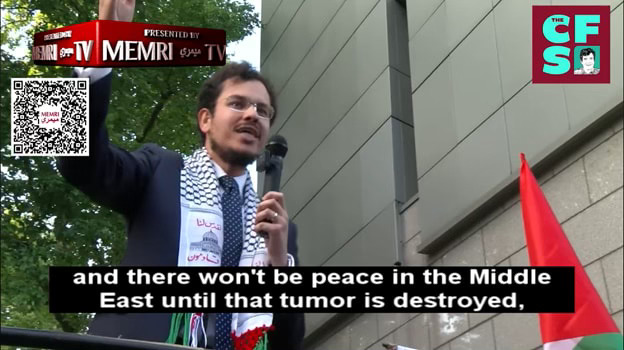
Curtesy of Memri
On August 25, 2025, a Palestinian activist named Saleem Nussibeh stood outside the Israeli embassy in London and issued a stark declaration: “Tomorrow, this will be the embassy of Palestine [...] there won’t be an Israel anymore.” He publicly screamed for the “destruction of the Zionist entity,” stating that there would be “no peace in the Middle East until the tumor is destroyed.” The crowd at the rally echoed his sentiments, chanting “Palestine is Arab” and “Intifada! Intifada!.” Such explicit calls for the elimination of a sovereign state, particularly one predominantly inhabited by a specific ethnic and religious group, raise profound questions about the nature of the Israeli-Palestinian conflict and the international community’s response to it.
Conclusion: A Call for Defeat and Transformation
Saleem Nussibeh’s rally in London serves as a potent and alarming illustration of the core tenets of Palestinianism that Dr. Einat Wilf meticulously describes. His calls for the destruction of Israel are not isolated extremist views but deeply rooted in a consistent, century-long ideology that permeates Palestinian society and is actively fostered by international bodies like UNRWA. While legally a fine line exists between calling for the destruction of a state and inciting genocide, the practical and demographic realities of Israel, combined with the dehumanizing language and explicit territorial claims, render Nussibeh’s rhetoric functionally genocidal against the Jewish people in Israel.
The ability of such rhetoric to be openly proclaimed in a Western capital, even in the presence of law enforcement, highlights a profound Western failure to acknowledge the true nature of the conflict. This failure, according to Wilf, stems from a deep-seated ambivalence towards Jewish power and sovereignty, which is outsourced to the Palestinians.
For true peace to be possible, Dr. Wilf argues for a fundamental paradigm shift: “Palestinianism as an ideology must die.” This requires “defeat, [and] unconditional surrender” of this ideology, similar to the post-World War II transformation of Germany and Japan. It demands dismantling the “ideological infrastructure” of UNRWA, erasing the concept of a “right of return,” and forcing Palestinians to acknowledge the “outcome of your choice” for their current suffering.
Only by recognizing this uncomfortable truth and ceasing to “Westsplain” away Palestinian intentions can the international community, and Israel, move beyond the endless cycle of violence and truly work towards a future where two peoples can coexist. The consistent message from Palestinian voices, including Nussibeh’s, must finally be heard and taken seriously: the goal is the elimination of Israel, and until that changes, no genuine peace can emerge.

Curtesy of Memri


