On Human Nature in the Attack on Salman Rushdie
8 January 2026
Human Nature at the Knife’s Edge
This is my third article on this journey, and by now the reader will have noticed that the Rushdie affair stubbornly refuses to stay put inside any single category—crime report, culture war, theological tantrum, or “security incident”—because it is, in miniature and in blood, a demonstration of what our species does at its most revealing: it manufactures meanings and then kills in their name, writes fictions and then dies for them, builds cathedrals of imagination and then tries to burn the architect alive. A man steps onto a stage in broad daylight to speak about words; another steps onto the same stage to make words irrelevant by turning a body into an argument. The point is not merely that fanaticism still walks among us, but that it recruits something uncomfortably ordinary in us—the tribal itch to outsource conscience to a cause, the pleasure of certainty without the nuisance of thought, the primitive thrill of belonging to a “we” that can declare a “they” unfit to breathe. And if the scene sickens, it is because it clarifies: the contest is not between a believer and a secular or tradition and modernity, but between the open mind and the closed fist, between the examined life and the borrowed verdict, between the risky freedom of narrative and the cheap finality of a blade.
The Two Men in the Amphitheatre
The attack on Salman Rushdie on August 12, 2022, was more than a shocking news event; it was a perfect, horrifying laboratory for revisiting the core paradox of human nature. On a stage in Chautauqua, New York, two fundamental human potentials collided. One was embodied by the Artist, Salman Rushdie, a man who has dedicated his life to the creation of worlds through words, a master of narrative’s infinite possibilities. The other was the Assassin, a young man who had surrendered his own story to become the agent of another’s—a “murderous ghost from the past,” as Rushdie would later write, enacting a sentence passed down 33 years earlier. In that moment of violence, the stage of the amphitheater became a crucible, revealing the strange and terrible relationship between virtue and violence that defines our species.
In this essay I shall use the analytical frameworks of three contemporary thinkers as scalpels to shed some light on this event. From primatologist Richard Wrangham’s The Goodness Paradox, I shall borrow a lens to understand the evolutionary biology of planned violence. From neuroscientist Nicholas D. Wright’s Warhead, I shall take a Model of the brain’s constant struggle to predict reality. And from literary scholar Angus Fletcher’s Primal Intelligence, I shall use a theory of the mind’s narrative machinery.
Through these lenses, a central thesis emerges:
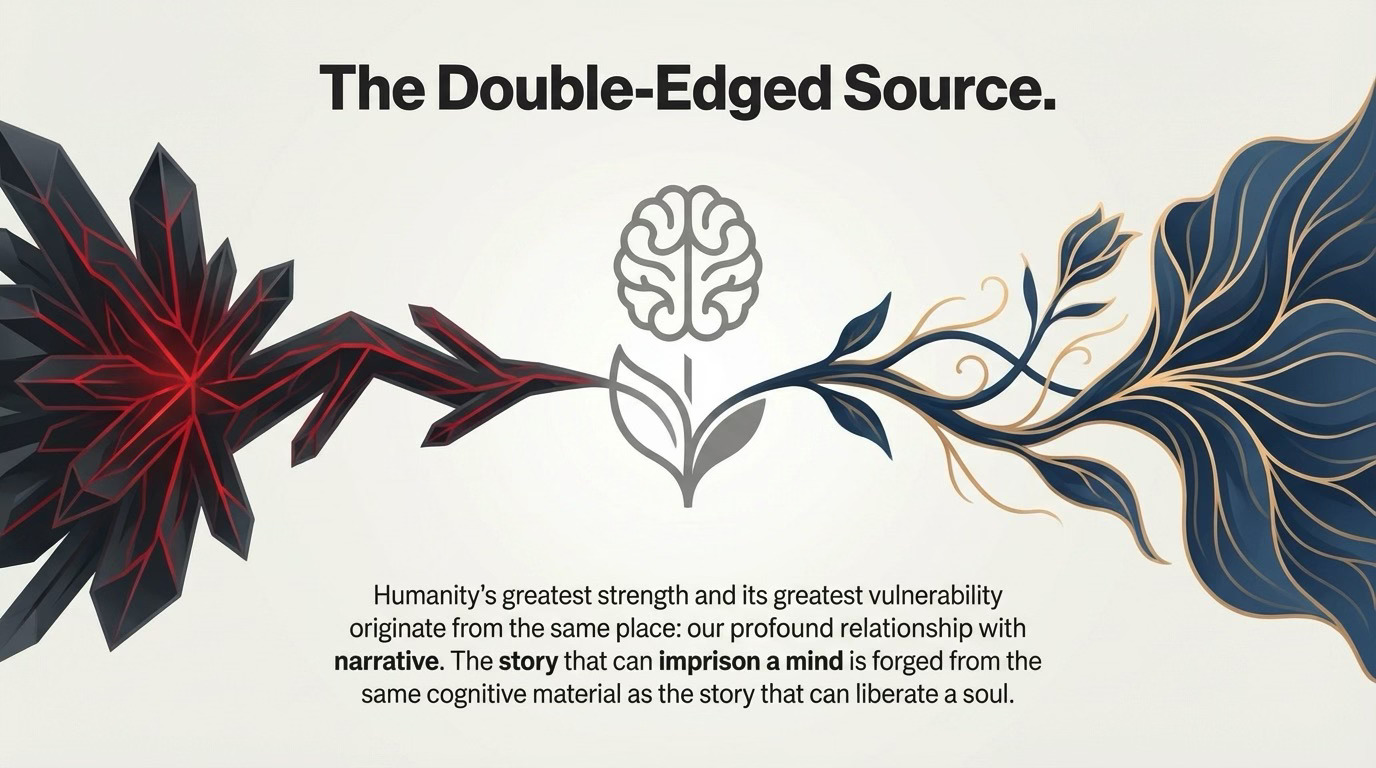
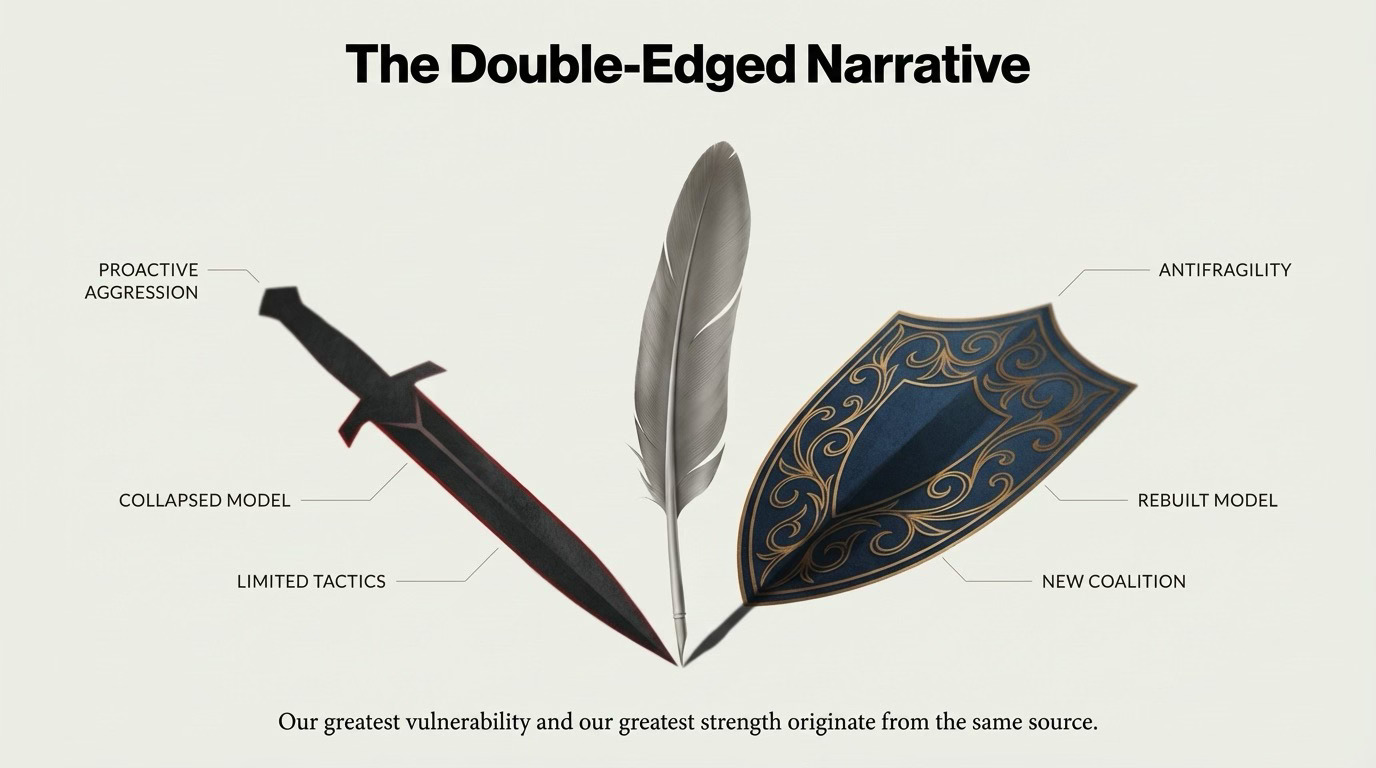
The confrontation between the Artist and the Assassin reveals that humanity’s greatest vulnerability and its greatest strength originate from the same source. Our capacity for cold, coalitionary violence—the kind that allows a man to prepare and do everything in his power to kill a stranger in the name of an idea—and our capacity to create meaning, resilience, and love from the wreckage of trauma, are both born of our profound relationship with narrative.
The story that can imprison a mind and license atrocity is forged from the same cognitive material as the story that can liberate a soul and rebuild a shattered world. To understand the Artist’s triumph, we must first get acquainted with the cognitive architecture of the Assassin—the mind that held the knife.
Anatomy of an Assassin
To understand the psychology of the man who attacked Salman Rushdie is not an exercise in empathy for the unforgivable. It is, rather, a human necessity. To prevent such acts, one must first comprehend the mechanisms that produce them. Understanding the Assassin is about understanding a dark potential within the human condition itself—a potential that the frameworks of Wrangham, Wright, and Fletcher illuminate with terrifying clarity. He is not a monster in the sense of being inhuman; he is, tragically, a testament to a specific, and specifically human, mode of being.
The Proactive Killer
In The Goodness Paradox, Richard Wrangham draws a critical distinction between two types of aggression that cleaves the human psyche in two. The first is reactive aggression: the hot, impulsive, in-the-moment rage that leads to a bar fight or a crime of passion. The second is proactive aggression: the cold, planned, premeditated violence of the stalker, the executioner, or the soldier on a mission. While humans have evolved to have remarkably low levels of reactive aggression compared to our primate cousins—we are, in Wrangham’s terms, a “self-domesticated” species, like Dr Jekyll—we possess an unparalleled and terrifying capacity for proactive aggression, the violence of Mr Hyde.
The attack on Salman Rushdie was a textbook case of what Wrangham calls coalitionary proactive aggression. Rushdie’s own description of his attacker as a “sort of time traveler, a murderous ghost from the past” perfectly captures the premeditated, almost impersonal nature of the act. This was not a man losing his temper. This was a man carrying out a plan, an executioner for an ideological coalition. As Wrangham’s “execution hypothesis” posits, our ancestors secured group cohesion by systematically eliminating non-conformists. From this evolutionary perspective, capital punishment is not a modern invention but a foundational element of human morality, the ultimate tool of social control. The Assassin, then, was the self-appointed agent of a moral system, carrying out a sentence on a perceived heretic. Through Wrangham’s lens, the man on the stage is not a monstrous aberration but a chilling manifestation of an evolved mechanism for moral enforcement—a perversion of a core social instinct.
The Weapon of Surprise
As neuroscientist Nicholas D. Wright explains in Warhead, the human brain is not a passive receiver of information but an active prediction machine. It constantly builds and refines a Model of the world to anticipate what will happen next. When reality violently contradicts this Model, the brain registers a massive “prediction error”—a profound and disorienting shock.
The Assassin’s primary weapon, even before the knife, was surprise. The attack was a meticulously engineered prediction error, designed to shatter not only Salman Rushdie’s Model of the world but our own. A literary festival is supposed to be a safe, civilised space. When that assumption is violated, the cognitive frame collapses. As Rushdie writes in his memoir, Knife, “the targets of violence experience a crisis in their understanding of the real.” This is the neurological signature of trauma:
the moment the world ceases to make sense because the brain’s predictive Model has been proven catastrophically wrong.
The Assassin, in contrast, operated from a dangerously simplistic Model. His failure was not merely having a rigid worldview fed by “Imam Yutubi videos,” but possessing a predictive Model that had collapsed into a single, unchangeable simulation. His brain, unlike a healthy one, could not run alternative scenarios or ask What if. This collapse granted him the terrible certainty required for what Wright identifies as a surprisingly rare trait, even among soldiers: the “will to kill.” He was not assailed by doubt or prediction error; he was the agent of it, a man whose collapsed Model of the world gave him the certainty to destroy the richer, more complex world of another.
The Prison of a Single Story
In Primal Intelligence, Angus Fletcher defines intelligence not as logic or processing power, but as a suite of four innate, narrative-based powers: intuition, imagination, emotion, and common sense. Viewed through this framework, the Assassin represents a catastrophic failure of this primal intelligence. He is a man imprisoned by a single, externally-imposed story, demonstrating a systemic shutdown of all four core cognitive functions.
His imagination failed to generate branching What Ifs beyond the fatwa’s directive; his future narrowed to a single, violent point. His intuition failed to “spot the exception”—he could see Rushdie only as an instance of a rule to be eliminated, not as an individual human being. His emotion was not used as “critical intel” to guide his actions but was instead subsumed by a singular, received narrative of righteous hate. Finally, his common sense was entirely absent; he showed no capacity to gauge the “unknown unknowns” of his environment or the consequences of his act, committing himself to a fatalistic Plan A with no conception of alternatives.
He was the epitome of what Fletcher terms “limited tactics.” Where true intelligence marries a clear goal with tactical flexibility—“defined strategy, unlimited tactics”—the Assassin had a defined strategy (kill Rushdie) but catastrophically limited tactics. In Knife, Rushdie’s imagined dialogue with “The A.” portrays this perfectly. The attacker’s mind is a non-generative cognitive loop, incapable of the storythinking that branches into multiple futures, retreating instead into the chilling paradox: “Only submission leads to freedom.” He embodies the terrifying potential of narrative not as a tool of liberation, but as the architecture of a prison.
The Artist’s Response
If the Assassin represents a cautionary tale of narrative’s destructive power, Salman Rushdie’s response demonstrates its profound capacity for healing, defiance, and the reconstruction of a self. The attack was an attempt to end his story, to reduce him to a mere victim, a footnote in the history of fanaticism. His survival, and his subsequent decision to write about it, is an act of reclaiming the narrative—of proving that the story is more powerful than the blade.
Answering Violence with Art
Angus Fletcher introduces the concept of “antifragility”—the capacity not merely to endure setbacks, but to turn loss into growth and become stronger from them. It is the psychological alchemy of transforming trauma into purpose. Rushdie’s decision to write Knife is a conscious, deliberate act of leveraging story and imagination to achieve exactly this. He declares his intention explicitly:
he “would answer violence with art” in order to “refuse to be a mere victim.”
This transformation was fuelled by what Fletcher calls “wonder”—the profound positive surprise that can rewire our life story. For Rushdie, this wonder came from two sources: the sheer improbability of his survival, and the overwhelming global outpouring of love and support. This “fortunate plot twist,” as Fletcher would term it, provided the emotional fuel necessary to integrate the trauma. The love he received from his wife Eliza, his family, and millions of strangers was a positive shock that countered the negative shock of the attack. It confirmed his belief that “love is a force...it can change the world,” allowing him to begin weaving the horror into a new, stronger narrative of survival and reaffirmation.
Defying the Executioner
Through Richard Wrangham’s lens, Rushdie is the archetypal individual targeted for elimination by a group’s moral-enforcement mechanism. He is the non-conformist whose existence challenges the dogma of the coalition. The attack was the physical manifestation of the execution hypothesis, an attempt to enforce ideological purity through violence.
His survival, therefore, is a profound defiance of this primal system. But more than mere survival, his response—grounded in reason, art, and an unflinching commitment to free expression—is a triumph of the civilised self. He is Wrangham’s Dr Jekyll, the product of human self-domestication, refusing to be destroyed by the calculated, proactive violence of Mr Hyde. Furthermore, the global support Rushdie received can be seen as the spontaneous formation of a powerful competing moral coalition. This new, global coalition rallied not around religious dogma, but around the values of individual dignity, artistic freedom, and the sanctity of the mind. Rushdie did not face the executioner alone; a world of readers and citizens stood with him, asserting a different, more tolerant vision of humanity.
The Power of a New Narrative
Applying Nicholas D. Wright’s framework, the entire project of writing Knife can be understood as the conscious and arduous process of building a new, more resilient predictive Model of the world. The attack was a prediction error of such magnitude that it shattered his previous reality. The book is the meticulous work of constructing a new predictive engine, one recalibrated by catastrophic failure.
Rushdie uses the raw data of his experience—the painful details of his recovery, his physical limitations, and his deepening relationship with his wife, Eliza—to construct this new Model. It is a Model that must now predict a world where extreme, irrational violence can erupt in a place of peace. It is, therefore, a sadder but wiser Model. He captures this perfectly in his final assessment of his and Eliza’s “wounded happiness.” It is a state that acknowledges the permanent “shadow in the corner” but is “strong nevertheless.” This is not a return to innocence but the stable output of a predictive model that has successfully integrated terrible new data without collapsing. That act of narrative reconstruction is the ultimate answer to the blade.
The War of Stories
The confrontation on the stage at Chautauqua was a stark, bloody dramatisation of human nature’s core duality, a conflict rooted in our species’ unique and powerful relationship with narrative. The frameworks of Wrangham, Fletcher, and Wright allow us to map the opposing forces at play in this deeply human drama.
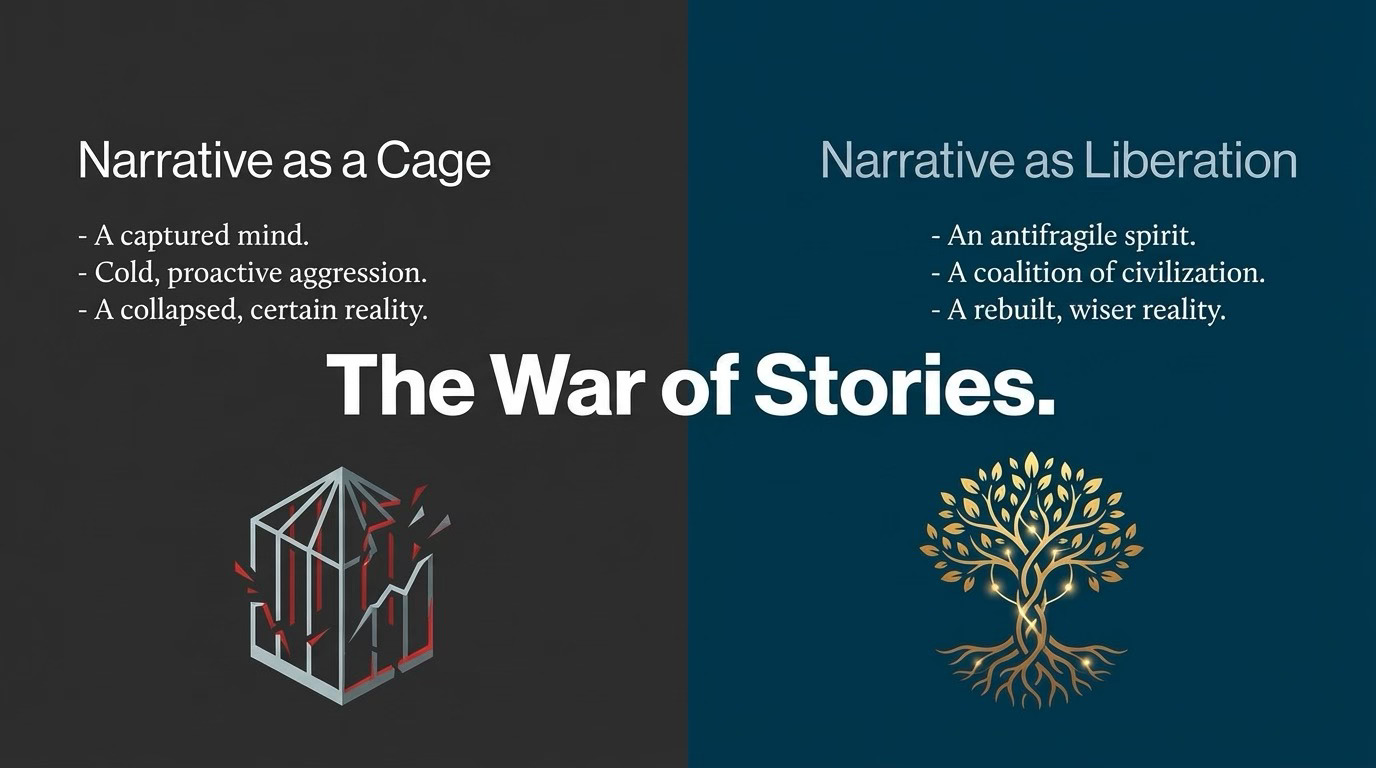
On one side stands the chilling human capacity to be captured by a single, rigid, inherited story. It is a story that deactivates our primal intelligence, shutting down imagination and common sense (Fletcher). It is a story that licenses cold, premeditated, proactive aggression against those deemed outside the coalition (Wrangham). And it is a story that creates a collapsed and dangerously certain Model of the world, breeding a rare and murderous will (Wright). This is the path of the Assassin: narrative as a cage.
On the other side stands the resilient human capacity to author a new story from the ashes of trauma. It is a story that demonstrates antifragility, turning loss into a source of wonder and strength (Fletcher). It is a story that defies the primal impulse of ideological execution, rallying a new coalition around the values of civilisation and love (Wrangham). And it is a story that consciously rebuilds a shattered predictive model into a wiser, more complex, and more durable understanding of reality (Wright). This is the path of the Artist: narrative as liberation.
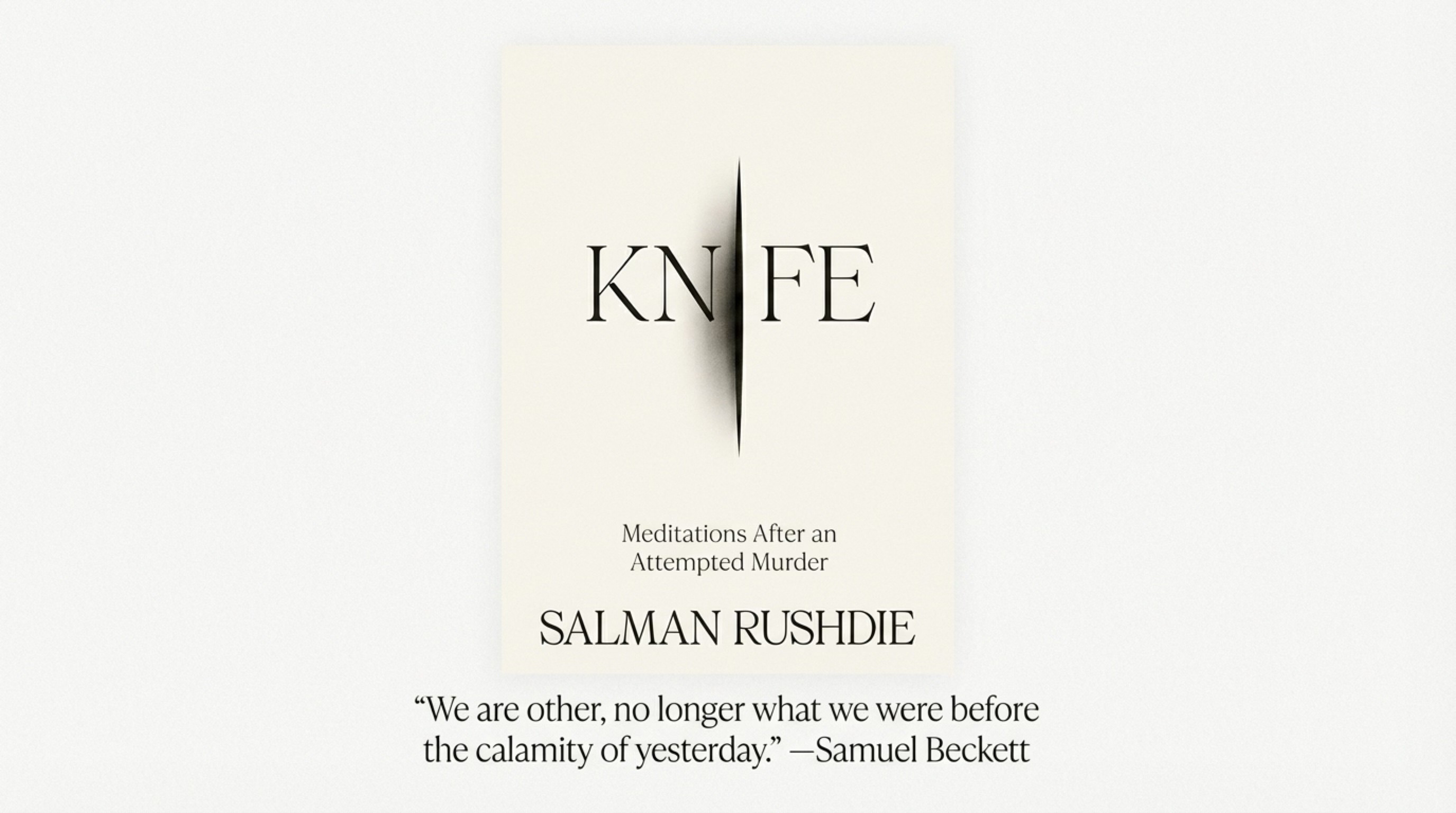
In this essay, I have merely attempted to paint a map of the battlefield. I am fully aware that it is an analysis, an abstraction. To truly comprehend the human stakes—to feel the terror of a world collapsing and the wonder of a self being remade, and to understand the choice we all face between these two ways of being—you must abandon the analysis and enter the story itself. You must read Salman Rushdie’s own account in Knife.
Sources:
Salman Rushdie, 2024, Knife: Meditations After an Attempted Murder. New York, NY: Random House.
Angus Fletcher, 2025, Primal Intelligence: You Are Smarter Than You Know. New York: Avery.
Richard Wrangham, 2019, The goodness paradox: The strange relationship between virtue and violence in human evolution. New York: Pantheon Books.
Nicholas D. Wright, 2025, Warhead: How the Brain Shapes War and War Shapes the Brain. New York: St. Martin’s Press.