October 7: Where Did the Error Go?
Three Years After the Pogrom, a Personal Conjecture About Error, Agency, Memory—and the People Who Pay
6 October 2026
Note
Tomorrow marks three years since October 7, 2023.
I have discovered that I still do not quite know how to write about it.
I have written about Hamas, Israel, Gaza, Iran, jihadism, intelligence failure, Anfal, Sinjar, protected explanations, and the strange capacity of intelligent people and institutions to become trapped by their own ideas.
But there is a more difficult question.
What did October 7 do to my own thinking?
A catastrophe should not simply give us a position that we spend the rest of our lives defending.
It should give us problems we cannot escape.
For me, October 7 eventually became one such problem:
When an explanation cannot correct itself, where does the error go?
Today I publish the most personal of my three essays for this anniversary.
October 7: Where Did the Error Go?
Three Years After the Pogrom, a Personal Conjecture About Error, Agency, Memory—and the People Who Pay
Tomorrow, on October 7 itself, I will publish the hardest of the three.
Yesterday I published the first of three essays leading into the third anniversary of October 7, 2023. It began in an unexpected place: the cockpit of Flydubai Flight FZ1073, where an axe, a wounded captain, and a descending aircraft made the visible crisis unmistakable—but did not explain it. The Axe Was Visible. The Explanation Was Not. asks how invisible explanations become physical reality, and whether criticism can still reach an error before its consequences become irreversible. Today, I turn directly to October 7.
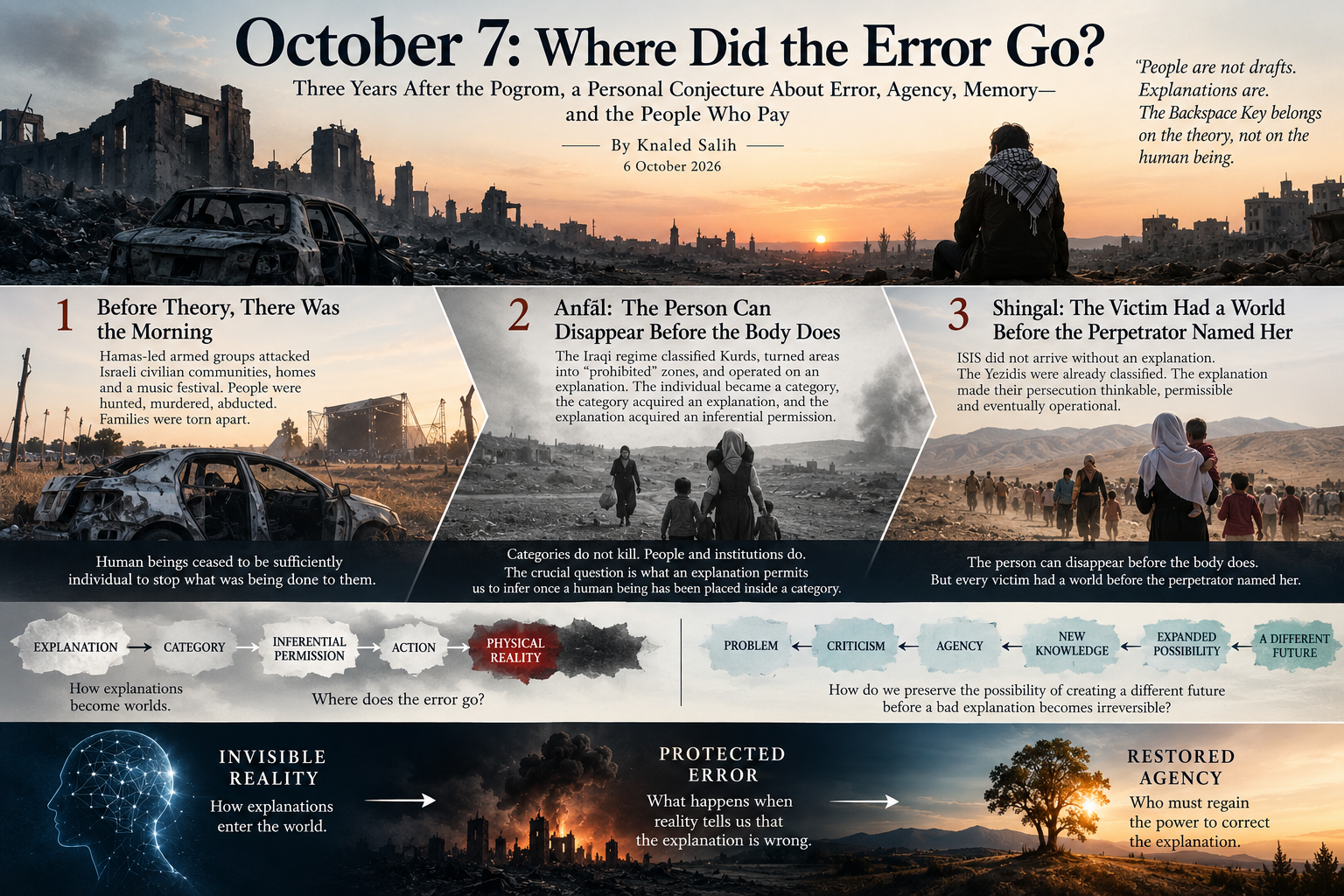
October 7: Where Did the Error Go?
Three Years After the Pogrom, a Personal Conjecture About Error, Agency, Memory—and the People Who Pay
People are not drafts. Explanations are. The Backspace Key belongs on the theory, not on the human being.
Three years have almost passed since October 7, 2023, and I have discovered that I still do not quite know how to write about it.
That is a strange admission for someone who writes as much as I do. I have written about Hamas, Israel, Gaza, Iran, jihadism, intelligence failure, protected explanations, the politics of corpses, and the strange ways highly intelligent people and institutions can become trapped by their own ideas. I have written books in which some of the questions raised by that morning return again and again.
But I have avoided something more difficult: what did October 7 do to my own thinking?
I do not mean what political position it gave me. We should distrust that way of describing intellectual life. A catastrophe should not hand us a position and ask us to spend the rest of our life defending it. It should give us problems we cannot escape.
October 7 gave me several. Three years later, I think they may be one problem:
When reality produces information capable of correcting an explanation, what happens to that information?
Or, in the formulation that has followed me from anfāl to Shingal, from October 7 to Gaza: where does the error go?
I did not possess that question on October 7. I have it now. I think I needed these three years to understand what it demands of me.
Before Theory, There Was the Morning
On October 7, Hamas-led armed groups crossed from Gaza into southern Israel and attacked civilian communities, homes, military positions and a music festival. It has later become clear that the killing of civilians and the taking of hostages were central aims of the planned assault and documented murder, hostage-taking and other crimes against humanity and war crimes.
I use the word pogrom deliberately. But even that word does not contain the morning.
People were hunted. People were murdered in their homes. People running from a music festival were shot. People were abducted. Families were torn apart.
Human beings ceased, in the minds of their attackers, to be sufficiently individual to stop what was being done to them.
That last sentence is where my own history entered the event.
Not because October 7 was anfāl. It was not. Historical distinctions matter. Legal distinctions matter. Scale matters. Actors matter. Institutions matter. Intent matters. Mechanisms matter.
But while watching October 7, something old returned.
anfāl: The Person Can Disappear Before the Body Does
anfāl was an organized campaign of the Iraqi state against Kurds. Human Rights Watch, drawing on captured Iraqi documents and hundreds of witness interviews, concluded that the Iraqi regime committed genocide. The campaign involved mass executions and disappearances, chemical attacks, forced displacement and the destruction of thousands of villages.
I had spent years with the documents of that machinery. What stayed with me was not only the killing. It was the classification.
The state had an explanation of Iraq. The Kurd contradicted it.
Certain Kurdish areas became prohibited. People living in them could cease to be encountered first as individual human beings. Their location, ethnicity and presumed relationship to Kurdish resistance could place them inside a category upon which the machinery of the state could operate.
That taught me something I did not yet know how to formulate: the person can disappear before the body does.
First the individual becomes a category. Then the category acquires an explanation. Then the explanation acquires an inferential permission. Eventually an institution acts upon the permission.
That is more precise than saying categories kill. Categories do not kill. People and institutions do. The important question is what an explanation permits someone to infer once another human being has been placed inside a category.
That question returned on October 7.
Jew. Israeli. Zionist. Settler. Occupier. Enemy.
These words are not interchangeable. Some can be legitimate descriptive or political categories. But once a category carries the inference therefore a legitimate civilian target, the person has vanished inside the explanation.
People are no longer encountered. They are processed.
Shingal: The Victim Had a World Before the Perpetrator Named Her
Then another Kurdish memory entered: Shingal.
Again, not because Shingal and October 7 are identical. They are not. Shingal sharpened the mechanism.
When ISIS attacked the Yezidis in August 2014, it did not arrive without an explanation and then discover a people it disliked. The explanation had already classified them. UNITAD later found reasonable grounds to conclude that ISIS acted with genocidal intent against the Yezidis of Shingal. Its findings documented systematic killings, enslavement, sexual violence, forced conversion, child transfer and the separation of captives according to age and sex.
I once wrote that for ISIS, the explanation arrived before the person. I now think that sentence concedes too much to the perpetrator.
The Yezidi person arrived first.
Long before ISIS there were families, villages, faith, sacred places, marriages, songs, disputes, children, ambitions, ordinary mornings and an entire lived world. ISIS’s explanation arrived later. What arrived first in the perpetrator’s mind was not the Yezidi human being but the perpetrator’s theory of the Yezidi.
That distinction matters because otherwise even my account allows ISIS to decide when the Yezidi enters history. It does not. The victim possesses a world before the perpetrator names her.
And if she survives, freedom requires more than keeping her alive. The opposite of attempted erasure is not merely survival. It is restored authorship.
Shingal Also Turns the Question Back Toward Kurdistan
Shingal belongs here for another reason. It prevents Kurdistan from occupying the morally comfortable position of victim.
ISIS bears responsibility for the genocide it committed against the Yezidis. That should not be blurred. But there is also a Kurdish question: what happened to the institutions that were supposed to protect Shingal? What assumptions governed them? What failed? Who was accountable? What changed afterward?
If I can use Shingal to analyze ISIS but cannot use it to examine Kurdish political and security institutions, then my explanation has already begun protecting me.
Victimhood does not create epistemological immunity.
Kurds have suffered extraordinary crimes. That does not make Kurdish institutions infallible. Yezidis suffered genocide. That does not make them illustrations in somebody else’s Kurdish national story. Palestinians can suffer terribly without Hamas becoming correct. Israelis can survive a pogrom without every subsequent Israeli policy becoming correct.
The rule I now want to preserve is simple: protect the person, preserve agency, criticize the explanation.
Hamas Is Not Merely a Reaction
This brings me to one of the most uncomfortable corrections I have had to make in my own thinking.
There is a way of explaining Hamas that appears compassionate because it explains everything through context: occupation, displacement, blockade, humiliation, poverty, trauma, Israeli policy, regional politics.
All of these can matter. But an environment is not an explanation of an actor.
Hamas also possesses ideas. Ideas about history, Palestine, Islam, Israel, Jews, resistance, martyrdom, political legitimacy, violence, victory, time and the future.
To explain an actor entirely through what has been done to him can become another way of denying his agency.
The same mistake can be made with anyone. Palestinians are not merely what Israel has done to them. Israelis are not merely what Hamas has done to them. Kurds are not merely what Saddam Hussein, Turkey, Iran or Syria have done to them. Yezidis are not merely what ISIS did to them.
History conditions choice. It does not choose for us.
Context helps explain why an idea can become attractive, powerful or replicable. It does not tell us what the idea says. We need both. If we collapse them, explanation becomes excuse.
The Palestinian Must Not Disappear Either
But restoring Hamas’s agency creates another danger: Hamas can become the Palestinian. That would reproduce the same disappearance by category.
The Palestinian who rejected October 7 must remain visible. So must the Gazan who despises Hamas, the Palestinian who wants freedom from Israeli domination and freedom from Islamist domination, the critic, the secularist, the dissident, the woman whose political future cannot be reduced to somebody else’s theory of resistance, the person trying to create a political alternative that does not yet exist.
A people permitted to appear only as victims has not been granted full agency. Neither has a people permitted to appear only through its armed organizations.
I know this from Kurdistan. Kurds have made choices. Some courageous. Some farsighted. Some shortsighted. Some destructive. Some tragically wrong. To acknowledge this does not weaken the Kurdish case. It recognizes Kurdish adulthood.
Palestinians deserve the same recognition. No people should have to choose between recognition of its suffering and recognition of its agency.
October 7 Was Also an Israeli Error Signal
October 7 was not only the product of an explanation. It destroyed explanations too.
Israel possessed formidable intelligence, military and technological capabilities. Yet Hamas-led forces achieved a coordinated breach and assault across numerous civilian and military locations. The scale of the surprise became a question about assumptions, interpretation and preparedness.
This is where a distinction that has increasingly shaped my work became unavoidable: intelligence is not rationality.
Intelligence can solve extraordinarily difficult problems inside an existing explanation. Rationality requires something else: the capacity to make the explanation itself an object of criticism and, when necessary, replace it.
A highly intelligent institution can therefore become extraordinarily effective at interpreting information through a model that should itself have been reconsidered.
After an intelligence failure, the question is not only what information was missing. It is also what explanation determined what the available information was allowed to mean.
That question applies far beyond Israel. It applies to governments, universities, companies, political parties, religions, intelligence services and individuals.
Including me.
When “No Other Choice” Becomes a Political Constitution
Some Israeli assumptions may indeed have been false. Some options may genuinely have become less credible after October 7. Beliefs about deterrence, containment, Hamas’s incentives, border security or the relationship between economic arrangements and political moderation may have required radical revision.
That is not necessarily closure. It can be learning. Error correction requires allowing failed assumptions to die.
This is why Benjamin Netanyahu’s address to the United Nations on September 24, 2026 struck me so forcefully. He repeatedly returned to a sentence he attributed to his brother Yoni: ’We have no other choice.’ He connected it to 1967, Entebbe, October 7, Israel’s multi-front wars, Iran, Jewish historical vulnerability and the existence of an Israeli state and army capable of defending Jews.
I understand the power of that sentence. Perhaps a Kurd understands it particularly well.
There really are moments when choice-space contracts brutally. Fight. Flee. Hide. Surrender. Die. Kurds have known such moments. Yezidis on Mount Shingal knew them. Jews have known them.
There are nights in history when ’no other choice’ is not propaganda. It is a description of an emergency.
But something changes when the sentence moves from the emergency into the permanent political architecture.
A people may need ’no other choice’ to survive one night. It cannot build an open future if ’no other choice’ becomes its permanent constitution.
I now distinguish three claims that can hide inside the same sentence. First: immediate physical closure, where very few viable options really exist. Second: current knowledge closure, where we do not presently know another workable solution. Third: epistemological closure, where no other solution can exist and searching for one becomes naïve, disloyal or dangerous.
My concern is with the third.
The absence of a presently known alternative does not prove that another can be created. But neither does it prove that another can never be created. Rational optimism is not wishful thinking. It is the refusal to mistake present ignorance for permanent impossibility.
Kurdistan Has Its Own Version of “No Other Choice”
The question turns back toward Kurdistan immediately.
The Pêşmerge exists partly because Kurdish history taught Kurds that survival could not safely be outsourced. anfāl makes that lesson difficult to dismiss. So does Helebje. So do repeated episodes of abandonment and betrayal.
But the harder Kurdish question begins after survival: how does survival power become correctable public power?
An armed force may be necessary for survival. The existence of an armed force does not make every explanation governing that force correct. Party structures may have been necessary in clandestinity. That does not make them the final architecture of a free society. Wartime loyalty may preserve a movement. That does not make permanent loyalty a substitute for public criticism.
The weapon may help secure survival. The institution governing the weapon helps determine whether survival becomes freedom.
That question applies to Kurdistan. It applies to Israel. It applies to every political movement that has survived by means it later mistakes for the purpose of survival itself.
Truth, Propaganda and the Right to Correct the Government
Netanyahu called information warfare an eighth front and described it as a ’war for truth.’ He accused foreign governments and media of spreading falsehoods about Israel and strongly rejected accusations of genocide in Gaza.
There is a real problem here. Propaganda exists. Disinformation exists. October 7 denial exists. Antisemitism exists. States and movements manipulate information.
The conclusion cannot therefore be that there is no struggle over truth.
But another conclusion is equally important: the existence of propaganda does not make the government the authority that defines truth.
A democratic society must be capable of fighting lies without converting criticism into enemy action. Otherwise truth itself becomes protected from correction.
The important question is not whether a government is criticized unfairly. Governments often are. It is whether criticism can still return to the explanation and change it.
The Kurdish Sentence Inside Somebody Else’s Argument
In the same UN speech, Netanyahu attacked Turkey’s President Erdoğan and referred, among other things, to Kurdish civilian deaths and Erdoğan’s denial of the Armenian genocide.
As a Kurd, I notice immediately when Kurdish suffering enters somebody else’s argument.
And that recognition produced another uncomfortable thought: I cannot object when others instrumentalize Kurdish suffering and then instrumentalize Yezidi, Jewish or Palestinian suffering myself.
Kurdish suffering cannot be decorative evidence. Neither can anfāl. Neither can Shingal. Neither can October 7.
A catastrophe deserves to change an explanation, not merely strengthen its rhetoric.
Then Came Gaza
October 7 does not disappear because of what followed. What followed does not disappear because of October 7.
I need both sentences.
Nearly three years later, Gaza remains devastated. OCHA reported in September 2026 that civilians continued to face widespread destruction, severe humanitarian need, ongoing strikes, precarious water access, damaged infrastructure and continuing displacement-related risks.
Palestinian suffering cannot become double-entry bookkeeping against Israeli suffering. Nor can Israeli suffering become a ledger against which every Palestinian death is deducted.
A dead child does not become less dead because another child was murdered first.
But chronology does not disappear either.
October 7 happened. Agency happened. Choices happened. Then other choices happened.
The analytical and moral task is to keep causation, context, agency, responsibility and human visibility present at the same time. Difficulty is not permission to erase one of them.
Explanation Is Not Excuse
The distinction can be stated simply.
Explanation travels backward into causes. Responsibility remains attached to choices.
To understand how Hamas arose is not to justify October 7. To understand October 7 is not to justify every subsequent Israeli decision. To understand Jewish historical vulnerability is not to make Israeli policy immune from criticism. To understand Palestinian dispossession is not to make Palestinian political strategies immune from criticism. To understand anfāl is not to make Kurdish institutions immune from criticism. To understand Shingal is not to take political authorship away from Yezidis.
Context matters. Agency matters. Neither should be permitted to abolish the other.
Where Does the Error Go?
I can now state the problem more carefully.
An error does not literally go anywhere. That is the metaphor. The harder question is what happens when reality produces information capable of correcting an explanation.
Sometimes the signal reaches the explanation. The model is criticized, revised or replaced. Action changes. Reality is tested again.
Sometimes the signal is reclassified. Criticism is blocked. The model survives. Action continues. The contradiction between the explanation and reality does not disappear; its cost accumulates somewhere else.
Censorship can do this. Sacralization can. Fear can. Party loyalty. Career incentives. Institutional monopoly. Identity. Violence. Reclassification of critics.
And one of the most dangerous mechanisms is the conversion of failure itself into evidence that the original explanation was correct.
When success proves the theory and failure also proves it, reality can no longer reach the theory.
Who Pays When the Explanation Is Protected?
This may now be the question I care about most.
When an explanation is protected, the mismatch between the explanation and reality does not vanish. Costs accumulate.
Sometimes the people who created the explanation pay. Often they do not.
The cost migrates toward people with less power to force revision: the dissident, the minority, the soldier, the hostage, the civilian, the woman, the heretic, the village, the child, the people whose existence contradicts the model.
An error-correcting society tries to make the explanation pay. The policy changes. The leader leaves. The theory is discarded. The institution is redesigned. The hypothesis dies.
A closed system increasingly makes the person pay.
That is where anfāl returns. And Shingal. And October 7. And Gaza.
Not because these histories are equivalent. They are not.
They force the same question: what was allowed to die—the explanation, or the person?
People Are Not Hypotheses
This brings me to the simplest formulation I have found.
People are not hypotheses. They must not be falsified so that theories can survive.
People are not drafts. Explanations are. The Backspace Key belongs on the theory, not on the human being.
Backspace does not mean magical reversibility. The dead cannot be restored by pressing a key. A destroyed village cannot be undeleted. A raped woman cannot be returned to the morning before the crime. A hostage cannot recover stolen years. A traumatized child cannot simply be reset.
Backspace means preserving the capacity to revise or replace an explanation before the accumulated cost of protecting it becomes catastrophically irreversible.
Science has versions of it. Courts have versions. Elections. Appeals. Free journalism. Opposition. Independent investigation. Leadership replacement. Open criticism. Institutional review.
None guarantees correction. They make correction possible without requiring catastrophe first.
Institutions Can Correct Error—or Industrialize It
anfāl taught me this too.
anfāl was institutional. Bureaucratic. Documented. Organized. The Iraqi state had ministries, security agencies, military commands, records and procedures. Human Rights Watch’s archival investigation showed a campaign dependent on coordinated military, security, party and administrative machinery.
So the choice is not institution versus chaos.
It is correctable institution versus institution organized to protect its explanation.
A bureaucracy can institutionalize criticism and correction. It can also institutionalize error with terrifying efficiency.
Failure Does Not Teach by Itself
I used to speak too loosely about learning from failure. Failure itself does not teach.
Failure provides an opportunity for learning.
After failure, a society can criticize and revise. It can rationalize and protect. It can permit competing explanations. It can escalate coercion. It can collapse.
What matters is what selects among those possibilities.
After catastrophe, I now look for a few concrete signs. Was the previous model genuinely reconsidered? Were contrary explanations permitted? Were failed predictions acknowledged? Could critics speak? Did leaders accept responsibility? Were success criteria rewritten after the fact? Was blame simply transferred? Did failure itself become proof that the theory had always been correct?
That last possibility should frighten us. If reality cannot produce an outcome that counts against the model, the model has ceased to be corrigible.
Defeating the Actor Is Not Defeating the Explanation
Shingal taught me another lesson. ISIS lost its territorial caliphate. That does not mean every idea that made ISIS possible disappeared.
Ideas can outlive armies. They can outlive leaders and institutions. They can migrate, mutate and reconstruct themselves in new carriers.
The same question therefore applies to Hamas. If Hamas is destroyed organizationally but the explanatory environment that makes Hamas-like politics plausible becomes stronger, what exactly has been defeated?
And the question applies to Israel too. If Israel defeats its enemies militarily but October 7 permanently establishes that every political alternative to indefinite force is an existential risk, what has Hamas succeeded in changing?
This is not an argument against force. Sometimes force may be necessary to preserve the possibility of future correction. But force is also an action governed by explanations, and those explanations must remain criticizable.
When Enemies Begin Producing Each Other’s Evidence
Another idea entered my thinking here, one I once stated too loosely.
Enemies do not author one another. Hamas did not create Zionism. Israel did not create Islamist theology. Saddam did not create Kurdish identity. ISIS did not create Yezidi identity.
The more precise claim is that an enemy can become a co-author of the conditions under which certain explanations become more plausible, selectable and replicable.
Hamas acts on its explanation of Israel. Israel changes. Israel acts on its explanation of Hamas and Palestinian politics. Palestinian society changes. Each actor then observes the changed other and says: you see, I was right about them.
We begin producing each other’s evidence.
This does not erase agency. It makes agency more important. Nor does interaction imply equal responsibility. A feedback loop can contain radically unequal power, intentions, capabilities, legal obligations and moral responsibility.
Recursive does not mean equivalent. It means that actions alter the environment in which rival explanations compete.
Trauma Has No Single Political Outcome
I have corrected another assumption too. Trauma does not automatically produce closure.
Sometimes catastrophe destroys bad explanations. Sometimes it produces institutional reform. Sometimes victims reject the worldview that brought catastrophe upon them. Sometimes societies become more open. Sometimes less.
So the question is not whether trauma contracts political possibility. It is under what conditions trauma becomes criticism and under what conditions it becomes protection.
Open criticism, competing explanations, replaceable leadership, access to information, institutional accountability and freedom to dissent may help turn catastrophe into learning.
Sacralization, censorship, identity fusion, suppression of alternatives and permanent emergency may push the other way.
But these are conjectures too. They have to survive reality.
How Much of My Future Will I Let My Enemy Write?
This question is personal for me.
How much Kurdish political thought should Saddam Hussein still be permitted to write decades after anfāl? How much Yezidi life should ISIS still define after the territorial caliphate has disappeared? How much of Israel’s future should Hamas be allowed to write after October 7? How much of the Palestinian future should Israel—or Hamas—be allowed to write?
This is not a demand to forget. Quite the opposite. Memory matters because knowledge matters.
But there is a difference between memory and sovereignty.
Learn from history. Do not grant history sovereignty over possibilities that have not yet been created.
Memory should inform choice. It should not abolish choice.
And unfinished justice is not imprisonment by memory. Yezidis still seeking security, missing relatives, accountability or recovery are not trapped in the past. A hostage family demanding answers is not trapped in the past. A Palestinian family living among ruins is not trapped in the past. A Kurdish family still searching for the remains of an anfāl victim is not trapped in the past.
Correction requires memory. What it rejects is the conversion of memory into a permanent veto over future knowledge.
The Palestinian Future Must Contain Palestinians
It is not enough to protect Palestinians from being equated with Hamas. Palestinians must appear as creators.
A Palestinian future cannot simply be whatever Israel permits, Hamas survives, Iran finances, Arab states negotiate or Western activists imagine.
There must remain the Palestinian who says: Hamas does not own my suffering. Israel does not own my future. Iran does not own my cause. The international solidarity movement does not own my identity.
I am not merely an object of occupation, resistance, humanitarianism or somebody else’s historical guilt. I am an agent in a future that has not yet been created.
That is not sentimentality. It is political and epistemic personhood.
A human being is not merely someone whose life should be protected. A human being is a potential creator of explanations: a critic, a chooser, a discoverer of alternatives.
The Israeli Future Must Contain Israelis Beyond October 7
The same principle applies to Israel.
October 7 may rationally have destroyed previous assumptions. But Hamas should not receive permanent authorship over the Israeli future.
Security is real. Self-defense is real. Jewish historical vulnerability is real. Netanyahu ended his UN speech by emphasizing that Jews now possess a state and army and can defend themselves, before returning again to the refrain that Israel has ’no other choice.’ A Kurd can understand the emotional and political force of that argument.
Survival cannot always be outsourced.
But the deeper test comes afterward: can a people preserve the means of defending itself without allowing the machinery of defense to define the entire future it was built to preserve?
That question belongs equally to Kurdistan.
What I Refuse to Let October 7 Do to My Thinking
After three years, perhaps this is the most personal part.
I cannot control what October 7 did to history. I can ask what I will permit it to do to my thinking.
I refuse to let October 7 turn every Palestinian into Hamas.
I refuse to let Gaza turn every Israeli into Netanyahu.
I refuse to let antisemitism make Palestinian suffering invisible.
I refuse to let Palestinian suffering make antisemitism invisible.
I refuse to let context abolish agency, or agency abolish context.
I refuse to let victimhood create immunity from criticism.
I refuse to let suffering become automatic evidence that my previous explanation was correct.
I refuse to let anfāl turn every Arab into Saddam.
I refuse to let ISIS define the Yezidi forever by what ISIS did to her.
I refuse to let Kurdish suffering exempt Kurdish institutions from criticism.
I refuse to let history close choices that knowledge has not yet created.
And most importantly, I refuse to protect my own explanation merely because October 7 made it emotionally necessary to me.
Because the moment I do that, I reproduce the mechanism I am trying to understand.
My Own Explanation Must Be Allowed to Die
That requirement turns the argument back against me.
Perhaps I have given one mechanism too much explanatory power. Perhaps what I call protected error merely redescribes phenomena better explained by ideology, institutional inertia, coercion, trauma, groupthink, motivated reasoning, path dependence or strategic interaction.
Perhaps my idea of enemies co-producing one another’s evidence is only a more literary description of a security dilemma. Perhaps Backspace is too elastic. Perhaps anfāl has trained my eye to see anfāl-shaped mechanisms where they do not exist.
Perhaps I am constructing a vocabulary capable of swallowing every counterexample.
If so, it has failed.
The question is not whether I can describe anfāl, Shingal, October 7 and Gaza using the same words. The question is whether the same correction problem is actually operating, and what evidence would show me that it is not.
My conjecture must remain killable. Otherwise I am not practicing error correction. I am merely praising it.
What Would Prove Me Wrong?
If highly protected systems consistently corrected their explanations more effectively than systems permitting open criticism, I would have a serious problem.
If blocking error signals did not increase the eventual cost of correction, I would have a problem.
If those costs did not often migrate toward people with less power to revise the model, my argument about transferred correction costs would weaken.
If the actions of adversaries did not meaningfully alter the environment in which rival explanations became plausible, the idea of enemies co-producing one another’s evidence would need to go.
If ’no other choice’ rhetoric reliably accompanied vigorous efforts to create and test alternatives, my concern about closure would require revision.
I do not want concepts that survive whatever reality does. That would be the most ironic possible conclusion to this intellectual journey.
Two Doors Are Still Not Enough
I return repeatedly to the architecture of choices.
Israel or Palestine. Security or justice. Resistance or surrender. War or capitulation. One state or two states. Recognition or elimination.
Some of these are genuine choices. Some may be unavoidable at particular moments. But the visible menu is not necessarily the boundary of possibility.
There are things physically possible, things institutionally possible, things we know how to do, and things we can presently imagine. These are not the same space.
Freedom therefore requires more than having options placed before us. It requires the capacity to perceive options, criticize them and create new ones.
But there is no guarantee that the option we need already exists.
That is why saying ’build a third door’ is not enough. A door must lead somewhere. It must solve problems the previous doors could not solve. It requires new knowledge.
The Beginning of Correction
I began October 7 looking for the error that had produced the massacre.
Three years later, I am looking at something more disturbing: the capacity of opposing errors to protect and reproduce one another.
But I am also looking at something more hopeful.
They do not have to.
Failure can produce criticism. Trauma can produce knowledge. Memory can inform without ruling. Agency can survive structure. A people can refuse to become what its enemy’s explanation requires it to become. An institution can admit that its model failed.
A Palestinian can reject Hamas without surrendering Palestine. An Israeli can defend Israel without making every current security doctrine permanent. A Kurd can remember anfāl without giving Saddam sovereignty over the Kurdish future. A Yezidi can remember ISIS without allowing ISIS to remain the author of Yezidi identity.
This is what I mean by an open future.
Not a peaceful future guaranteed by good intentions. Not a world without enemies. Not a world without force. Not a world without terrible mistakes.
An open future is one in which mistakes remain correctable before their correction requires another generation of bodies.
Three Years Later
I can now state my conjecture more simply than when I began.
October 7 was a pogrom, an act of intentional mass violence against civilians, and a catastrophic Israeli security and intelligence failure. The years that followed became another test: what do people and institutions do when reality tells them that something in their explanation has failed?
Do they revise it? Protect it? Displace the error? Transfer its cost? Recruit the suffering it produces as fresh evidence for another protected explanation?
When correction is blocked, the contradiction between explanation and reality does not vanish. Its costs appear somewhere.
Sometimes they fall on the institution. Sometimes the leader. Sometimes the movement. Too often they fall on people who had the least power to create or revise the explanation.
And when those people are wounded, displaced, humiliated, terrorized or killed, their suffering becomes new information inside another explanatory system. That system can learn. Or it can protect itself. And the cycle begins again.
So the sequence I now see is not simply protected error followed by catastrophe. That is too crude.
It is explanation, encounter with reality, error signal, correction or protection, consequences, who pays, what is learned, what is replicated, what choices remain visible, and what new choice can be created.
That is my conjecture. Not my conclusion.
The Backspace Key
Perhaps civilization can be understood in one unexpectedly simple way.
Not as the absence of error. Human beings will always make errors.
Not as the victory of the correct ideology. No one possesses the final explanation.
But as an architecture that tries to make errors die before people have to die to preserve them.
That is why criticism matters. Why opposition matters. Why free inquiry matters. Why institutional accountability matters. Why leadership must remain replaceable. Why doctrines must remain criticizable. Why the person must remain visible beneath every category. Why agency must survive explanation.
Three years after October 7, I no longer think the most important question is who possesses the final moral vocabulary for describing the catastrophe.
I think the harder question is whether our explanations can still be reached by reality.
If they can, correction remains possible.
If they cannot, someone will eventually pay for keeping them alive.
I want the explanation to pay first.


