Never Is Not an Explanation
The Middle East, the Sword, and the Error of Turning Repeated Failure into Future Impossibility
20 September 2026
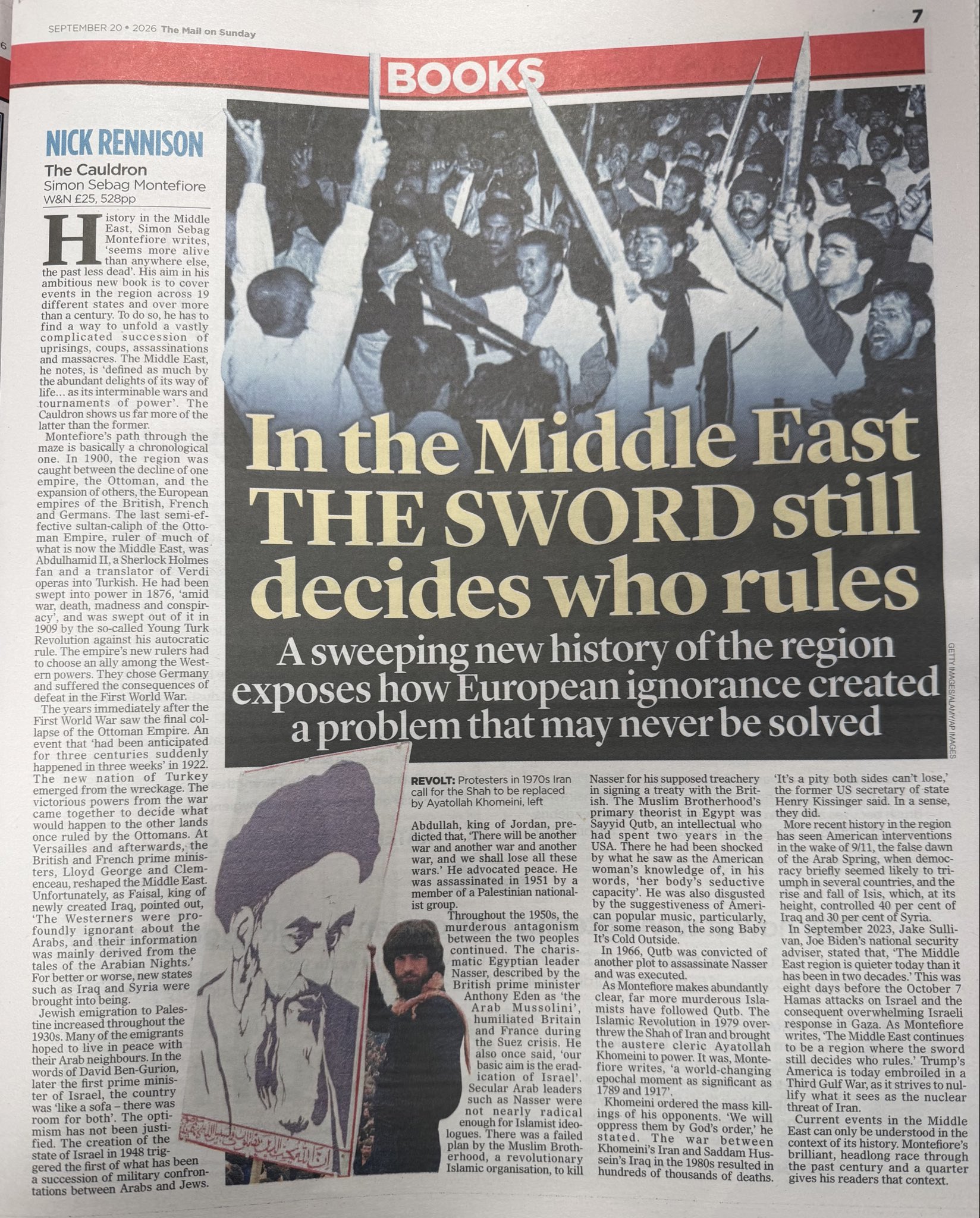
The headline makes two claims.
The first is historical: “In the Middle East the sword still decides who rules.”
The second is prophetic: European ignorance created “a problem that may never be solved.”
The first claim can be investigated. The second abandons investigation at precisely the point where it is most needed.
Before examining either, one distinction is necessary. The words appear in the display headline and subheading of Nick Rennison’s review of Simon Sebag Montefiore’s The Cauldron. Newspaper headlines are commonly written or rewritten by editors. The text does not establish that Montefiore wrote the phrase, nor even that Rennison chose it. A fair criticism must therefore address the proposition itself and the editorial frame imposed on the review—not silently attribute it to the author of the book.
Montefiore’s subsequent response, however, changes the position slightly. He posted a photograph of the review and described it as “a nice surprise,” reproducing its praise of The Cauldron and directing his audience to the page. He did not write the offending headline, as far as the available evidence shows. But once he publicly circulated the page without qualification, the headline was no longer merely something imposed upon his book without his participation. He helps amplify it.
This does not prove that he agrees with every word chosen by the newspaper’s editors. Authors routinely celebrate favorable reviews without endorsing every sentence, caption or headline surrounding them. Intellectual fairness requires that distinction. Yet Montefiore is not an uninformed reader encountering a casual turn of phrase. He is an acclaimed historian whose book promises to make the region intelligible through history. He was therefore unusually well placed to notice that “may never be solved” contradicts the very possibility of historical explanation. If history can reveal how political problems were produced, it can also reveal that they were produced rather than ordained—and that different institutions, choices and knowledge may alter them.
His silence does not make him the author of the claim, but it does make the absence of correction significant. He accepted and circulated the praise while leaving its most fatalistic proposition untouched. A brief qualification would have been enough: the region’s conflicts are formidable and historically accumulated, but no historian possesses the knowledge required to place them permanently beyond human correction. By offering no such protest, Montefiore allowed the prestige of his scholarship to travel alongside an assertion that his scholarship cannot establish.
That caution does not make the language unimportant. The headline is the largest argument on the page. It tells the reader how to interpret everything beneath it: repeated war becomes evidence of regional essence, European error becomes an irreversible creation, and an unfinished political history becomes a future without an exit.
This is exactly why the word never requires examination.
“May” Does Not Rescue “Never”
Grammatically, may expresses possibility rather than certainty. The headline does not say that the problem will never be solved. It says that this outcome is possible.
That qualification makes the sentence safer, but not more explanatory.
Almost anything that has not yet happened may fail to happen. A conflict may continue for another decade or another century. A state may collapse. A settlement may fail. But to select permanent insolubility from the infinite field of logical possibilities is to imply that the evidence gives us a reason to take it seriously.
What is that reason?
The review supplies a long record of Ottoman decline, imperial intervention, contradictory ambitions, state formation, migration, assassination, nationalism, coups, revolution, Islamism, foreign invasion and war. This history supports the proposition that violence has repeatedly shaped political authority in the region. It does not support the proposition that no future knowledge, institution, settlement or political invention can alter that pattern.
The movement from has repeatedly happened to may remain impossible to overcome for all time is not historical explanation. It is induction inflated into destiny.
The future contains knowledge we do not possess, institutions that have not yet been designed, alliances not yet attempted and political actors not yet born. A claim about what can never be solved must identify a mechanism that excludes all such possibilities. The headline identifies none.
It converts the limits of present imagination into a limit of human possibility.
What Is “The Problem”?
The phrase becomes still weaker when we ask what its singular noun refers to.
What exactly is the problem?
Is it the Israeli–Palestinian conflict? The territorial consequences of the Ottoman collapse? Authoritarian government? Sectarian hierarchy? Kurdish statelessness? Foreign intervention? Resource dependence? Military rule? The weakness of accountable institutions? Rival national projects? The political use of sacred history? The inability to replace rulers without violence?
These problems interact, but they are not one problem. They have different histories, agents, mechanisms and possible corrections. Compressing them into “the Middle East problem” creates a single civilizational object too large to analyze and therefore easy to declare insoluble.
The language also turns a region inhabited by hundreds of millions of acting, arguing and changing persons into something that outsiders must “solve.” It retains the viewpoint of imperial administration even while condemning European ignorance: Europe made a defective arrangement, and history waits for someone to find the correct arrangement.
But societies are not equations with one final answer. Political order is never solved once and for all. It is maintained through institutions that discover error, permit opposition, revise policy, replace leaders, renegotiate arrangements and protect persons from those who claim permanent authority.
The proper contrast is therefore not between a final solution and eternal chaos. It is between systems that can correct political errors without bloodshed and systems in which correction requires a sword.
European Ignorance Is Not Yet a Mechanism
The headline’s accusation contains substantial truth. European powers intervened in the region with inadequate knowledge, imperial incentives and little accountability to the populations whose futures they reorganized. The review itself recalls Faisal’s complaint that Western information about Arabs came largely from The Arabian Nights. The collapse of the Ottoman Empire, the mandates, externally shaped state structures and competing promises form an indispensable part of any explanation.
But ignorance created the problem is too imprecise.
Ignorance does not draw a border, arm a client, impose a mandate, issue incompatible commitments, suppress a revolt or construct a minority regime. Institutions and actors do these things. They act under incentives, ideologies and distributions of power. Some know very little; some know a great deal and still choose domination because domination serves their purposes.
Calling the cause “ignorance” can accidentally excuse conduct by depicting destructive policy as a misunderstanding. It can also become a universal solvent: whenever an intervention fails, insufficient cultural knowledge is blamed, while the interests and immunities that selected the policy disappear.
A stronger explanation would identify mechanisms such as:
- borders and governing arrangements imposed without corrigible consent;
- contradictory commitments made to different populations;
- rulers protected by external patrons from domestic accountability;
- military institution made more effective than civic institutions;
- communal categories hardened into systems of political allocation;
- oil, arms and strategic rivalry rewarding control rather than correction; and
- historical claims converted into vetoes over living persons.
These mechanisms do not absolve regional actors. On the contrary, they restore agency. The review’s own chronology includes Ottoman rulers, Young Turks, Arab monarchs and nationalists, Zionist leaders, military officers, Islamists, Iranian revolutionaries and regional dictators. European power is central to the story, but it is not the only power in the story.
To make Europe the sufficient cause of everything that followed would reproduce the Eurocentrism being criticized. It would grant Europeans not only immense power, which they possessed, but near-exclusive authorship of Middle Eastern history, which they did not.
Does the Sword Decide?
The sword is a powerful metaphor because it captures a visible recurrent fact: rulers, borders and regimes in the region have often been established, defended or destroyed through organized violence.
But even this proposition needs qualification.
Force can remove a ruler. It cannot by itself administer a society, produce legitimacy, collect reliable knowledge, sustain cooperation or make a political settlement self-correcting. Armies depend on bureaucracies, finances, alliances, narratives and degrees of acquiescence. A coup succeeds not simply because someone possesses weapons, but because institutions fracture, commands are obeyed, rivals defect and enough people conclude that resistance is impossible or too costly.
The sword may decide the immediate contest over the palace while leaving undecided the deeper question of governability.
There is also a danger of selection. A history organized around assassinations, coups, invasions and massacres will naturally reveal a region governed by force. Those events are real and must not be minimized. Yet the explanatory frame can make less spectacular forms of causation disappear: bargaining, institution-building, labor, commerce, education, civil resistance, municipal government, legal contest, women’s organizing, intellectual change and ordinary coexistence.
If violence is selected as the organizing principle, every episode becomes another proof that violence is the region’s organizing principle.
The claim can then become self-sealing. When the sword succeeds, it proves that force decides. When it fails, the resulting disorder proves that only a stronger sword could have decided. When a period of relative peace emerges, it is described as an interval before the next eruption. No possible outcome corrects the thesis.
That is not a hard-to-vary explanation. It is a protected image.
From Recurrence to Essence
The headline performs a familiar intellectual transformation:
repeated violence → permanent regional character → insoluble future
Each arrow requires an argument. Neither is supplied.
Repeated violence may result from reproducible institutional conditions rather than an enduring civilizational essence. If rulers cannot be removed peacefully, opposition is criminalized, minorities cannot renegotiate their status, great powers subsidize favored regimes, borders are treated as sacred while persons are treated as expendable, and defeat threatens collective extinction, then political actors will predictably invest in coercion.
These conditions can persist for a long time. Persistence, however, is not permanence.
The difference is decisive. An essence cannot be corrected; a mechanism can. If the cause is “the Middle East,” history becomes fate. If the cause is a set of institutions and incentives that reward coercion and prevent peaceful revision, then inquiry can ask where those mechanisms operate, who benefits from them and what changes their selection environment.
Fatalism often presents itself as realism because it has lowered its expectations after repeated disappointment. But disappointment is not a theory. Nor is pessimism made rigorous by extending it indefinitely.
The Political Uses of Insolubility
The claim that a conflict cannot be solved is not politically neutral.
It can benefit rulers who present repression as the only barrier against chaos. It can benefit armed movements that depict compromise as naïve. It can excuse external powers that alternate between intervention and abandonment while treating each failure as proof of the region’s incapacity. It can make unjust arrangements appear regrettable but necessary. It can persuade dominated populations that no peaceful correction is available and dominant populations that force is their only security.
Most importantly, it shifts responsibility from institutions to destiny.
If the problem is permanently insoluble, no actor need answer for preserving the conditions that reproduce it. Failed policy becomes evidence of impossibility. Violence confirms the need for violence. Every new wound enlarges the archive from which the next prophecy of inevitable conflict is drawn.
“Never” therefore does more than describe despair. It may help select the conduct that makes despair rational.
The Missing Kurdish Test
The visible review ranges across states and conflicts, but it does not mention the Kurds. That observation applies to this text; it cannot establish that Montefiore’s much larger book neglects them.
The omission nevertheless provides a useful test of the frame. A history organized through the region’s recognized states may treat the existing map as the natural container of politics. Kurdish demands then appear as complications inside Turkey, Iraq, Iran and Syria rather than as evidence that the state system itself selected some national projects for sovereignty and others for permanent minority status.
This does not yield one automatic answer—independence, federalism, autonomy or some other arrangement. It reveals why the language of a final regional “solution” is dangerous. Any supposedly completed map may protect yesterday’s answer from today’s persons.
A corrigible political order must allow inherited settlements to be questioned without requiring either territorial dismemberment or violent suppression as the only available outcomes.
A Better Conjecture
The headline can be replaced by a proposition that preserves its historical seriousness without claiming ownership of the future:
Violence persists where the speed and reach of coercion exceed the capacity of institutions to discover, contest and reverse political error.
Applied to this region, the conjecture becomes:
Many Middle Eastern conflicts have endured not because the region constitutes one insoluble problem, but because force repeatedly produces settlements whose rulers, borders, identities and governing explanations are protected from peaceful correction.
This explanation is harder to vary because it specifies a mechanism. It also risks being wrong.
We should expect the sword’s political role to diminish where rulers can be removed without killing them; criticism is protected; defeated parties retain rights; minorities and stateless peoples can contest inherited arrangements; external patrons cannot immunize clients from accountability; and failed policies reduce the authority of those who imposed them.
If those conditions develop and violence does not decline, the conjecture must be revised. If coercion declines where those conditions remain absent, it must also be revised. Unlike “may never be solved,” it admits evidence from the future.
That is what an explanation must do.
A Verdict
The review offers a history in which power, violence and the failures of external understanding matter greatly. Nothing in this text justifies dismissing that history. Nor should criticism of the headline minimize imperial intervention or the succession of wars, coups, assassinations and authoritarian regimes that the book appears to document.
But the phrase “may never be solved” is not the culmination of that evidence. It is a retreat from explanation.
It combines four errors:
- It turns many distinguishable conflicts into “a problem.”
- It reduces complex agency to “European ignorance.”
- It infers future impossibility from historical recurrence.
- It offers no mechanism capable of excluding correction.
The word may protects the sentence from straightforward falsification. The word never gives it emotional grandeur. Together they produce a proposition that sounds grave while assuming almost no explanatory risk.
The Middle East does not need to be “solved” as though it were a civilizational riddle. Its persons need political arrangements under which mistaken decisions can be exposed, rulers can be replaced, inherited settlements can be reconsidered and disputes can continue without becoming wars of existence.
The sword decides when institutions prevent every less destructive form of decision.
That is not a law of the region.
It is a correctable political failure.


