Netanyahu and Trump: Masters of the Long Game
By Khaled Salih
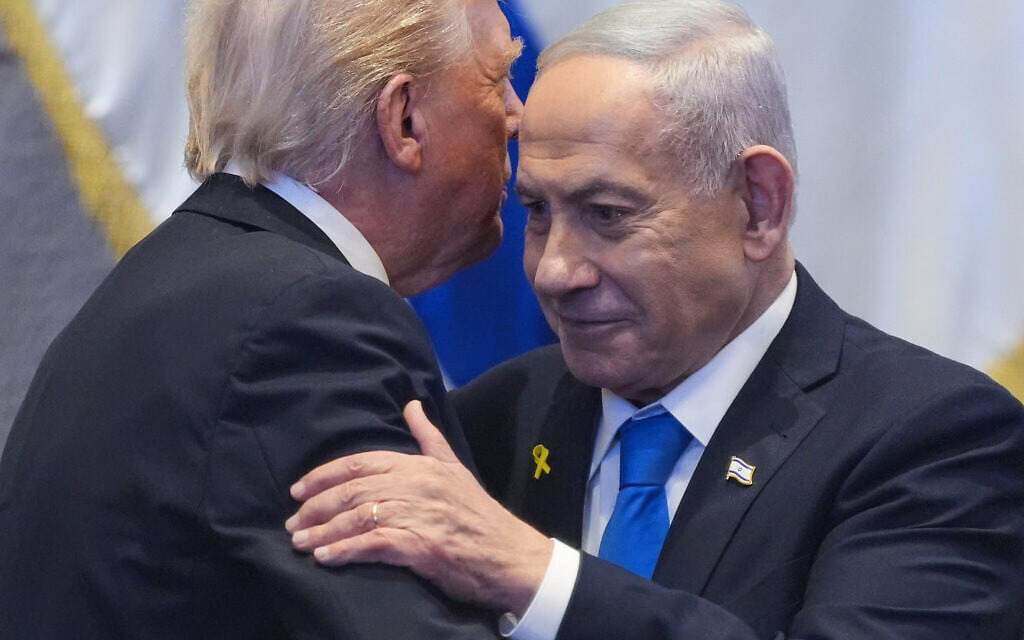
Long Game Hug: US President Donald Trump talks with Israel’s Prime Minister Benjamin Netanyahu in the Knesset, Oct. 13, 2025.(AP Photo/Evan Vucci, Pool), source: Times of Israel
In the grand theatre of geopolitics, the script is typically written by finite players—statesmen who measure success in election cycles, treaties, and battlefield victories. Yet, a rare few leaders emerge who refuse to play by this script, treating every conclusion as a new beginning. They are the grand continuers. To understand them, we require a different lens, a framework that offers, in the words of philosopher Robert Pirsig, a “new pattern for understanding the facts you already have.” James Carse’s philosophical treatise, Finite and Infinite Games, provides just such a pattern. It proposes that human interaction can be understood as one of two types of games: finite games, played to be won, and infinite games, played for the sole purpose of continuing the play. This analysis posits that both Donald Trump and Benjamin Netanyahu, contrary to the typical political scorecard, are master practitioners of the “infinite game.” Their ultimate goal is not to win a single election or conflict, but to perpetuate the play of power, influence, and national survival. This systematic, comparative analysis reveals how both leaders use the tactical victories of finite games to fuel their strategic, infinite objectives.
The Arena of Power
To comprehend the strategies of leaders like Trump and Netanyahu, it is essential to first grasp the distinction between the two types of games defined by James Carse. This is the bedrock of our analysis, moving beyond simplistic labels of “winning” and “losing” to a deeper understanding of political motivation, resilience, and long-term strategy. The finite player seeks closure and a title; the infinite player seeks continuation and the strength to keep playing. This fundamental difference in objectives shapes every decision, tactic, and rhetorical flourish.
The core principles of these two games, synthesised from Carse’s philosophy, reveal two starkly different approaches to power and purpose.
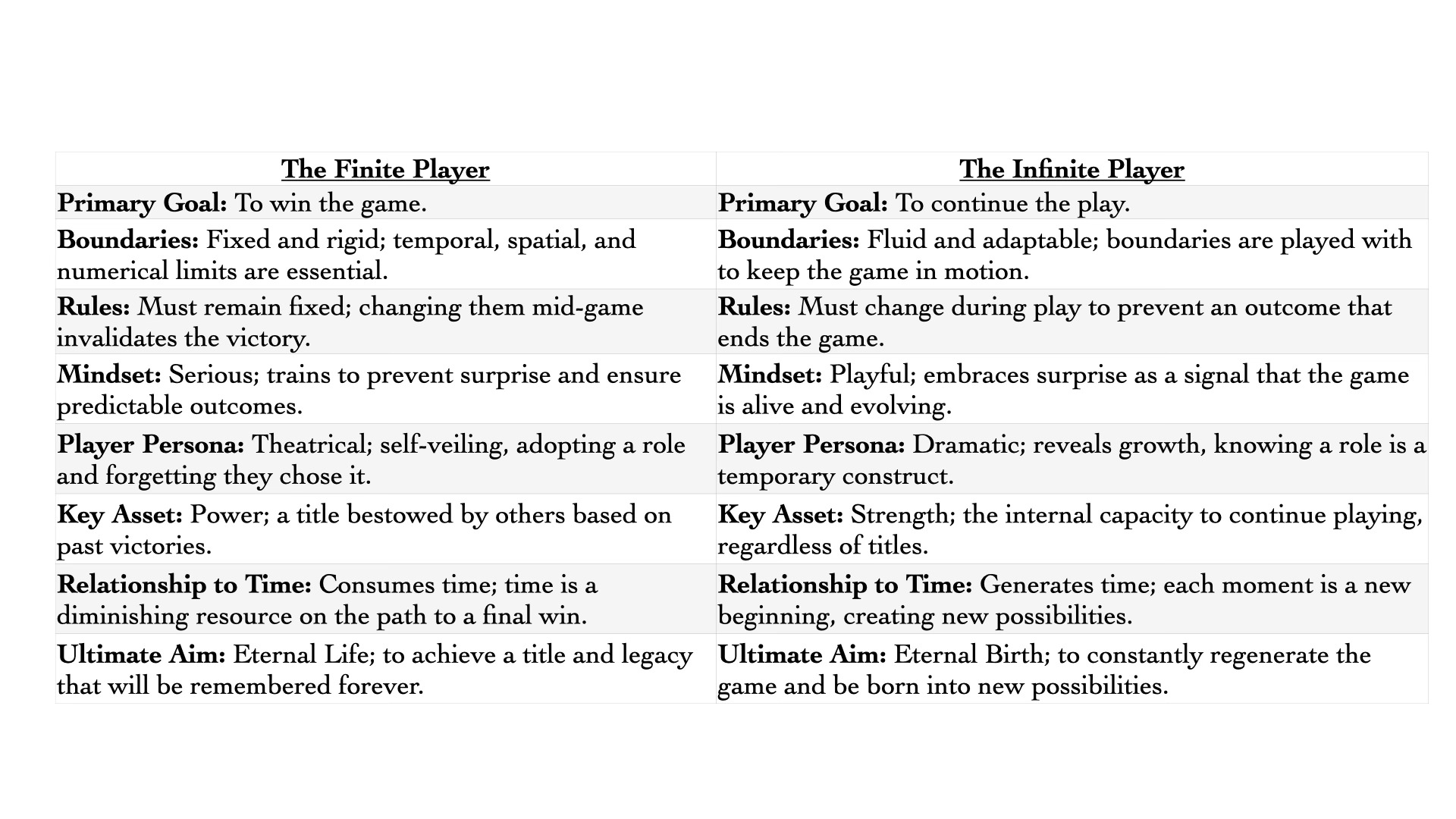
This theoretical framework provides the necessary tools to study the political careers of our two subjects, revealing the underlying logic of their seemingly unpredictable actions.
The Players
Donald Trump and Benjamin Netanyahu are complex figures whose long and often disruptive careers are best understood through the infinite game lens. They are not merely politicians seeking the next victory but strategists whose core objective is the continuation of their influence and the perpetuation of the games they have chosen to play—be it the reshaping of global alliances or the survival of a nation. While their methods are distinct, they share an underlying logic that prioritises endurance over finality.
Donald Trump’s Infinite Playbook
Donald Trump’s political and diplomatic style is a masterclass in infinite play, consistently subverting the established rules of engagement to keep his opponents off-balance and the game in motion.
Changing the Rules of the Game
Trump’s diplomatic methodology, described by analysts as “Post-Modern Realpolitik,” is a textbook example of an infinite player altering the rules to his advantage. By deploying unconventional envoys like real estate developer Steve Witkoff, he bypassed the State Department’s “obstacle course” of formal expertise. He masterfully blurs business and diplomacy, treating international relations as a “mixed-use real estate project” where commercial leverage and statecraft are integrated. This approach, combined with his mastery of spectacle, fundamentally changes the nature of the diplomatic game from one of protocol and process to one of personal dominance and transactional dealmaking.
Embracing Surprise
The finite player, according to Carse, “train[s] to prevent surprise.” Trump, in contrast, weaponizes it. His “tactical ambiguity” keeps allies and adversaries in a constant state of uncertainty, forcing them to engage on his terms because “they couldn’t know what would happen if they didn’t.” His off-the-cuff remarks are not signs of chaos but deliberate moves to disrupt the finite game. His joke to the Israeli Knesset that Arab leaders waiting for him in Egypt might “have taken their Boeing 747s and left” was a masterful play with the boundaries of diplomatic time and protocol, asserting his centrality and forcing all other players to wait on his move, thus reinforcing his dominant role in the infinite game of regional power.
Strength over Power
Trump’s “Peace Through Strength” doctrine is the political manifestation of Carse’s infinite “strength”—not the power to win a final battle, but the capacity to perpetuate the game from a position of dominance. It is not about using military might to achieve a finite victory, but about creating a condition of perpetual advantage that forces opponents to continuously react, ensuring the continuation of play on his terms. The success of this approach is validated by the unified praise he received in the Israeli Knesset, where Prime Minister Netanyahu declared, “No American president has ever done more for Israel.” This was not praise for a single victory, but for a fundamental strengthening of Israel’s position, enabling its own infinite game to continue.
Benjamin Netanyahu’s Infinite Game of Survival
Benjamin Netanyahu’s long political career is a testament to the art of continuation. His primary objective is not just winning the next election but ensuring the continuation of his political influence and, by extension, the infinite game of Israel’s security and national survival.
The Goal of Continuation
For Netanyahu, every political and military action is a move to perpetuate the game. His statement in the Knesset, that Israel paid a “high price” in the war so that “our enemies now understand... Israel is here to stay,” perfectly captures this infinite mindset. The goal was not merely to win a two-year war but to send a message of endurance that would secure Israel’s future participation in the regional game. Victory is a means to continuation, not an end in itself.
Playing with Boundaries
The infinite player adapts boundaries to keep the game alive. Speaker Amir Ohana highlighted how Netanyahu navigated the “great pressures” of the war by making the “harder decisions” about “how much we have to be hard towards Hamas and when we have to be more moderate.” This is not indecisiveness but a strategic flexibility. By modulating his approach—sometimes hardening boundaries, sometimes softening them—he prevented a stalemate or a catastrophic loss that could have ended the game, ensuring both his political survival and the nation’s.
The Dramatic Statesman
An external analysis notes that Netanyahu embodies the “contradictions required for survival in Israel’s unstable political system.” This aligns with Carse’s “dramatic” infinite player. Unlike a finite player who becomes fused with their theatrical role—believing they are the wartime leader—Netanyahu’s shifting personas demonstrate the dramatic player’s awareness that the role is a temporary tool, adopted to navigate a specific moment in the infinite game of political survival. He reveals not a fixed character, but a dynamic capacity for growth and adaptation in service of continuation.
It was this shared mastery of infinite strategy—changing rules, flexing boundaries, and prioritising endurance—that allowed them to turn their most significant finite challenge into a strategic victory that would reset the entire game.
The Finite Victory as a Strategic Move
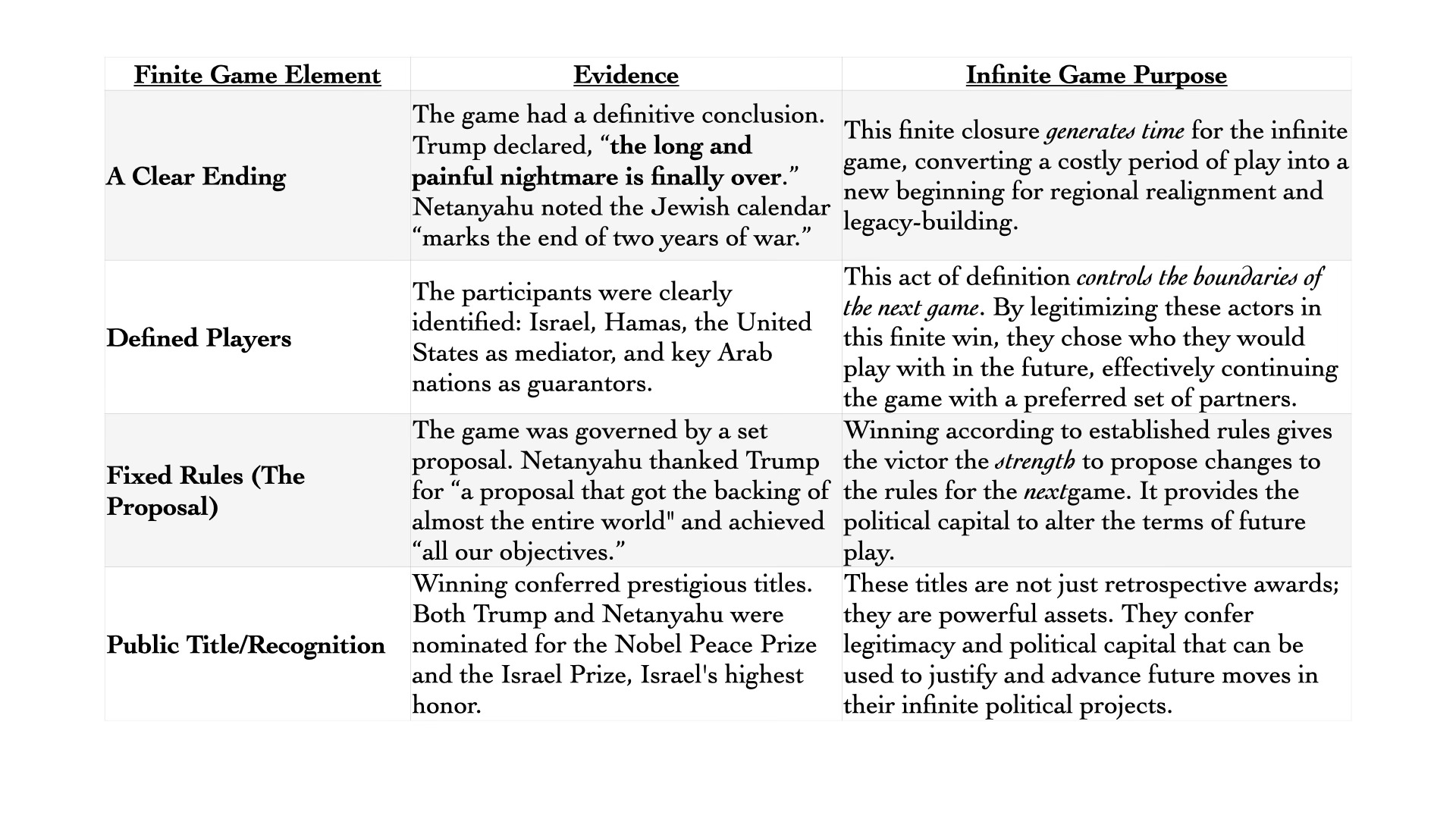
The genius of an infinite player lies not merely in playing an infinite game, but in mastering the art of “nesting”: using finite victories as fuel for their ultimate purpose of continuation. Understanding this principle is the key to differentiating these leaders from conventional politicians, who see finite victories as ends in themselves. For Trump and Netanyahu, the successful conclusion of the two-year war and the return of all live hostages was not an end. It was a momentous finite victory played within the infinite game—a pivotal move designed to reshape the Middle East and secure their political legacies.
The Peace Deal as a Finite Game
The agreement that ended the war contained all the hallmarks of a classic finite game, played for the purpose of a clear and decisive win.
The Rhetoric of Victory
The language used by both leaders to frame this finite victory reveals their infinite objectives. They presented the win not as a conclusion, but as a new beginning.
- Trump explicitly coached Netanyahu on this pivot. He told the Knesset, “Bibi, you’re going to be remembered for this far more than if you kept this thing going, going, going — kill, kill, kill.” This was a strategic reframing, urging his partner to move beyond the finite game of attrition and into the infinite game of legacy, statesmanship, and lasting regional influence.
- Netanyahu masterfully translated the finite military victory into a resource for the infinite game of national survival. He declared that demonstrating Israel’s resolute strength was “the indispensable foundation of peace.” This rhetoric positions the war’s conclusion not as an end, but as the establishment of a new, stronger starting position from which Israel can continue to play the infinite game of ensuring its future.
This masterful use of a finite victory to fuel infinite aims demonstrates a political approach that must now be studied at its core principles.
The Game That Never Ends
By viewing Donald Trump and Benjamin Netanyahu through the clarifying lens of James Carse’s Finite and Infinite Games, their seemingly chaotic or controversial actions resolve into a coherent and formidable strategy. Their careers are not defined by a quest for final victory but by a relentless drive for continuation. They do not play to conclude the game; they play so that they can keep playing, constantly adapting the rules, boundaries, and narratives to ensure their own political endurance and the survival of the projects they lead. They embody a political philosophy fundamentally different from that of their peers.
- The Finite Politician plays to win the next election; The Infinite Player plays to reshape the political landscape for a generation.
- The Finite Politician adheres to existing rules; The Infinite Player changes the rules of the game itself.
- The Finite Politician seeks the power of a title; The Infinite Player cultivates the strength to continue playing, with or without a title.
Carse makes a final, profound distinction between the ultimate aims of the two players. Their ultimate aim is not to achieve the static immortality of eternal life, where a legacy is carved in stone, but to master the art of eternal birth—constantly regenerating the game and being born anew into the endless possibilities of power. They play not to build a monument to their past victories, but to ensure they are forever relevant in the game that never truly ends.
Sources:
James P. Carse, Finite and Infinite Games: A Vision of Life as Play and Possibility. New York: The Free Press, A Division of Macmillan, Inc.
Khaled Salih, 20251026, “Rubio is the Signal, Ignore the Noise.” https://khaledsalih.substack.com/p/rubio-is-signal-ignore-the-noise
— 20251020, “Thomas Small’s Smokescreen on TRIGGERnometry.” https://substack.com/home/post/p-176742220
— 20251020, “The_Kushner_Factor.” https://khaledsalih.substack.com/p/the-kushner-factor
— 20251019, “War of Revival at the Core of Israel’s Antifragility.” https://substack.com/home/post/p-176597531
— 20251017, “Dominance: Donald Trump’s Art of Humiliation as Statecraft.” https://substack.com/home/post/p-176432039
— 20251016, “‘I, Donald J. Trump,’ Love Israel and the Middle East.” https://substack.com/home/post/p-176367071
— 20251014, “The cilantro leader: A review of Amit Segal’s A Call at 4 AM.” https://substack.com/home/post/p-176133419
— 20251006, “Israel’s Black Swan and the Jump to Antifragility.” https://khaledsalih.substack.com/p/israels-black-swan-and-the-jump-to
Simon Sinek, 20190513, “The Infinite Game: How to Lead in the 21st Century.” www.youtube.com/watch?v=3vX2iVIJMFQ


