Nadav the Arrogant
By Khaled Salih

Setting the Stage
The “Call Me Back Live in NYC” event convened a panel of prominent commentators—moderated by Dan Senor and featuring Amit Segal and Nadav Eyal—to discuss the multifaceted crises facing Israel in the wake of war. While ostensibly a dialogue among peers, the discussion quickly established a distinct hierarchy of voice and influence. This attempt provides a meticulous, multi-faceted analysis of Nadav Eyal’s communication style and its palpable impact on the debate’s dynamics and substance. We will move beyond subjective impression to highlight Eyal’s rhetorical posture by integrating quantitative conversational data with established theoretical frameworks from neuroscience, psychology, and philosophy. In doing so, I aim to reveal the deep structure of a communicative performance that not only commanded attention but also shaped the very reality being discussed.
Quantitative Analysis of Conversational Dynamics
Before delving into the content of the arguments, let us examine the quantitative metrics of the event itself. By measuring objective patterns of interaction—such as the allocation of questions and the distribution of speaking turns—we can reveal the underlying power dynamics and conversational control that might otherwise remain subjective impressions. These metrics provide a skeletal framework upon which the more substantive analysis of rhetoric and cognition can be built, exposing how the architecture of the conversation privileged one voice over another.
Moderator’s Focus
The most direct mechanism for controlling a panel discussion is the moderator’s allocation of questions. A quantitative audit of the transcript reveals a significant imbalance in Dan Senor’s management of the conversation, a pattern that consistently positioned Nadav Eyal as the primary respondent and central intellectual figure of the event.
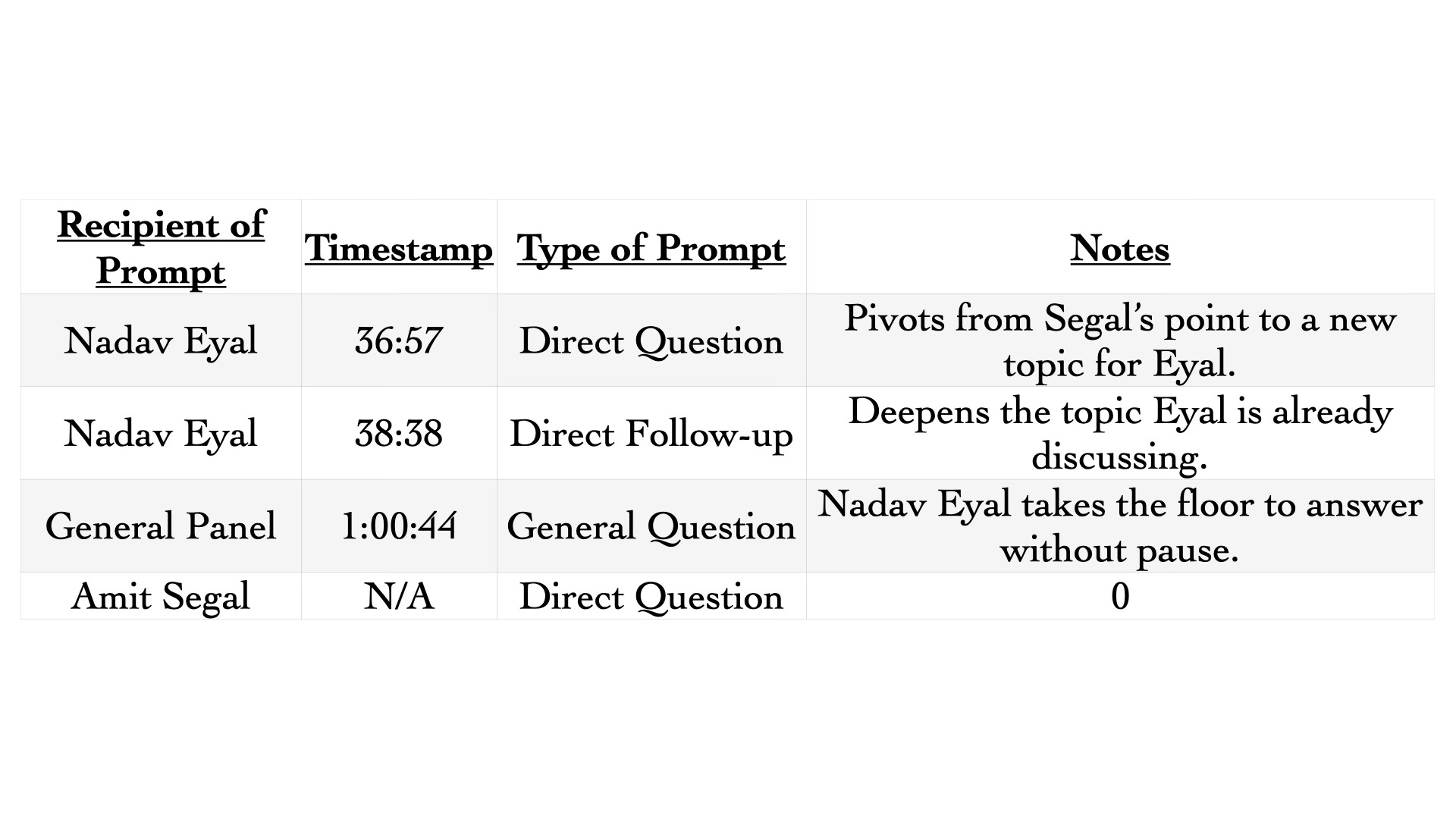
This data provides a more robust and defensible foundation for this argument about conversational dominance. Senor not only directed his most substantial and challenging questions exclusively to Eyal, thereby inviting him to frame the discourse on key strategic issues, but also ceded the floor to him when posing questions to the panel at large. The prompt at 1:00:44 (“A year from now, will Benjamin Netanyahu still be prime minister?”) was open, yet Eyal immediately captured it at 1:00:56. This unequal distribution of conversational cues—both direct and captured—implicitly cast Eyal as the panel’s principal authority and Segal as a secondary contributor, a dynamic that would be borne out in the subsequent allocation of time.
Time and Thematic Control
The moderator’s focus on Eyal, combined with Eyal’s own expansive responses, created an environment where Amit Segal’s contributions were systematically marginalised. This pattern is most evident in the long portion of the discussion between timestamps 36:57 and 58:05, a span of over twenty minutes where Segal is rendered almost entirely silent.
This marginalisation was not merely a matter of time but of thematic control. At 36:19, Segal attempts to introduce a critical and concrete point about the physical reality of the war’s aftermath:
“There was a map yesterday showing that 62% of the buildings in Gaza were reduced to ruins in this war... I think the Israeli media should cover more what is going on in Gaza.”
This is a substantive, empirical point that invites a deeper discussion about media responsibility and the tangible consequences of the conflict. However, the moderator, Dan Senor, immediately pivots away. While politely acknowledging the point with, “Okay, I want to come back to that,” he promptly changes the subject and directs a new, “uncomfortable question” back to Nadav Eyal. Segal’s topic is never revisited. This sequence serves as a clear illustration of how the conversational agenda was controlled, steering away from Segal’s grounded observation and back toward the more abstract, strategic framework favoured by Eyal.
The quantitative data on conversational dominance thus serves as a powerful bridge to a qualitative analysis of the arguments themselves, revealing how the structure of the dialogue enabled the substance of a particular view to prevail.
Cognitive Dissonance
In the context of political rhetoric, cognitive dissonance refers to the mental stress experienced when an individual holds two or more contradictory beliefs or values simultaneously. A skilled orator often seeks to resolve this dissonance for an audience, but sometimes their own argumentation reveals a deep, unresolved contradiction. Next will focus on a rhetorically potent dissonance at the core of Nadav Eyal’s commentary:
the simultaneous celebration of profound national achievement and the implicit dismissal of the political and state structures that make such achievement possible.
The Paradox of Achievement Without a State
Eyal’s narrative of the conflict is one of resounding success. He presents a triumphant vision of a nation overcoming a profound threat, stating that “the attempt to attack Western civilisation, especially the Jewish state, failed, and it failed big time” (8:02). Yet, when identifying the agents of this victory, his rhetoric performs a curious sleight of hand. Instead of crediting the state’s leadership or institutions, he foregrounds the actions of an individual citizen:
“… the one that began fighting this axis of evil was a singer-songwriter from Israel on October 7th. His name was Aner Shapira.” (8:25)
While celebrating individual heroism is powerful, Eyal’s consistent framing constructs an apparent paradox. He praises the achievements of “the Jewish state” while minimising or erasing the role of the actual state—the political echelon in Israel, including the Prime Minister, the Minister(s) of Defence, and state institutions such as the IDF and Mossad. This rhetorical choice constructs a nation that succeeds not because of, but in spite of, its organised leadership. The triumph belongs to an amorphous “society” or heroic individuals, while the state apparatus remains conspicuously absent from the narrative of success.
Ostrich Parasitic Syndrome
This narrative tendency can be effectively analysed through the lens of what Gad Saad terms Ostrich Parasitic Syndrome (OPS). In his book The Parasitic Mind, Saad defines OPS as “a malady of disordered thinking that robs people of their ability to recognize truths that are as obvious as the existence of the sun” (Saad 2020).
Eyal’s argument exhibits a rhetorically useful form of this syndrome. The rhetorical utility of this manoeuvre lies in its power to construct an emotionally resonant narrative of citizen-led heroism that neatly bypasses the complexities and controversies of state action. By constructing a story of a leaderless victory, he fails to acknowledge the obvious truth that large-scale national military and strategic successes are fundamentally dependent on the actions—however flawed—of the state’s political and military leadership. The mobilisation of reserves, the execution of complex military operations, and the engagement in high-stakes international diplomacy are not conducted by singer-songwriters, however heroic their individual actions may be. By deploying an OPS-like narrative, Eyal effectively buries the “obvious truth” of the state’s central role, presenting a compelling but ultimately dissonant account of events that allows for the celebration of victory without an endorsement of the incumbent political structure.
This analysis of the content of Eyal’s dissonant arguments naturally leads to an examination of the underlying cognitive style and intellectual posture that generates them.
Arrogance
To fully comprehend the force of Nadav Eyal’s rhetoric, we must move beyond surface-level observations of conversational patterns and argument content. In this section I shall analyse the deep structure of his rhetorical arrogance using specific theoretical lenses from neuroscience and psychology. By employing Iain McGilchrist’s influential model of the divided brain, supplemented by frameworks from Gad Saad and David Deutsch, we can build a cohesive psychological profile of Eyal’s communicative posture. This approach allows us to interpret his confidence not merely as a personality trait, but as a manifestation of a specific, dominant, and ultimately limited mode of processing the world.
The Tyranny of the Emissary
In his seminal work, The Master and His Emissary, neuroscientist Iain McGilchrist posits that the brain’s two hemispheres offer two fundamentally different “takes” on reality. The Master (the Right Hemisphere) provides a holistic, intuitive, and contextual understanding of the world, grounded in embodied, lived experience. The Emissary (the Left Hemisphere) processes the world in a different manner: it creates abstract, de-contextualised, and fragmented representations that are useful for manipulation and control but are ultimately a simplified map, not the territory itself. McGilchrist argues that the Emissary has begun to act as if it were the Master, creating a world based on its own self-referential models while dismissing the holistic wisdom of the Master. Nadav Eyal’s rhetorical style provides a powerful case study of the Emissary’s tyrannical dominance.
The Emissary’s Worldview
Nadav Eyal’s arguments frequently rely on abstract models and generalised historical and political doctrines over the messiness of lived reality [44:05, 30:27]. When analysing the perception of disproportionate international media coverage, he moves beyond the specific context and instead offers a de-contextualised comparison to the political system of the United Kingdom [33:16], noting the emergence of a new party dedicated “only with one thing: Gaza” [33:34] to argue that the intense focus on Israel “is not about Gaza, it’s about the Jews” [34:01]. Eyal similarly analyses the profound human and societal trauma of the hostage crisis by framing it mechanistically as an “anomaly” compared to the international community (citing 2,000 Ukrainian children sent to Russia) and by searching for a definitive military “recipe” for the security doctrine, demonstrating a preference for structural models and strategic calculations [44:05, 44:18].
This reliance on abstraction, categorisation, and utility exemplifies the Emissary’s mind at work. As McGilchrist observes, the Left Hemisphere’s thinking is inherently de-contextualised and tends toward “a slavish following of the internal logic of the situation, even if this is in contravention of everything experience tells us.” Such analytic formulations prioritise a “clean, generalised re-presentation” or theoretical model, where the goal is certainty and power to manipulate, over the complex, painful, and embodied experience of the events. The Emissary, or Left Hemisphere, is frequently “less capable of understanding what it does see,” and in pursuing this abstract view, it produces a vision that is “detached, disembodied, mechanical,” and ultimately “lifeless.”
The Confabulating Interpreter
The Left Hemisphere, when dominant, does not tolerate ambiguity or gaps in its knowledge. McGilchrist describes the left-hemisphere “interpreter,” a mechanism that, when faced with information it cannot readily understand, prefers to “make up something plausible ... to fill” the void (McGilchrist, 2009). This manufactured explanation is then presented with absolute certainty.
This process is on full display in Eyal’s response to Dan Senor’s nuanced challenge at 38:38. Senor raises a complex paradox: the moving spectacle at Hostage Square is both a sign of societal strength and a strategic tool for Hamas. This is a difficult, ambiguous reality. Eyal’s “interpreter” immediately resolves the tension, not by grappling with the ambiguity, but by reframing the issue with a simple, declarative statement about democracy. He then asserts this re-framing with unshakable conviction: “it was absolutely the case” (39:21). He does not explore the paradox; he eliminates it. As McGilchrist observes, the Left Hemisphere offers its conclusions not “in a guessing vein but rather [as] a statement of fact” (McGilchrist, 2009).
Suppressing the Master’s Voice
The dynamic between Eyal and Segal can be powerfully interpreted through the Master-Emissary lens. Amit Segal’s interjection about the vast physical destruction in Gaza (36:19) and the need for Israeli media to confront it represents the Master’s (Right Hemisphere) attempt to introduce embodied, difficult, and contextual reality into the discussion. It is an appeal to look at the visceral, uncomfortable truth on the ground.
Nadav Eyal’s subsequent rhetorical dominance, facilitated by the moderator, functions as the Emissary’s (Left Hemisphere) dismissal of this inconvenient data. The conversation is immediately steered away from the rubble of Gaza and back toward Eyal’s preferred abstract, strategic arguments. This dynamic mirrors the allegory from Nietzsche, recounted by McGilchrist, of the trusted Emissary who, in his self-importance, “became contemptuous of his master” (McGilchrist, 2009), ultimately usurping him. In the process, the concrete, holistic perspective was tabled in favour of the abstract, self-confident representation.
The Parasitic Mind
Gad Saad identifies “polylogism” as the flawed premise that an individual’s “method of thinking was determined by his social class” or, by extension, their unique experience (Saad 2020). It is a rhetorical tactic that asserts one’s arguments are derived from a special, inaccessible mode of knowing, thereby invalidating any critique from those who have not shared that specific experience.
Nadav Eyal employs a classic form of rhetorical polylogism in his argument:
“Only a person... who traveled to Gaza during the war, who spoke with the troops... would have seen the screens that I have seen” (50:03).
This statement functions as more than a simple rhetorical shield; it is an assertion of a private, inaccessible epistemology. It attempts to shift the entire grounds of argumentation from the logical coherence of a claim to the experiential authority of the claimant. By implying that any counter-argument is illegitimate because it lacks access to a unique Gnostic truth available only to a select few, Eyal’s move is fundamentally at odds with rational discourse. It is a debate-ending manoeuvre that makes claims unfalsifiable by rendering them dependent not on public evidence but on private revelation.
Deutsch’s Anti-Rational Memeplex
Physicist David Deutsch uses the persistence of antisemitism as an analogy for an “anti-rational memeplex”—a self-sustaining pattern of belief that survives not by being true, but by “constantly inventing new justifications when old ones fail.” Nadav Eyal’s core narrative—one of absolute Israeli victory and unwavering moral clarity—functions in a similar way.
When this core narrative is challenged by contradictory evidence, it does not break; it adapts. For example, when Dan Senor introduces the idea that the hostage crisis has taken a wrecking-ball to Israeli society (38:38)—a fact that complicates a simple narrative of victory—Eyal’s memeplex does not collapse. Instead, it generates a new justification: the societal division is re-framed as proof of a vibrant, healthy democracy in action (39:02). In this way, contradictory data is co-opted and reinterpreted to support the original premise, making the narrative functionally immune to falsification. While Deutsch’s term is “anti-rational,” it may be more precise to say that Eyal’s narrative is not devoid of reason, but rather operates under its own self-contained and self-validating rationality, a closed system impervious to external critique.
Together, these theoretical frameworks from neuroscience, psychology, and philosophy converge to paint a remarkably consistent portrait of a rhetorical strategy rooted in abstraction, certainty, and self-validation—the triumphant, and tyrannical, voice of the Emissary.
The Emissary’s Victory and the Price of Clarity
The preceding analysis demonstrates that Nadav Eyal’s rhetorical performance during the “Call Me Back Live” event is a masterclass in communicative control. His success is not accidental but rooted in a distinct and powerful cognitive style. This style is characterized by quantifiable conversational dominance that marginalises alternative viewpoints; a foundational and rhetorically potent dissonance that celebrates national success while erasing the state apparatus that enables it; and a deep psychological posture consistent with what Iain McGilchrist terms the “tyranny of the Emissary.” By prioritising abstract models, asserting absolute certainty in the face of ambiguity, and deploying rhetorical shields to deflect inconvenient truths, Eyal constructs a compelling, internally consistent, and intellectually commanding arrogant narrative symptomatic of the Emissary’s self-referential world. However, this victory comes at a significant price. While such an approach projects an aura of immense clarity and control, it achieves this by suppressing unwelcome realities, marginalising nuanced perspectives, and ultimately creating a closed, self-validating version of reality.
Sources:
Call me Back, 20251017, “Call me Back LIVE in NYC - with Nadav Eyal and Amit Segal.” www.youtube.com/watch?v=mI-hRV823YY
David Deutsch, 2011, The Beginning of Infinity: Explanations that Transform the World. New York, NY: Viking.
The Duke Report, 20250807, “A User’s Guide to Neuro-Linguistic Defense. Defending Yourself From Word Magic.”

Iain McGilchrist, Iain, 2009, The Master and His Emissary: The Divided Brain and the Making of the Western World. New Haven: Yale University Press.
—, 2021, The Matter With Things: Our Brains, Our Delusions, and the Unmaking of the World. London:Perspectiva Press.
Gad Saad, 2020, The Parasitic Mind: How Infectious Ideas Are Killing Common Sense. Washington, DC: Regnery Publishing.


