Mamdani-the-son: Identity as Political Armour
By Khaled Salih
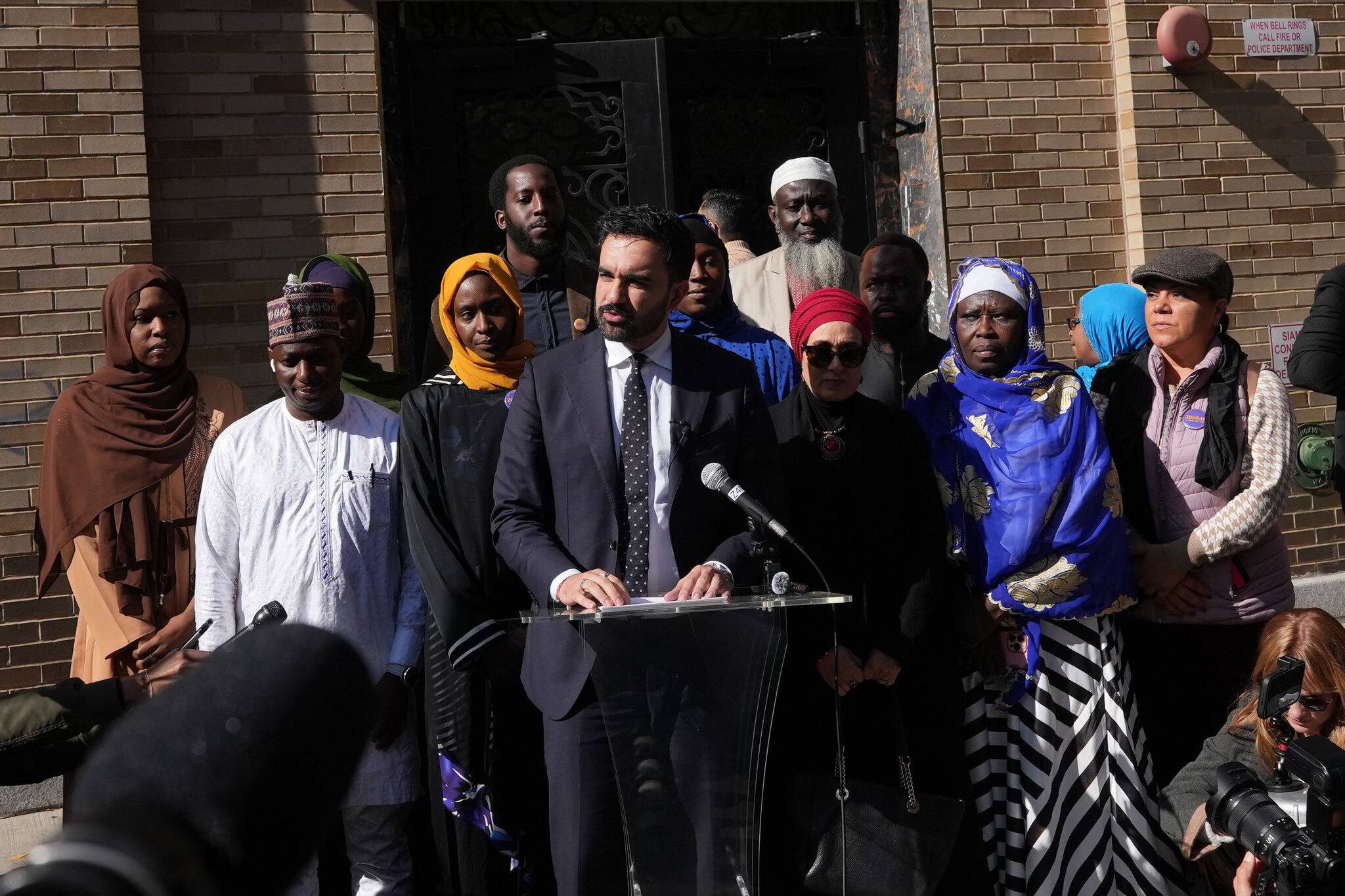
Zohran Mamdani: “You are my human shield!” NYT
The photograph could have been composed by a Renaissance painter of moral allegories. A man in a dark suit stands at a clear podium, his expression a studied mixture of gravity and resolve. Behind him, a dozen faces form a living backdrop: men and women, most of them Black Muslims, several in headscarves or traditional dress, all arranged with the symmetry of purpose. The sunlight catches the folds of fabric; the microphones gleam like minor deities of modern piety. The scene feels less like a press conference than a benediction.
The accompanying headline from The New York Times reads: “Mamdani Says Rivals Are Pushing Hate as Mayor’s Race Enters Last Stretch.” The text accuses; the image absolves. Here stands the candidate not as a man in politics but as a man under siege, defended by the virtuous. The moral choreography is immaculate:
“those behind me are my evidence, my human shield, my rebuttal in flesh and fabric.”
Before a syllable is spoken, the picture delivers its verdict—criticism of him will look suspiciously like criticism of them.
This is the perfected grammar of contemporary politics. Words are expendable; optics are not. Identity has become the most efficient form of rhetorical armour—a way of converting moral history into campaign capital. In the old world, a politician defended himself with argument. In ours, he surrounds himself with immunity.
The effect is subtle but devastating to the life of the mind. If virtue can be borrowed simply by proximity to the historically oppressed, then ideas no longer need to withstand scrutiny. The photograph itself does the thinking: it tells us who is good, who is wronged, who must be shielded from censure. It is a tableau that says, “I represent justice; therefore I cannot be unjust.”
In New York—a city addicted to performance—this kind of imagery finds its natural habitat. Its Muslim population is enormous and diverse, yet Black Muslims make up only a small fraction of the whole. Their prominence in this frame therefore magnifies a sliver of reality into a moral majority. What may have begun as solidarity becomes spectacle: a demographic fact transfigured into a symbol of virtue. The camera, that tireless liar of modern life, turns diversity into divinity.
To call this cynical is not quite right. It is worse than cynicism; it is piety without reflection. The individuals behind the podium are almost certainly sincere. They stand because they believe in the cause or the candidate. But the function of their presence, within the choreography of political theatre, is to create a visual taboo. The moral power of identity—once a call for recognition—has been refashioned into a prophylactic against dissent.
This is how moral capital circulates in the public square today: not through argument but through adjacency. A politician framed by a coalition of the pious or the marginalised does not need to say, “I am good.” The lens says it for him. Criticism then becomes not a matter of evidence but of etiquette—an impropriety, a social blunder, almost an act of bigotry. The photograph achieves what a thousand press releases cannot: it intimidates.
The irony, as ever, is that such theatre is bipartisan. The progressive gathers refugees; the conservative poses with police officers or soldiers; the corporate titan flanks herself with smiling workers of several hues. The message never changes: look who stands behind me, therefore look who cannot be against me. It is the same stale trick played to different music. Representation becomes stagecraft; empathy becomes choreography.
And yet the damage is real. When human beings are enlisted as moral shields, they are not being empowered; they are being instrumentalised. The claim of inclusion curdles into spectacle, and politics becomes a ceremony of self-exoneration. We no longer test ideas for coherence; we test photographs for diversity. It is, if you like, a kind of spiritual bribery: the attempt to purchase immunity with someone else’s virtue.
The antidote is both simple and demanding. A civilisation that values freedom of thought must recover the courage to look past optics and to insist that ideas stand naked, unaccompanied by sentimental props. To evaluate a politician by the costume of his supporters is to surrender reason to reflex. The citizen’s duty is not to applaud the tableau but to interrogate the script.
A century ago, Orwell warned that political language was designed to make lies sound truthful and murder respectable. He could not have imagined that imagery itself would one day replace the language altogether. The photograph has become the argument. The more we worship diversity as ornament, the less we practise it as discourse.
The picture of Zohran Mamdani—whether one finds him admirable or not—will drift soon enough through the data streams of our amnesiac age. But the habit it represents will endure until we relearn an older art: to separate authenticity from artifice, solidarity from staging. Until then, identity will continue to serve as armour—bright, burnished, and impenetrable—and behind it, the slow suffocation of thought will proceed unopposed.


