Lost in the Left: How Hamas Ruined Gaza and the Palestinian Cause
By Khaled Salih
October 7, 2023
“I say to the masses of the people and our nation, and to the free people of the world: Today, the wrath of al-Aqsa has exploded – the rage of our people, our nation, and the free people of the world. I say to our pure mujahideen: This is the day that you make this criminal enemy understand that its time is up. [The Quran says:] 'Kill them wherever you may find them.’”
—Mohammed Deif — Hamas Military Commander
October 7, 2023 was a day of unprecedented terror in Israel, and a day that unleashed disastrous consequences for Gaza. In a meticulously planned onslaught, Hamas militants breached the border from Gaza into Israeli communities, killing around 1,200 people (the vast majority civilians, including infants, children, and the elderly) and abducting over 250 hostages, in what has been called the worst single-day massacre of Jews since the Holocaust (Roberts 2025). The Roberts Commission Report, a 318-page investigation by a British parliamentary panel chaired by historian Andrew Roberts, documented how Hamas fighters went house to house executing entire families, burned people alive in safe rooms, massacred en masse 260 youngsters at a music festival, and carried out acts of sadistic brutality including torture, beheadings, and sexual violence (Roberts 2025; Halperin-Kaddari et al. 2025). The assault—codenamed by Hamas as al-Aqsa Flood—was anything but a spontaneous military clash; it was a premeditated terror rampage designed to maximize civilian suffering. Hamas had even built mock Israeli towns for training and carried detailed kill-and-capture lists of civilians, underscoring the deliberate nature of the atrocity (Roberts 2025).
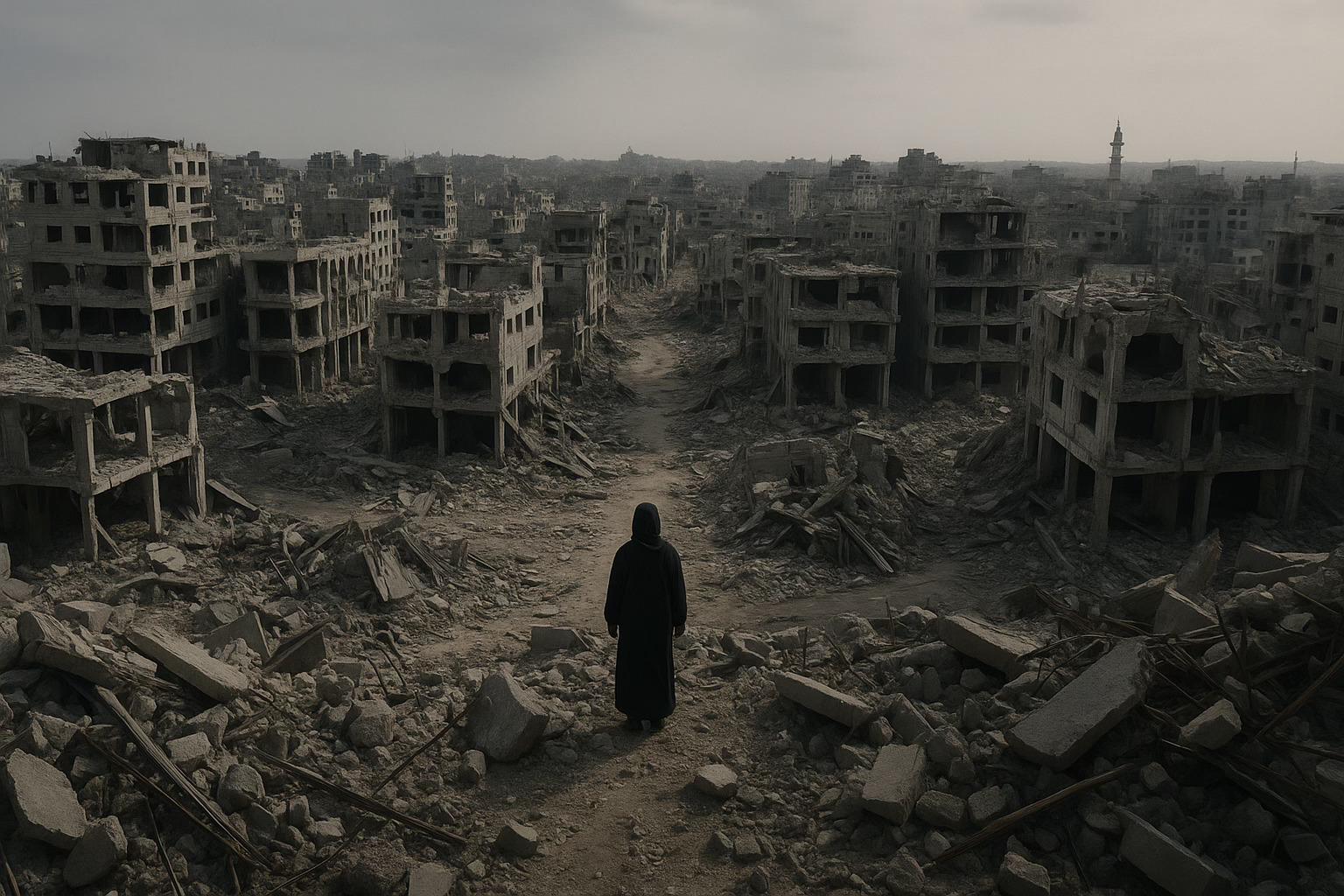
Israel’s response was swift and overwhelming. Within hours, Israeli forces began a relentless aerial bombardment and later a ground invasion of Hamas-ruled Gaza. What followed is the most intense conflict the Gaza Strip had seen. Entire neighborhoods were flattened, more than a million people displaced, and critical infrastructure wrecked, as the entire Strip was prepared to be use and abuse for the purpose of making any Israeli rescue attempts almost impossible without the level of sufferings Hamas had planned of the Gazans. Strategically, Hamas’s gambit triggered exactly what Israel’s leaders had long warned: a full-scale campaign to eradicate Hamas’s military capacity and leadership. Israeli officials vowed that Hamas, which had ruled Gaza since a 2007 coup, would “cease to exist” by the end of the war. In short, Hamas’s October 7 operation achieved a momentary tactical surprise at an unfathomable moral cost—and in return brought unprecedented suffering upon Gaza and a perilous setback to the broader Palestinian national cause.
Why would Hamas pursue such a path of action? How could its leadership celebrate a massacre that ultimately invited ruin upon its own people? To probe these questions, this essay examines Hamas’s mindset and decision-making through the lens of Iain McGilchrist’s hemisphere hypothesis—the theory that the brain’s left and right hemispheres attend to the world in profoundly different ways. McGilchrist, a psychiatrist and philosopher, argues that the left hemisphere of the brain, when functioning without the tempering balance of the right, yields a mode of thinking marked by abstraction, certainty, and a narrow focus on utility, often at the expense of empathy, context, and reality-testing (McGilchrist 2009; McGilchrist 2021). By contrast, the right hemisphere attends to the broad, lived context of experience, sees nuance and connections, and understands the unique, embodied reality of other beings (McGilchrist 2009). In McGilchrist’s metaphor, the right hemisphere is like a wise “Master” attuned to reality, while the left hemisphere is its efficient “Emissary,” a specialist in manipulation and analysis—an emissary that, in modern times, has usurped its master’s role, imposing its fragmented version of reality as if it were the whole (McGilchrist 2009). When “the Master’s emissary becomes a tyrant” (McGilchrist 2009), the result is a kind of cognitive tyranny: an outlook characterized by unwarranted overconfidence, denial of contradiction, loss of context, dehumanization, and rigidity. Strikingly, these are the very traits that appear to dominate Hamas’s leadership style and public statements.
To understand Hamas’s behavior after October 7, it is illuminating to enumerate several key features of left-hemisphere-dominated thinking, as identified by McGilchrist, and compare them with the observable traits of Hamas’s conduct:
- Denial of Reality and Refusal of Dissonance: The left hemisphere, McGilchrist notes, has a remarkable capacity for denial. When it dominates, people tend to “stick to their existing point of view”, disregard evidence that contradicts their narrative, and even “make stuff up… to maintain [their] point of view,” all with a “desperate need for certainty” (McGilchrist 2021; McGilchrist 2009). Failures or anomalies are rationalized away rather than confronted – “evidence of failure does not mean we are going the wrong direction, only that we have not gone far enough in the direction we are already headed” (McGilchrist 2009). So it has been with Hamas. In the wake of global outrage at the October 7 atrocities, Hamas leaders have either denied or downplayed the very crimes they proudly perpetrated. For external audiences, Hamas officials insisted that they had not intended to harm civilians, offering vague excuses about “complications on the ground” (Pacchiani and Bachner 2023). They flatly denied reports of rapes and sexual mutilation of Israeli women—despite mounting forensic evidence and testimonies compiled by independent investigators (Halperin-Kaddari et al. 2025; Rose 2025). A Hamas spokesman derided such accounts as “not worth commenting on,” essentially dismissing documented horrors as Zionist propaganda (Rose 2025). Yet, in stark contradiction, Hamas simultaneously celebrated the massacre to its home audience. The group released gruesome GoPro footage taken by the attackers, paraded hostages through Gaza’s streets, and lauded the “heroic operation” in its propaganda. This grotesque two-faced narrative led Andrew Roberts to observe of Hamas: “They are trying to celebrate something they deny happened, and deny something they’ve celebrated happening. It’s unlike anything else” (Philpot 2025). The denial began even as the massacres were ongoing (Philpot 2025) – a disinformation campaign aimed to muddy the waters, much like Holocaust denial, only in real time. Such behavior exemplifies the left-brain tyrant’s mindset: facts are irrelevant when they don’t fit the theory. Hamas’s leadership appears intent on “having their cake and eating it” (celebrating the terror for its supporters while erasing it before the world’s eyes), a feat possible only in a psyche divorced from reality.
- Overconfidence and Grandiosity: McGilchrist writes that a left-dominant mode breeds naïvely optimistic forecasting and a conviction of being “always the winner”, even against evidence (McGilchrist 2009). It “detests uncertainty,” jumping to definitive conclusions and clinging to them (McGilchrist 2021). Hamas leaders exhibit a brash certainty about their cause and outcome that, in hindsight, borders on delusion. In the weeks after October 7, as Gaza burned under Israeli airstrikes, senior Hamas figures remained triumphant and defiant. Yahya Sinwar, Hamas’s chief in Gaza, surfaced to boast that “Oct. 7 was just a rehearsal” – vowing even greater bloodshed to come (Jewish Chronicle 2023). Similarly, Hamas politburo member Ghazi Hamad declared in a televised interview, “The al-Aqsa Deluge [October 7] is just the first time, and there will be a second, a third, a fourth”, openly threatening to repeat the carnage “again and again” until Israel is destroyed (Pacchiani and Bachner 2023). Such statements were made even as Israel’s military was decimating Hamas’s command centers in Gaza. The overconfidence is astonishing: Hamas behaved as if the outcome was a foregone victory, portraying the calamity unfolding in Gaza as a temporary trial on the path to eventual triumph. “Will we have to pay a price? Yes, and we are ready to pay it,” Hamad said arrogantly, referring to the massive Palestinian civilian casualties as a price worth paying. “We are called a nation of martyrs, and we are proud to sacrifice martyrs”(Pacchiani and Bachner 2023). This rhetoric exemplifies the grandiose certainty and unflinching fatalism of an extremist ideology. It also reflects what McGilchrist describes as the left hemisphere’s entrenched single-mindedness—it cannot entertain doubt or alternative outcomes. Rather than reassess the wisdom of provoking a war that has devastated Gaza, Hamas’s response is to double down and promise more of the same, interpreting any setback as proof that they must “go further in the direction [they] are already headed” (McGilchrist 2009).
- Lack of Context and Vision Narrowing: A hallmark of left-hemisphere dominance is a focus on parts at the expense of the whole. McGilchrist notes that without the right hemisphere’s broader vision, the left hemisphere becomes “blind to what is not clear or certain or cannot be brought into focus right in front of it”, losing the “broader picture” (McGilchrist 2009). It acts like a mapmaker who mistakes his map for the territory, “imposing its own ‘map’ of reality heedless of contrary information” (McGilchrist 2021). One could argue that Hamas’s leadership became trapped in its own ideological “map” – a tight, simplistic narrative of resistance and divine victory – and thereby lost sight of the real-world context of its actions. The decision to launch the October 7 attack showed staggering strategic myopia. Tactically, Hamas achieved surprise and momentary brutal success; but strategically, it ignored the likely context and aftermath: that Israel (a far stronger power) would inevitably act with overwhelming force, and that much of the world would endorse Israel’s right to destroy Hamas in self-defense. Indeed, Hamas’s attack shattered any diplomatic progress that was being made on behalf of Palestinians. Prior to Oct. 7, Israel faced growing international pressure over the “occupation,” and regional diplomacy (like potential Saudi-Israeli normalization talks) was creating openings that Hamas opposed. By choosing maximal violence, Hamas ensured a maximalist response. The ensuing war has divided global public opinion, initially generating broad sympathy for Israel’s plight and later polarizing views as images of Gazan suffering spread. Crucially, Hamas’s actions sidelined the Palestinian agenda for statehood, if the ever had one, in favor of an all-or-nothing genocidal confrontation. As the war ground on, Palestinian President Mahmoud Abbas and the Palestinian Authority in the West Bank were marginalized, and any prospect of a peace negotiation or two-state solution became more remote than ever. In McGilchrist’s terms, Hamas failed to see the larger context – the humanity of Israeli civilians, the welfare of Gaza’s population, and the geopolitical reality that Israel cannot be eliminated by terror. Instead Hamas leaders saw only what their one-track mindset allowed: an opportunity to strike a sensational blow against “the occupation,” irrespective of the broader consequences. This echo of left-brain tunnel vision – “not seeing the whole means not seeing the context” (McGilchrist 2021) – led Hamas to make catastrophically poor judgments based on what their ideological map told them would happen rather than the reality unfolding around them.
- Dehumanization and the Loss of Empathy: Perhaps the most disturbing aspect of Hamas’s attack was the evident dehumanization of their victims. Eyewitness reports and forensic evidence compiled by the Roberts Commission and others indicate that many Hamas perpetrators engaged in acts of exceptional cruelty – rape, mutilation, torture – that went beyond killing for military aims and seemed driven by a desire to terrorize and degrade (Roberts 2025; Halperin-Kaddari et al. 2025). Such behavior requires seeing the other as less than human. It is noteworthy that Hamas’s ideology explicitly dehumanizes Israelis: Hamas’s long-standing charter casts the Jewish people in conspiratorial, demonic terms and calls for Israel’s annihilation, and Hamas spokesmen regularly refer to Israelis as “occupiers” and “rats” or “pigs” rather than fellow human beings. In Ghazi Hamad’s post-massacre interview, he chillingly said, “Israel is a country that has no place on our land… we must remove it… we are not ashamed to say this”, confirming that Hamas’s goal is not coexistence or negotiation but outright eradication of the other (Pacchiani and Bachner 2023). McGilchrist’s framework helps us see how dehumanization is linked to left-hemisphere thinking. The left hemisphere prefers the impersonal to the personal; it “categorizes” rather than empathizes. In a left-dominated worldview, “the impersonal would come to replace the personal… The human individual would be seen as an instance of a category rather than as a unique being” (McGilchrist 2021). This mode of thinking strips away the rich, empathetic understanding supplied by the right hemisphere—which is attuned to faces, emotions, living realities—and replaces it with abstractions and labels (McGilchrist 2009). Hamas fighters, indoctrinated with an absolutist ideology, were able to butcher children and old women in part because they no longer saw people—only “Zionist enemies” in an abstract struggle. Moreover, Hamas’s indifferent sacrifice of Gazan lives (boasting about martyrs and using civilians as human shields around military sites) suggests a similarly chilling abstraction of their own people as mere instruments of jihad. This reflects what McGilchrist describes as the left hemisphere’s propensity to objectify and exploit: “The left hemisphere’s take on the world… seeks to grasp and control it. The bonds between person and person, and between person and place, would be actively disrupted as incomprehensible to the left hemisphere acting on its own… Exploitation rather than cooperation would become the default relationship”(McGilchrist 2021). Indeed, Hamas’s reign in Gaza has often been characterized as tyrannical and exploitative: an Islamist police state that squelches dissent, brainwashes youth with a death-fetishizing ideology, and appropriates humanitarian aid for building tunnels and rockets. In the tyranny of the left hemisphere, empathy is eclipsed by ideology; likewise, under Hamas’s tyranny in Gaza, the natural human sympathies that should tether leaders to the well-being of their people were all but extinguished.
- Rigid Ideology and Absolutism: Finally, Hamas’s approach epitomizes the rigidity of a left-brain mindset. McGilchrist observes that the left hemisphere, enamored with its theories and categories, is “largely indifferent to discrepancies,” and will override lived experience in favor of its internal schema (McGilchrist 2009). It prefers clear binaries and “either/or” choices, whereas the right hemisphere is more comfortable with nuance and “both/and” complexity (McGilchrist 2009). Hamas’s worldview is nothing if not binary: It frames the conflict as absolute resistance versus absolute evil, permitting no shades of gray. In Hamas’s rhetoric, “we are the victims… everything we do is justified” (Pacchiani and Bachner 2023; Memri) while Israel is an illegitimate, permanent aggressor. There is no room in this narrative for Hamas itself ever to be at fault, nor for any form of compromise or coexistence. Notably, even after the war ravaged Gaza, Hamas leaders rejected calls for any kind of disarmament or transformation. Their ideology—rooted in theocracy and maximalist demands—remained inflexibly committed to Israel’s destruction. When asked if Hamas’s aim was the complete annihilation of Israel, Hamad answered, “Yes, of course” (Pacchiani and Bachner 2023; Memri). This is a textbook case of ideological rigidity, impervious to context or consequence. Such absolutism has a quasi-delusional quality. Analysts have likened Hamas’s fervor to a cult of death, noting how its propaganda glorifies martyrdom and promises victory through divine intervention rather than any pragmatic roadmap for improving Palestinian lives. The tragedy is that this rigid mindset sabotaged the very cause of Palestinian liberation. By pursuing an all-or-nothing goal, Hamas ensured a response that left Palestinians with nothing: thousands dead, communities shattered, and future prospects darker than ever. McGilchrist has drawn parallels between left-hemisphere dominated thinking and certain psychiatric conditions like schizophrenia, where an individual becomes trapped in an internal loop, unable to ground beliefs in shared reality (McGilchrist 2021). The schizophrenic mind, he notes, often lacks a “sense of reality or substantiality of experience” and lives in a self-reinforcing world of delusions, making “poor judgments based on what [the brain] tells him reality is” (McGilchrist 2021). There is a disturbing resonance here: Hamas’s insistence on an absolute fantasy (Israel’s elimination) in the face of overwhelming reality (Israel’s military power and international backing) — and its willingness to lead its people into catastrophe for the sake of that fantasy — suggests a collective cognitive distortion. It is as if Hamas was “living in the map instead of the territory”, to paraphrase McGilchrist, mistaking its ideological image of how things should be for how things are.
The humanitarian and strategic fallout of Hamas’s left-brained blunder is something the Palestinian people will grapple with for years if not decades. Gaza today lies in ruins; a generation of Gazans has been traumatized and further impoverished. The Palestinian cause on the world stage has been grievously undermined: where once Palestinians garnered broad empathy as an “occupied people” striving for “statehood,” now the narrative is mired in debates about Hamas’s terror and Israel’s harsh self-defense. Many countries that were inching toward engagement with the Palestinians have pulled back, wary of Hamas’s influence. Even within the Arab world, there was initially shock and quiet condemnation of Hamas’s massacre, followed by public anger at Israel’s response – a cycle that nonetheless leaves Palestinian civilians as the ultimate losers. In one bitterly ironic episode, the United Nations Independent Commission of Inquiry (COI) – a body often critical of Israel – found itself acknowledging Hamas’s brutality on October 7 as constituting war crimes, even as it controversially opined that the attacks “as tragic and outrageous as they were” did not pose a threat to Israel’s existence (COI 2024). Such hair-splitting was cold comfort to the victims of the massacre and did little to rally international consensus. If anything, October 7 has hardened Israeli public’s determination to prevent any sovereign Palestinian entity that could fall into Hamas’s hands. The political fallout in Israel has been severe as well, but it has unified virtually the entire Israeli population around the goal of eliminating Hamas. Meanwhile, Hamas’s boast that the onslaught would ignite a regional uprising did not materialize: the West Bank saw unrest but not full revolt; Hezbollah in Lebanon engaged in limited clashes but held back from a full-scale war. Iran’s ballistic missile attacks on Israel backfired, loosing the nuclear deterrence it had built up for decades. In effect, Hamas misread both friend and foe.
Looking at Hamas through McGilchrist’s conceptual lens is not to psychoanalyze the group in a clinical sense, but to illuminate patterns in its behavior. The left-hemisphere style of thinking – narrow, overconfident, detached from lived reality, and unmoderated by empathy – offers a strikingly apt framework for understanding how Hamas leaders might have convinced themselves that October 7 was not only justified but destined for success. It explains how they could revel in barbarism and yet remain blind to its consequences. It also sheds light on their ongoing communications: even as Gaza suffered unspeakably, Hamas statements remained bombastic, devoid of introspection or remorse, locked in the same combative messaging. One is reminded of McGilchrist’s description of a mind dominated by the left hemisphere: “entrenched… unwilling to see other points of view… filling in gaps to extinguish doubt” (McGilchrist 2021). This is an apt description of Hamas’s public posture and perhaps its internal deliberations as well.
Ultimately, Hamas’s leadership became “lost in the left” – trapped in a one-sided mode of thinking that allowed ideology to eclipse reality. In doing so, they betrayed their own people in Gaza as much as they brutalized their enemies in Israel. By sabotaging Gaza, Hamas also sabotaged the moral standing of the Palestinians. There is a tragic, double-edged legacy to October 7. On one edge, the immediate victims: the Israeli families torn apart by Hamas’s inhuman violence. On the other edge, the long-term victims: the Palestinians whose aspirations for “freedom and statehood” are now overshadowed by the specter of Hamas’s atrocities. Any honest accounting must recognize that Hamas did not “defend” Gaza on that day; rather, it damned Gaza to an ordeal of destruction and loss from which recovery will be immensely hard.
Iain McGilchrist’s hypothesis warns of what happens when we favor one mode of thinking to the exclusion of its balancing counterpart. A healthy mind (or a healthy leadership) integrates the left’s strengths with the right’s wisdom – analysis with empathy, conviction with humility, strategy with humanity. In Hamas’s case, the ruthless Emissary had long since silenced the wise Master—ever since they began throwing fellow Palestinians (such as Fatah members) off rooftops, simply for expressing dissent or revealing inconvenient truths at critical junctures.The result was a calamity that serves as a cautionary tale. As Gaza slowly emerges from the rubble, one can only hope that a more whole-brained perspective eventually takes root among its people and leaders – one that sees violence not as an end in itself or a sacred path to glory, but as a dead-end road of suffering. Only by restoring context, compassion, and reality to the center of decision-making – in other words, by restoring the missing right-hemisphere values – can the Palestinian cause move forward in a way that truly serves life and hope rather than death and delusion.
Bibliography
COI 2024. Independent International Commission of Inquiry on the Occupied Palestinian Territory, including East Jerusalem, and Israel. Fifth Report, U.N. Human Rights Council, June 2024. (Includes “Detailed findings on attacks carried out on and after 7 October 2023 in Israel.”)
Halperin-Kaddari, Ruth, et al. 2025. A Quest for Justice: Report on Sexual Violence during the October 7, 2023 Hamas Attack. Ramat Gan, Israel: Bar-Ilan University (The Dinah Project).
Jewish Chronicle 2023. “‘October 7 Was Just a Rehearsal,’ Warns Hamas Leader Yahya Sinwar.” The Jewish Chronicle (London), December 1, 2023. (Original report by JNS.)
McGilchrist, Iain. 2009. The Master and His Emissary: The Divided Brain and the Making of the Western World. New Haven: Yale University Press.
McGilchrist, Iain. 2021. The Matter With Things: Our Brains, Our Delusions, and the Unmaking of the World. Perspectiva Press.
Memri, December 28, 2023, “Hamas In Their Own Words Since The October 7 Attack”
Pacchiani, Gianluca, and Michael Bachner. 2023. “Hamas official says group aims to repeat Oct. 7 onslaught many times to destroy Israel.” The Times of Israel, November 1, 2023.
Philpot, Robert. 2025. “Chair of UK Oct. 7 report: ‘Denial started while the massacres were still ongoing’ (Interview with Andrew Roberts).” The Times of Israel, May 9, 2025.
Reuters 2023. “How many Palestinians have died in Gaza? Death toll explained.” Reuters, December 9, 2023. (Reporting by Ali Sawafta and Maggie Fick.)
Rose, Emily. 2025. “Israeli report accuses Hamas of sexual violence, urges legal action.” Reuters, July 8, 2025.
Roberts, Andrew (chair). 2025. 7 October Parliamentary Commission Report (“The Roberts Report”). London: UK Parliament All-Party Parliamentary Group on Israel, March 2025.
WST, updated February 27, 2025, “Hamas Took Around 250 Hostages From Israel. Here’s What We Know.”


