Kurdistanî Azad
The Long Dream of Kurdish Self-Rule
Ann-Catrin Emanuelsson & Khaled Salih
10 June 2026
In 1991, while Kurds were fleeing Saddam Hussein’s army into the mountains, we were in London expecting our first child.
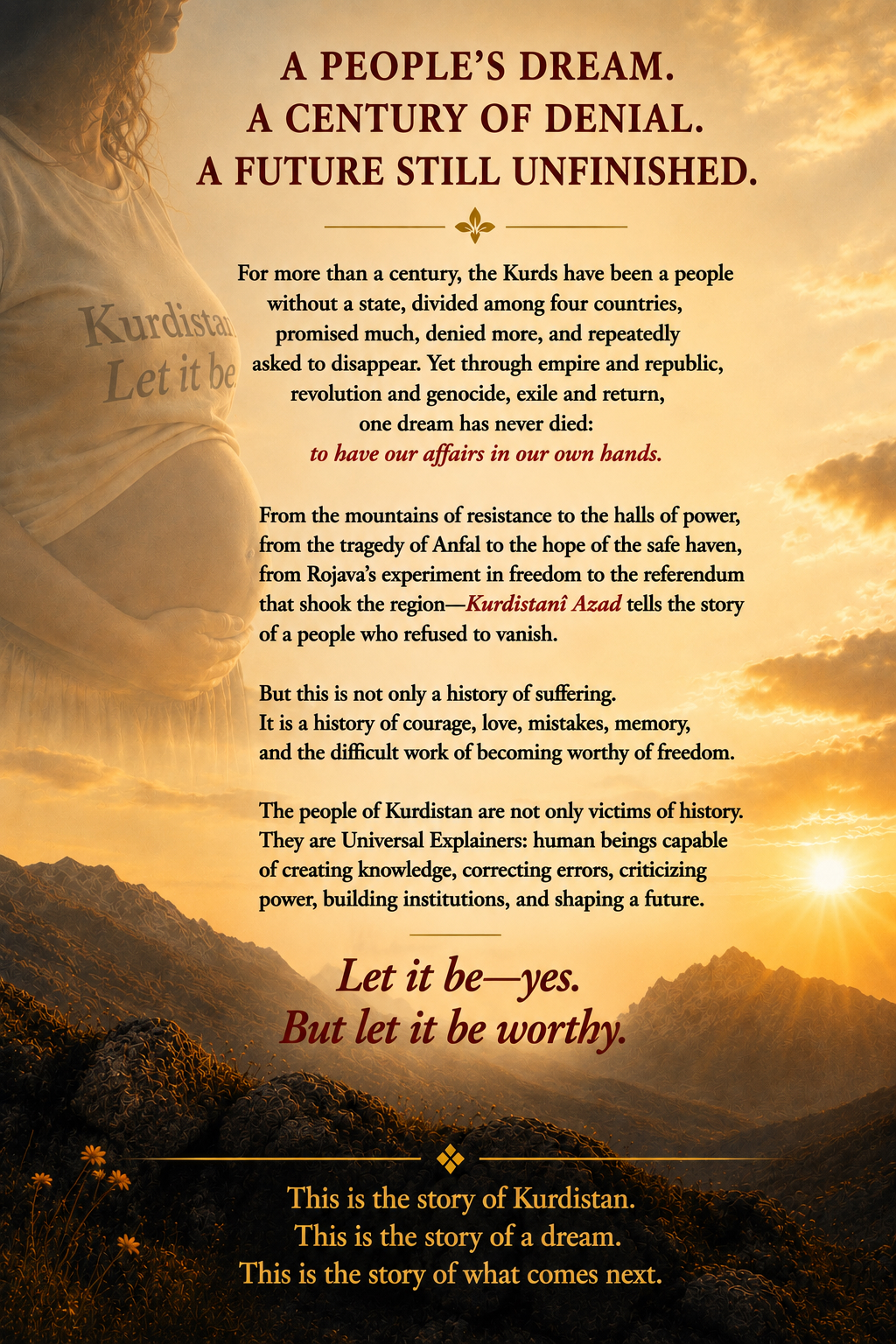
At a Kurdish refugee event, we bought a T-shirt that said:
Kurdistan — Let it be.
That sentence became the seed of our book.
Kurdistanî Azad is the story of a people denied, divided, used, betrayed, armed, protected, wounded, governed, and still unfinished.
Its central question is simple:
Can Kurdistan become not only a place Kurds died for, but a place Kurds can live — freely, critically, and without fear?
Serialization begins now.
Announcing the serialization of our book on Substack
In 1991, while Kurds were fleeing Saddam Hussein’s army into the mountains, we were in London expecting our first child.
One life was growing quietly inside a mother’s body. At the same time, hundreds of thousands of Kurdish lives were exposed to cold, hunger, soldiers, closed borders, and the old question that had followed Kurds for more than a century:
Would the world protect them, use them, forget them, or abandon them again?
At a Kurdish refugee event in London, we bought two T-shirts. On them were the words:
Kurdistan — Let it be.
Ann-Catrin wore hers while pregnant. Khaled took a photograph. The words stretched across the life we were waiting for.
At the time, it was half hope, half defiance.
Years later, we understood that the photograph carried the whole book.
Kurdistan was not only a territory, not only a political demand, not only a grievance against history, and not only a future state. Kurdistan was unborn life. A possibility carried through fear. A fragile expectation. A responsibility.
The words were modest:
Let it be.
But perhaps that is where every serious politics of Kurdistan begins.
Let it exist.
Let it live.
Let it speak its name.
Let it breathe.
Let it become a home.
This is why we wrote Kurdistanî Azad: The Long Dream of Kurdish Self-Rule.
The title has two meanings. In Kurdish, Azad means free. So Kurdistanî Azad means Free Kurdistan. But in the story that opens the book, Kurdistan is also the name of a daughter, and Azad is her father. When someone asks the child, “Whose Kurdistan are you?” she answers:
Kurdistanî Azad.
Kurdistan of Azad.
Kurdistan of freedom.
Free Kurdistan.
That double meaning gives the book its heart. Kurdistan is not introduced first as a map. It is introduced as a child, a father, a voice, a wound, a name, and a question:
What does it mean for a people to have their affairs in their own hands?
That question is older than the modern Middle East. Sheikh Ubeidullah of Nehri expressed it in 1880 with devastating simplicity:
“We want our affairs to be in our own hands.”
More than a century later, that sentence still contains the center of the Kurdish political experience.
But this book is not a hymn. It is not propaganda. It does not ask the reader to admire Kurds without asking hard questions of Kurdish leaders, parties, movements, institutions, families, myths, and mistakes.
Love for Kurdistan must not become blindness.
A people denied power must gain power. But once power becomes Kurdish, it too must be criticized. The test is not whether Kurdistan can raise a flag. The test is whether Kurdistan can build institutions that allow its own errors to be found and corrected.
A free Kurdistan would not be a place without error. It would be a place where error can be named, tested, criticized, and repaired without fear.
That is the standard of the book.
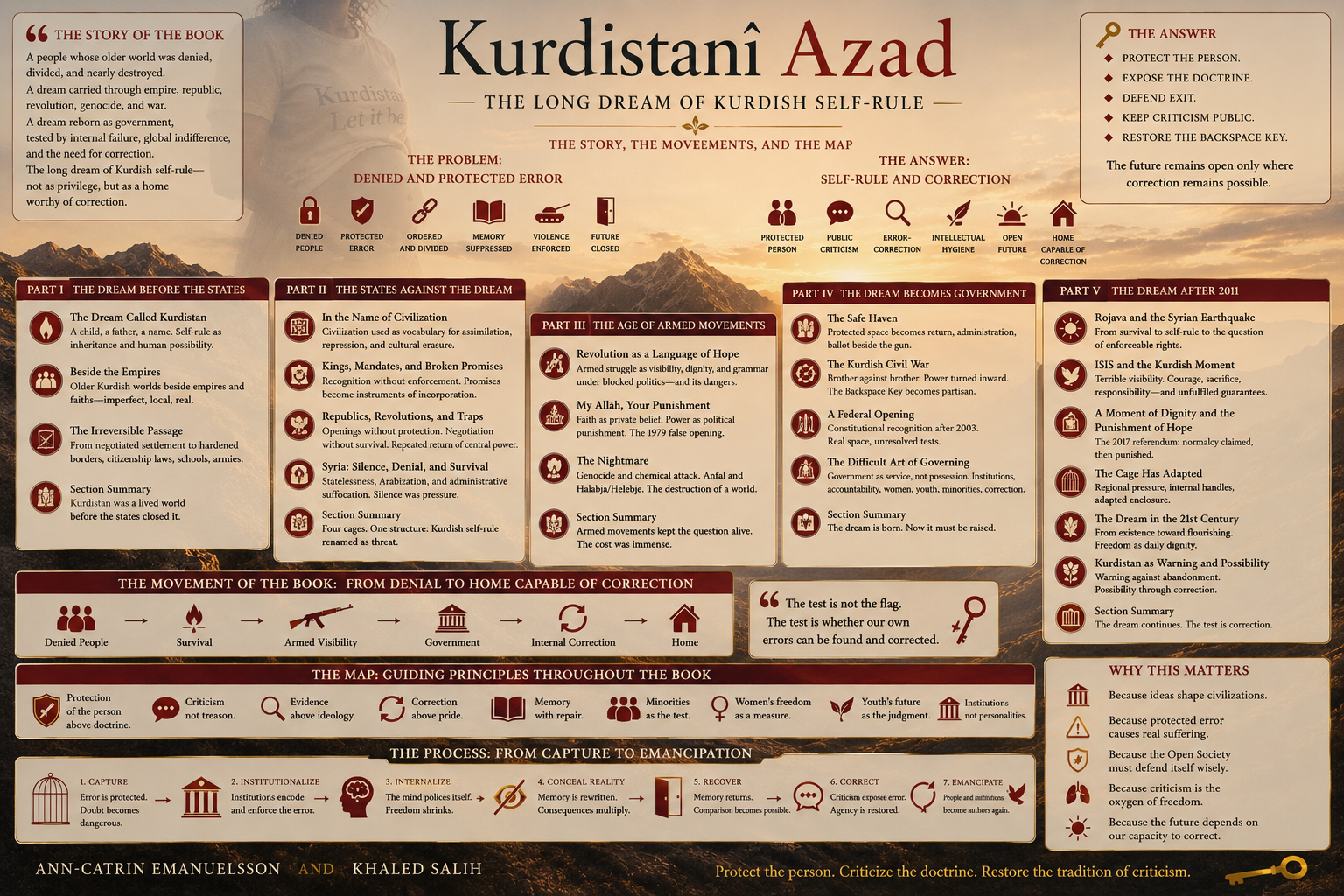
The story moves from the older Kurdish world before the modern states, through the collapse of empire, Sèvres, Lausanne, Mosul, mandates, Turkish assimilation, Iraqi incorporation, Iranian openings and traps, Syrian silence, armed movements, Anfal, Halabja, the safe haven, the Kurdish civil war, federalism, the difficult art of governing, Rojava, ISIS, the 2017 referendum, the adapted regional cage, and finally the unfinished question of the twenty-first century.
The movement is simple, but painful:
denied people → survival → armed visibility → government → internal correction → home
The book begins before the states. Kurdistan was not empty before diplomats drew borders over it. It was a lived world of mountains, villages, routes, dialects, religious networks, principalities, tribes, cities, memories, and frontier bargains. It was not a modern state. It was not democratic or innocent. But it was not nothing.
Older Kurdish self-rule was imperfect, local, unequal, negotiated, and real. It gave Kurdish society room: room for language, memory, mediation, religious networks, and distance from imperial centers.
Then came the irreversible passage.
After the First World War, the old imperial order collapsed. Sèvres briefly opened a door. Lausanne closed it. A political error became a border. The border became citizenship law, school curriculum, army, court, passport, and diplomatic habit. By the time Kurds asked for correction, the machinery created by the error presented itself as reality itself.
That is how Kurdistan became divided among states that claimed the right to decide what Kurds could be.
Turkey answered the Kurdish dream in the name of civilization. Iraq answered through mandates, monarchy, Arab nationalism, broken promises, war, and genocide. Iran answered through openings without protection: Simko, Mehabad, Qazi Muhammad, revolution, negotiation, and return of the center. Syria answered through silence: census, statelessness, Arab Belt, banned names, school language, surveillance, and administrative invisibility.
The methods differed. The structure repeated.
Kurdish self-rule was renamed as rebellion, separatism, backwardness, foreign interference, disorder, or danger.
When peaceful roads were closed, the mountains again became political space.
That is why the book enters the age of armed movements with moral discipline. It refuses two temptations: romanticizing the gun because the cause was just, and condemning the gun from a safe distance without understanding why so many peaceful roads had been closed.
A weapon may keep a people visible under denial. It cannot by itself teach a society how to govern freely.
That distinction matters.
Kurdish armed movements gave visibility, sacrifice, organization, courage, and continuity. They also produced hierarchy, secrecy, coercion, factionalism, internal violence, leader cults, dependency on foreign patrons, and the habit of imagining politics through sacrifice. These were not uniquely Kurdish defects. But they became Kurdish responsibilities.
Then came the nightmare.
Anfal was not only military repression. It was the organized destruction of a world. Villages, wells, orchards, graves, families, animals, roads, songs, and memories were attacked. Halabja was not only mass death. It was death by atmosphere.
After genocide, Kurdish self-rule was no longer only a political aspiration. It became a survival argument.
What institutions, protections, and powers are necessary so that this cannot happen again?
The safe haven after 1991 did not answer that question completely. But it changed Kurdish history. It was not independence. It was not full security. But it was not nothing. It was protected space becoming public life: return, voting, administration, Kurdish schools, Kurdish media, Kurdish police, Kurdish parties, Kurdish parliament, and the first Kurdish government.
The dream had been born.
Now it had to be raised.
That is the hardest turn in the book. It is easier to dream Kurdistan than to administer Kurdistan. It is easier to resist domination than to build institutions that do not dominate in their own name. Government means courts, budgets, salaries, oil contracts, journalists, police, Pêşmerge reform, women’s rights, minorities, youth, schools, public trust, and citizens who can criticize power without fear.
The danger does not disappear when power becomes Kurdish.
It changes location.
This is why the Kurdish civil war matters so deeply. Civil war does not only kill people. It damages the idea of the people. It teaches citizens to ask not only, “Are you Kurdish?” but “Which party?” That question becomes a small knife inside national unity.
The Backspace Key had become partisan.
Correction itself became filtered through party loyalty.
And yet the dream continued.
After 2003, Kurdish self-rule entered constitutional language in Iraq. Federalism became a real opening, but not a protected future. Kirkuk became not only a territorial dispute, but a repair-test: could constitutional correction repair older policies of Arabization, expulsion, demographic engineering, and broken return?
After 2011, the map shook again. Syria fractured. Rojava emerged. ISIS rose. Kobani became courage. Sinjar became responsibility and humility. Kurdish fighters became morally indispensable in the struggle against ISIS.
But a people may become morally indispensable and still remain politically disposable.
That is one of the central warnings of the book.
The 2017 independence referendum then gave Kurds one day of dignity. For one day, they were not asking to be admired as fighters, pitied as victims, managed as a minority, postponed as a problem, or used as a temporary ally. They were answering a normal political question:
Do we want independence?
That was dignity.
But dignity was punished. The Kurds had the stronger moral argument. Their opponents had the stronger coercive position. A people can be morally right and strategically defeated at the same time.
After the referendum, the cage did not disappear.
It adapted.
Turkey, Iran, Iraq, and Syria compete with one another, but they often converge against Kurdish sovereignty. The old map remains powerful. Borders remain hard. External powers still use Kurdish courage more easily than they guarantee Kurdish rights. And uncorrected Kurdish divisions become foreign handles.
This is why the book ends not with innocence, not with despair, and not with propaganda.
It ends with a harder hope.
Kurdistan is a warning because unprotected peoples can be denied, used, divided, abandoned, and destroyed.
Kurdistan is a possibility because suffering can become wisdom, memory can become institutions, and self-rule can become daily dignity.
The dream in the twenty-first century cannot be measured only by independence. It must also be measured by language, courts, youth who can stay, women’s freedom, minority trust, ecological repair, knowledge institutions, diaspora memory, local self-government, and ordinary citizens who can correct institutions.
Existence has been proven.
Flourishing remains unfinished.
Freedom must be practiced before it is recognized.
That is why we are now serialising Kurdistanî Azad here on Substack.
We will publish the book chapter by chapter, not only as history, but as an invitation to think with us. Each chapter follows events, but also asks what explanations, institutions, promises, betrayals, fears, and errors made those events possible.
The infographic accompanying this announcement is the map of the book. It shows the movement from denial to home capable of correction. It is not a decoration. It is a guide.
The whole book can be read as one question:
Can Kurdistan become not only a place Kurds died for, but a place Kurds can live?
A place where the child can learn the language.
Where the citizen can criticize the party.
Where the journalist can expose mismanagement.
Where the woman can refuse inherited authority.
Where the court can correct power.
Where memory protects without becoming hatred.
Where the future is not owned by leaders, parties, or foreign diplomats.
Where the dream becomes worthy of the child, her questions, and her future.
That is Kurdistanî Azad.
Free Kurdistan.
Kurdistan, daughter of Azad.
The long dream of Kurdish self-rule.
Kurdistan — let it be.
And if it is allowed to be, let it become protected, corrected, loved, and worthy of those who dreamed it.