Kurdistan Was Never the Problem
Bad Kurdish politicians are not an argument against Kurdistan. They are an argument for institutions capable of correcting bad Kurdish politicians.
1 September 2026
Note:
A bad Italian politician is an argument against the politician. A bad British government is an argument against the government. A disastrous Iraqi government is an argument for changing the government.
But when Kurdish politicians fail, something peculiar often happens: Kurdistan itself is placed on trial.
I have never understood why Kurds should be required to pass a test no existing people could pass—the test of political infallibility.
Kurds are fallible human beings. Of course they will produce bad politicians, bad policies, institutional failures, internal disagreements, and sometimes terrible mistakes.
The serious question is not whether Kurds will make mistakes.
It is whether they possess the political agency and institutions to discover those mistakes, criticize them, remove those responsible, and try again.
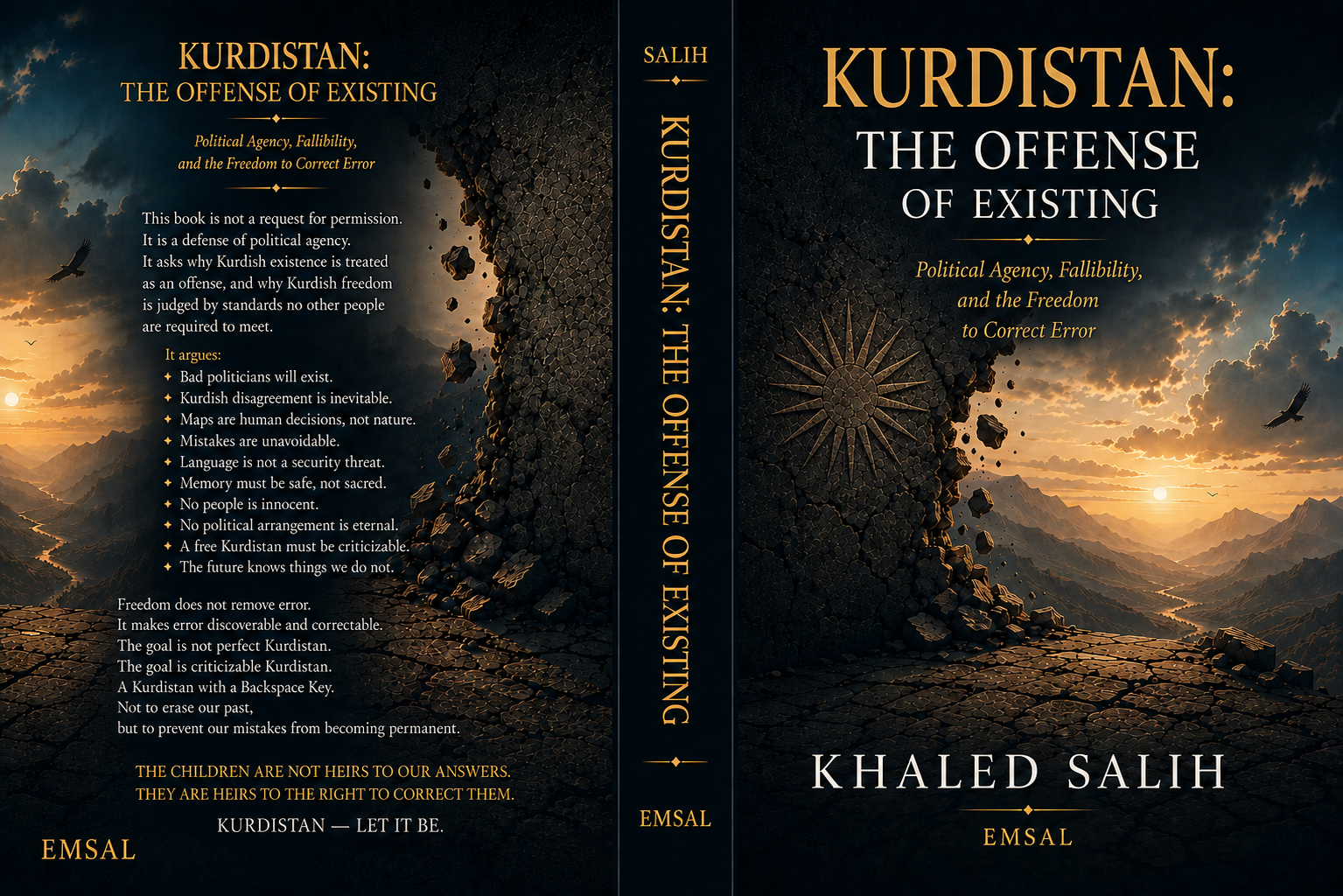
That is the argument behind my new book, Kurdistan: The Offense of Existing, and this new essay:
Kurdish freedom does not require Kurdish perfection.
It requires the freedom to be wrong—and the freedom to correct the error.
Someone tells me:
There are plenty of things Kurdish politicians have done that I disagree with.
There are decisions I would reverse, institutions I would reform, leaders I would replace, party practices I would criticize, constitutional arrangements I would redesign, and opportunities I believe Kurdish leaders have squandered.
Kurds have fought other Kurds.
Kurdish parties have accumulated power.
Institutions have sometimes become subordinate to parties and families. Corruption, patronage, polarization, weak accountability, restrictions on criticism, economic dependency, and failures of government are real problems.
None of this should be hidden.
But neither should something else.
Bad Kurdish politicians are not an argument against Kurdistan.
They are an argument against bad Kurdish politicians.
I find it difficult to disagree.
The reason is almost embarrassingly simple:
I regard Kurds and Kurdish politicians as fallible human beings.
Nothing more is required to explain their capacity for political failure. They do not need a specifically Kurdish defect. They do not need a national pathology. They do not need to demonstrate some peculiar incapacity for self-government.
They need only to be human.
Human beings make mistakes. Politicians make mistakes. Institutions fail. Parties accumulate power. Leaders protect themselves. Good intentions produce bad consequences. People misunderstand problems, defend failed explanations, repeat inherited errors, and sometimes refuse to correct them.
Kurds possess no exemption from any of this.
But that observation cuts in both directions.
If Kurdish fallibility is ordinary human fallibility, then Kurdish failure cannot logically constitute a special argument against Kurdish political agency.
The relevant question is not:
Can Kurds produce bad politicians?
Of course they can.
The relevant question is:
What happens when Kurdish politicians are bad?
Can they be criticized?
Can their policies be reversed?
Can their explanations be challenged?
Can institutions constrain them?
Can citizens remove them peacefully?
Can a Kurdish society discover that something it has done is wrong—and correct it?
That is the distinction that matters to me.
The problem is not that Kurds make mistakes. The problem begins when their institutions make mistakes difficult to correct—or when outsiders turn those mistakes into an argument that Kurds should never have possessed political agency in the first place.
Existing peoples are normally permitted fallibility.
Kurds should require no exemption from fallibility.
They require only exemption from the extraordinary demand for infallibility.
Yet much of the political discussion surrounding Kurdistan has difficulty maintaining precisely this distinction.
Existing states are permitted to have terrible governments without their existence being placed on trial. Governments fail. Presidents become authoritarian. Prime ministers become corrupt. Parties capture institutions. Constitutions malfunction. Democracies elect fools. Countries start disastrous wars. Economies collapse.
We normally understand what follows.
Criticize the government.
Replace the ruler.
Reform the institution.
Change the policy.
Amend the constitution.
Try again.
But when Kurdish politics fails, something strange often happens.
The error does not remain where it occurred.
A bad Kurdish politician becomes evidence against Kurdish political agency.
A corrupt Kurdish institution becomes evidence that Kurds are not ready for self-government.
A dispute between Kurdish parties becomes evidence that Kurdistan is impossible.
A Kurdish civil war becomes evidence that Kurds cannot govern themselves.
A failed policy becomes evidence against Kurdish sovereignty.
And eventually the argument arrives somewhere remarkable:
Perhaps Kurdistan itself was the mistake.
That is the asymmetry I explore in my new book, Kurdistan: The Offense of Existing.
The book begins with an apparently absurd proposition:
Kurdistan has been caught existing.
That may be closer to the political problem than it first appears.
Bad Politicians Are Allowed to Exist
Imagine applying the Kurdish standard consistently.
Italy has had bad politicians.
Therefore Italy should cease to exist.
Britain has made catastrophic political decisions.
Therefore British sovereignty was premature.
Iraq has experienced dictatorship, coups, wars, corruption, sectarianism, institutional collapse, and catastrophic governance.
Therefore Arabs in Iraq have demonstrated that they are not ready to govern themselves.
Turkey has imprisoned critics and experienced authoritarianism, coups, political violence, economic crises, and profound polarization.
Therefore Turkish self-rule should be suspended until Turks demonstrate political maturity.
Iran has produced repression on an enormous scale.
Therefore Persians should be governed by someone else.
Nobody serious reasons this way.
And rightly so.
Political failure normally generates an argument about how political power should be corrected, not about whether the population governed by that power possesses political standing at all.
Yet Kurdish failure is repeatedly made to carry a heavier burden.
Kurds are asked not merely to propose institutions.
They are asked to certify the future.
Will Kurdistan be democratic?
Will its politicians behave?
Will minorities be protected?
Will the economy succeed?
Will Kurdish parties cooperate?
Will corruption disappear?
Will neighboring states accept it?
Will it remain stable?
These are legitimate questions about any political project.
But something changes when they become an entrance examination for political agency itself.
No existing state could pass such an examination retrospectively.
No future state could pass it prospectively.
Politics does not come with a certificate of successful completion issued before history begins.
The Kurdish Disclaimer
There is therefore a Kurdish version of the political disclaimer.
Before defending Kurdish political agency, one is often expected to say:
Of course the KDP has problems.
Of course the PUK has problems.
Of course the Kurdistan Regional Government has failed in important respects.
Of course the KDPI has problems.
Of course the PKK has problems.
Of course there is corruption.
Of course Kurdish politics is divided.
Of course the referendum was mishandled.
Of course Kurdish leaders have made mistakes.
Only after completing the ritual may the speaker cautiously proceed:
But perhaps Kurds nevertheless possess legitimate political claims.
I reject that structure.
Not because Kurdish politicians should be protected from criticism.
Precisely the opposite.
Kurdish political agency becomes defensible only when Kurdish politicians can be criticized without Kurdistan itself being placed on trial.
That is the distinction.
I do not want less criticism of Kurdish government.
I want better criticism.
I want criticism that reaches the decision, institution, explanation, party, law, leader, or constitutional arrangement responsible for the error.
Not criticism that mysteriously travels past all of them and lands on the proposition:
Kurds should not govern themselves.
Where Does the Error Go?
This leads to one of the most important questions behind Kurdistan: The Offense of Existing:
Where does the error go?
Suppose a Kurdish government makes a terrible decision.
Where should the error go?
Into the policy.
Into the assumptions behind it.
Into the institution that failed to detect it.
Into the politician responsible for it.
Into the electoral system if that system prevents correction.
Into the constitutional architecture if it protects power from criticism.
That is where error belongs.
But imagine instead that the failure produces this conclusion:
This proves Kurds are incapable of self-government.
The error has moved.
The politician has escaped.
The institution has escaped.
The policy has escaped.
The explanation has escaped.
And an entire people has inherited the failure.
That is not accountability.
It is the displacement of accountability.
Worse, it can protect the very Kurdish politicians whom the argument supposedly criticizes.
If every Kurdish governmental failure becomes an argument against Kurdistan, Kurdish critics face an impossible choice: expose the failure and risk supplying ammunition against Kurdish political agency, or protect the national cause by protecting the people who govern badly in its name.
That is a disastrous architecture.
A free political culture requires the opposite.
No party is Kurdistan.
No family is Kurdistan.
No leader is Kurdistan.
And therefore criticizing a Kurdish leader cannot logically be equivalent to criticizing the existence of Kurdistan.
That separation is indispensable both to Kurdish freedom and to Kurdish accountability.
Disagreement Is Not Disqualification
There is another familiar argument.
Kurds disagree.
Indeed they do.
Sometimes profoundly.
Kurdish parties have fought one another. Kurds disagree about independence, federalism, relations with Baghdad, Ankara, Tehran, and Damascus, relations with neighboring states, economic policy, religion, secularism, party power, foreign alliances, and the political future itself.
But what conclusion follows?
There is a peculiar expectation that a people seeking political agency must first display a unity that no functioning political society actually possesses.
Americans disagree.
Britons disagree.
Israelis disagree.
French people disagree.
Iraqis disagree.
Turks disagree.
Political disagreement is not evidence that politics has failed.
Political disagreement is what politics is for.
The relevant question is not whether Kurds disagree.
It is whether Kurdish institutions can make disagreement survivable.
Can one party lose an election and remain?
Can an opposition newspaper criticize a government and continue publishing?
Can someone criticize a Barzani without becoming anti-Kurdish?
Can someone criticize a Talabani without becoming an enemy?
Can someone criticize Öcelan without becoming an enemy?
Can a minority reject the preferences of the majority without losing equal political standing?
Can a government be replaced without the political order collapsing?
That is the test.
I call one part of it in the book:
the right to lose and remain.
A political system becomes civilized not when disagreement disappears, but when losing power ceases to mean losing one’s place in the political community.
The Right to Make Our Own Mistakes
This brings me to a proposition that can easily be misunderstood.
Kurds have the right to make their own mistakes.
That does not mean Kurdish mistakes become morally legitimate.
It does not mean Kurdish governments may violate the rights of others.
It does not mean independence, federalism, confederalism, or any particular constitutional arrangement is automatically correct.
It means something more fundamental.
Fallibility cannot be an argument against political agency, because every political agent is fallible.
Moving the decision from Hewlêr to Baghdad does not remove error.
Moving it to Ankara does not remove error.
Moving it to Tehran or Damascus does not remove error.
Moving it to Washington, London, Brussels, or the United Nations does not remove error.
It relocates the fallible decision-maker.
The relevant question is therefore not:
Who will never make mistakes?
There is no such political actor.
The relevant question is:
Which arrangements make mistakes easier to discover and correct?
That is a radically different way of thinking about self-rule.
The right to make our own mistakes is incomplete without the right—and institutional capacity—to correct them.
A Map Is Not an Argument
Then there is the map.
Kurdistan appears on many maps as absence.
Turkey exists.
Iran exists.
Iraq exists.
Syria exists.
Kurdistan does not.
And from this visual fact an extraordinary philosophical conclusion is often smuggled in:
The existing arrangement is reality.
The alternative is ideology.
But maps are not nature.
They are records of human decisions.
Borders have histories.
States have histories.
Constitutions have histories.
Political arrangements that now appear permanent were once disputed proposals.
A map is not an argument.
This does not mean every border should be changed.
It means inherited borders do not acquire moral infallibility merely by surviving long enough to appear natural.
The existing arrangement has an enormous practical advantage:
It exists.
That gives it weight.
It does not give it final immunity from criticism.
Kurdish alternatives must be criticized.
So must the arrangements they seek to replace or revise.
Kurdish Politicians Are Not Kurdistan
This distinction matters especially now because criticism of Kurdish politics is necessary.
There are Kurdish institutions that deserve much harder scrutiny.
There are political practices that should end.
There are concentrations of power that should be dismantled.
There are journalists who should be freer.
There are institutions that should belong more clearly to citizens rather than parties.
There are economic arrangements that should be made more transparent.
There are Kurdish leaders who have remained too powerful for too long.
A book defending Kurdistan that could not say these things would not defend freedom.
It would defend a protected error.
But the opposite mistake is equally serious.
Kurdish political failures cannot automatically become evidence against Kurdish political existence.
Otherwise an extraordinary incentive emerges.
The worse Kurdish politicians behave, the stronger the argument becomes for denying political agency to the people governed by them.
That punishes citizens for the failures of rulers.
My argument is the reverse.
The worse politicians can become, the more important institutions of correction become.
Freedom of expression matters because error must be discoverable.
Political competition matters because alternatives must be allowed to survive.
Independent institutions matter because rulers cannot be the final judges of their own performance.
Democracy matters not because voters always choose wisely, but because governments must be removable without bloodshed.
The purpose is not to find perfect Kurdish rulers.
It is to make fallible Kurdish rulers correctable and replaceable.
No Purity Test for Kurdistan
Kurds should not respond to criticism by constructing an alternative mythology of innocence.
Kurdish history contains suffering on a scale that demands remembrance.
But suffering does not produce infallibility.
Victimhood does not confer omniscience.
A people can be terribly wronged and still make terrible mistakes.
Kurds have done so.
That fact should be incorporated into the case for Kurdish freedom, not hidden from it.
Purity is the wrong test. Accountability is the right one.
The argument for Kurdistan is not:
Kurds are better than Arabs.
Kurds are better than Turks.
Kurds are better than Persians.
Kurds are uniquely tolerant.
Kurds are naturally democratic.
Kurds will never oppress anyone.
Those would be dangerous claims.
The argument is far less romantic and much stronger:
Kurds are human beings.
They therefore possess the same capacity for error as everyone else—and the same capacity for criticism, knowledge creation, institutional improvement, and correction.
That is enough.
A Criticizable Kurdistan
This is where my argument eventually arrives.
Not at Sacred Kurdistan.
Not at Perfect Kurdistan.
Not even necessarily at Independent Kurdistan as an answer that history must deliver.
It arrives at:
Criticizable Kurdistan.
A political home in which Kurdistan itself can be questioned.
Its leaders criticized.
Its history revised in light of evidence.
Its institutions reformed.
Its governments replaced.
Its minorities protected.
Its assumptions reconsidered.
Its constitutional form changed if better arrangements are discovered.
Even independence, if achieved, must remain a political arrangement rather than a sacred object.
This is what distinguishes political freedom from political idolatry.
The purpose of Kurdistan cannot be to create a sacred object called Kurdistan.
It must be to create a political home for human beings.
Kurdistan Is Larger Than Its Politicians
This is where I find something useful in the current debate about Israel and Benjamin Netanyahu, even though the Kurdish and Jewish histories should not be collapsed into one another.
A state, nation, or political claim cannot sensibly be reduced to its current rulers.
Israel is not Netanyahu.
America is not Trump.
Turkey is not Erdoğan.
Iraq was not Saddam Hussein.
And Kurdistan is not Barzani, Talabani, the KDP, the PUK, the PKK, the PYD, or any other leader, family, or organization claiming to speak in its name.
Politicians come and go.
Parties rise and decline.
Policies fail.
Institutions change.
Explanations are replaced.
A political community must be larger than all of them.
Otherwise criticism of a ruler becomes treason against the nation—and criticism from outside turns the ruler’s mistakes into an indictment of the people.
Both errors protect power.
The distinction we need is harder and more useful:
Protect the person. Criticize the explanation. Test the institution. Replace the ruler when necessary. Preserve the possibility of correction.
The Offense of Existing
That is why I called the book Kurdistan: The Offense of Existing.
The title is deliberately absurd.
Its absurdity exposes the argument.
Kurds are permitted to exist culturally.
They may have music.
Food.
Costumes.
Poetry.
Mountains.
Memories.
Martyrs.
Language—sometimes.
They may even be admired for surviving.
The difficulty begins when existence becomes political agency.
When the Kurdish question changes from:
Do Kurds exist?
to:
What political arrangements should Kurds themselves have the standing to create, criticize, test, and revise?
At that point existence becomes an offense.
The book refuses to answer that offense with another claim to certainty.
I cannot guarantee that Kurdistan will succeed.
I cannot guarantee that Kurdish politicians will behave wisely.
I cannot guarantee that independence, where sought, will solve the problems its advocates expect it to solve.
Nobody can.
And that is precisely why the demand for guarantees is the wrong test.
The argument for Kurdish political agency cannot depend on Kurds being right.
It must survive the discovery that they are sometimes wrong.
Let Kurdistan Be Wrong
So perhaps the Kurdish equivalent of the Netanyahu question should not be:
Are Kurdish politicians good enough to justify Kurdistan?
It should be:
What happens when Kurdish politicians are bad?
Can they be criticized?
Can they be defeated?
Can they be removed?
Can institutions survive them?
Can policies be reversed?
Can citizens expose corruption without becoming enemies of the nation?
Can Kurds discover that something they believed about themselves was mistaken?
Can Kurdistan press Backspace?
If the answer is yes, Kurdish political failure does not disprove Kurdistan.
It becomes material from which a better Kurdistan can be created.
That is the deeper freedom I am defending.
Not the freedom to be right.
The freedom to discover that we were wrong—and correct it.
The case for Kurdistan therefore does not end with independence, federalism, autonomy, or any other constitutional formula.
Those are possible answers.
They are not final answers.
The deeper claim is about political standing:
Kurds deserve the opportunity to participate in creating the institutions under which they live.
They deserve the opportunity to try.
And if they fail, they deserve the opportunity to learn.
The final argument of Kurdistan: The Offense of Existing is therefore not that Kurdistan will be perfect.
It is that Kurdistan should remain possible.
Possible enough to try.
Open enough to criticize.
Free enough to correct.
Because no people should have to prove that it will never make mistakes before being permitted to make history.
And no bad Kurdish politician should ever again be allowed the extraordinary privilege of becoming an argument against the political agency of millions of human beings.
Kurdistan—let it be.


