Kurdistan Has Once Again Been Caught Existing
15 August 2026
A troubling encounter in New York, and the peculiar political theory according to which a place may contain people, cities, governments, borders, memories—and still not exist
On a street in New York, amid the flags and loyalties of world football, a young American called Sûre (pronounced “Soora”) spotted a woman draped in the Turkish flag.
He knew roughly what he was doing.
Sûre runs a simple kind of experiment on his YouTube channel. He approaches people—among them Turks, Arabs and Persians—holds up the flag of Kurdistan, and asks whether they recognize it.
Sometimes they do.
Sometimes they do not.
And sometimes something more interesting happens: recognition first disguises itself as ignorance, and ignorance eventually becomes political argument.
The woman in the Turkish flag initially said she did not recognize it.
Sûre pressed.
He told her what it was.
Kurdistan.
Then the problem changed.
“There is no Kurdistan,” she said.
The young man faced a small biographical difficulty.
“I grew up in Kurdistan.”
He had lived there for seven years.
Not metaphorically.
Not spiritually.
Not in the mysterious territory of nationalist imagination.
He had actually lived there.
In Silêmanî, my hometown.
His Kurdish friends had even given him a Kurdish nickname: Sûre. He was ginger-haired, reddish enough that the Kurdish children around him found the name obvious.
So Sûre grew up partly in Kurdistan.
He lived among Kurds.
He learned Kurdish remarkably well.
He crossed borders.
He encountered the Kurdistan Regional Government.
He acquired the bureaucratic evidence one normally acquires when spending years in a place: visas, stamps, officials, checkpoints, institutions, addresses, memories.
And now, years later, standing in New York, he had managed to provoke exactly the argument his little experiment was designed to uncover.
The woman explained that having a flag did not mean having a land.
Sûre mentioned the Kurdistan Regional Government.
“They don’t have government,” she replied.
He pointed out that it has a president and a prime minister.
This proved insufficient.
Later he tried the strongest argument available to a person accused of having lived somewhere imaginary.
He tried again:
“I lived there.”
The answer remained remarkably stable.
There is no Kurdistan.
One has to admire the epistemological confidence.
A man produces seven years of childhood.
A city appears.
A language appears.
A government appears.
A flag appears.
A border administration appears.
Millions of people continue inconveniently living there.
And yet the theory survives.
There is no Kurdistan.
Kurdistan had once again committed its oldest offense.
It had been caught existing.
The Woman Is Not the Point
Before proceeding, one correction is necessary.
This essay is not about one Turkish woman in New York.
She does not represent Turks.
She does not represent Turkey.
Sûre approached her precisely because she was visibly presenting herself as Turkish in the football crowd, and because he suspected the Kurdish flag might produce a revealing response. That makes the encounter deliberate. It does not make her representative.
I have no interest in converting one encounter in New York into an accusation against a people.
That would violate the principle governing this series:
Protect the person. Criticize the explanation.
The woman matters because, in a few unusually clear sentences, she expressed a political proposition much older and more consequential than herself.
It is rarely stated so plainly.
Indeed, respectable political language usually hides it under more sophisticated vocabulary.
But the proposition is approximately this:
Kurds may exist, provided Kurdistan does not.
More precisely:
Kurds may exist culturally, socially and individually, provided they do not draw independent political conclusions from their existence.
They may speak.
Work.
Farm.
Marry.
Study.
Vote.
Serve in armies.
Pay taxes.
Dance.
Sing.
Cook.
Remember.
Write poetry.
Tell their children that they are Kurdish.
Perhaps even wave the Kurdish flag, provided nobody becomes excessively constitutional about it.
The difficulty begins when Kurds move from existence to agency.
When language becomes education.
When memory becomes criticism.
When geography becomes political thought.
When people treated as an object of policy begin behaving as subjects of politics.
When the question changes from:
May Kurds exist?
to:
Who gets to decide what happens in Kurdistan?
That is when the map begins to feel nervous.
Existing, With Permission
The New York exchange eventually produced an even more revealing sentence.
The woman wanted to emphasize coexistence and hospitality. Kurds, she explained, could have houses, jobs, farms and ordinary lives because, as she put it,
“we are letting you guys to do it.”
The intention was conciliatory.
The grammar was sovereign.
Hospitality and hierarchy had appeared in the same sentence.
The guest may be welcomed warmly while the host quietly retains the right to decide whether the guest belongs.
There is an entire political theory hidden inside the word letting.
You may live.
Because we let you.
You may work.
Because we let you.
You may own a home.
Because we let you.
You may retain your language, identity and customs.
Because we permit these things.
The statement does not deny Kurdish human existence.
It defines the terms under which that existence is acceptable.
The deeper proposition is therefore not merely:
Kurds may exist, provided Kurdistan does not.
It is:
Kurds may exist, provided somebody else retains the final authority to explain why they are allowed to exist politically.
This is the distinction between being a subject and being an agent.
A subject may receive permission.
An agent may criticize the authority granting it.
A subject petitions.
An agent chooses.
A subject is administered.
An agent participates in deciding the terms of administration.
A subject may be treated generously.
An agent does not depend upon generosity for political existence.
This is why the Kurdish problem has so often been misunderstood when reduced to culture.
The deepest issue is not whether Kurds are allowed to be Kurdish.
The issue is whether Kurdish existence is permitted to generate Kurdish political agency.
Culture Is Safe Until It Develops Consequences
Culture is relatively easy to tolerate when it remains decorative.
A Kurdish song presents no constitutional difficulty.
A Kurdish dress can be photographed.
A Newroz fire may even look impressive on television.
Kurdish food is unlikely to redraw an administrative boundary.
A poem can be translated.
A dance does not demand a parliament.
The trouble begins when culture acquires consequences.
If Kurdish is merely something spoken at home, it is culture.
If Kurdish becomes a language of education and administration, it becomes political.
If Kurdistan is something remembered in songs, it is nostalgia.
If Kurdistan becomes a question about political authority, it becomes dangerous.
If Kurds celebrate history, they possess heritage.
If they use history to criticize an inherited settlement, they have apparently become nationalists.
The hidden rule begins to emerge.
Kurdish identity may be acknowledged.
Kurdish political conclusions remain suspect.
There is something peculiar about this arrangement.
Almost everyone else may possess theories about Kurdistan.
Governments have Kurdish policies.
Foreign ministries have Kurdish policies.
Security agencies have Kurdish policies.
Generals have Kurdish policies.
Diplomats have Kurdish policies.
Think tanks produce Kurdish policies.
Academics sometimes produce several before lunch.
But when Kurds formulate political conclusions about Kurdistan, the vocabulary changes.
Separatism.
Destabilization.
Irredentism.
Nationalism.
Unrealism.
Danger.
Sometimes these criticisms may be correct.
That matters.
Kurdish political movements can be wrong.
Kurdish leaders can be authoritarian.
Kurdish parties can be disagreeable.
Kurdish nationalism can become intolerant.
Kurdish policies can fail.
Nothing about Kurdish agency makes Kurdish decisions correct.
But notice the asymmetry.
The inherited arrangement appears as reality.
The Kurdish alternative appears as ideology.
One side receives the map.
The other receives the burden of proof.
The Map’s Greatest Trick
Maps possess an extraordinary political talent.
They begin as decisions and end as scenery.
A line may be negotiated, imposed, inherited, administered, defended, printed, reproduced, taught in schools and displayed behind television presenters.
Give it enough time and it acquires the dignity of geology.
It simply is.
Question it, and you appear ideological.
Defend it, and you appear realistic.
This is quite an achievement.
A political arrangement has disguised itself as a feature of nature.
The lived world then acquires a peculiar burden: what people inhabit, speak, administer and remember is expected to wait for the map’s permission before it becomes politically real.
Mountains do not require constitutions declaring their territorial integrity.
Rivers do not arrest cartographers.
Political borders sometimes require rather more assistance.
That does not mean borders are inherently illegitimate.
It means they are political arrangements.
And political arrangements are conjectures about how human beings should govern themselves.
Some arrangements survive because they work reasonably well.
Some survive because alternatives are worse.
Some survive repeated criticism and adaptation.
Some command broad consent.
Some make peaceful correction possible.
And some survive because challenging them is dangerous, illegal, prohibitively costly or conceptually forbidden.
These are not the same achievement.
An arrangement that survives criticism is one thing.
An arrangement that survives by preventing criticism from reaching it is another.
Duration does not settle the question.
No political settlement becomes true merely by surviving long enough.
Longevity is not truth.
Familiarity is not legitimacy.
And a map is not an argument.
But Neither Is the Kurdish Map
At this point a nationalist temptation appears.
I want to resist it.
The easy answer would be:
The existing borders are artificial; the Kurdish borders are natural.
No.
That would merely replace one metaphysical map with another.
A Kurdish border would also be a political arrangement.
A Kurdish constitution would also be a conjecture.
A Kurdish state would also contain institutions capable of failure.
A Kurdish majority could mistreat minorities.
A Kurdish security service could abuse power.
A Kurdish government could centralize authority.
A Kurdish party could confuse itself with Kurdistan.
Kurdish historians could convert memory into mythology.
Kurdish nationalists could decide that criticism of nationalism is betrayal of the nation.
A Kurdish ruler could eventually stand before a Kurdish map and announce that history had finally reached the correct destination.
If that is where the argument for Kurdistan leads, the argument has failed.
The answer cannot be to replace a sacred non-Kurdish map with a sacred Kurdish one.
The better distinction is:
protected arrangements versus criticizable arrangements.
That changes everything.
The question ceases to be:
Whose map is sacred?
The answer is:
None.
The question becomes:
Which political arrangements allow errors to be discovered and corrected by the people who must live with their consequences?
That question applies in Baghdad.
It applies in Ankara.
It applies in Tehran.
It applies in Damascus.
And it must apply in Erbil and Silêmanî too.
Otherwise the criticism has learned nothing from itself.
The Case for Kurdistan Cannot Depend on Kurds Being Right
This is where the argument becomes uncomfortable for nationalists—and therefore useful.
The case for Kurdish political agency cannot depend upon Kurdish innocence.
It cannot depend upon Kurdish leaders being virtuous.
It cannot depend upon Kurdish parties becoming united.
It cannot depend upon every Kurdish interpretation of history being correct.
It cannot depend upon Kurdistan guaranteeing prosperity.
It cannot depend upon independence, federalism, confederalism, autonomy or any other arrangement producing perfect results.
That standard is impossible.
No existing state was required to pass it before being permitted to exist.
The United States did not submit a five-hundred-year governance forecast before independence.
France does not cease to be France when its government fails.
Britain is not dissolved because its politicians make mistakes.
Iraq may fail repeatedly and remain Iraq.
Turkey may make catastrophic political errors and remain Turkey.
Iran may make bad decisions and remain Iran.
Syria may undergo devastation beyond description and remain on the map.
But the moment Kurdistan appears as a political possibility, a peculiar demand often emerges:
Will it work?
Can you guarantee stability?
Will the Kurds agree?
Will their politicians be democratic?
Will corruption disappear?
Will minorities be safe?
Will the economy succeed?
Will neighboring states accept it?
Will there be peace?
These are serious questions.
They should be asked.
But they become intellectually peculiar when they operate as entrance examinations imposed only upon the alternative.
The relevant question is not whether Kurdistan can guarantee that it will never make mistakes.
It cannot.
Neither can anyone else.
The relevant question is what institutions make mistakes correctable.
That is a different political philosophy.
And a far more demanding one.
Where Does the Error Go?
This series begins with one question.
It will keep returning.
Where does the error go?
Suppose a government makes a bad decision affecting Kurdistan.
Can those affected expose it?
Can they organize against it?
Can they publish criticism?
Can the criticism travel upward?
Can a court intervene?
Can a bad policy be reversed?
Can those responsible be removed without violence?
Suppose the constitution itself contains the error.
Can the constitution be amended?
Suppose the relationship between a central government and Kurdistan repeatedly produces conflict.
Can the relationship itself become an object of criticism?
Suppose an inherited border no longer solves the problems its defenders claim it solves.
May the border enter the discussion?
Or is the border permitted to end the discussion simply by existing?
And now reverse the test.
Suppose the error is Kurdish.
Suppose a Kurdish government becomes authoritarian.
Can it be removed?
Suppose Kurdish parties capture institutions.
Can citizens challenge them?
Suppose a Kurdish majority mistreats a minority.
Can the minority organize effectively?
Suppose Kurdish nationalism becomes intolerant.
Can Kurdish nationalists be criticized without the critic being declared an enemy of Kurdistan?
Suppose one of our cherished historical stories turns out to be false.
Can we delete it?
Suppose we are wrong.
Where does our error go?
This is where Kurdish self-rule either becomes a serious theory of political freedom or collapses into another doctrine of protected authority.
We cannot demand that Baghdad be criticizable while Erbil becomes sacred.
We cannot demand that Ankara reconsider inherited arrangements while Kurdish arrangements become immune to reconsideration.
We cannot condemn political systems for telling Kurds “there is no alternative” and then build a Kurdistan whose leaders say exactly the same thing.
We cannot answer protected error with another protected error.
A Kurdish flag does not solve the problem of authority.
It changes who possesses it.
The deeper problem remains:
Can authority be corrected?
Sûre’s Childhood Problem
There is something beautifully absurd about Sûre’s encounter in New York.
A young American lived for seven years in Silêmanî.
He learned Kurdish.
Kurdish children gave him a Kurdish nickname.
He remembers Kurdistan because Kurdistan is part of his biography.
Then, thousands of kilometers away, he deliberately asks someone wearing another national flag to identify Kurdistan’s—and watches recognition turn into denial.
What exactly is being denied?
Not the people.
They are standing everywhere.
Not the language.
Sûre speaks it.
Not the cities.
They can be visited.
Not institutions.
They administer millions of lives.
Not even necessarily the word Kurdistan.
The argument is subtler.
The denied thing is not Kurdistan’s empirical existence. It is the political meaning permitted to attach to that existence.
Kurdistan may exist as lived geography.
It may exist administratively.
It may exist biographically.
What remains contested is whether those facts may generate an independent political conclusion.
It may describe where someone grew up.
It must not necessarily become a question about who should govern there.
This is why the exchange matters.
Sûre did not stumble into the argument. He went looking for it.
His videos repeatedly test what happens when the Kurdish flag is presented to people whose national political traditions have often required Kurdistan to remain something less than a political fact.
The method is simple enough to look playful: show the flag and ask what it is.
But sometimes the answer reveals more than recognition.
In New York, Sûre’s experiment moved from:
I do not recognize that flag
to:
There is no Kurdistan.
Then came his wonderfully inconvenient reply:
But I lived there.
At that moment the parody required no invention.
Reality had contradicted the doctrine.
The doctrine survived.
Let Kurdistan Become a Question
Perhaps Kurdistan’s most disruptive act is therefore not independence.
It is becoming a legitimate question.
A question about authority.
A question about consent.
A question about inherited arrangements.
A question about whether people exist for institutions or institutions exist for people.
A question about whether a political settlement may ever be wrong.
And questions are dangerous to arrangements that have mistaken permanence for truth.
Because once Kurdistan becomes a legitimate question, the burden changes.
The existing state must explain itself.
The existing border must explain itself.
Centralization must explain itself.
Federalism must explain itself.
Autonomy must explain itself.
Independence must explain itself.
And Kurdistan must explain itself too.
No exemptions.
No sacred maps.
No historical arrangement receiving immunity merely because it already exists.
No Kurdish arrangement receiving immunity merely because it is Kurdish.
That is the wager of this series.
I will treat Kurdistan as thinkable.
Not inevitable.
Not sacred.
Not historically innocent.
Not guaranteed to succeed.
Thinkable.
And because it is thinkable, criticizable.
That sounds modest.
It is not.
Because the moment Kurdistan becomes a permissible political conjecture rather than a prohibited conclusion, something remarkable happens.
Pointing at the map is no longer enough.
Its opponents have to make an argument.
And so do I.
Kurdistan has once again been caught existing.
The next charge is already being prepared.
Very well, we will be told.
Suppose Kurdistan exists.
Suppose Kurds possess political agency.
Suppose the map itself may be criticized.
Can Kurdistan guarantee that it will succeed?
An interesting requirement.
Existing states are permitted history.
Kurdistan, apparently, must submit a business plan.
That will be our next offense.
Next: Kurdistan Is Asked to Guarantee Success Before Being Allowed to Try.
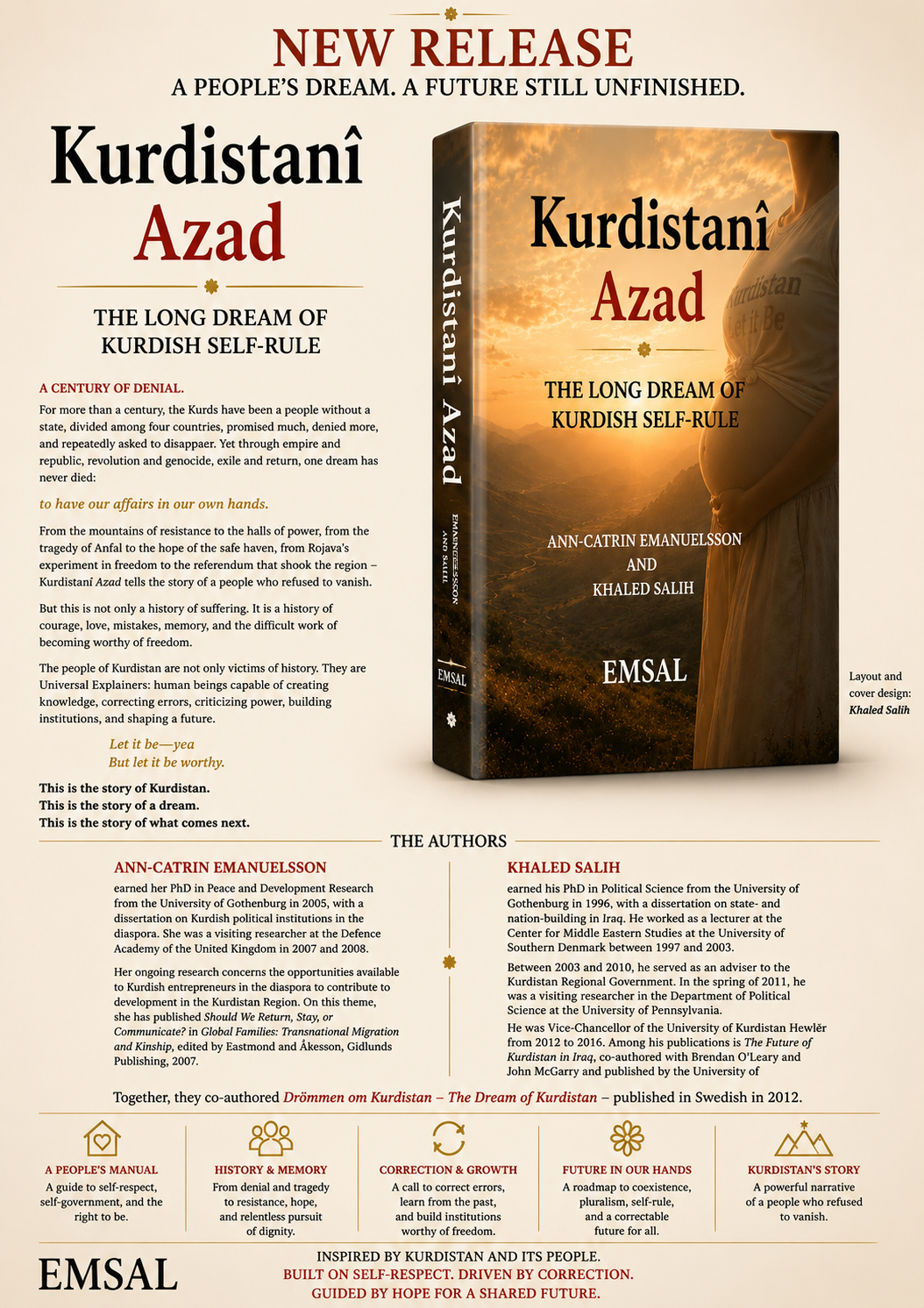
This is the first essay in The Parody of Kurdistanî Azad, [inspired by Matthew Feinberg, thank you!] my post-publication series extending questions that emerged while writing Kurdistanî Azad. The series begins where the book left us: not with the claim that Kurds are always right, but with the harder question of how fallible people can build political arrangements capable of discovering when they are wrong.
The purpose of this series is not to make Kurdistan immune from criticism. It is to make Kurdistan impossible to dismiss without argument.
Kurdistan — Let it be.


