Jîna Amini, Four Years Later
One state is asking Kurdistan to stay home. The same state is asking Iran to learn how to fight.
15 September 2026
Note
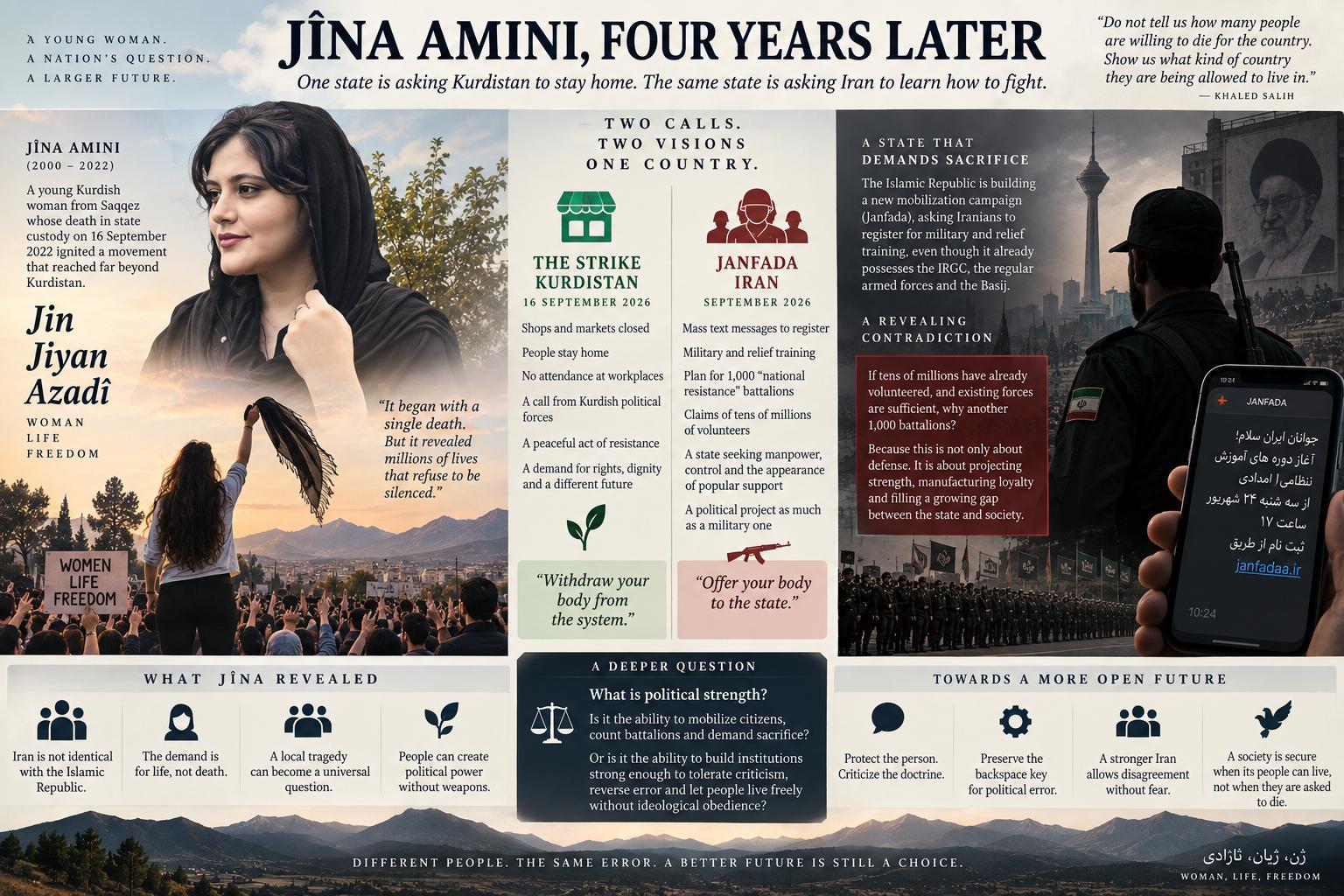
Four years after Jîna Amini, Iran is staging a remarkable contrast.
In Kurdistan in Iran, people are being called to stay home, close their shops, and withdraw their participation in memory of a young Kurdish woman whose death gave the world Jin, Jiyan, Azadî — Woman, Life, Freedom.
At the same time, the Islamic Republic is mass-texting citizens to register for military and relief training under a new mobilization campaign, Janfada, built around the language of sacrifice.
One side says: withdraw your body from the system.
The other says: offer your body to the state.
That contrast raises a deeper question than who can mobilize more people.
What is political strength?
Is it the ability to organize battalions, display loyalty and call citizens to sacrifice?
Or is it the ability to build institutions strong enough to tolerate criticism, reverse error, protect dissent and let people live freely without requiring ideological obedience?
My new essay argues that Jîna Amini’s legacy is ultimately not about martyrdom.
It is about something more demanding:
the kind of political order in which people no longer have to die in order for an error to become visible.
Four years later, the question remains:
Do not tell us how many people are willing to die for Iran. Show us what kind of Iran they are being allowed to live in.
Jîna Amini, Four Years Later
One state is asking Kurdistan to stay home. The same state is asking Iran to learn how to fight.
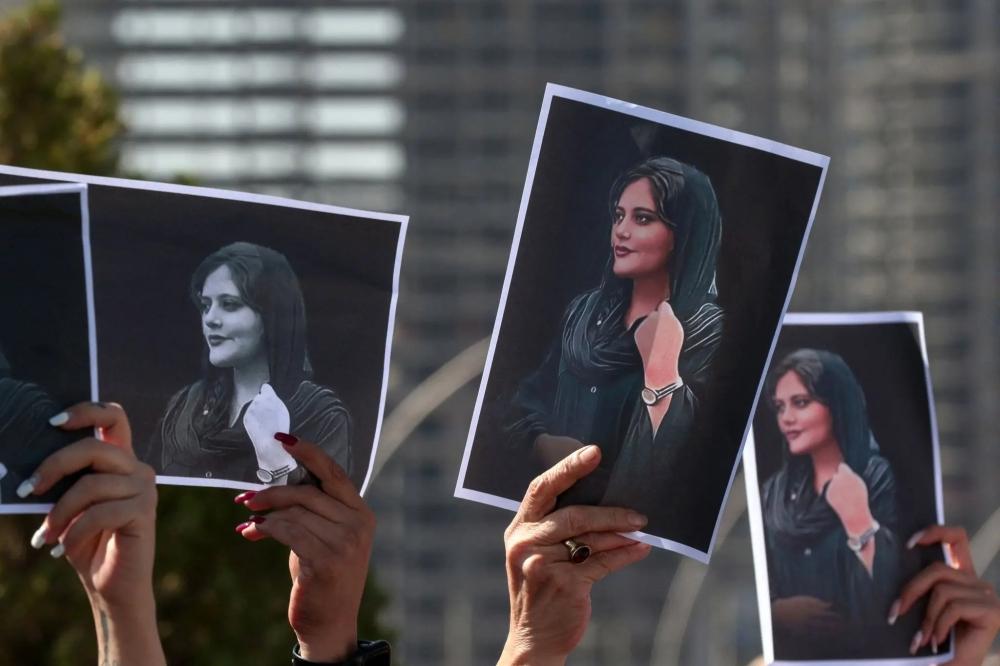
Four years ago, a young Kurdish girl from Seqqiz entered Tehran alive and left the custody of the Islamic Republic dying.
Her name was Jîna Amini.
The world came to know her largely as Mahsa Amini. But the name that travelled first from Kurdistan into Iran and then across the world was Jîna. At her funeral in Saqqez, the Kurdish words Jin, Jiyan, Azadî — Woman, Life, Freedom became the language of an uprising that soon exceeded Kurdistan itself. Jîna’s death did not create all the grievances that erupted in 2022. It revealed how many had already accumulated beneath the surface.
Now, on the fourth anniversary of her death, two events are occurring almost simultaneously.
They deserve to be read together.
On September 16, a coalition of Kurdish political forces in Iran has called for a general strike across Kurdistan in Iran—Rojhelat. Shops and markets are being asked to close. People are being asked not to go to work. The coalition describes the action not simply as commemoration, but as peaceful civil resistance against continuing repression and deteriorating political and economic conditions.
At almost exactly the same moment, the Islamic Republic is doing something very different.
It is asking Iranians to mobilize.
A new initiative called Janfada—literally invoking the idea of sacrificing oneself—is announcing military and relief training and plans to organize 1,000 “national resistance” battalions. Iranian state media say applicants can register through a website or by SMS and will be organized into popular battalions in coordination with the armed forces.
That juxtaposition is almost too revealing.
In Kurdistan:
Stay home. Close the shop. Refuse participation.
From the state:
Register. Train. Mobilize. Prepare to sacrifice.
Two entirely different theories of political power are confronting one another.
One asks citizens to withhold themselves from the state.
The other asks citizens to give themselves to it.
And Jîna stands between them.
A state asking for bodies
The Islamic Republic already possesses the Islamic Revolutionary Guard Corps, the regular armed forces, the Basij and an extensive security apparatus.
Yet it now speaks of creating another thousand battalions.
Perhaps the regime’s explanation is exactly what it says: Iran faces external danger, and citizens must be mobilized to participate in national defense. States have every right to organize legitimate civil defense, disaster response and military preparedness.
But that explanation should not end criticism.
It should begin it.
If the existing institutions are sufficient, why is another mass mobilization structure necessary?
If overwhelming popular enthusiasm already exists, why is a campaign of websites, SMS recruitment and highly publicized numerical claims required?
If tens of millions are genuinely ready to sacrifice themselves, what explanatory work is being performed by the announcement of another thousand battalions?
The answer may not be purely military.
It may also be political.
A state does not merely need force.
It needs the appearance of consent behind force.
That distinction matters enormously.
The Islamic Republic wants to show that the population and the regime remain fused: that when the state calls, society answers; when the state is threatened, millions stand behind it; when Iran is challenged, the Islamic Republic and Iran become indistinguishable.
But Jîna Amini exposed precisely the weakness in that equation.
Iran is not identical with the Islamic Republic.
The population is not identical with the regime.
Defending one’s country is not identical with defending every institution governing it.
And willingness to sacrifice for Iran cannot automatically be counted as consent to those who currently exercise power in Iran.
That is the category error hidden inside the mobilization.
Jîna revealed another Iran
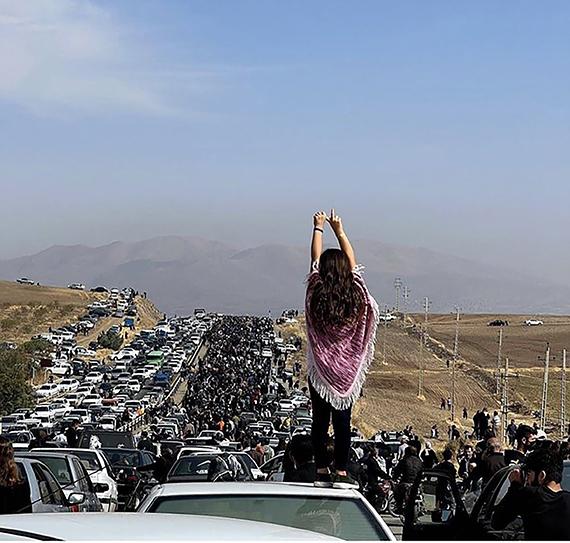
The importance of Jîna was never simply that she became a victim of the morality police.
There had been victims before her.
There had been executions, imprisonment, compulsory veiling, repression of women, persecution of Kurds and other minorities, censorship, and political violence long before September 2022.
What happened after Jîna was different.
A local death became a universal question.
The Kurdish slogan Jin, Jiyan, Azadî travelled because it compressed an enormous political idea into three words.
Not state.
Not leader.
Not martyrdom.
Not sacrifice.
Woman. Life. Freedom.
Notice what is absent.
Death.
That matters.
Authoritarian political systems frequently elevate sacrifice. They sacralize the person who dies for the state, the revolution, the faith, the nation, the leader or the cause.
Jin, Jiyan, Azadî begins somewhere else.
It begins with life.
And that creates a profound philosophical confrontation.
One political imagination asks:
What are you prepared to die for?
The other asks:
What kind of life should people be free to live?
These are not the same question.
The Backspace Key
I have increasingly thought about politics through a simple metaphor: the Backspace Key.
Human beings make errors.
Governments make errors.
Revolutions make errors.
Opposition movements make errors.
Nations make errors.
The decisive distinction is not between political systems that make mistakes and those that do not.
There are no systems in the second category.
The distinction is between systems that preserve the capacity to correct error and systems that protect error from correction.
Jîna Amini became internationally important because her death exposed what happens when a political system loses its Backspace Key.
A rule about women’s dress had become more than a rule.
It had become doctrine.
The doctrine had become institutionalized.
The institution possessed coercive power.
Criticism of the rule became criticism of the ideological order itself.
And eventually the body of a 22-year-young girl became the location where the uncorrected error was enforced.
This is the question I repeatedly ask:
Where does the error go?
If the doctrine cannot be corrected, the police officer cannot question it, the institution cannot abandon it, the legislature cannot remove it, the judiciary cannot invalidate it and citizens cannot peacefully replace those responsible for it, the error does not disappear.
It travels downward.
Into the person.
Into the dissident.
Into the woman.
Into the Kurd.
Into Jîna.
That is what protected error does.
Four years later
This is why the fourth anniversary should not become ceremonial.
Commemorations themselves can become a form of closure.
Flowers.
Photographs.
Hashtags.
Anniversary statements.
Then another year passes.
The better question is:
What has been corrected?
The coalition calling for the September 16 strike says civil liberties have deteriorated and points to continuing arrests, severe sentences, economic pressure and executions. The strike is therefore being framed not simply as remembrance but as an instrument of peaceful political pressure. IranWire
That is significant.
A general strike is an unusual form of power.
Its mechanism is absence.
Nobody needs to occupy a ministry.
Nobody needs to seize a television station.
Nobody needs to fire a weapon.
The individual simply refuses normal participation.
The closed shop says:
You may govern the territory, but today you cannot pretend that normality means consent.
An empty marketplace becomes political speech.
This has particular resonance in Kurdistan, where strikes have repeatedly been used as instruments of collective resistance.
And that makes the contrast with Janfada even sharper.
The regime says:
Present yourself.
The strike says:
Withdraw yourself.
The regime counts bodies mobilized.
The strike counts bodies absent.
Both understand something fundamental:
Political systems depend upon participation.
But criticism must run in every direction
The Open Society requires another discipline.
Opposition to the Islamic Republic must not itself become immune from criticism.
“Woman, Life, Freedom” cannot become sacred doctrine.
Kurdish political organizations cannot become sacred institutions.
Iranian opposition figures cannot become untouchable leaders simply because the present regime is authoritarian.
And Kurdish nationalism cannot demand freedom from Persian or Islamic domination while reproducing closure within Kurdish political life.
The principle has to remain universal:
Protect the person. Criticize the doctrine.
That includes doctrines I sympathize with.
A movement worthy of Jîna’s name must preserve the possibility that tomorrow’s generation may criticize today’s opposition.
Otherwise the Backspace Key has merely changed hands.
The regime’s deepest problem may not be manpower
This is why I find the Janfada campaign so revealing.
Its significance may ultimately have less to do with the exact number of battalions created than with the problem the campaign is trying to solve.
The Islamic Republic wants to demonstrate social depth.
It wants to show that behind the IRGC, the army and the Basij stands an even larger reservoir of ordinary citizens prepared to mobilize.
Perhaps many genuinely are.
Iranian patriotism is real.
External threats are real.
People who detest their government can still defend their country.
That should never be difficult to understand.
But precisely for that reason, registration numbers cannot straightforwardly measure regime legitimacy.
A person may defend Iran without endorsing the Islamic Republic.
A person may join relief training without embracing clerical rule.
A person may fear foreign attack while also demanding political freedom.
A person may even simultaneously oppose foreign military intervention and oppose the regime.
The human being is more complicated than propaganda categories permit.
The important political question is therefore not:
How many people can the regime register?
It is:
How many people can the political system afford to let disagree with it without turning disagreement into disloyalty?
That is a much more demanding measure of strength.
Strong political systems do not require unanimity.
They survive criticism.
They lose elections.
They reverse policies.
They expose failures.
They tolerate satire.
They permit citizens to say that their rulers are wrong while remaining full members of the political community.
Their strength lies precisely in not needing to confuse the government with the nation.
The great choice after Jîna
There is another reason the fourth anniversary matters.
Jîna’s story is often flattened into a binary:
Islamic Republic versus opposition.
But the real political choice-space is larger.
Iran need not choose between the existing regime and chaos.
It need not choose between clerical centralism and another centralized nationalism.
It need not choose between territorial integrity and recognition of Kurds, Baluch, Arabs, Azeris and others.
It need not choose between women’s freedom and social cohesion.
These are inherited menus.
And inherited menus can be wrong.
One of the most important lessons I take from David Deutsch is that the alternatives visible to us at any particular moment are not the limits of possibility.
When every available choice is bad, rationality does not require choosing the least bad forever.
It requires creating another choice.
That is where Jîna’s Kurdish identity matters.
She should not be erased into an abstract Iranian symbol.
She was from Saqqez.
She was Kurdish.
Her Kurdish name was Jîna.
And the words that became the uprising’s language were Kurdish.
But neither should she be imprisoned inside Kurdish ownership.
The extraordinary power of what happened in 2022 was exactly the opposite.
Something particular became universal without ceasing to be particular.
Jin, Jiyan, Azadî left Kurdistan without needing to stop being Kurdish.
That is how good ideas travel.
Not by erasing their origin.
By exceeding it.
What would victory look like?
Not a different group compelling women to dress differently.
Not another sacred ideology.
Not another centralized state declaring that criticism threatens national unity.
Not another political elite treating Iran’s diversity as a security problem.
Not another leader claiming to embody the people.
And certainly not a political order in which citizens are valued principally for their willingness to become جانفدا — Janfada, self-sacrificers.
The deeper opposite of authoritarianism is not disobedience.
It is corrigibility.
A political order worthy of the words Woman, Life, Freedom would protect people while permitting relentless criticism of ideas.
It would allow governments to lose.
It would allow doctrines to retreat.
It would allow women to decide what to wear.
It would allow Kurds to debate what political relationship they want with Iran.
It would allow Iranians to defend their country without being required to sanctify its rulers.
It would preserve institutions through which mistakes can be found before citizens have to pay for them with their bodies.
That would be the beginning of correction.
Jîna versus Janfada
So four years after Jîna Amini’s death, I am struck by an almost unbearable contrast.
On one side stands a young girl who never volunteered to become a symbol.
Her death produced a slogan centered on life.
On the other stands a political system now inviting citizens to enroll under a name centered on sacrifice.
Perhaps nothing captures the philosophical struggle inside Iran more clearly.
Jîna: Woman. Life. Freedom.
Janfada: mobilization, readiness, sacrifice.
The first asks what kind of society makes human life freer.
The second asks how many people can be mobilized in defense of the existing order and the country it claims to embody.
Iran may genuinely need citizens capable of defending it.
But Iran also needs something harder to build than another thousand battalions.
It needs institutions capable of correcting themselves.
Tomorrow, Kurdistan is being asked to close its shops and remain home.
Today, the state is asking Iranians to register for military and relief training.
I would watch both.
Not because one number will tell us who is winning.
But because they represent competing answers to a deeper question:
Where does political strength come from?
From the number of people a state can mobilize?
Or from the number of citizens it can allow to disagree without fearing them?
Four years after Jîna, that question remains unanswered.
And perhaps this is the most important thing her name still asks of Iran:
Do not tell us how many people are willing to die for the country.
Show us what kind of country they are being allowed to live in.


