Israel’s Gaza conundrum
By Khaled Salih
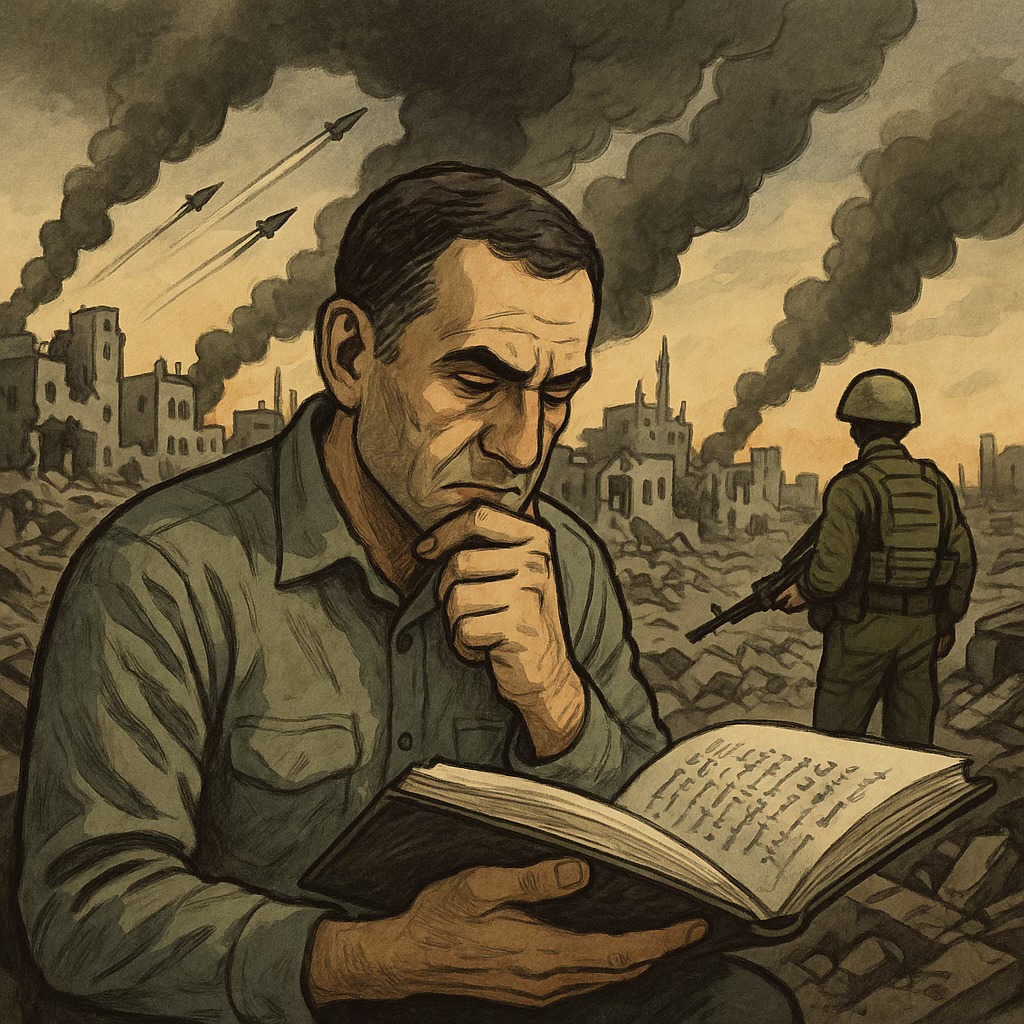
“The most regrettable thing in this situation is not that the attack was large, but rather that the attack was not large enough to capture 3,500 prisoners [hostages] instead of the number of prisoners, which is approximately 250-350.” [p. 23]
— Ahmed Abu Suhayb
Senior commander in Hamas’s missile force in Gaza
Imagine this
You start a war against a country.
That is what happened on 7 October 2023.
On that day, thousands of armed members of Hamas and other terrorist organisations launched simultaneous and coordinated attacks against civilian communities and military bases in southern Israel. This assault was described as unprecedented in its scale, the multiplicity of attack sites, the number of victims, and the extreme brutality of the acts committed. Prior to and during the infiltration, Hamas launched over 500 rockets into Israel, serving partly to mask their entry and create chaos and fear. The attack was underpinned by an extreme ideology rooted in explicit genocidal intent and the fundamental dehumanisation of the Jewish people. Documents and religious rulings recovered from Hamas operatives indicated that they were instructed to act with extreme brutality against Jews, soldiers, and civilians, with one ruling stating it was permissible to kill or take everyone (including children, women, and the elderly) as hostages.
During the attack, more than 1,200 people were brutally murdered, and many others were injured. A defining feature of the atrocities was the widespread and heinous acts of Conflict-Related Sexual Violence (CRSV). This sexual violence occurred across at least six different locations: the Nova music festival, Route 232, Nahal Oz military base, and Kibbutzim Re’im, Nir Oz, and Kfar Aza. Most victims of these sexual assaults were murdered during or immediately after the attacks, leading to their permanent silencing. Clear patterns of sexual violence emerged, including victims found partially or fully naked with their hands tied, often to structures like trees or poles; evidence of gang rapes followed by execution; genital mutilation; and public humiliation. Specific acts documented included attempted rape, sexual assault, forced sexual acts, forced nudity, verbal and physical sexual harassment, and threats of forced marriage. Accounts from morgue attendants described bodies with objects inserted into their private parts and signs of shooting or other mutilations in the genitalia area. Visual evidence included footage depicting sexual humiliation and assault, such as the dead body of Shani Louk being paraded in Gaza, almost fully naked, surrounded by cheering terrorists. Intercepted communications also included a Hamas terrorist referring to a female captive as a “sabaya,” a term associated with sexual slavery. The sexual violence also continued in captivity, with released hostages reporting forced nudity, physical and verbal sexual harassment, sexual assaults, and threats of forced marriage. Additionally, Hamas terrorists actively tried to destroy crime scenes and victims’ bodies, with numerous sites and bodies deliberately burned. [Dinah Project]
Then imagine a devastating war as a consequence of your actions: The level of destruction in Gaza as a direct consequence of the attack on October 7, 2023, is unprecedented in recent history. Vast destruction of buildings, infrastructure, cultural sites, farmland, and the natural environment. The sheer scale has rendered much of the Gaza Strip uninhabitable and has resulted in long-term humanitarian, social, economic, psychological, and reconstructive challenges.
After all of that calamity, imagine you write a book in Arabic in Gaza in order to assess your own ideology, actions, and the reaction of your enemy. What would you regret? That you started the war? That you underestimated the strength of your enemy? The suffering of your people as a result of your adventure? So far, I have not seen any proper discussion among Palestinians about these issues. Recently, I came across a post on Substack (thank you, Alex Stein) about a book that should have covered all these issues. That book in Arabic is written by a senior commander in Hamas’s missile force in Gaza, signed on December 14, 2024, and published in January 2025.
Imagine you are an Israeli decision-maker on the war in Gaza and see only one regret from a military commander in Gaza.
“The most regrettable thing in this situation is not that the attack was large, but rather that the attack was not large enough to capture 3,500 prisoners [hostages] instead of the number of prisoners, which is approximately 250-350.”
Such a statement, stripped of any reflection on the devastation inflicted upon both peoples, starkly illuminates the uncompromising mindset that continues to drive the conflict. It underscores that, for key Hamas leaders, the October 7th assault was not a tragic miscalculation but an incomplete success, to be measured only in terms of enemy casualties and hostages taken. For Israel’s decision-makers and opinion-makers, this chilling absence of remorse reinforces the view that Gaza is not merely a territorial or political challenge, but a persistent and existential threat rooted in ideology and history, a reality shaped by decades of conflict, failed peace efforts, and the unresolved consequences of the 2005 disengagement.
There is an intricate and often painful relationship between Israel and Gaza, particularly since the 2005 disengagement and its lasting consequences, culminating in the October 7th attacks. It highlights how the disengagement, driven by a deep disillusionment after the First and Second Intifadas, was a pragmatic attempt to address demographic concerns and avoid imposed peace, yet it inadvertently fostered a betrayal of security due to an over-reliance on technology. The text also explores the profound ideological trauma it caused for the religious Zionist right and frames Gaza as a persistent, existential threat to Israel, drawing parallels between Hamas and historical adversaries. Finally, it delves into the post-October 7th debate over re-occupying Gaza City, presenting both religious and halachic justifications for an obligatory war against Hamas, alongside moral limitations on warfare and significant warnings about the potential catastrophic consequences of re-occupation without national unity or considering military fatigue.
Disengagement, disillusionment, and the reckoning
The relationship between Israel and Gaza, particularly from the 2005 disengagement through the October 7th attacks and up to the current debate on re-occupying Gaza, is marked by a complex interplay of historical, religious, military, and political factors.
The 2005 disengagement
The disengagement from Gaza in 2005, spearheaded by Ariel Sharon, was a powerful idea born from a crisis of political ideas regarding the Israeli-Palestinian conflict [Goodman]. It emerged following a period of deep disillusionment among Israelis, stemming from the First and Second Intifadas [Goodman]:
Disenchantment from the myth of land. The First Intifada (1987) shattered the romantic notion for many secular Israelis that Judea and Samaria were purely biblical land. The image of an Israeli soldier facing a Palestinian child with a rock made Israelis question their role as Goliath rather than David, leading to a sense of disenchantment from the myth of land [Goodman].
Disenchantment from the myth of peace. The Second Intifada (2000), characterised by widespread bus bombings and terrorist attacks, delivered a fatal blow to the utopian vision of peace [Goodman]. This violence occurred right after the Oslo Accords and significant Israeli offers at Camp David, leading many Israelis to believe that violence was not simply a result of occupation, but persisted even when efforts were made to end it [Goodman].
In this context of radically confused Israelis who learned they couldn’t control Palestinians (First Intifada) or make peace with them (Second Intifada), Sharon’s unilateral disengagement offered a pragmatic solution. The calculation was that withdrawing from Gaza, which was not topographically threatening Tel Aviv and housed approximately a million Palestinians, would improve Israel’s demographic situation without significant geographic security risks. Sharon framed it as land to avoid peace and to prevent internationally imposed peace initiatives [Goodman].
However, the disengagement had profound ideological implications, especially for the religious Zionist right. It created a tragic dilemma by forcing a choice between loyalty to the sacred state and the sacred land. While the majority ultimately chose to prioritise the state, seeing its existence as a divine miracle, a brutal opposition emerged that prioritised the land, leading to calls for disobeying orders and even crippling the state to protect the land. This trauma, marked by scenes of soldiers physically removing families from their homes, fostered a sense of grievance among settlers and contributed to the rise of more militant elements within the religious right, who now hold significant power in the Israeli government [Goodman].
Crucially, the disengagement was predicated on a betrayal of security linked to an over-reliance on technology. The military establishment believed that technology could compensate for the loss of human intelligence sources in Gaza post-withdrawal. This led to a dangerous delusion: “We’re in the dark and we thought we’re in the light” [Goodman]. This myth of technology also fostered the idea of a small, smart, and technologically advanced army, leading to a reduced emphasis on the number of soldiers, a factor that would prove critical later [Goodman].
Gaza as a persistent and existential threat
Historically, Gaza holds deep significance in Jewish tradition, described as a Philistine stronghold that launched raids into ancient Israel and has “across millennia, been a base for forces seeking to weaken or destroy the Jewish presence in the Land.” There has been a painfully familiar pattern of hostile powers entrenched in Gaza using it as a “spearhead against Jewish life,” equating Philistines with Hamas in this regard [Hoffman].
Despite the 2005 disengagement, Gaza “didn't leave us” [Goodman]. Since the disengagement, there have been numerous conflicts, which Micah Goodman refers to as “seven [to] eight wars” before October 7th, 2023 [Goodman]. The perception of Hamas, the ruling power in Gaza, aligns with historical enemies.
Rodef principle. Hamas, “by both ideology and action, functions as a rodef” (one who pursues another with intent to kill) against Israel. Jewish law permits, and even obligates, stopping such a pursuer by any means necessary. Neutralising Hamas’s power base is seen as a “mitzvah to save life (pikuach nefesh)” [Hoffman].
Amalek analogy. While not literally Amalek, Hamas’s “charter, rhetoric, and actions align with that same ideology of annihilation.” The Torah’s command to “remember what Amalek did to you” serves as a warning not to be “naïve about the nature of certain threats! and not to leave them in place to strike again [Hoffman].
Blocked the wells. The Midrash’s depiction of Philistines as those who “blocked the wells,” cutting off life and sustenance, is seen as “hauntingly mirrored by Hamas’ use of tunnels, human shields, and blockades to choke Israeli security and threaten civilian life” [Hoffman].
October 7th: The catastrophe and the reckoning
The October 7th attacks were a brutal validation of the concerns about Gaza as an existential threat and a stark revelation of the failures stemming from the disengagement and the “myth of technology” [Goodman]:
Intelligence failure. The attacks underscored Israel’s “immense catastrophe” and the “terrifying” reality that Israel “thought we see when we didn’t see anything" due to over-reliance on technology [Goodman].
Insufficient army size. The myth of a “lean mean fighting machine” based on drones and robots proved disastrous. October 7th revealed Israel “doesn’t have a large enough army to fight seven fronts” and a critical need for more soldiers, including the ultra-Orthodox who were previously deemed unnecessary [Goodman].
Re-occupy Gaza City: A “Milchemet Mitzvah” or a catastrophe?
Following October 7th, the decision to conquer Gaza City, the “heart of Hamas’ power,” is framed from a Jewish perspective as a "pivotal moment” and not merely a military operation, but one “layered with meaning” [Hoffman].
Religious and halachic justification for conquest
Milchemet Mitzvah (commanded war). The battle against Hamas is deemed a milchemet mitzvah because Hamas is “an armed faction sworn to Israel’s destruction, which has already carried out massacres and kidnappings” [Hoffman]. Allowing Hamas to regroup would be “standing idly by the blood of your fellow” [Hoffman].
Preventative action. Taking Gaza City is seen as “not an act of escalation, but of prevention,” aimed at removing the capability of an entrenched enemy to repeat October 7th on a larger scale [Hoffman].
Completeness of action. Jewish history and halacha warn against “incomplete action” when faced with an existential threat, as “half-measures invite its return.” Leaving Hamas’s infrastructure intact risks repeating cycles of attack [Hoffman].
Pidyon Shvuyim (Redeeming captives). While agonising, the decision to conquer Gaza City is linked to ensuring “no more Jews are taken” and emboldening no more enemies through restraint, choosing “survival over sentiment” [Hoffman].
Moral and ethical limitations on warfare
Bal Tashchit (Do not destroy). Judaism imposes “strict limitations on conduct,” forbidding wanton destruction of resources, unnecessary harm to civilians or infrastructure, and emphasising the “sanctity of life and creation.” This ethic resonates with the IDF’s “Tohar HaNeshek” (purity of arms) doctrine [Hoffman].
Responsibility for collateral harm. Halacha places moral responsibility for civilian suffering on the aggressor who hides among non-combatants and uses them as human shields [Hoffman].
Post-war governance. “Winning a battle is not the same as winning peace.” After conquest, Israel faces a “moral test” to establish justice, care for the stranger, and prevent oppression, aiming for a “just post-war order that prevents the return of war” (tikkun olam) [Hoffman].
Kiddush Hashem (Sanctity of the name]. How Israel conducts itself in Gaza City, even under provocation, will shape global perceptions of Jews, bearing strategic and spiritual responsibility [Hoffman].
Peace as the ultimate ideal. Despite the necessity of defence, “war is not the Jewish ideal,” and peace remains the ultimate aspiration, as reflected in prophetic visions of "nation shall not lift up sword against nation” [Hoffman].
Concerns and warnings regarding re-occupation:
Micah Goodman views the option of conquering Gaza as “catastrophic,” arguing that it goes “against world opinion,” “radically against” Israeli public opinion, and that the army is “filled with fatigue” [Goodman]. He emphasises that Israel struggles to win wars without “national unity government” and that a divided populace behind such a dramatic move, especially one risking hostages, could lead to dire consequences if it fails [Goodman].
Goodman proposes an alternative, the “Lebanon model,” which involves targeted strikes against Hamas’s rebuilding capacity rather than full occupation. This approach would disarm Hamas without controlling the population, allowing Israel to “heal” and prepare for a “bigger war" with Iran. He stresses that Israeli soldiers are tired, and fatigue leads to mistakes [Goodman].
In conclusion, the journey of Gaza in the Israeli narrative, from the disengagement to the current situation, reveals a deep tension between perceived pragmatic necessities and profound ideological and security (mis)calculations. The disengagement, a product of disillusionment and a belief in technological solutions, inadvertently created new traumas and vulnerabilities that tragically culminated in October 7th.
References
Ahmed Abu Suhayb, 2025, ṭūfān al-aqṣā… sīāqāt wa-māʾālāt, (طوفان الأقصى… سياقات ومآالت) (al-aqsa flood … context and aftermath). No publisher, or place of publication.
The Dinah Project, A Quest for Justice October 7 and Beyond, https://thedinahproject.org/wp-content/uploads/2025/07/The-Dinah-Project-full-report-A4-pages_web-1.pdf
Joshua Hoffman, 20250809, “Jewish sources say a lot about conquering Gaza City.” https://substack.com/@futureofjewish/p-170501837, referred to as Hoffman in the text.
Times of Israel, 20250808, “Micah Goodman on 20 years to Disengagement as Israel is set to occupy Gaza”, www.youtube.com/watch?v=x-l_HqewbuM&list=TLGGxt-9MAA1RUcxMDA4MjAyNQ, referred to as Goodman in the text.
Khaled Salih, 20250714, “When the wretched of Gaza returned. Death’s dream kingdom for six hours and one minute.” https://khaledsalih.substack.com/p/when-the-wretched-of-gaza-returned
Alex Stein, 20250806, “How do Hamas View the War?”,

Glossary
Mitzvah (מִצְוָה) — literally “commandment” commonly use as a religious obligation or a good deed in accordance with the Torah.
pikuach, “preservation” or “watching over,” and nefesh “life” or “soul.” Together, the term means “preservation of human life.”
Midrash (מִדְרָשׁ) is a classical Jewish method, and body, of interpretation that seeks to uncover meaning in the Hebrew Bible beyond its plain sense. The word comes from the Hebrew root ד־ר־ש (d-r-sh), “to seek, inquire, investigate, or interpret.”
Halacha (הֲלָכָה) is the collective body of Jewish religious law, covering not just ritual observance, but ethics, civil matters, and daily life.
Pidyon Shvuyim (פִּדְיוֹן שְׁבוּיִים) literally means “redemption of captives” and is a long-standing Jewish legal and moral obligation in halacha to rescue or ransom fellow Jews held in captivity.
Bal Tashchit (בַּל תַּשְׁחִית) is a biblical commandment and ethical principle in halacha that prohibits wasteful destruction.
Tohar HaNeshek (טֹהַר הַנֶּשֶׁק) means “purity of arms” and is a modern Israeli ethical doctrine that governs the moral use of military force.
Tikkun Olam (תִּיקּוּן עוֹלָם) means “repairing the world” or “perfecting the world” and is a multifaceted concept in Jewish thought, with roots in classical rabbinic literature but evolving into a central ethical idea in modern Judaism.
Kiddush Hashem (קִידּוּשׁ הַשֵּׁם) means “sanctification of the Name”, referring to actions that bring honor to God’s name through righteous behavior, moral courage, and steadfast faith — especially in public.


