Israel: From Cognitive Collapse to Antifragile Consolidation
25 November 2025
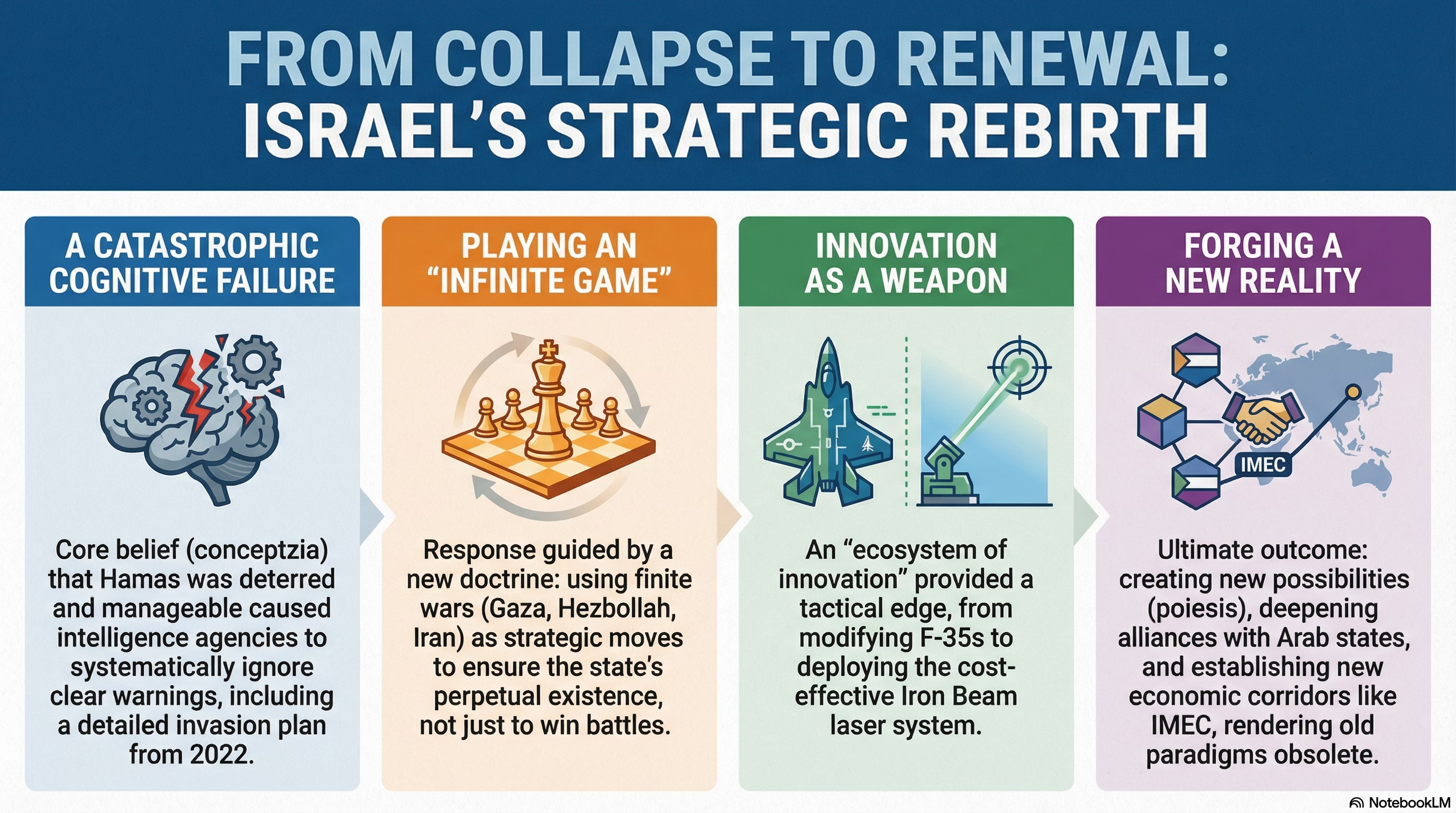
In this essay, I bring together the core insights of my two earlier articles and reshape them into a single, chronologically coherent story: from Israel’s cognitive collapse and institutional failures on October 7th, 2023, through the cascading wars on multiple fronts, to the painful process of learning, adaptation, and antifragile consolidation that followed. Rather than asking the reader to reconstruct the sequence from separate texts, I have woven the analyses of systemic failure, crisis management, and strategic recovery into one continuous narrative arc—moving from shock, blindness, and fragmentation to recalibration, resilience, and long-term statecraft. Even if you have encountered the previous articles in the “wrong” order, this piece is meant to stand on its own: it distills and integrates their arguments so that Israel’s journey—from institutional breakdown to renewed investment in its survival as a state, a people, and a culture—can be followed as a single, compelling trajectory.
A Tale of Two Theses
This essay synthesises two complementary perspectives to understand the profound transformation of Israel’s strategic posture between 2023 and 2025. The first is a study in catastrophic cognitive failure: an examination of the institutional blindness, doctrinal rigidity, and cultural complacency that led directly to the national trauma of the October 7th attack. The second is an account of strategic reorientation and renewal, interpreting Israel’s subsequent military campaigns not as isolated acts of retribution, but as the calculated moves of an antifragile, infinite-game player. Here I shall first perform a cognitive autopsy of the debacle that shattered Israel’s sense of invincibility. Then I shall analyse the strategic response that not only neutralised its enemies but fundamentally reshaped the geopolitical architecture of the Middle East. One can acknowledge, without in any way suggesting that such a catastrophe was desirable or “necessary,” that the very depth of the cognitive collapse—a systemic failure of metacognition—forced a profound strategic reckoning, out of which a more antifragile posture eventually emerged. For an infinite player, existential shocks are not events to be sought or welcomed, but grim realities that, once they have occurred, must neither be denied nor wasted: they compel the painful work of forging new strategic realities in the service of survival.
Part I: The Cognitive Catastrophe of October 7th
The Anatomy of a Debacle
Before applying a theoretical cognitive framework to the events of October 7th, it is crucial to establish the tangible, on-the-ground failures that created the conditions for the catastrophe. The disaster was not the product of a single error but a systemic breakdown across doctrine, intelligence analysis, and institutional culture. Understanding these observable failures provides the necessary foundation for diagnosing the deeper, underlying cognitive pathologies that allowed them to fester. These symptoms of institutional decay paved the way for the deeper cognitive causes that will be explored next.
The Doctrinal Blind Spot
In the lexicon of Israeli national security, the term conceptzia refers to a dominant strategic concept that shapes how the entire security establishment perceives threats and formulates policy. Before October 7th, a fatally flawed conceptzia held sway: the belief that Hamas was deterred, pacified by economic incentives, and more interested in governing Gaza than in waging war. This doctrine was not merely an assessment; it became an article of faith.
The strategy was rooted in economic pacification, with the belief that Qatari financial aid and an expanded work permit programme for Gazans had tempered Hamas’s ideological fervour. This bipartisan entrenchment was so pervasive that Naftali Bennett’s government significantly expanded the programme, with Bennett himself explaining in 2022 that “Hamas doesn’t want to hurt” the thousands of Gazans profiting from the policy. The establishment’s confidence was articulated with chilling certainty by then-IDF Chief of Staff in December 2022, who declared the preceding two years had been the “quietest and most stable in Gaza” because of this very strategy.
This security doctrine was actively reinforced by a political objective. As analysts Yaakov Katz and Amir Bohbot detail, Prime Minister Benjamin Netanyahu’s government viewed Hamas’s rule as “something of an Israeli asset”—a useful tool to divide the Palestinians and prevent the emergence of a unified entity that could advance a two-state solution. This political imperative created a powerful feedback loop, reinforcing the security establishment’s flawed assessment that Hamas was a manageable actor with primarily economic motives.
The Watchtower Was Blind
The failure of October 7th was not caused by a lack of information but by an institutional refusal to interpret it correctly. The watchtowers had eyes, but the institution was blind. A series of prescient warnings and detailed enemy plans were systematically ignored because they did not conform to the dominant conceptzia. The evidence for this systemic blindness is stark and damning:
- The Jericho Walls Document. In 2022, a year before the attack, Israel’s Military Intelligence (Aman) produced a document that was a horrifyingly accurate blueprint for the October 7th invasion. Titled “Jericho Walls,” it meticulously detailed Hamas’s precise plan for a multi-front attack. In a telling sign of institutional disconnect, Defence Minister Yoav Gallant was reportedly unaware of its existence until after the massacre had occurred.
- The Unit 8200 Analyst’s Emails. In the months leading up to the attack, a junior analyst in the elite signals intelligence Unit 8200 sent repeated emails to her superiors, warning that Hamas was conducting large-scale training exercises that mirrored the “Jericho Walls” plan. Senior officers dismissed her warnings, convinced the exercises were merely “for show.” In a powerful act of defiance, she signed one of her reports with a pointed quote from a revered, deceased Aman commander, signalling that her colleagues were failing to live up to the agency’s legacy.
- Avigdor Lieberman’s 2016 Memorandum. Seven years prior, then-Defence Minister Avigdor Lieberman penned a memorandum detailing Hamas’s extensive military build-up of rockets, drones, and GPS jammers. He cautioned with remarkable foresight, stating: “Fences and fortifications do not prevent war and do not guarantee quiet and security.”
The Cultural Collapse
Beyond flawed doctrines lies a deeper, more corrosive problem: a failure of institutional culture. Former Mossad chief Yossi Cohen provides a scathing critique, arguing that a culture of complacency, arrogance, and a lack of imaginative rigour within the IDF and Shabak (Shin Bet) created the conditions for collapse.
Cohen describes a security establishment that had grown “all too cozy,” with a leadership class “so tightly knit” that its members spoke “almost exclusively to one another” and failed to question the system. This insularity bred overconfidence and an absence of the “modesty” required for genuine security. He contrasts this sharply with the ethos he enforced at Mossad, as illustrated below.
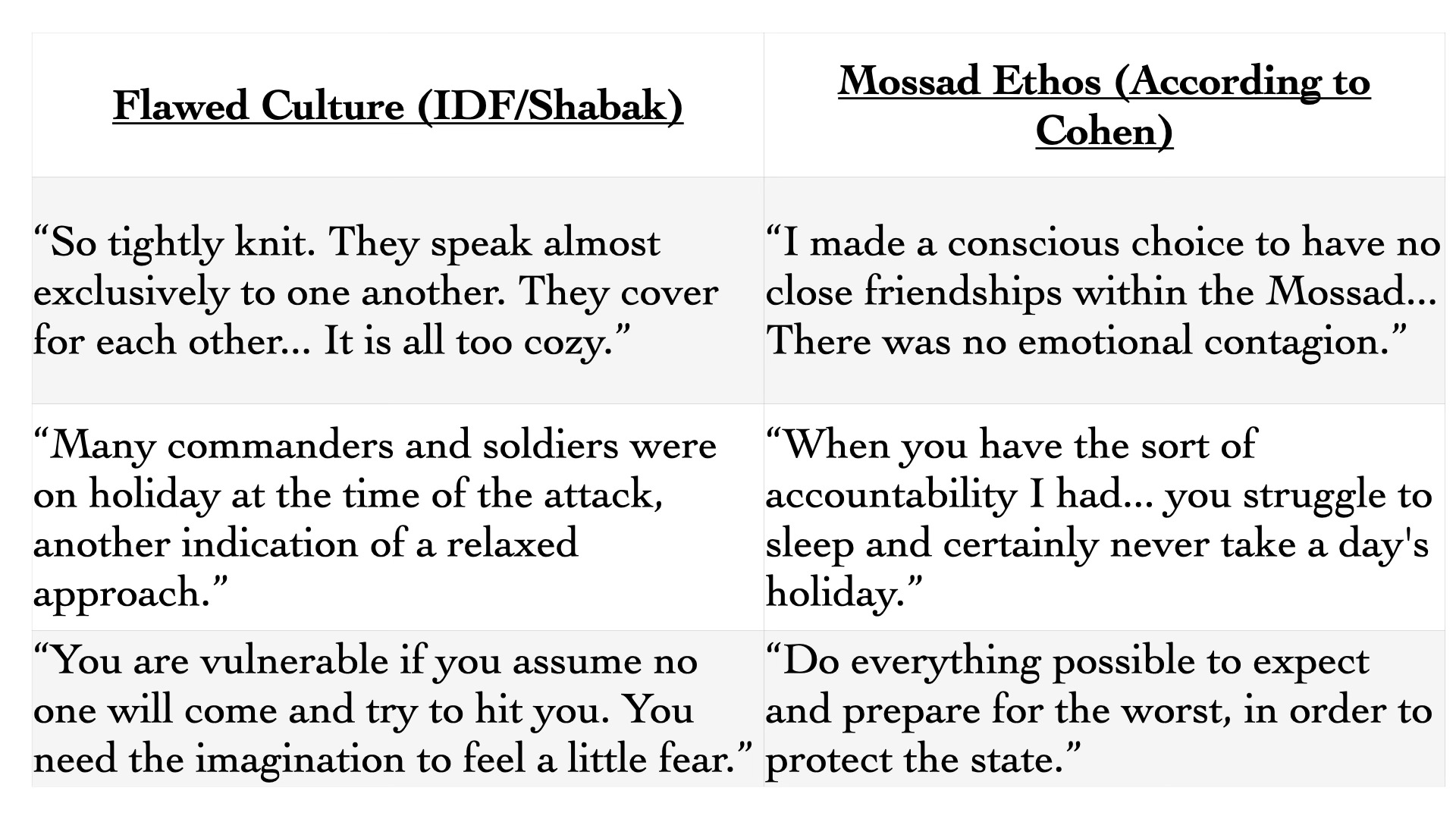
This culture had devastating consequences. It fostered an environment where the institution had lost the ability “to feel a little fear of the unexpected, or the supposedly impossible” and failed the most essential “mirror test” of self-accountability—the ability to, as Cohen puts it, “Stand in front of it, naked, and tell yourself you are doing your job. You should never be capable of lying to yourself.”
A Cognitive Autopsy of the Blunder
Applying a formal cognitive framework allows us to move beyond a simple catalogue of errors and diagnose the root causes of the failure. Using the work of cognitive scientist Nicholas D. Wright, this section will deconstruct the breakdown in the fundamental processes of sense-making and decision-making that led to October 7th. Having diagnosed this cognitive collapse, we can then appreciate the profound scale of the strategic recovery and adaptation that followed.
A Flawed Mental Map
According to Nicholas D. Wright, complex organisations operate using internal Models of the world—structured mental maps that help them make sense of reality and anticipate the future. The October 7th failure began with a catastrophic flaw in the Israeli security establishment’s Model of Hamas. Wright posits that for a Model to be useful, it must meet three criteria RAF; Israel’s failed on every count.
- Closeness to Reality. The Israeli Model depicted Hamas as a quasi-rational actor preoccupied with governance and deterred by economic incentives. This was dangerously divergent from the reality detailed in the “Jericho Walls” document: a brutal army meticulously planning a large-scale invasion. The Model was not just inaccurate; it was an inverted image of the truth.
- Anticipation of Problems. A useful Model simulates possible futures to prepare for threats. Israel’s Model, however, actively excluded or “pruned” the most dangerous scenario from its decision tree. By assuming Hamas’s rationality was purely economic, it refused to seriously contemplate the horrific possibility of a massacre, even when evidence pointed directly towards it.
- Flexibility to Change. The world is dynamic, and a useful Model must adapt to new information. Israel’s Model of Hamas had become rigid and sclerotic. This was the institutional expression of the “all too cozy” establishment described by Yossi Cohen, where “No one questions the system.” The Model was no longer a working hypothesis but a fixed ideology.
Institutional Analgesia
In Wright’s framework, learning occurs through “prediction error”—the signal generated when reality contradicts a Model’s expectations. The unheeded intelligence warnings were massive prediction errors that the system failed to process. The establishment had developed a form of institutional congenital analgesia: an inability to feel the pain of its own errors and, therefore, an inability to react to the damage being done.
The Jericho Walls document and the Unit 8200 analyst’s emails created a colossal discrepancy between the Model’s core prediction (“Hamas is quiet and deterred”) and observed reality (“Hamas is actively training for a full-scale invasion”). Each should have triggered a fundamental reassessment. The system did not fail because it couldn’t learn; it refused to learn due to the political convenience of maintaining Hamas as a divisive “asset” (Katz & Bohbot) and the cultural complacency that discouraged dissent (Cohen).
The Deception Gambit
As Wright explains, we perceive a “controlled Model” of the world shaped by both our internal expectations and incoming sensory data. Hamas’s deception strategy masterfully manipulated Israel’s expectations, causing it to fundamentally misinterpret the data it received.
Hamas patiently fed Israel’s expectations, remaining silent during Islamic Jihad flare-ups to reinforce the Israeli belief that it was a “responsible” actor. This manipulation caused Israeli intelligence to misinterpret the undeniable “sensory data” of Hamas’s large-scale invasion drills. The expectation (“Hamas is deterred”) overrode the sensory input (“Hamas is training for an invasion”), and the exercises were dismissed as being “for show.” This pattern is a classic feature of military deception, paralleling, as Wright notes, the Japanese attack on Pearl Harbor. The famous call of “Tora, Tora, Tora” signified the achievement of complete surprise against an American fleet whose commanders’ perceptual Model did not include the possibility of such a strike.
The Absence of Wisdom
The capstone of Wright’s framework is “metacognition,” or “thinking about thinking.” It is the ability to critically assess one’s own knowledge and question one’s own assumptions. The October 7th failure was, in its final analysis, a catastrophic collapse of institutional metacognition.
Yossi Cohen’s critique of a leadership that lacked “modesty” and failed the “mirror test” is a direct indictment of an institution with poor metacognition. The establishment was unable to ask the crucial question: “What if our entire Model is wrong?” Wright makes a vital distinction between being clever and being wise. The Israeli intelligence community was undoubtedly clever, possessing immense technical capabilities and data. Yet it lacked wisdom—the institutional humility and intellectual flexibility to question its core assumptions. This absence of self-awareness was the central node of failure that bound the flawed doctrine, unheeded warnings, and cultural complacency into a perfect storm of catastrophe.
Part II: The Antifragile Response and Strategic Reorientation
The Infinite Game
Israel’s response to the catastrophe of October 7th can only be fully understood through the lens of James P. Carse’s game theory. Carse makes a core distinction between finite games, which are played for the purpose of winning, and infinite games, which are played for the purpose of continuing the play. Israel’s actions demonstrate a sophisticated understanding of this distinction, waging a series of finite wars as instruments to perpetuate its ultimate infinite game. This section defines that theoretical framework before analysing its practical application in Israel’s military campaigns.
Israel’s Infinite Game
Israel’s overarching Infinite Game is the perpetual continuation of the state’s existence, security, and cultural integrity. This is not a game with a defined endpoint or a final victory; its sole purpose is to endure. This non-negotiable objective is perfectly encapsulated by former Prime Minister Golda Meir’s foundational statement on Israeli strategic identity:
“The Jews’ secret weapon is that we have nowhere else to go.”
This is the pure logic of an infinite player. When final defeat is unthinkable, every action and every war is subordinated to the single imperative of continuation.
The Embedded Finite Games
A Finite Game is a contest with clear boundaries, fixed rules, and a declared winner. Between 2023 and 2025, Israel prosecuted a series of distinct but interconnected finite games to eliminate immediate threats to its infinite game. As chronicled by historian Arthur Herman, these campaigns included:
- The Gaza War against Hamas (Operation Iron Swords).
- The Campaign to Degrade Hezbollah in Lebanon.
- The Neutralisation of the Houthi Threat.
- The Strategic Reshaping of Syria post-Assad.
- The Twelve-Day War against Iran’s nuclear and military infrastructure.
Waging Finite Wars for Infinite Ends
This analysis will now deconstruct how Israel leveraged each of its major finite military campaigns not as ends in themselves, but as strategic moves to strengthen its long-term position and ability to continue its infinite game. These actions were enabled by a specific cognitive toolkit, which will be explored in the subsequent section.
Dismantling Hamas
The war in Gaza was a necessary, defensive finite game to eliminate an immediate threat. The objective, as articulated by Arthur Herman, was to “break the backs of both Hamas and Hizbollah,” restoring the conditions necessary for Israel to continue its infinite game. Military analyst Edward Luttwak’s observation of the IDF’s estimated 50-to-1 kill ratio against Hamas combatants was described as an “incredible measure of success,” framing a clear metric for achieving the finite goal of destroying the enemy’s war-making capacity.
Crippling the “Axis of Resistance”
The campaigns against Hezbollah and the Houthis were a masterclass in “playing with boundaries,” a key trait of an infinite player. The Mossad’s covert pager operation against Hezbollah dissolved the perceived boundary of the group’s secure communications network, redefining the battlefield.
It is one of those exquisite coincidences that could only occur in the Middle East, where the Almighty appears to have a sardonic sense of humour. The “Party of allāh” (hizb allāh), commanded by Hassan “Victory of allāh” (nasr allāh), and later passed to Hashem “The Pure of the Religion” (safī ad-dīn), has been systematically dismantled by the very state they vowed to destroy. The irony hangs heavier than dust: the Party of allāh, the Victory of allāh, and the Pure of the dīn, all brought low by the very infidels they promised to drive into the sea. If this is divine justice, it arrives with a distinctly tribal accent and a targeting pod. One almost wants to apologise to the Almighty for noticing that, on this occasion at least, Hashem’s aim was rather good. In Jewish tradition, Hashem (“The Name”) is the reverential substitute for God, a term of awe and restraint starkly contrasting with the bold proclamations embedded in the names of Hezbollah’s leadership.
Decapitating the Hydra
The Twelve-Day War against Iran was the ultimate example of a finite game waged for an infinite goal. As chronicled by Herman, this was a coordinated operation. After initial Israeli Air Force strikes neutralised Iran’s air defences, the U.S. Air Force delivered the coup de grâce, as American B-2’s and cruise missiles smashed Iran’s biggest and most important nuclear facilities. This pre-emptive strike at the “head of the hydra” was designed to ensure the state’s survival for decades, free from the threat of nuclear annihilation.
The Cognitive Toolkit of the Infinite Player
An infinite player’s success relies on a specific cognitive toolkit rooted in adaptation, creativity, and narrative cohesion that transcends pure logic. These cognitive faculties were the engine that produced the tangible, world-shaping outcomes that reshaped the region.
From Prediction Error to Strategic Adaptation
The shock of October 7th represented what Nicholas Wright terms a “prediction error”—a biological signal that forces a radical update to a state’s strategic model. For a rigid, finite player, such a shock can be paralysing. For an infinite player, however, it is a powerful catalyst for adaptation. The catastrophe forced a complete reassessment of threats and capabilities, demonstrating the profound plasticity required to transform a moment of supreme vulnerability into a trigger for strategic renewal.
Imagination and Unlimited Tactics
Israel’s military performance exemplifies Angus Fletcher’s concept of a “defined strategy, unlimited tactics.” Its military superiority is not a fixed inventory but an “ecosystem of innovation,” as described by Nachum Kaplan. This mindset is evident in numerous examples:
- Platform Modification. The transformation of the standard F-35 into the F-35I Adir, integrating proprietary systems to create new tactical possibilities.
- Economic Innovation. The deployment of the Iron Beam (Ohr Eitan) laser system, ensuring economic sustainability in a protracted conflict. The system was named “Light of Eitan” in honour of a fallen soldier whose father contributed to its development, powerfully linking technological advancement to the national narrative of collective sacrifice.
- Covert Creativity. The meticulously planned pager operation against Hezbollah, showcasing an imaginative approach to asymmetric warfare.
Narrative, Identity, and Cultural Resilience
Sustaining motivation through a painful conflict requires a powerful narrative. Wright’s concept of the “identity-culture spiral,” where individual identity reinforces group culture, explains the source of Israel’s resilience. The narrative of a people’s army where citizens fight for national survival creates a powerful cohesion. As observed by Herman, the national response to the hostage crisis provided a shared and unifying purpose that transcended politics and sustained the nation in service of its infinite game.
Poiesis
The ultimate goal of an infinite player, as defined by Carse, is poiesis—the creative act of initiating new possibilities. The ultimate proof of Israel’s success lies not in its military victories, but in the new strategic reality it forged from the conflict. These creative acts set the stage for the continuation of Israel’s unending game.
A Realigned Regional Architecture
Counter to predictions that the war would isolate Israel, it “accelerated the alignment Sinwar hoped to destroy.” Synthesising analyses from Herman and Zineb Riboua, the conflict led to deeper military coordination between the IDF and Arab armies via CENTCOM, as pragmatic states recognised that Israeli hard power was more valuable than the opinions of “Western university students.”
The Genesis of New Economic Corridors
Israel’s victory solidified its role as the “geographic hinge” of the India-Middle East-Europe Corridor (IMEC). This is a direct act of poiesis. As Riboua notes, this framework offers a viable alternative to China’s centralised Belt and Road Initiative by creating a system that “distributes power across participating states”—the hallmark of infinite play.
The Irrelevance of Old Paradigms
Perhaps most significantly, Israel’s actions rendered old diplomatic frameworks obsolete. As Herman concludes, “the Israel boycott movement, and the siren calls for a Palestinian state... [became] irrelevant.” By breaking the Iranian-backed “axis of resistance” and deepening its integration with pragmatic Arab states, Israel successfully changed the rules of the game, forcing all other players to adapt to a new reality.
The Antifragile Player and the Unending Game
This analysis has traced a journey from a profound cognitive collapse, rooted in a failed mental model and institutional arrogance, to an antifragile strategic response that reshaped a region. The catastrophe of October 7th was the direct result of a system that had lost the wisdom to question its own assumptions. The subsequent military campaigns were the work of a state forced to learn, adapt, and fight for its very continuation.
Israel’s actions from 2023-2025 exemplify an infinite player that leverages finite crises not merely to survive, but as catalysts for renewal. Arthur Herman’s vision of a potential “golden age” for Israel and the Middle East should not be interpreted as a final victory, but as the successful creation of a new, open set of possibilities—a true act of poiesis that ensures the continuation of the game.
In the end, Iran’s vaunted “Ring of Fire” proved nothing more than a bonfire of Tehran’s vanities – each proxy war it sparked only strengthened Israel’s resolve and spurred an even more ferocious counterstrike. From Gaza to Lebanon, from Yemen to a collapsing Syria, Israel systematically severed every Iranian tentacle – dismantling Hamas in Gaza, defanging Hezbollah in Beirut, neutralising the Houthis in Yemen, and preempting chaos in Syria’s ruins – with unsparing precision. Having thus cut off each limb of the Octopus strategy, Jerusalem delivered the coup de grâce at the head: a twelve-day air campaign that shattered Tehran’s nuclear program and decapitated Iran’s military leadership in its own capital. In doing so, Israel not only survived an existential siege but fundamentally changed the rules of the region – forcing every player to adjust to a new reality drawn up in Jerusalem rather than Tehran, Damascus, Beirut or Gaza City.
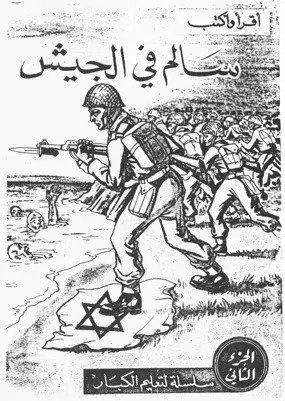
The cover of a primer, Sālim in the Army, used to teach reading and writing to Syrian soldiers.
References:
James P. Carse, 1986, Finite and Infinite Games: A Vision of Life as Play and Possibility. New York, NY: The Free Press, A Division of Macmillan, Inc..
Yossi Cohen, 2025, The Sword of Freedom: Israel, Mossad, and the Secret War. Broadside Books: New York, NY Year.
Angus Fletcher, 2025, Primal Intelligence: You Are Smarter Than You Know. New York: Avery.
Arthur Herman, 202511, “The Strategic Fruits of Israel’s Military Victory. Israel contra mundum.” https://ideas.tikvah.org/mosaic/essays/how-israel-changed-the-face-of-the-middle-east
Jews and Other, “Anti-Semitic and Anti-Israel Cartoons.” https://www.jewsandothers.com/cartoons/
Nachum Kaplan, 20251121, “Beyond the F-35: The weapons, networks, and intelligence that keep Israel ahead of its rivals.”

Yaakov Katz & Amir Bohbot , 2025, While Israel Slept: How Hamas Surprised the Most Powerful Military in the Middle East. New York: St. Martin’s Press.
Zineb Riboua, 20251120, “How Israel’s Victory Strengthens America’s Hand.” https://ideas.tikvah.org/mosaic/essays/responses/how-israels-victory-strengthens-americas-hand?queryID=6461f346cca75edb6a6c612384cd84e4
Khaled Salih, 20251122, “An Antifragile State: Israel’s Military Strategy as an Infinite Game.” https://khaledsalih.substack.com/p/an-antifragile-state-israels-military
—, 20251026, “Netanyahu and Trump: Masters of the Long Game.” https://substack.com/home/post/p-177200350
20250906, “‘Don’t forget to keep living’: A review of While Israel Slept: An Indictment of Systemic Failures.” https://khaledsalih.substack.com/p/dont-forget-to-keep-living?
— 20251019, “War of Revival at the Core of Israel’s Antifragility.” https://substack.com/home/post/p-176597531
Nicholas D. Wright, 2025, Warhead: How the Brain Shapes War and War Shapes the Brain. New York: St. Martin’s Press.


