islām’s 6 Doctrinal Truths Hidden in Plain Sight
By Khaled Salih
“Every man, wherever he goes, is encompassed by a cloud of comforting convictions, which move with him like flies on a summer day.” Bertrand Russell
In the West, discussions about islām are often framed by simplified, reassuring narratives that emphasise peace, tolerance, and shared values. This version of the faith is presented in schools, echoed by political leaders, and reinforced in media. However, a deep, doctrinal analysis of islām’s foundational texts, the qur’ān, the hadith, and classical shari‘a law, reveals a far more complex and often counter-intuitive reality. [There is no capital letter in the Arabic language, so all Arabic words are written as they would appear in any Arabic text. The “magic” used in Arabic to elevate the meaning of a word is to put an “al” in front of the word. For example, the verb root h-d-y can form hadā (to guide, lead to the right way). hādī means the one who guides and al-hādī means The Guide, which is also among allāh’s, as well as muḥammad’s, 99 names.]
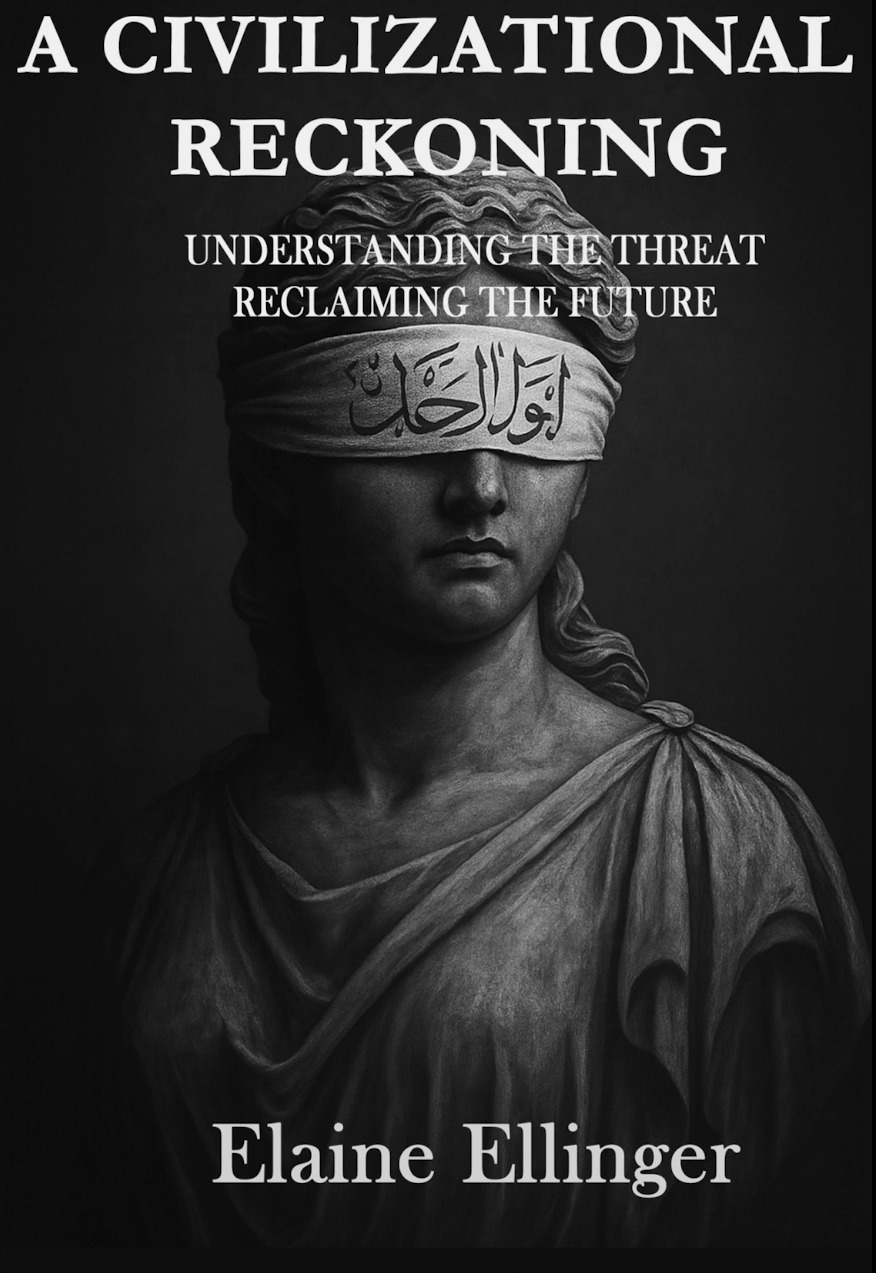
Drawing from the documented analysis in Elaine Ellinger’s book, A Civilizational Reckoning: Understanding the Threat, Reclaiming the Future, I would like to distills six of its most surprising and impactful takeaways for laypeople. These points challenge common perceptions by grounding them directly in the core tenets that guide islāmic belief and practice worldwide.
Her account operates in a completely different analytical register from the revisionist studies of islām’s origins. Whereas revisionist scholars such as Gabriel Said Reynolds and the Inârah Institute question the authenticity and formation of the qur’ān and the historical existence of muḥammad, Ellinger assumes the traditional framework as given and studies islām from within its own doctrinal system. Her method is juridical, not historical: she treats the texts and classical jurisprudence as authoritative and prescriptive sources that continue to govern muslim belief and behaviour. Her focus is on the application of these texts (“a cloud of comforting convictions”) rather than their composition. [See Kerr and Salih in Sources.]
1. The qur’ān’s “Perfect Preservation” Is a Doctrinal Claim, Not a Historical Fact
The common belief among muslims is that the qur’ān is the perfectly preserved, unaltered word of allāh, guarded from any error since its revelation. Yet, the historical record tells a more complicated story. According to islāmic tradition itself, the qur’ān was first compiled into a single volume after muḥmmad’s death, gathered from scattered materials like “palm stalks, bones, and stones.”
Later, during the reign of the third Caliph, ‘uthman, discrepancies in recitation prompted him to order the creation of a standardised version. He then commanded that all other existing qur’ānic materials be burnt. This process of standardisation did not end in the 7th century. As recently as 1924, the Royal Cairo edition was created to resolve textual variations in Egyptian state schools; this new standard was approved by al-azhar university, and many pre-1924 qur’āns were dumped into the Nile.
Even with these efforts, parts of the revelation were reportedly lost, including one striking example cited in the source text:
“It was narrated that ‘ayshah said: ‘The verse of stoning and of breastfeeding an adult ten times was revealed, and the paper was with me under my pillow. When the messenger of allāh died, we were preoccupied with his death, and a tame sheep came in and ate it.” (ibn Majah 1944)
Furthermore, the source notes the existence of multiple, recognised variant readings (qirā’āt) of the qur’ān and cites research showing documented corrections and alterations in early manuscripts. This historical complexity challenges the foundational claim of a single, perfectly preserved text from the beginning. The gap between doctrinal assertion and the historical record is significant, yet it is a topic rarely discussed in public forums.
2. islām Does Not Mean Peace, It Means Submission
One of the most widely circulated claims about islām is that its name means peace. According to Ellinger’s doctrinal analysis, this reflects “dawa messaging, not doctrinal fact.” While the Arabic root s-l-m is shared by both salām (peace) and islām (submission), the two terms are not interchangeable.
The book states clearly that islām means submission to the will of allāh and his divine law, shari‘a. From a doctrinal viewpoint, peace is the condition that is achieved after this submission is complete, either through conversion or through the acceptance of non-muslims living as subjugated subjects under Islamic rule.
In islāmic doctrine, peace (salām) follows only after such submission, either by becoming muslim or accepting muslim rule (see Q8:60-61, 9:29; ibn Kathir tafsir). Western school materials have claimed for over thirty years that islām means “peace.” This reflects da‘wa messaging, not doctrinal fact.
3. Truth Is Conditional, and Deception Is Permitted
In islām, truth is so central that one of allāh’s 99 names is al-haqq, “The Truth.” This absolute conception of truth, however, paradoxically accommodates doctrinally-sanctioned deception when it serves a greater purpose. In this framework, “truth” is equated with al-haqq itself, a revealed, fixed, and absolute system to which everyone must submit.
Counterintuitively, this includes permission for deception. Concepts such as taqiyya (strategic lying) and kitmān (omitting part of the truth) are permissible tools that can be used to protect or advance islām. The 14th-century shari’a manual Reliance of the Traveller (ROT), certified by al-azhar university as a valid reference for Islamic law today, provides a starkly clear ruling on this matter:
“One should compare the bad consequences entailed by lying to those entailed by telling the truth, and if the consequences of telling the truth are more damaging, one is entitled to lie.” (ROT)
The book highlights a modern example: King Charles’ ramadhān message, in which he quoted the gentle-sounding part of a qur’ān verse (“allāh does not burden a soul beyond that it can bear…”). He must have been recommended to omit its conclusion: “...so give us victory over the disbelieving people.” This omission completely changed the verse’s meaning for a non-muslim audience, illustrating how partial truths can be used to present a softened, misleading version of the doctrine.
4. It’s Not Flattering
While often perceived as an inward-focused faith, islām’s foundational texts dedicate a remarkable amount of attention to those outside the religion. According to a statistical analysis cited in the book, 64% of the qur’ān is about the kāfir, or non-believer.
The term kāfir is not a neutral label like unbeliever. Elaine Ellinger describes it as a “moral and legal designation” for an inferior class of person. Throughout the qur’ān, the kāfir is consistently portrayed as cursed, defiled, the “worst of creatures,” an enemy of allāh whose heart is sealed, and deserving of subjugation and divine wrath. This division is central to the islāmic principle of al-walāʾ wa-l-barāʾ, a command for muslims to maintain loyalty to fellow muslims while showing disavowal of, and enmity toward, non-muslims. This dualistic standard is summarised plainly in the qur’ān itself:
“muḥammad is the messenger of allāh; and those with him are forceful against the kāfirs, merciful among themselves...” (Q48:29)
This fundamental doctrinal division between believer and kāfir is crucial for understanding islām’s prescribed relationship with the non-muslim world, as it establishes a permanent, religiously mandated hierarchy.
5. A Factory Reset
Many in the West hope that islām can undergo a reformation, similar to that in Christianity, to align its teachings with modern, secular values of equality and individual freedom. However, according to Ellinger, the foundational texts are structured to prevent this.
The concept of “renovation” in islām’ (as described in a hadith) is not about modernisation or progressive reform. Instead, it is a call to return the faith to its original 7th-century template as practiced by muḥammad: a “factory reset.” Furthermore, innovation (bidʿah) in religious matters is strictly forbidden and condemned as a grave error.
“The worst of things are those that are newly invented; every newly-invented thing is an innovation and every innovation is going astray, and every going astray is in the Fire.”
As the ultimate barrier to internal reform movements, the author points to the doctrinally mandated death penalty for apostasy. The command, “Whoever changes his religion, then kill him” (Bukhari 6922), makes organised efforts to fundamentally alter or leave the faith a capital offence.
6. Just... islām
In political and media discourse, a careful distinction is often made between islām, the peaceful religion, and islām-ism, the violent political ideology. Ellinger argues that this is an artificial and misleading separation.
islām’s foundational texts, the qur’ān, hadith, and sīra (biography of muḥammad), have always integrated religion, law, politics, and military action. The goal of implementing shari‘a law as the governing system for society is presented not as an extremist corruption of the faith, but as central to it. The book points out the linguistic oddity that a follower of Catholicism is a Catholic, but a follower of islām is a muslim, not an islāmist. This unique terminology helps maintain the separation in the public mind. In reality, the groups labeled islāmist are often the ones most faithfully applying the supremacist and militant commands found directly in islām’s core texts. Their goal of implementing shari‘a is a direct application of islām’s dualistic view of the kāfir (Point 4), its resistance to reform (Point 5), and its ultimate definition as submission (Point 2), not a modern corruption of the faith.
“Our prophet, the messenger of our lord, has ordered us to fight you till you worship allāh alone or give jizya (i.e., tribute); and our prophet has informed us that our lord says: ‘whoever amongst us is killed (i.e., martyred) shall go to paradise... and whoever amongst us remains alive shall become your master.’” (Bukhari 3159)
The central theme that emerges is that the simplified, sanitised version of islām often presented for Western consumption is frequently at odds with the complex, demanding, and often harsh realities found in its foundational texts. Understanding these core doctrines is therefore not an act of prejudice, but a prerequisite for navigating the legal, political, and social challenges that inevitably arise when two irreconcilable legal and moral systems meet within a single society.
Given this gap between public perception and doctrinal reality, how can we foster more honest and informed conversations about the role of religious ideologies in modern, pluralistic societies?
Sources:
Elaine Ellinger, 2025, A Civilizational Reckoning: Understanding the Threat, Reclaiming the Future, POI Books, https://www.amazon.co.uk/dp/106887600X?utm_source=chatgpt.com
Robert M Kerr, 2025, “Koranische Leserlichkeit,” in Der 13, Juli/August, pp. 5-6.
Bertrand Russell, 1928. Sceptical Essays. London: George Allen & Unwin, 1928, p. 31.
Khaled Salih, 20251004, “Reconstructing beginnings of early islām, muḥmmad, and the qur’ān.” https://khaledsalih.substack.com/p/reconstructing-beginnings-of-early
— 20251002, “Shattering the pagan Mecca myth: Islam’s Christian context.” https://khaledsalih.substack.com/p/shattering-the-pagan-mecca-myth-islams


