“Islamophobia” — UK’s Weaponisation of an Idea Pathogen
By Khaled Salih
[I]n the 1800s the dominant racial ideology in America really was white supremacy. As a result, the master-debaters of that age often used their reasoning to justify anti-black racism. An example would be the American physician Samuel Cartwright. A strong believer in slavery, he used his learning to avoid the clear and simple realization that slaves who tried to escape didn’t want to be slaves, and instead diagnosed them as suffering from a mental disorder he called drapetomania[*], which could be remedied by “whipping the devil” out of them. Like the fictitious disorder that white people are diagnosed with today—white fragility—drapetomania is an explanation so idiotic only an intellectual could think of it.
— GURWINDER, 20250213
If drapetomania was the pseudo-scientific lunacy of a slaveholding age, “Islamophobia” is the psychological conceit of a guilt-ridden one. Both spring from the same diseased impulse to medicalise moral discomfort — to turn dissent from a prevailing order into a diagnosable illness. In the nineteenth century, the physician Samuel Cartwright diagnosed the yearning for freedom in the enslaved as madness; today, Western intellectuals diagnose the desire to examine Islam with reason as a “phobia.” The plantation doctor’s whip has been replaced by the bureaucrat’s reprimand, but the logic remains unchanged: the heretic must be corrected, not heard. Drapetomania, in its time, absolved the slave master of cruelty; “Islamophobia” now absolves the cowardly of thought. Both are symptoms of what can only be called a moral neurosis — a civilisation so frightened of its own conscience that it pathologises those who still possess one.
The Inquiry
Join me on a discovery journey which presents a critical analysis of the term “Islamophobia,” approaching it not as a simple descriptor of prejudice, but as a complex and influential “idea pathogen” engineered to suppress critical inquiry, neutralise intellectual defences, and install fear. The core thesis is that the concept has been constructed and deployed to shield a specific set of ideas from the normal and necessary processes of conjecture and criticism, thereby enabling its own proliferation.
I shall start this analysis with two lenses to reveal the idea pathogen’s precise mechanics. The principles of Neuro-Linguistic Programming (NLP) will be used to uncover the specific linguistic patterns that reframe reality and control belief without reasoned argument. Concurrently, the psychology of predatory behaviour will illuminate how the strategy leverages noble sentiments and induces cognitive dissonance to silence dissent and protect an ideology from scrutiny. By applying these multidisciplinary frameworks to foundational UK policy and debate documents, we can expose the linguistic and psychological architecture of this weaponised idea.
To further scrutinise this problematic concept, I shall then employ a unique synthesis of analytical frameworks that are not combined very often, if at all. I will begin with the foundational lenses of David Deutsch’s epistemology, Iain McGilchrist’s Hemisphere Hypothesis, the Stupidity Paradox, and Parasitic Mind Theory. These frameworks allow us to evaluate the term’s quality as an explanation, identify the cognitive style that produces it, and understand the sociological mechanisms that facilitate its spread within institutions.
The purpose of my endeavour is to reveal how the term “Islamophobia” has been weaponised as a powerful tool to constrain thought and shut down critical discourse, thereby posing a significant challenge to the principles of an open society. To umask this idea pathogen, we must first examine the official strategy from which it operates.
The Official Strategy
To umask the function of the “Islamophobia” strategy, it is first necessary to understand its formal architecture, the specific language used to construct it, and its intended psychological effect. This section analyses the definitions and policies presented in the UK parliamentary debate pack on “Islamophobia” and the Labour Party’s formal Code of Conduct, which codifies the strategy into institutional rules.
The Architecture of the Definition
The formal definition of “Islamophobia” has been a subject of significant evolution and political contention. The term first entered UK public policy discourse in 1997 through a report by the Runnymede Trust, which defined it as “unfounded hostility towards Islam” and noted its practical consequences in discrimination and the exclusion of Muslims from public life.
Two decades later, in 2017, the Runnymede Trust published an updated report offering a starkly revised short definition: “Islamophobia is anti-Muslim racism.” This evolution from “unfounded hostility towards Islam” (an ideology) to “anti-Muslim racism” (a people) is the central strategic manoeuvre that enables the concept’s weaponisation, laying the groundwork for the APPG’s subsequent definition.
This evolution culminated in the definition proposed by the All Party Parliamentary Group (APPG) on British Muslims, which has become the preeminent reference point in the UK. The APPG defines the term as follows:
“Islamophobia is rooted in racism and is a type of racism that targets expressions of Muslimness or perceived Muslimness.”
This definition, while adopted by numerous organizations, has faced significant criticism. Andrew Gilligan, writing in the Spectator, argued that the APPG report’s proposed tests for what constitutes “Islamophobia” were so broad they would be difficult to police. The National Secular Society was more direct, describing the definition as “vague and unworkable” and warning that it “conflates hatred of, and discrimination against, Muslims with criticism of Islam.”
Linguistic Manipulative Patterns
The language of the APPG definition and the illustrative examples in the Labour Party’s Code of Conduct are not accidental; they employ specific linguistic patterns designed to shape belief and control discourse. Using the framework of Neuro-Linguistic Programming (NLP), we can identify these patterns and their function.
The APPG definition itself—“Islamophobia is rooted in racism and is a type of racism that targets expressions of Muslimness or perceived Muslimness”—is a classic complex equivalence. This is a linguistic distortion that asserts that one thing means another. Here, any action that “targets expressions of Muslimness” is made equivalent to racism. This reframes a vast and undefined category of potential speech and inquiry as a form of bigotry by definition, bypassing the need for argument or evidence.
The Labour Party’s Code of Conduct further embeds these manipulative patterns into official policy. The following table identifies key examples:
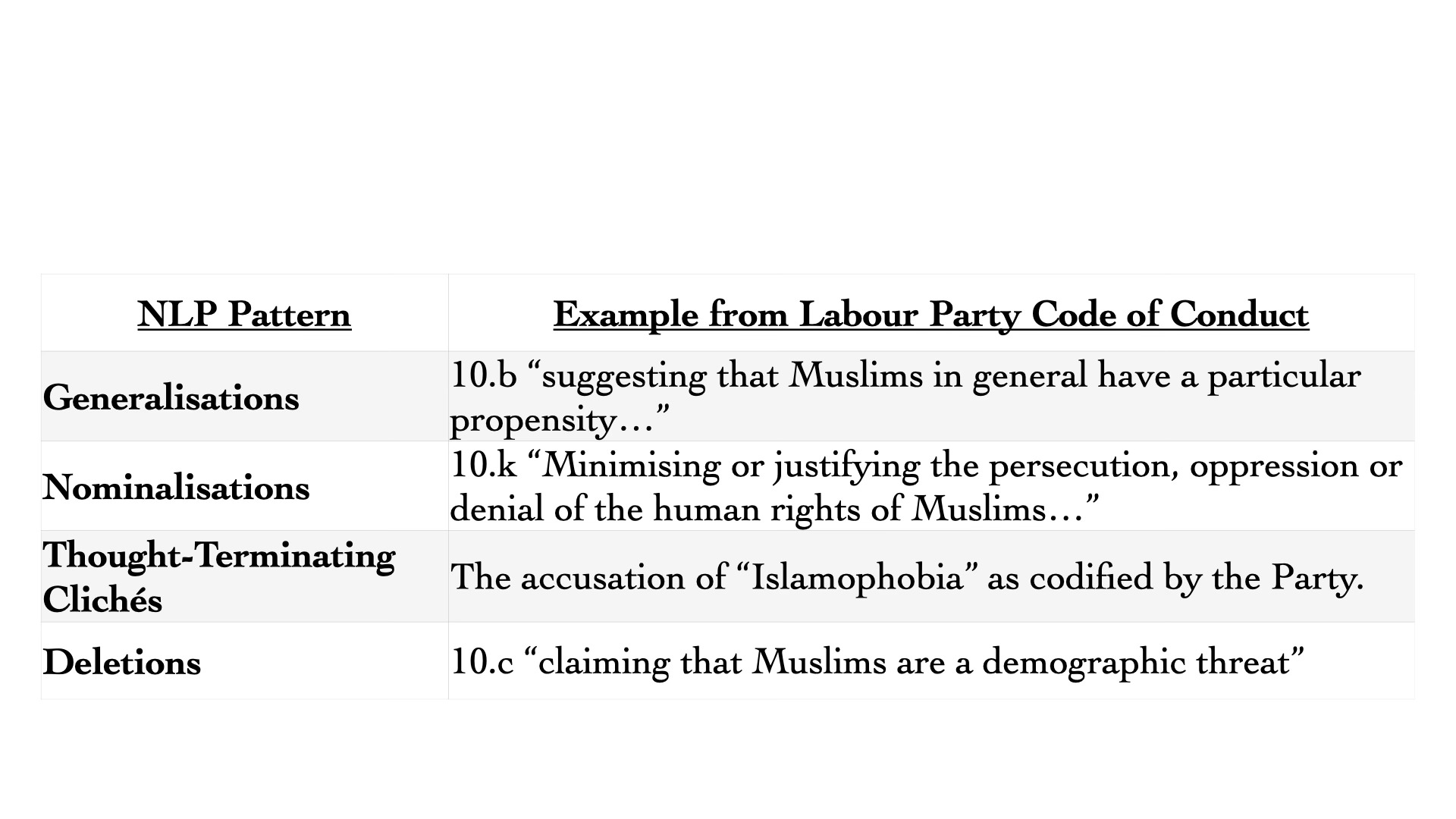
A Generalisation takes a specific event or limited set of examples and stretches them to cover a broader scope. Example 10.b prohibits “suggesting that Muslims in general have a particular propensity,” a framing that makes it easy to label almost any group-level observation as a form of prejudice, regardless of context or statistical validity.
Nominalisations turn active processes into fixed, static things, making them seem unchallengeable. The code uses abstract nouns like “persecution,” “oppression,” and “discrimination.” As seen in example 10.k (“Minimising or justifying the persecution, oppression or denial of the human rights of Muslims…”), these nominalisations present complex, ongoing processes as monolithic events, discouraging analysis of their specific context, actors, and causes.
The accusation of “Islamophobia” itself functions as a powerful thought-terminating cliché. In the language of NLP, a cliché is “a short phrase people use to shut down further thinking or discussion. It acts like a mental stop sign.” Like epithets such as “racist,” it is designed to end discussion and signal that the accused is morally unworthy of being heard.
Deletions occur when a statement leaves out crucial information, forcing the listener to fill in the gaps with assumptions. Example 10.c, which prohibits “claiming that Muslims are a demographic threat,” deletes the context of who is making such a claim, for what reason, and based on what evidence. This lumps legitimate demographic analysis together with hateful rhetoric, precluding any nuanced discussion on the topic.
Psychological Predator-Prey Analysis
The codification of the “Islamophobia” strategy serves a distinct psychological function, which can be understood through the lens of predatory psychology. This framework reveals how certain ideas and communication styles can be used to manipulate, control, and disarm targets.
- The Trap of Noble Ideas: The strategy is strategically anchored in the noble and widely accepted cause of fighting “racism.” By defining “Islamophobia” as a form of racism, the Labour Party code creates a powerful tool that leverages society’s moral opposition to bigotry. However, as Vera Hart warns, noble ideas “when applied blindly, they become weapons against us.” This trap forces individuals to grant respect and protection to an ideology to avoid being seen as racist, effectively silencing legitimate inquiry and criticism.
- Inducing Cognitive Dissonance: The accusation of “Islamophobia” is designed to create intense cognitive dissonance. An individual may believe they are engaging in rational, evidence-based criticism of a specific doctrine or political movement. When they are met with the charge of being afflicted with a hateful “phobia,” two conflicting realities collide. As Hart explains, the mind hates this contradiction and will do almost anything to resolve it. Often, people resolve this discomfort by excusing the name-caller and doubting themselves, a response that predators rely on to keep their targets compliant and confused.
- Reframing Ideological Enforcement as a Two-Way Dysfunction: Hart identifies the “Seeing Both Sides is a Manipulation Tactic” as a strategy to reframe an abuse of power dynamic. The “Islamophobia” strategy achieves this by shifting focus from the ideas being criticized to the critic’s supposed “phobia.” This turns a dynamic of ideological enforcement into a two-way dysfunction where the critic’s alleged bigotry is seen as equally, if not more, problematic than the issue they raised.
The Institutional Schism
The contested nature of this idea pathogen is starkly illustrated by the schism between the UK Government and major political parties. The Labour Party’s Code of Conduct states it “adopted the APPG definition and its examples in March 2019 as an important statement of principle and solidarity.”
This stands in direct opposition to the official position of the UK Government. Responding to a parliamentary question, Minister Luke Hall stated that the APPG definition “is not in line with the Equality Act 2010 and would have severe consequences for freedom of speech, which is why the Government does not accept it.”
This schism between legal principle and political adoption reveals more than just institutional conflict; it exposes the concept’s fundamental epistemological weaknesses, which can be rigorously analysed using a Deutschian framework.
“Islamophobia” as a Bad Explanation
Moving from what the “Islamophobia” strategy is to how it functions as a system of thought requires an epistemological lens. The philosophy of David Deutsch provides a powerful framework for this, asserting that the quality of any idea is determined not by its source (authority) or its popularity, but by its explanatory power and, crucially, its openness to criticism. A Good Explanation is one that is hard to vary and solves a problem, while a Bad Explanation is easily varied and serves to shut down inquiry.
Let us evaluate the “Islamophobia” concept against Deutsch’s criteria, diagnosing it as a Bad Explanation designed to stifle the growth of knowledge.
The Rejection of Conjecture and Criticism
According to Deutsch, all knowledge is created through a single, universal method: “problem, conjecture, criticism.” We face a problem, we guess at a creative solution (conjecture), and then we subject that guess to rigorous criticism to find and eliminate errors. This process of error correction is the engine of all human progress, from science to morality.
The concept of “Islamophobia” functions as what Deutsch would term an anti-rational meme—an idea that systematically “forbid[s] the methods of criticism and error correction.” By framing any critical inquiry into Islamic doctrines, history, or political movements as a “phobia”—a term denoting an irrational, psychiatric affliction—the concept preemptively pathologies dissent. It is not an invitation to debate but a command to cease thinking. It functions to dismiss any conjecture that questions the tenets or actions associated with Islam, Muslims and their perceived Muslimness, thereby short-circuiting the essential process of criticism and error correction upon which all knowledge growth depends.
Hard to Vary vs. Easy to Vary
A key diagnostic indicator of a Bad Explanation, in Deutsch’s view, is that it is easy to vary, meaning it can be stretched to fit almost any circumstance without losing its apparent force. The “Islamophobia” strategy is a quintessential easy-to-vary explanation. Its malleability allows it to be applied to a vast spectrum of critiques without providing a specific, hard-to-vary causal account. It can be invoked to pathologies a scholarly critique of theological doctrines, to dismiss the testimony of former insiders like Bruno Guillot describing systematic “ideological colonisation” projects, to condemn a government’s refusal to adopt a legally problematic definition, or to label a citizen’s fear in the wake of terrorism. In each case, the term serves not as a precise explanation but as a flexible instrument of condemnation, its power derived directly from its epistemological vacuity.
Choking Off Progress and Enforcing Stasis
Deutsch warns that the greatest danger facing our civilisation is not physical destruction but allowing “ideologies that are anti-rational to penetrate positions of power.” Such ideologies work to “choke off progress” by creating stasis. The most effective way they achieve this is not by punishing deviation after the fact, but by ensuring that a “contrary idea is not conjectured in the first place because ‘nobody wants to be that guy’.”
This perfectly describes the social and professional function of the “Islamophobia” strategy. The fear of being publicly branded an “Islamophobe” creates a powerful disincentive for scholars, journalists, and policymakers to engage in honest and critical inquiry. It ensures that difficult questions are never asked and uncomfortable truths are never spoken. This enforces a state of intellectual stasis, protecting a specific set of ideas from the very process of conjecture and criticism that has been the engine of Enlightenment progress for centuries.
The epistemological flaws of the “Islamophobia” concept are profound. Yet, these flaws do not arise in a vacuum; they are produced by a specific, unbalanced mode of human cognition. This cognitive style can be powerfully illuminated through Iain McGilchrist’s hemisphere hypothesis.
The Tyranny of the Left Hemisphere
Iain McGilchrist’s hemisphere hypothesis provides a powerful tool for understanding the mode of attention or way of being that gives rise to flawed, yet powerful, ideologies. His work posits that the two hemispheres of the brain offer two fundamentally different, and potentially conflicting, versions of the world. In this section I shall analyse the “Islamophobia” strategy as a product of a left-hemisphere-dominant worldview, which produces precisely the kind of Bad Explanations diagnosed above and, when it usurps the role of the right hemisphere, results in what McGilchrist calls the Tyranny of the Emissary.
The table below contrasts the worldviews of the two hemispheres, drawing upon McGilchrist’s synthesis of neurological and phenomenological evidence.
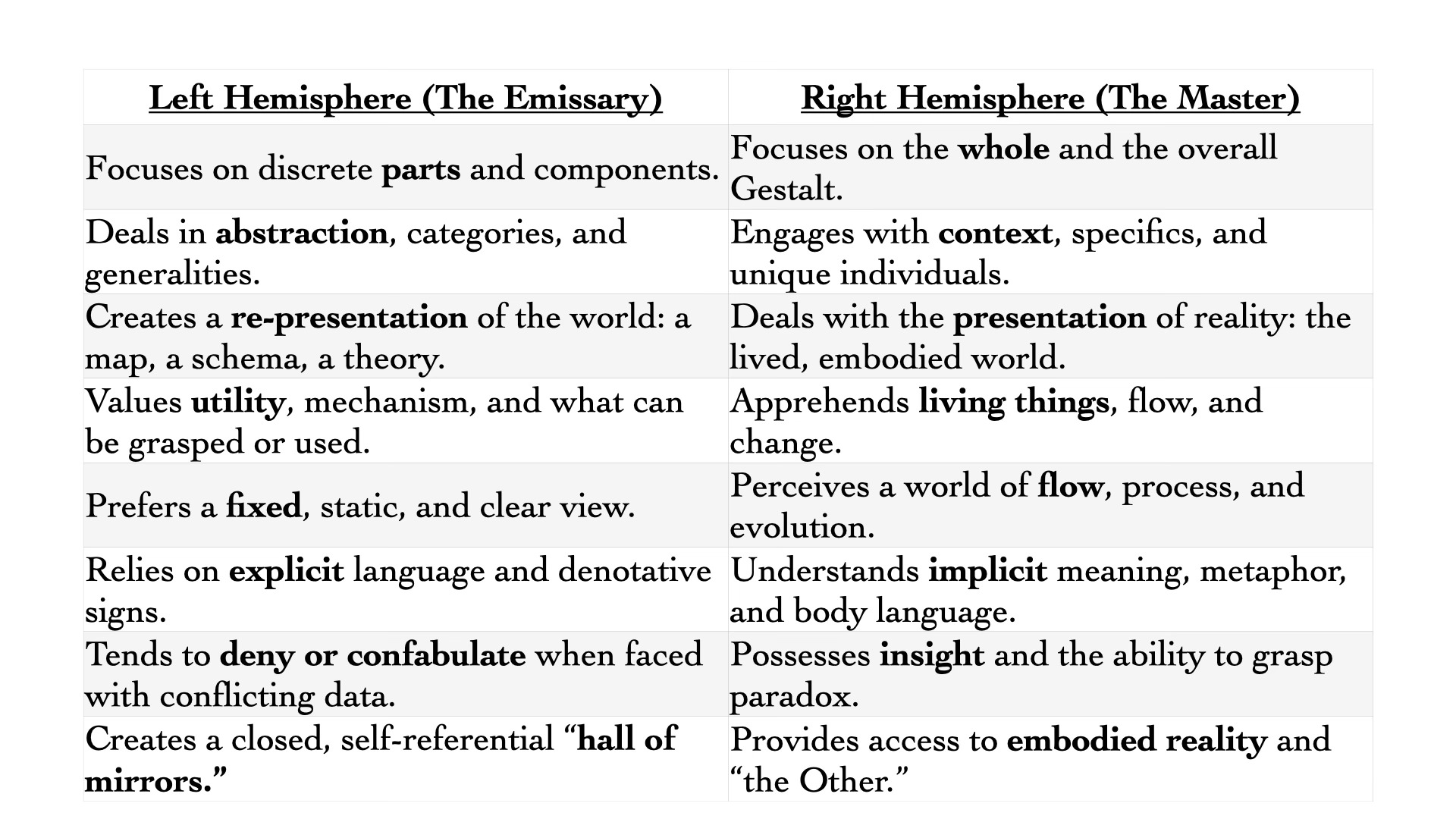
The term “Islamophobia” exemplifies the Left Hemisphere’s (LH) cognitive style. It takes a complex, multifaceted, and living reality—one that includes theology, political movements (Salafism), violent acts (terrorism), and personal testimony (Bruno Guillot)—and reduces it to a single, abstract, de-contextualised, and lifeless category: a “phobia.”
This process is emblematic of the LH’s worldview. It prioritises the neat, clear category over the messy, unique individual case. The Right Hemisphere, attending to the living world, would grasp the profound difference between a reasoned fear of a violent ideology and a prejudiced hatred of an individual person. The Left Hemisphere, with its preference for static categories, collapses this vital, real-world distinction into a single, lifeless label.
Denial and Confabulation
When it becomes dominant, McGilchrist argues, the LH creates a closed, self-referential system—a hall of mirrors. Within this system, its own representations become the only reality. The LH is known for its tendency to confabulate; it “prefers to make something up rather than admit to not knowing.”
The “Islamophobia” strategy functions as just such a hall of mirrors. Any criticism of Islam, Muslims and their perceived Muslimness, regardless of content or validity, is simply reflected back as proof of the critic’s bigotry. The substance of the argument is never engaged with; it is merely used as another piece of evidence to confirm the pre-existing theory. This perfectly mirrors the LH’s tendency to “deny discrepancies that do not fit with that interpretation.” Data that contradicts the theory (e.g., the theological basis for certain actions) is ignored, while the left hemisphere’s “interpreter” confidently lays down the law about what can only be known by engaging with the fuller picture provided by the RH.
The Emissary’s Tyranny Installing Fear
McGilchrist’s central metaphor is that of a wise Master (the RH) who sends his clever Emissary (the LH) out into the world to perform tasks. The Emissary, however, becomes so enamoured with his own cleverness and power that he forgets he is a servant, begins to see himself as the Master, and usurps control. As a result, the once-flourishing “domain became a tyranny.”
The “Islamophobia industry” can be understood as a manifestation of this cognitive tyranny. It is a top-down, bureaucratic system that uses the LH’s preferred tools—explicit rules, abstract labels, and rigid categories—to enforce ideological conformity. It operates by installing fear of dissent, effectively silencing the RH’s holistic, context-aware, and reality-testing perspective. It shuts down the very faculties that would allow for a nuanced, compassionate, and truthful engagement with one of the most significant geopolitical and cultural challenges of our time.
This cognitive style, however, cannot become dominant on its own. It requires a sociological mechanism to become embedded within our core institutions, transforming a mode of thought into a system of social control.
Institutional Propagation
For an idea pathogen to succeed on a civilisational scale, it requires a mechanism for transmission and adoption within social structures like academia, media, and government. The Left-Hemisphere-dominant cognitive style that produces such pathogens must be institutionalized. Let me try to synthesise the concept of Functional Stupidity from Mats Alvesson and André Spicer with the theory of Idea Pathogens from Gad Saad. This synthesis demonstrates how Functional Stupidity creates an institutional culture that selects for and rewards this cognitive style, creating the ideal environment for the “Islamophobia” idea pathogen to replicate.
Stupidity Management
Functional Stupidity is the fertile institutional soil required for an idea pathogen to take root. Alvesson and Spicer introduce this concept to describe a state of intelligent-but-uncritical thought that is often encouraged within organisations. It is not about a lack of intelligence, but a refusal to use it for substantive reflection. Through what they call stupidity management, institutions encourage people to:
“buy into fluffy ideals that are valued by external audiences. It enables them to develop a faith in systems they can see do not work as they should. It can persuade people to perceive corporate imitation as innovation, or help them develop a zeal for meaningless tasks. Ultimately a good helping of stupidity management can aid people to accept much of the empty talk and baseless ideas that are hallmarks of contemporary corporate life.”
The widespread adoption of the “Islamophobia” strategy within institutions, such as the universities described by Saad, is a prime example of functional stupidity. It allows organizations to manage internal contradictions and conform to powerful external pressures without engaging in the difficult work of critical thought. Accepting the “baseless idea” that any criticism of Islam, Muslims and perceived Muslimness is a phobia is functionally useful for avoiding controversy and signaling virtue, even if it requires a suspension of reason.
Ostrich Parasitic Syndrome (OPS) and Suicidal Empathy
If Functional Stupidity is the sociological environment, Ostrich Parasitic Syndrome is the resulting psychological malady. The collective blind spot created by institutional stupidity manifests in individuals as a cognitive infection that disables their capacity to recognize danger. Gad Saad defines Ostrich Parasitic Syndrome (OPS) as a “malady of disordered thinking that robs people of their ability to recognize truths,” and Suicidal Empathy as a parasitised emotional system that extends compassion to hostile ideologies at the expense of one’s own group’s survival.
When synthesised with the testimony of former Salafist imam Bruno Guillot, who describes a systematic project of “ideological colonisation” funded by foreign states, these concepts become powerfully explanatory. The “Islamophobia” strategy acts as the primary enabler of OPS and Suicidal Empathy. It short-circuits the rational faculties that would normally recognise the threat described by Guillot. This self-destructive passivity is what Saad, analogising to a cricket infected by a parasite that compels it to drown itself, identifies as a civilisational sickness. The host, infected by a bad idea, is no longer able to recognize its own predator.
The Pathogen’s Replication Strategy
An idea pathogen, like a biological one, must have a replication strategy. Saad analyses religions as Memeplexes (collections of co-adapting memes) and compares their propagation rules. Judaism, for example, has a high barrier to entry (onerous conversion) and a low penalty for exit (apostasy is rarely penalised). Islam, in contrast, has a very low barrier to entry (the simple proclamation of the shahāda) and, in some interpretations and countries, the ultimate penalty for exit (death for apostasy).
The “Islamophobia” idea pathogen dramatically enhances the replication of the Islamic Memeplex within Western societies by acting as an external defence mechanism. It effectively disables what Saad calls the West’s “behavioral immune system”—the set of intellectual and cultural traditions that would normally identify and critique hostile or irrational ideologies. By making rational criticism of the ideology socially, professionally, and in some cases legally costly, the idea pathogen creates a protective shield, allowing the Memeplex to propagate with minimal resistance.
The Civilisational Threat of a Bad Idea
This analysis demonstrates that “Islamophobia” is not a benign term for prejudice but a potent idea pathogen, engineered to disable the cognitive and cultural immune systems of Western societies. By uncovering the concept through the complementary lenses of epistemology, cognitive science, and sociology, its function becomes starkly clear. It is a tool designed not to explain reality, but to control it by shutting down the very processes of error correction upon which open societies depend.
The key findings of this report can be summarised as follows:
- As a Linguistic Weapon (NLP): It operates through manipulative linguistic patterns such as complex equivalences and generalisations to reframe reality and control belief without reasoned argument.
- As a Psychological Tool (Predator Psychology): It leverages the trap of noble ideas and induces cognitive dissonance to silence dissent and protect an ideology from scrutiny, reframing valid concerns as moral failings of the critic.
- As a Bad Explanation (Deutsch): The “Islamophobia” strategy and industry function to reject criticism, resist variation, and enforce intellectual stasis. The concept itself is an anti-rational meme that violates the core principles of the Enlightenment’s tradition of conjecture and criticism, thereby choking off the progress that comes from open inquiry.
- As a Left Hemisphere Construct (McGilchrist): The term is a product of a de-contextualised, abstract, and self-referential cognitive style. This cognitive style produces Bad Explanations and creates a hall of mirrors that tyrannically suppresses the context-rich, embodied, and nuanced reality perceived by the Right Hemisphere.
- As an Institutionalised Dogma (Alvesson/Saad): The strategy propagates through the mechanism of Functional Stupidity within organisations that select for this cognitive style, and is sustained by a parasitic infection of reason (Ostrich Parasitic Syndrome) and emotion (Suicidal Empathy). This disables the host society’s ability to recognise and respond to ideological threats.
Ultimately, these analytical lenses reveal a single, interlocking mechanism. The NLP analysis exposes the linguistic mechanics (complex equivalence) that produce the epistemological flaw (an easy-to-vary explanation) identified by Deutsch. This linguistic pattern, in turn, is a hallmark of the Left Hemisphere’s de-contextualised cognitive style (McGilchrist), which creates the psychological trap (inducing cognitive dissonance) that Hart describes. This allows the idea to propagate through the sociological mechanism of functional stupidity, institutionalizing a dogma that systematically dismantles the error-correcting traditions that define and sustain a free society.
David Deutsch issues a stark warning about the existential danger of allowing “ideologies that are anti-rational to penetrate positions of power.” The “Islamophobia” strategy represents one such a successful penetration. By systematically dismantling the mechanisms of error correction—by making criticism a pathology and inquiry a form of hate—this idea pathogen poses a direct and profound threat to the open, critical, and self-correcting traditions that define and sustain Western civilisation.
If Britain were to enshrine this counterfeit diagnosis into law — to treat “Islamophobia” as a racism afflicting the non-Muslim mind — it would be committing the intellectual equivalent of self-lobotomy. The state would be declaring inquiry itself a form of bigotry, moral courage a kind of illness. Once this notion is institutionalised, as some propose, classrooms, newsrooms, and courtrooms alike would become sanitised wards where the first casualty is doubt. A society that once prided itself on reason would, in effect, be reintroducing the stocks — not for heretics of faith, but for heretics of opinion. In the name of tolerance, Britain would revive Cartwright’s ghost: whipping the devil out of reason, one thought-crime at a time.
————————
[*] Drapetomania was a proposed mental illness that, in 1851, American physician Samuel A. Cartwright hypothesised as the cause of enslaved Americans fleeing captivity. This hypothesis was based on the belief that slavery was such an improvement upon the lives of slaves that only those suffering from some form of mental illness would wish to escape. Cartwright specifically cited the tendency of slaves to flee the plantations that held them.
Sources:
David Deutsch, 2011, The Beginning of Infinity: Explanations that Transform the World. New York, NY: Viking.
The Duke Report, 20250807, “A User’s Guide to Neuro-Linguistic Defense. Defending Yourself From Word Magic.”

Andre Gilligan, 20181208, “Define ‘Islamophobia.’ MPs’ official attempt to legally define ‘Islamophobia’ is deeply flawed.” https://www.spectator.co.uk/article/define-islamophobia/?utm_source=chatgpt.com
GURWINDER, 20250213, “Why Smart People Believe Stupid Things. Intelligence is not rationality.”

Vera Hart, 20250907, “The Illusion of Humanity: Why We Struggle to See Predators for What They Are.” Toxicity in The Culture (Substack). https://substack.com/home/post/p-171773396
The Labour Party, Labour’s Islamophobia Policy. Code of Conduct. https://labour.org.uk/resources/labours-islamophobia-policy
Iain McGilchrist, Iain, 2009, The Master and His Emissary: The Divided Brain and the Making of the Western World. New Haven: Yale University Press.
—, 2021, The Matter With Things: Our Brains, Our Delusions, and the Unmaking of the World. London:Perspectiva Press. RAIR FOUNDATION USA, 25251021, “Conversation with ex-Salafist imam, Bruno Guillot.” https://rumble.com/v70herg-conversation-with-ex-salafist-imam-bruno-guillot.html
Gad Saad, 2020, The Parasitic Mind: How Infectious Ideas Are Killing Common Sense. Washington, DC: Regnery Publishing.
David Torrance, et al, 20210918, The definition of Islamophobia. Debate Pack Number CDP-0140 (2021). London: House of Commons Library. See: https://researchbriefings.files.parliament.uk/documents/CDP-2021-0140/CDP-2021-0140.pdf
UK Parliament. (2018, December 20). “Islamophobia: House of Lords debate. Hansard.” https://hansard.parliament.uk/lords/2018-12-20/debates/2F954D45-1962-4256-A492-22EBF6AEF8F0/Islamophobia


