Intelligence Without Error-Correction: Sweden, islām, and the Anti-Rational Drift of the Open Society
15 May 2026
After publishing the first essay in this series, “Intelligence Is Not Rationality,” I want to move from the principle to a concrete case.
The distinction matters because societies do not usually fail only when they become stupid. They can fail while remaining highly intelligent: administratively competent, legally careful, morally fluent, and rhetorically humane. The danger begins when that intelligence is no longer used to correct error, but to preserve categories that have stopped describing reality.
This second essay applies that framework to Sweden.
Sweden is not an unintelligent society. That is precisely why its anti-rational drift deserves careful attention. In its handling of Islām, Muslim representation, religious institutions, immigration, minority politics, and public funding, Sweden often displays intelligence without sufficient error-correction.
The question is therefore not whether Sweden can include, translate, administer, fund, consult, or tolerate. It can.
The question is whether Sweden can still correct itself when inclusion excludes, tolerance immunizes control, neutrality protects power, and democratic language conceals anti-liberal structure.
This essay examines three cases — Malmö’s election flyer, Simon Sorgenfrei’s argument about islām and islāmism, and Frederic Brusi’s memorandum on the Muslim Brotherhood in Sweden — as signs of one deeper pattern:
intelligence without error-correction.
Sweden is not an unintelligent society. That is precisely why its present drift is so serious.
A crude critic would say that Sweden has become naïve, stupid, weak, or blind. That language misses the deeper problem. Sweden remains one of the most administratively intelligent societies in the world. It can translate public information into multiple languages. It can produce careful legal memoranda. It can design inclusive public campaigns. It can fund civil society, classify organizations, invoke democratic values, and debate religion through academic nuance. It has institutional intelligence, bureaucratic intelligence, humanitarian intelligence, legal intelligence, and communicative intelligence.
But intelligence is not rationality.
Intelligence can administer a inherited frame. Rationality asks whether the frame is false. Intelligence can optimize a procedure. Rationality asks whether the procedure should exist. Intelligence can include. Rationality asks whether inclusion is reproducing a new exclusion. Intelligence can distinguish islām from islāmism. Rationality asks whether that distinction, though necessary, is sufficient. Intelligence can write a careful memorandum saying that direct evidence is insufficient. Rationality asks whether the evidentiary model is too narrow to detect the problem.
This is the distinction Sweden now urgently needs.
An Open Society does not survive because its institutions are clever, kind, procedural, or well-intentioned. It survives because it preserves error-correction. It protects the Backspace Key: the human and institutional capacity to say, “This category no longer describes reality,” “This policy produces the opposite of what it intends,” “This symbol is not neutral,” “This organization is legally compliant but socially closed,” “This inherited moral language is hiding a power relation.”
The central thesis of this essay is therefore simple:
Sweden’s problem is not lack of intelligence. It is intelligence without sufficient error-correction.
Nowhere is this more visible than in Sweden’s handling of islām, Muslim representation, immigration, religious institutions, and minority politics. The pattern does not appear primarily as open authoritarianism. It appears as something softer and more difficult to criticize: inclusion without self-criticism, tolerance without functional analysis, neutrality without attention to power, and complexity without falsification.
Three recent cases reveal the pattern: Malmö city’s election flyer, Simon Sorgenfrei’s argument about mosques, halal and the headscarf, and Frederic Frederic Brusi’s memorandum on the Muslim Brothers in Sweden, which is not publicly available. Each case is different. One is visual and municipal. One is academic and conceptual. One is bureaucratic and legal. But together they show the same anti-rational drift:
Swedish institutions and intellectuals often protect persons in intention while immunizing symbols, organizations, and norm systems in practice.
The result is not humane rationality. It is intelligent avoidance.
The three errors
The Swedish drift can be seen through three errors.
The first is the aesthetic error. This occurs when inclusion becomes an image before it becomes a question. A municipality selects a symbol to communicate openness, but does not ask what social meanings the symbol carries, whom it represents, and whom it erases. The result is not hatred. It is symbolic exclusion in the language of welcome.
The second is the conceptual error. This occurs when a necessary distinction becomes a substitute for deeper analysis. It is true that islām is not islāmism. It is true that mosques, halal, Ramadan, and the headscarf are not automatically expressions of political extremism. But rationality cannot stop at the label. It must ask what the practice does: whether it expands freedom or narrows it, whether it permits doubt or closes it, whether it protects the individual or disciplines the individual through family, community, organization, or sacred authority.
The third is the administrative error. This occurs when the state mistakes visible legal compliance for democratic openness. A religious or ideological organization may remain below the threshold of criminality while still producing environments in which apostasy, satire, women’s autonomy, secularization, dissent, and internal criticism become socially costly. A democratic state must not judge theology as theology. But it must judge whether publicly supported institutions strengthen or weaken the individual’s freedom to think, doubt, leave, and correct inherited authority.
Together, these errors form a pattern. The aesthetic error narrows representation. The conceptual error shields the narrowed representation from functional analysis. The administrative error then gives public legitimacy to organized structures because the wrong test has been applied.
This is intelligence without error-correction.
The danger is not merely that Sweden makes errors. Every society does. The danger begins when errors become harder to retrieve from because the institutions responsible for correction have learned to protect the error. When criticism is redescribed as hostility, when dissent is redescribed as stigmatization, when visible legality is mistaken for openness, and when inclusion itself becomes immune from criticism, error begins to damage the route back from error. That is the beginning of irretrievability inside an Open Society.
The distinction Sweden has forgotten: person, doctrine, organization
The first principle must be absolute: the Muslim is the person. The doctrine is not the person. The organization is not the individual. A democratic society must protect Muslims from hatred, discrimination, suspicion, harassment, and violence. No Muslim family should be treated as a problem merely because it is Muslim. No woman with a headscarf should be made the target of political rage. No mosque should be attacked as if the building itself were an enemy.
But protecting persons is not the same as immunizing doctrines, symbols, or organizations from criticism.
This is where much Swedish debate collapses. One side treats Muslim visibility as a threat in itself. The other side, reacting against that polarization, often treats Muslim symbols and institutions as if they were analytically innocent simply because they are not automatically extremist. Both positions fail. The Open Society must do something harder: protect the person and examine the system.
That is the rational distinction.
The question is not whether Muslims should be safe. They must be. The question is whether Swedish institutions can examine the social functions of religious symbols, organizations, gender norms, and political-theological networks without being accused of attacking Muslims as persons.
If Sweden cannot do that, it has not protected pluralism. It has disabled criticism in the name of pluralism.
The Aesthetic Error: Malmö and the Symbolic Narrowing of Inclusion
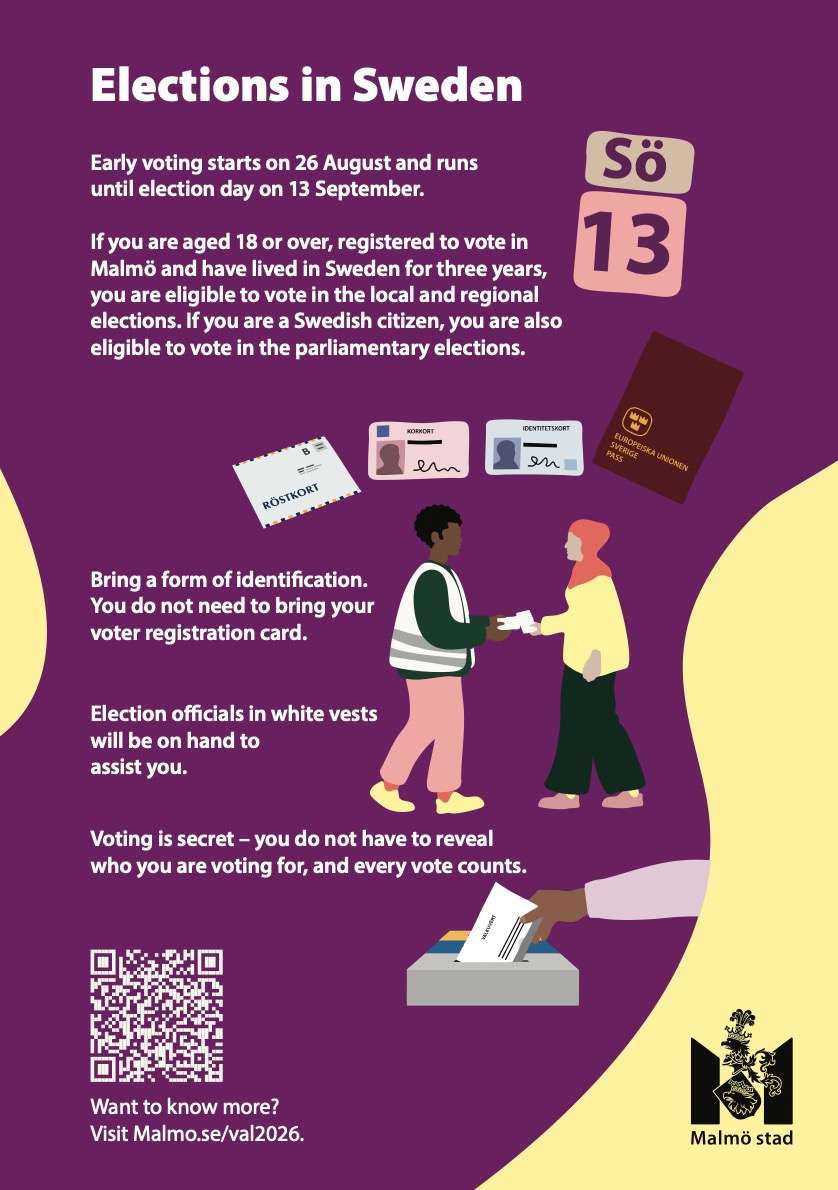
Malmö city’s election flyer for the 2026 election is, on the surface, exactly the kind of thing a democratic municipality should produce. It informs voters that early voting begins on 26 August and continues until election day on 13 September; it reminds them to bring identification; it explains that vote receivers in white vests will be present; it emphasizes that the election is secret and that every vote counts. The flyer appears in several languages: Swedish, English, Arabic, Dari, Persian, and Somali. As a democratic act of accessibility, this is good and necessary. Citizens must understand how to vote. Bureaucracy should not become a barrier to participation.
But the flyer does not communicate only through text. It communicates through image.
This is where the aesthetic error begins: the municipality does not merely inform citizens about voting; it teaches the public what democratic inclusion is supposed to look like.
The same illustration appears across the language versions: a vote receiver in a white vest meets a woman with a headscarf or veil, while a hand places a ballot into the ballot box. The scene is simple. But it is not neutral. It says something about who the municipality imagines as needing invitation into democratic participation.
The generous reading is obvious: Malmö wants to say that those who do not belong to the old Swedish majority culture, those with visible minority markers, those who may be new to Sweden, are also part of democracy. That intention is good.
But representation is not exhausted by intention. Images work through repetition, recognition, and symbolic choice. A public institution can make an error precisely while trying to do good.
The deeper question is this: when Malmö imagines the Muslim or minority-marked woman, why does it imagine her as veiled?
The problem is not the presence of the veiled woman. She is a citizen, voter, neighbor, worker, mother, student, and democratic subject. She must be visible. She must be protected. She must not be mocked, threatened, or excluded.
The problem is the solitude of the symbol.
If the veiled woman becomes the standard visual shorthand for Muslim female inclusion, then other women disappear: the secular Muslim woman, the ex-Muslim, the liberal believer, the woman who has removed the veil, the woman who fled moral policing, the woman for whom the veil is not dignity but memory of coercion. For such a woman, Malmö’s image may not feel like inclusion. It may feel like a second symbolic erasure. First, the religious or political system made the veil her assigned identity. Then the Swedish municipality, trying to include her, once again makes the veil the recognized image of her minority existence.
This is not the same as coercion. But it is symbolic re-inscription.
The error is subtle because it is produced by good intentions. Malmö does not attack the secular Muslim woman. It simply fails to imagine her. It does not impose the veil. It turns the veil into the visual shortcut through which minority womanhood becomes recognizable. That is why the aesthetic error is so important: the Open Society may exclude not by hostility, but by narrowing the image through which it recognizes the people it wants to include.
Here we see the difference between intelligence and rationality. Malmö’s intelligence is visible: translation, accessibility, democratic outreach, procedural clarity. But rationality would ask a more uncomfortable question: who disappears from this image? Which internal minority within the minority is erased? Which symbol is being normalized as the face of democratic inclusion?
The open institution wants to protect the person, but risks aestheticizing the symbol. It wants to include the minority woman, but may reproduce the most visible religious marker as her authentic public face.
This is how intelligent inclusion can become anti-rational: not by hating the individual, but by refusing to criticize the symbol through which the individual is represented.
In the aesthetic error, kindness becomes a picture, and the picture becomes a cage.
The Conceptual Error: Sorgenfrei and the Insufficiency of Labels
Simon Sorgenfrei is right about one important thing: mosques, halal, Ramadan, calls to prayer, and the headscarf are not in themselves islāmism. That distinction must be made. A society that cannot distinguish between Muslim piety, Muslim persons, islāmic tradition, and islāmist political mobilization becomes unjust and intellectually dishonest.
But the distinction is not enough.
The conceptual error is not that Sorgenfrei makes a false distinction. It is that he treats a true distinction as if it were sufficient.
Sorgenfrei’s argument is animated by a legitimate fear: that the concept of islāmism may expand so broadly that it becomes a weapon against Muslims as such. If every Muslim expression is called islāmism, then the concept loses precision and ordinary religious life becomes suspect. That danger is real.
But there is an opposite danger: that because something is not islāmism, it is treated as socially uncomplicated.
This is where Swedish debate becomes anti-rational. It often stops at the label and avoids the function.
Labels are necessary because they prevent crude generalization. But labels become anti-rational when they terminate inquiry before the function has been examined. A symbol does not become harmless merely because it is older than islāmism. An institution does not become liberal merely because it is not violent. A practice does not become private merely because it is religious.
It is not enough to say: “The headscarf is not islāmism.”
The rational question is: what social function does the headscarf perform in this context?
For one woman, it may be voluntary religious conviction. For another, family expectation. For another, a sign of modesty. For another, a strategy to avoid suspicion. For another, a political emblem. For another, a memory of coercion. The same symbol can mean freedom for one woman and unfreedom for another. A mature society must be able to handle both.
It is not enough to say: “Mosques are not islāmism.”
The rational question is: what ideas, authorities, gender norms, loyalties, and boundaries are reproduced in this institution? What is taught about apostasy, blasphemy, Jews, Christians, atheists, women’s autonomy, homosexuality, Swedish law, religious authority, and the right to leave?
It is not enough to say: “Halal is not islāmism.”
The rational question is: when is religious practice private conscience, and when does it become collective boundary-making?
This distinction between label and function is decisive.
The conceptual error consists in mistaking classification for understanding.
The Swedish debate often asks:
Is this islām?
Is this islāmism?
Is this extremism?
Is this piety?
Is this discrimination?
But the Open Society must also ask:
Does this practice create freedom or obedience?
Does it open doubt or close doubt?
Can the individual say no?
Can women deviate?
Can children grow beyond inherited identity?
Can ex-Muslims speak openly?
Can reformers question the prophet, law, tradition, and authority?
Can the Muslim use their own Backspace Key?
This is where the concept of islāmism must be widened without becoming sloppy. islāmism is not only violence. Political theology can be law-abiding and still anti-liberal. A movement can reject violence and still work for gender separation, religious social control, group discipline, suspicion toward apostates, distance from the majority society, and stronger religious boundaries.
The test is not only: “Is it violent?”
The test is: “Is it corrigible?”
Can the system tolerate a woman who refuses religious marking? Can it tolerate a child who leaves the faith? Can it tolerate satire? Can it tolerate historical criticism of scripture? Can it tolerate the claim that Islām is a humanly transmitted tradition rather than an immune authority?
If the answer is no, then the Open Society has a problem even without violence.
Sorgenfrei’s necessary distinction therefore needs a second distinction. Yes, mosques, halal and the headscarf are not automatically islāmism. But they are not analytically neutral either. They must be examined functionally.
Otherwise nuance becomes evasion.
The Administrative Error: Brusi and the Confusion of Compliance with Openness
Frederic Brusi’s 2025 memorandum on the Muslim Brothers in Sweden is the deepest of the three cases because it moves from symbol and concept to state judgment. The issue is not simply one document, one author, or one administrative conclusion. The memorandum reveals a broader problem: the modern bureaucratic state’s difficulty in distinguishing visible legal compliance from real democratic openness.
A democratic state assessing whether a religious organization should receive public support stands at a dangerous intersection. The administrative error is the bureaucratic form of anti-rationality: the state asks whether the visible legal threshold has been crossed, but fails to ask whether the social conditions of freedom are being weakened beneath that threshold. On one side is religious freedom. On the other is the protection of the cognitive conditions that make pluralism possible: criticism, exit, conscience, open inquiry, and the individual’s right to revise inherited authority.
The Brusi memorandum appears intelligent in the bureaucratic sense. It is cautious. It respects legal thresholds. It avoids crude accusation. It asks whether the available Swedish material proves that organizations such as Islāmiska Förbundet i Sverige, FIFS, or related actors openly violate democratic conditions. Do they incite violence? Do they urge members to break Swedish law? Do they operate an explicit competing legal system? Do they openly attack democratic order?
Within that narrow framework, Brusi finds the available evidence insufficient.
In a strictly legal-administrative sense, this may be understandable. But rationality requires a deeper question.
The absence of visible illegality is not the same as the presence of democratic openness.
A structure can be formally law-abiding and still cultivate an internal culture in which criticism, apostasy, women’s autonomy, secularization, satire, theological revision, or independent conscience becomes socially impossible. It can speak the language of democracy outwardly and function disciplinarily inwardly. It can participate in civil society while building a parallel moral ecosystem where individuals are protected from the Open Society’s influence rather than prepared to live freely within it.
This is the inductivist illusion: the state sees no smoking gun and concludes there is no fire. It sees no explosion and concludes the building is safe.
This is intelligence trapped inside the wrong evidentiary model. The bureaucracy sees what its categories permit it to see, then mistakes that limited visibility for reality.
But the building may be silent because the alarms have been disconnected.
A critical-rationalist state would not ask only: has the organization broken the law?
It would ask:
Does the organization permit internal error-correction?
Can inherited authority be criticized?
Can members leave without social death?
Can women reject the group’s gender norms without punishment?
Can young Muslims become secular, liberal, reformist, or ex-Muslim without being treated as traitors?
Can the organization revise its doctrines when they collide with individual freedom?
This is the Backspace Key test for public funding.
A democratic state should not fund only what remains legally quiet; it should fund what leaves the human being freer to criticize, dissent, exit, and revise inherited authority.
Brusi’s memorandum does not adequately apply it.
The state must be neutral toward theological truth. It should not decide whether islām, Christianity, Judaism, atheism, or any other worldview is metaphysically true. But neutrality toward theology must not become blindness toward power. A state need not judge whether a doctrine is true in order to judge whether an organization strengthens or weakens the conditions of freedom.
The relevant question is not: is this theology true?
The relevant question is: does the institution built around it protect the individual’s right to doubt, object, reinterpret, leave, and live as a citizen rather than as the managed representative of a collective religious identity?
There is another danger: liberal vocabulary can be mistaken for liberal structure. A document may use terms such as democracy, pluralism, integration, participation, secularism, and diversity. But words do not prove internal freedom. East Germany called itself the German Democratic Republic. The word “democratic” did not make it democratic. A closed system can wear the Open Society’s language as camouflage.
This is why administrative intelligence can become dangerous: it may read the vocabulary of openness while failing to examine the structure of closure.
The question is therefore not whether liberal words appear. The question is whether internal conditions correspond to them.
Can members criticize founders? Can inherited doctrines be historicized? Can women reject conservative gender roles? Can dissenters leave without moral excommunication? Can the organization publicly reject anti-liberal elements in the Muslim Brothers’ tradition? Can Muslim identity be interpreted by individuals rather than administered by organizational gatekeepers?
If not, liberal vocabulary may be aesthetic camouflage.
The deepest category error is “civil society.” A legally registered religious association may have the outer form of civil society while lacking its inner ethic. Civil society in the Open Society is not merely a legal category. It is the space where free persons associate, disagree, reform, leave, and create new forms of belonging. A closed ideological organization can adopt civil society’s form while weakening civil society’s function.
The question is therefore not only whether an organization is formally part of civil society.
The question is whether it increases or decreases the individual’s capacity for independent judgment.
Does it produce citizens or managed identities?
Does it protect conscience or collective discipline?
Does it serve the person or the organization’s claim over the person?
If the state does not ask these questions, it may subsidize the very structures that make some individuals less free.
In the administrative error, the state does not abolish freedom directly. It recognizes, funds, and legitimizes structures without first asking whether freedom inside them is real.
The disappearing secular Muslim
The most morally urgent consequence of this anti-rational drift is the disappearance of the secular Muslim, the liberal Muslim, the reformist believer, the ex-Muslim, the woman who rejects conservative gender norms, and the young person who wants to think freely.
This disappearance occurs in all three cases.
The three errors converge on this disappearance. The aesthetic error makes the secular or dissenting Muslim hard to see. The conceptual error makes their criticism harder to formulate. The administrative error makes the gatekeeper harder to challenge. What begins as inclusion can therefore end as a new structure of invisibility.
In the Malmö flyer, the Muslim or minority woman appears through the veil. The woman who came to Sweden to escape compulsory religious visibility disappears.
In Sorgenfrei’s argument, the concern to avoid collective suspicion of Muslims risks making islāmic symbols and institutions analytically too safe. The ex-Muslim, the unveiled woman, and the internal dissident become secondary to the fear of stigmatizing the religious expression.
In the Brusi memorandum, organized religious actors risk being treated as civil society representatives of Muslims. But when the state legitimizes the most organized religious gatekeepers, the internal critic loses leverage. She can now be told not only that she betrays the group, but that Swedish institutions themselves recognize the group’s representatives as democratic.
This is the cruel irony of bureaucratic inclusion.
The state thinks it is protecting a minority. In practice, it may strengthen the organized authorities over that minority.
This is what may be called suicidal empathy: the tendency of Open Society institutions to sympathize with group identity in a closed system at the expense of individual persons trapped within it. Empathy for persons is indispensable. But empathy becomes suicidal when it grants immunity to the structures that discipline persons.
Liberal democracy’s task is not to protect the strongest gatekeepers within minority communities. Its task is to protect the individual — especially when that individual stands against both majority prejudice and minority coercion.
How the three errors reinforce each other
The three errors are not isolated. They reinforce one another.
The aesthetic error normalizes the symbol. The conceptual error protects the symbol from functional analysis. The administrative error then legitimizes the organizations and structures that operate behind the symbol, provided they remain legally cautious.
The result is not an open conspiracy. It is something more Swedish, more bureaucratic, and more difficult to criticize: a chain of intelligent evasions.
The municipality says: we only wanted to include.
The academic says: we only wanted to distinguish Islām from islāmism.
The bureaucrat says: we only followed the evidence threshold.
Each statement may be true. That is precisely why the problem is dangerous. Anti-rational drift often does not begin with bad intentions. It begins when good intentions are protected from correction.
This is the sequence: the image narrows reality; the concept prevents the narrowing from being criticized; the bureaucracy then treats the narrowed reality as administratively legitimate.
That is how an Open Society can remain intelligent while losing rationality.
Sweden’s anti-rational drift
These three cases are not isolated. They reveal a wider Swedish pattern.
The same three errors appear across policy fields. Sweden often commits the aesthetic error when it turns diversity into visible representation without asking what the representation conceals. It commits the conceptual error when it uses morally reassuring categories — inclusion, tolerance, minority protection, dialogue, civil society — without testing whether those categories still describe reality. It commits the administrative error when it evaluates institutions through formal compliance while neglecting the internal conditions of freedom.
In immigration policy, Sweden often treated large-scale migration as a moral and administrative challenge: how to receive, house, translate, include, and provide services. Those were intelligent questions. But rationality would also have asked: what norms, family structures, religious authorities, gender codes, views of dissent, and concepts of law are being reproduced?
In integration policy, Sweden often treated participation as sufficient: language, employment, voting, schooling, civic contact. All of these matter. But rationality asks whether the person becomes freer to criticize inherited authority. Integration is not only entry into systems. It is entry into the right to say no.
In minority representation, Swedish institutions often consult organized religious actors as community representatives. This may appear inclusive. But it may empower gatekeepers and erase secular, liberal, reformist, feminist, and ex-religious voices.
In gender equality, Sweden often speaks with great force against native patriarchy, but becomes more hesitant when patriarchal control is coded as religion, culture, minority identity, or anti-racist sensitivity. The result is selective feminism: strong where criticism is easy, careful where criticism is necessary.
In academia, nuance can become anti-rational when it prevents functional judgment. Complexity is necessary. But complexity must not become a fog that shields power from criticism.
In bureaucracy, neutrality can become passivity. The state correctly refuses to judge theological truth, but then incorrectly refuses to judge the social power of religious organizations.
This is the anti-rational drift of the Open Society: not the disappearance of intelligence, but the loss of correction.
The remedy is intellectual hygiene: the disciplined restoration of distinctions where public language has become morally blurred. Intellectual hygiene asks whether we are protecting persons or protecting doctrines; whether we are defending pluralism or subsidizing gatekeepers; whether we are including individuals or aestheticizing symbols; whether we are applying neutrality to theology or becoming blind to power. Its purpose is not suspicion. Its purpose is correction.
The Backspace Key test for Swedish democracy
Sweden needs a new democratic test. Not an anti-Muslim test. Not a culture-war test. Not a test of theological truth. A freedom test.
Every publicly supported, publicly recognized, or publicly platformed religious or cultural organization should be assessed by questions such as these:
Can members leave without social punishment?
Can women reject religious or family norms without losing protection?
Can children grow into secular, liberal, reformist, or ex-religious lives?
Can inherited doctrine be criticized publicly?
Can blasphemy, apostasy, satire, and historical criticism be tolerated?
Can the organization accept Swedish law not merely tactically but morally when that law protects individual freedom?
Does public support strengthen individuals, or does it strengthen gatekeepers?
Are secular and dissenting members of the minority visible, or only religiously marked representatives?
Does the institution protect the person while allowing the symbol, doctrine, and organization to be criticized?
They also ask Sweden not to optimize inherited error: not to make a closed structure more inclusive, more fundable, more consultable, or more administratively respectable before asking whether it leaves the person free.
These are not anti-Muslim questions. They are pro-person questions.
They are questions designed to correct the aesthetic error, the conceptual error, and the administrative error at once: who is represented, what is being protected, and whether the institution leaves the person free.
The correct liberal principle is:
Protect the person. Criticize the symbol. Test the organization. Defend the right to doubt, leave, and begin again.
Sweden must become more rational, not less humane
Sweden’s task is not to become less compassionate. It is to become more rational.
The answer to anti-rational drift is not suspicion of Muslims, hostility to religious people, bans on ordinary piety, or contempt for minority visibility. That would betray the Open Society from the other direction. Muslims must be safe. Mosques must not be treated as enemy structures merely because they are mosques. Women with headscarves must not be harassed. Religious freedom must be defended.
The purpose of this distinction is not contempt. It is rescue. The secular Muslim, the liberal believer, the veiled woman, the unveiled woman, the ex-Muslim, the reformer, the child, and the dissenter all require the same protection: protection as persons, not as managed representatives of a doctrine or community.
But ideas, symbols, organizations, and norm systems must remain open to criticism.
The Open Society does not survive by kindness alone. It survives by corrigibility. It must be able to correct its own categories when inclusion excludes, when tolerance immunizes control, when neutrality protects power, when representation erases dissenters, and when democratic language conceals anti-liberal structure.
That means correcting the aesthetic error when representation becomes narrowing. It means correcting the conceptual error when nuance becomes evasion. It means correcting the administrative error when compliance is mistaken for openness.
Sweden’s problem is not lack of intelligence. Sweden has intelligence in abundance.
The question is whether Sweden still has the rational courage to use its intelligence against its own errors.
That is the test.
Can Sweden protect Muslims as persons while refusing to surrender criticism of islāmic symbols, institutions, organizations, and political theology?
Can Sweden include the veiled woman without erasing the woman who removed the veil?
Can Sweden distinguish islām from islāmism without pretending that non-islāmist religious norms are always socially harmless?
Can Sweden assess religious organizations not only by visible legality but by their internal relation to doubt, exit, gender equality, and individual freedom?
Can Sweden keep its Backspace Key?
If it cannot, Sweden will remain intelligent — but increasingly anti-rational.
Its images will be kind.
Its concepts will be nuanced.
Its memoranda will be careful.
And still, the Backspace Key will be harder to reach.
An intelligent society that loses error-correction does not become harmless.
It becomes a beautifully administered cage.


