Intelligence Is Not Rationality
14 May 2026
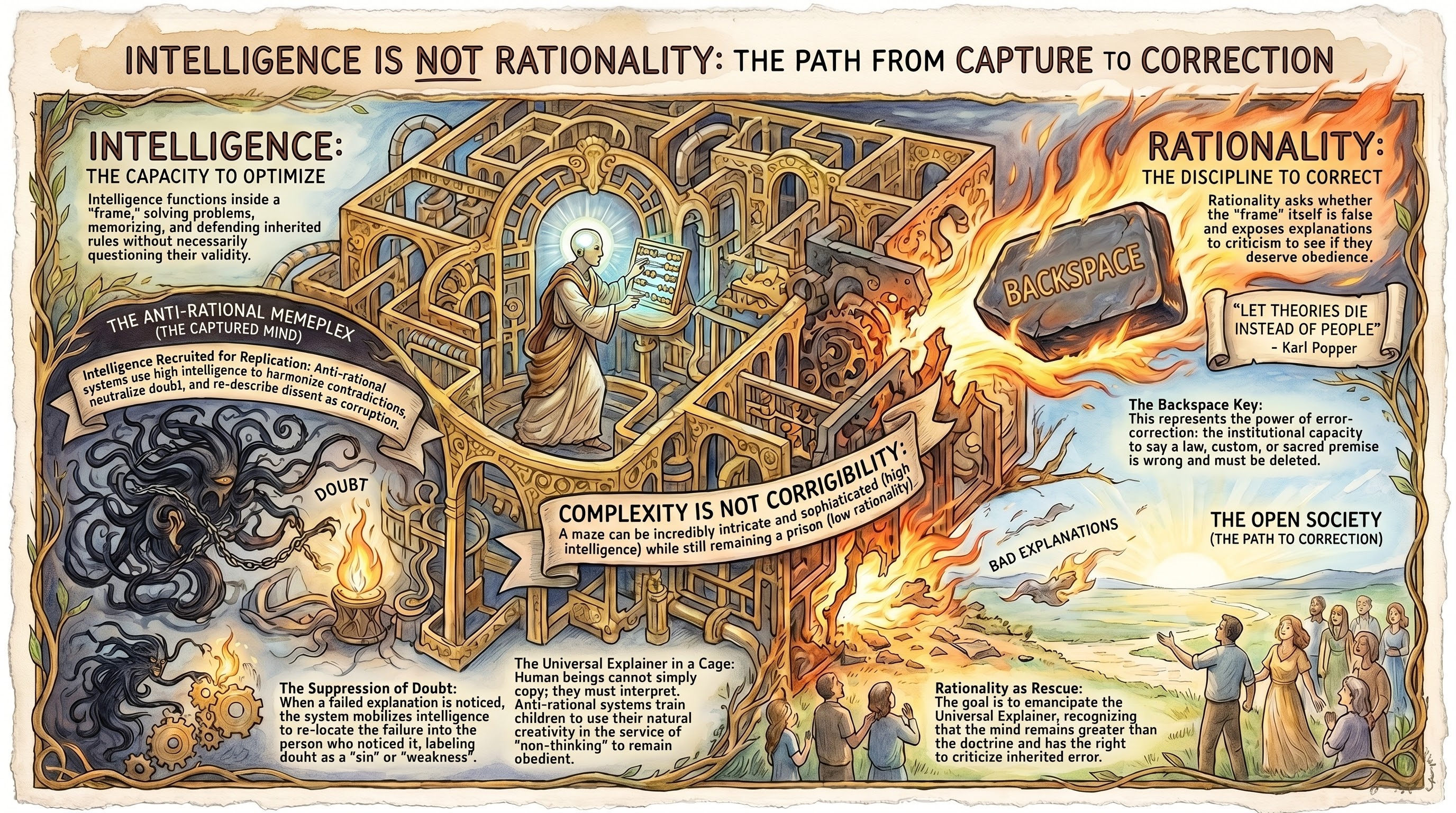
First Article in the Series: Intelligence vs RationalityIntelligence Is Not Rationality. What if the most sophisticated civilizations, the most educated elites, and the most impressive institutions are still fundamentally failing — not because they lack intelligence, but because they lack the courage and discipline to correct their deepest errors? Intelligence builds cathedrals of thought: intricate laws, subtle theologies, refined scholarship, and elegant arguments.
Rationality does something rarer and more dangerous — it asks whether the entire structure rests on a mistake. A society can be dazzlingly intelligent and still anti-rational. It can produce brilliance while disabling the one faculty that truly matters: error-correction. It can think with extraordinary power, yet refuse to let that power strike at its own foundations. This is the confusion I want to dissolve in this series.In this opening essay, I explore why intelligence and rationality are not the same — and why mistaking one for the other explains so much of our cultural, political, and civilizational drift. Intelligence optimizes inside the frame. Rationality questions the frame itself. Intelligence defends the tradition. Rationality asks whether the tradition has become a cage. The difference is everything. This is the first piece in the series Intelligence vs Rationality. Future essays will apply this lens to Sweden, to universities, bureaucracies, media, activist movements, and to major idea systems — including Islam as a body of doctrines and institutions. Throughout, one commitment remains absolute: protect the person, criticize the idea, and fiercely defend the right to doubt, revise, and begin again.I wrote this to clarify, not to condemn. To diagnose, not to dismiss. Read it. Reflect on it. And then tell me where you see intelligence without rationality operating in our world today. Comments are open. Bring your best objections, counterexamples, and sharper thoughts. This is meant to be a genuine conversation.Welcome to the series.
Let’s begin.
One of the central errors of modern political and civilizational analysis is the confusion of intelligence with rationality. Because a society produces scholarship, law, architecture, poetry, mathematics, administration, theology, memory, discipline, and technical skill, observers assume it must also be rational in the deeper epistemological sense. This is a mistake. Intelligence is a capacity. Rationality is a discipline. Intelligence can calculate, memorize, classify, defend, harmonize, administer, and build. Rationality does something more dangerous: it exposes its own explanations to criticism.
That distinction is essential.
A static society is not unintelligent. It is intelligence recruited for replication rather than correction. It may possess immense intellectual energy. It may produce jurists of dazzling subtlety, theologians of great argumentative skill, poets of refinement, administrators of competence, soldiers of courage, merchants of sophistication, and families of moral seriousness. None of this proves that the society is rational in the Popperian or Deutschian sense. Complexity is not corrigibility. A maze may be intricate and still be a prison.
The question is not: does this civilization think?
The question is: can it correct the root claims by which it thinks?
Intelligence solves problems inside a frame. Rationality asks whether the frame itself is false. Intelligence may optimize inherited instructions. Rationality asks whether the instructions deserve obedience. Intelligence may defend a sacred text with subtle arguments. Rationality asks whether the text’s authority has survived criticism. Intelligence may preserve a tradition. Rationality asks whether preservation has become an excuse for protecting error.
This is why anti-rational systems can be highly intelligent. Anti-rational does not mean stupid, primitive, uneducated, or incapable of producing culture. It means something narrower and more severe: a system becomes anti-rational when it disables the conditions under which its own errors could be corrected. It may think intensely, but it does not permit thought to strike the foundation. It may generate commentary, jurisprudence, theology, apologetics, and institutional complexity, but only inside the cage. The cage itself is not allowed to become the object of correction.
Intelligence can serve truth. But it can also serve closure.
A captured mind does not stop thinking. It begins thinking under command. It uses its creativity to defend the inherited system, harmonize contradictions, neutralize doubt, explain away moral unease, reinterpret dissent as corruption, and convert criticism into hostility. This is not the absence of intelligence. It is intelligence redirected against the Backspace Key.
The Backspace Key is the power of error-correction. It is the human and institutional capacity to say: this explanation has failed; this inherited rule is wrong; this sacred premise does not survive criticism; this authority may be mistaken; this custom should be deleted; this law must be revised; this doctrine may be false. A rational society protects this key. A static society disables it morally, socially, legally, or physically.
That is the difference between intelligence and rationality.
Intelligence may ask: how do I apply the rule correctly?
Rationality asks: should this rule exist?
Intelligence may ask: how do I defend the tradition?
Rationality asks: what if the tradition is wrong?
Intelligence may ask: how do I make the inherited system more efficient?
Rationality asks: are we optimizing inherited error?
The anti-rational memeplex survives by capturing intelligence before it becomes criticism. It does not need to abolish thought. That would be impossible, because human beings are Universal Explainers. They cannot simply copy like machines. Even imitation requires interpretation. A child must infer which gestures matter, which words are dangerous, which silences are required, which authorities may not be challenged, which doubts must be hidden, and which public performances signal belonging. The child is not trained not to think. The child is trained to think in the service of non-thinking.
This is the hideous practical joke of the static society: the very creativity that could have generated progress is recruited to prevent progress. The mind becomes inventive in order to remain obedient.
Rationality begins when that obedience is interrupted.
It begins when doubt is allowed to function as a signal rather than a sin. In a rational mind, doubt may indicate that an explanation has failed. It may point to a contradiction, an anomaly, a moral injury, a historical problem, or an inherited claim that no longer fits reality. Doubt is not automatically correct, but it is epistemologically precious because it can initiate inquiry.
A closed system cannot permit doubt to mature. It must strike early. It must re-describe doubt as contamination: weakness, rebellion, arrogance, Westernization, demonic whispering, betrayal, corruption, or insufficient submission. The failed explanation is protected by relocating failure into the person who noticed it. Intelligence is then mobilized not to investigate the doubt, but to suppress it.
That is anti-rationality: not the inability to reason, but the use of reasoning to prevent correction.
This distinction also clarifies why survival is not truth. A doctrine may survive because it is true, but it may also survive because it has become excellent at recruiting intelligence for its own defense. It may monopolize education, control marriage, sanctify obedience, discipline memory, punish exit, and make criticism socially lethal. Longevity proves only that a system possessed a mechanism of persistence. It does not prove that the system is true, humane, universal, or corrigible. Replication is not refutation. A cage may endure for centuries without becoming a home.
Biological evolution helps illuminate the distinction. A wing contains knowledge of air, but it does not understand aerodynamics. An eye contains knowledge of light, but it does not understand optics. Biological knowledge is real, but it is non-explanatory. It works locally without knowing why it works. A tradition can function similarly. It may contain inherited knowledge. It may preserve practices that once helped a community survive. But survival is not explanation. A ritual, law, taboo, or institution may know how to reproduce a social order without knowing why that order is true, moral, or universal.
Rationality is the capacity to ask dangerous questions.
What inherited pattern still solves a real problem?
What inherited pattern has become the problem?
Without that distinction, preservation becomes idolatry of survival.
The Open Society is not superior because its members are more intelligent. That would be a crude and false claim. The Open Society is superior because it institutionalizes correction. It does not depend on perfect people, final texts, infallible experts, sacred rulers, or pure traditions. It depends on mechanisms that allow bad explanations to be exposed and replaced without destroying the people who once held them. Its genius is not certainty. Its genius is corrigibility.
The Open Society says: let theories die instead of people.
The static society says: protect the doctrine, even if persons must suffer.
This is why rationality is morally higher than intelligence. Intelligence can build the machinery of extraction, surveillance, apologetics, censorship, and obedience. Rationality asks whether the machinery should exist. Intelligence can make the cage efficient. Rationality asks whether the cage is real, necessary, or just. Intelligence can serve empire, priesthood, party, tribe, bureaucracy, or sacred law. Rationality serves criticism.
The purpose of this distinction is not contempt. It is rescue. The people inside static systems are not lesser minds. They are not defective humans. They remain Universal Explainers whose intelligence has been re-directed, burdened, frightened, or conscripted. Their emancipation does not require acquiring a new humanity. It requires recovering the right to criticize inherited error.
The person remains greater than the system.
The mind remains greater than the doctrine.
Intelligence becomes rationality only when it turns toward correction.
That is the line on which the fate of the Open Society depends.


