ikhwān: Deeper than the Deep State, I
4 March 2026
Discovering the Rule
The phrase “deep state” has become the modern person’s all-purpose superstition: whenever something confusing happens, blame a hidden cabal, add a sinister acronym, and feel briefly intelligent. This essay does something more bracing—and more dangerous to the lazy mind. It argues that we’ve been staring at the wrong creature.
In this account, the classic deep state—Turkey’s shadow networks, Washington’s permanent bureaucracy, Europe’s Cold War “stay-behind” wiring, even Israel’s security autonomy—is still fundamentally domestic, tethered to flags, borders, and the dull necessity of keeping a particular state alive. The provocation here is that the Muslim Brothers’ project is deeper than that: not merely clandestine, but transnational, not merely political, but theological—a system that treats open societies as hosts to be colonized from within.
Because the argument is long—and because it actually builds, rather than shouting—I am publishing it as a two-part series.
Part One: The deep state, then the “upgrade”
Part one begins in the original habitat of the deep state: Turkey’s derin devlet, with its state-saving mythology, intermittent scandals, and habit of surfacing only when the lights flicker. From there it “mirrors” outward—Europe’s Cold War networks and America’s regulatory-security continuity—showing how these systems, however ugly or self-protective, remain bounded by national sovereignty.
Then comes the pivot. The Muslim Brothers enter not as a mere faction, but as an organizational method: a phased strategy of entrenchment, an insistence on narrative dominance, and a preference for working through legal and academic institutions rather than against them. You’ll see how this is framed as a form of slow-motion conquest—administrative, cultural, and institutional—sold to the naïve as “participation.”
Part Two: Money, patronage, and the theology that eats borders
Part two moves from the visible to the bankable: the financial and patronage architecture—charities, business networks, sovereign sponsors—and the role of safe jurisdictions and media amplification. It also pulls the curtain back on the Brotherhood’s earlier kinetic lineage, not to linger on melodrama, but to explain how a movement can mature from force to influence without ever abandoning its final destination.
And then the essay raises its most unsettling claim: that the ultimate weapon isn’t a cell or a suitcase, but a set of theological binaries that delegitimize pluralism and treat the nation-state as an obstacle to be dissolved. The series ends where it should: with the uncomfortable implication that modern democracies are well-equipped to fight bombs, and oddly helpless against ideas wearing a suit and carrying a grant letter.
The Deep State
The concept of the Deep State has undergone a profound transformation, evolving from its terrestrial, bureaucratic origins in the post-Ottoman Turkish Republic into a sophisticated, borderless, and theological architecture pioneered by the Muslim Brothers (ikhwān al-muslimīn). While traditional deep states in Turkey, the United States, Israel, and Europe are fundamentally bounded by national sovereignty and the preservation of a specific state order, the ikhwān model operates as an informational pathogen. This model utilizes the legal, academic, and democratic frameworks of Western, Arab and Muslim societies to facilitate a civilization jihād aimed at the eventual dissolution of Westphalian borders and the establishment of a universal caliphate.
The Anatolian Foundation
The etymological and conceptual genesis of the deep state is found in the Turkish phrase derin devlet, a term that emerged to describe a resilient, shadow network of military officers, intelligence operatives, and bureaucratic elites. This structure was not merely a cabal of criminals but a “state-saving” mechanism designed to protect the foundational principles of the Turkish Republic from perceived internal and external threats.
The Distributional Coalition of the Post-Ottoman Era
The Turkish deep state’s roots are traceable to the Committee of Union and Progress (CUP), a secret society founded in 1889. The CUP established a precedent for a “state within the state” that prioritized national survival over legal or constitutional constraints. Following the collapse of the Ottoman Empire, this tradition was institutionalized by Mustafa Kemal Atatürk (the father of the Turks!) and the military cadre that founded the Republic in 1923.
In the context of the theory of “distributional coalitions,” the Turkish deep state functioned as an exclusive group that sought to maintain its grip on power and resources by creating barriers to entry for rival ideological groups, particularly Islamists and Kurdish nationalists. This exclusion was justified through a secular-nationalist ideology that viewed the country as being under constant existential threat—an outlook shaped by the empire’s disintegration.
The mathematical logic of these exclusive organizations can be modeled through the impact on societal productivity. If we consider a society where P represents total productivity and G represents a special-interest group (the deep state), the group’s incentive to increase societal productivity is inversely proportional to its size relative to the population. As G becomes a smaller, more exclusive subset of the total population, its incentive to “grow the pie” diminishes compared to its incentive to “obtain a larger slice” through rent-seeking and collusion. This behavior leads to a complex system of regulations and “covert operations” that ensure the group’s survival at the expense of democratic transparency.
The Rupture of the Shadow: Susurluk and Ergenekon
The visibility of the derin devlet was historically intermittent, surfacing only during moments of systemic crisis. The 1996 Susurluk scandal provided the first forensic evidence of this shadow government. A fatal car crash in the town of Susurluk revealed a vehicle occupied by a high-ranking police chief, a member of parliament, and Abdullah Catli—a leader of the ultra-nationalist Grey Wolves and a convicted assassin on the Interpol most-wanted list. This collision exposed a network of state-sponsored extrajudicial violence involving the Counter-Guerrilla, a Turkish counterpart to NATO’s Operation Gladio.
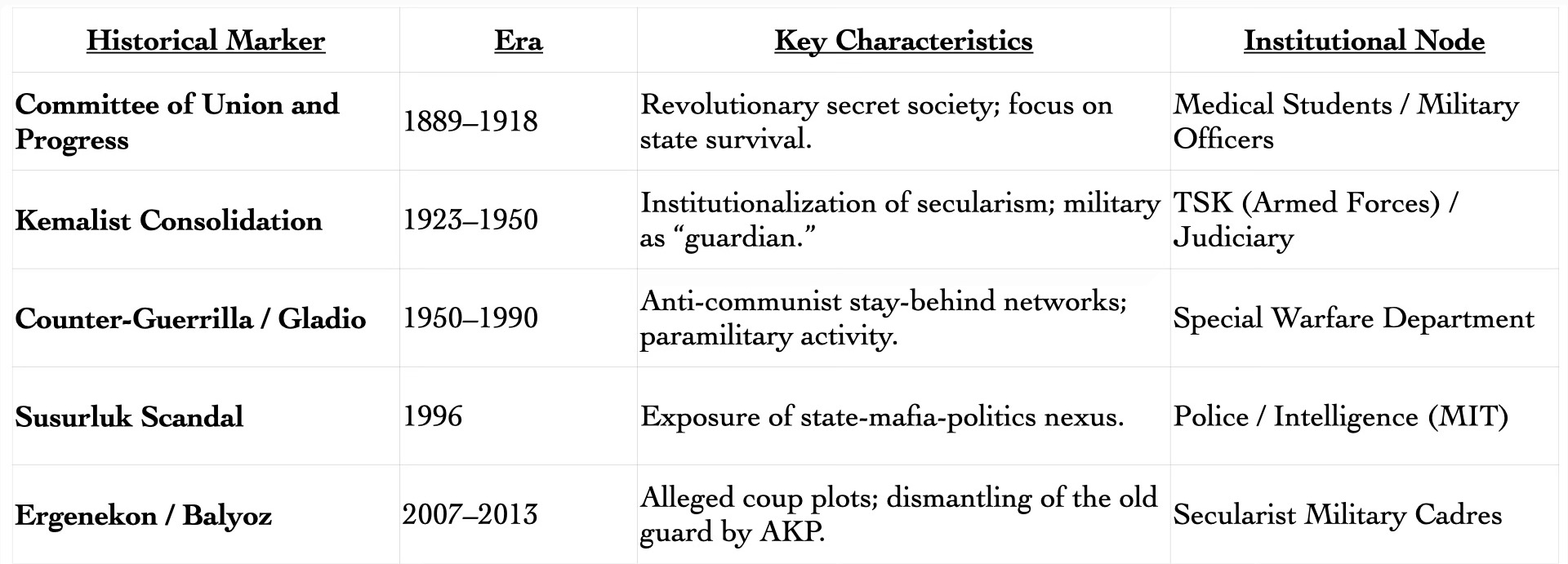
The deep state’s “depth” refers specifically to its lack of “openness” and its reliance on “covert operations” to manipulate political and economic elites. Its primary tools included political assassinations of intellectuals, the waging of counter-terrorist operations against groups like the PKK, and the orchestration of false-flag attacks to create the “groundwork for a military coup.”
Mirroring
The Turkish derin devlet served as a blueprint for understanding the “permanent bureaucracy” and “security establishments” of the West. While these entities differ in their adherence to the rule of law, they share the characteristic of being “nationally bounded”—their objective is the preservation of the specific sovereign entity they serve.
The European Stay-Behind Architecture
In Europe, the deep state manifested during the Cold War as Operation Gladio and similar networks across Belgium, the UK, and Italy. These were paramilitary “stay-behind” units organized by NATO and the CIA to engage in resistance should a Soviet invasion occur. However, as revealed by Italian Prime Minister Giulio Andreotti in the 1990s, these networks often engaged in domestic political manipulation, including bombings and psychological warfare, to prevent communist parties from gaining electoral success. This highlights a core feature of the national deep state: the belief that the “permanent interest” of the country supersedes the “temporary will” of the electorate.
The US Permanent State and the Mirage of Depth
In the United States, the term has evolved from describing foreign juntas to describing the domestic administrative state and the intelligence community. Unlike the Turkish model, which utilized “hitmen and mafia,” the American version operates through “distributional coalitions” within the civil service and the “security-military industrial complex.” This “permanent state” maintains continuity in foreign policy and national security regardless of presidential transitions, often utilizing “complexity of regulation” and “scope of government” to thwart radical policy shifts.
Israel: The Security-Centric Autonomy
Israel’s deep state model is characterized by a “high level of autonomy” necessitated by constant existential threats. This establishment—comprising the IDF, Mossad, and Shin Bet—often acts unilaterally to prevent the emergence of regional threats. The Israeli security establishment maintains a “strategic partnership” with its American counterpart but operates with a “boldness” that sometimes bypasses traditional diplomatic channels. In the Eastern Mediterranean, this security establishment has anchored a policy focusing on the “Israel-Cyprus-Greece axis” to counter the maritime and ideological expansionism of Turkey.
The Brothers
While the deep states of Turkey, the US, and Israel are designed to preserve the nation-state, the Muslim Brothers have engineered a model to surmount it. Founded in 1928 by Hassan al-Banna, the ikhwān began as an Muslim revivalist group but rapidly evolved into a transnational “informational pathogen.” It is “informational” because its primary theatre of war is the cultural and institutional narrative of the societies it seeks to transform; it is a “pathogen” because it utilizes the host’s own democratic and legal mechanisms to dismantle the state from within.
The Doctrine of tamkīn and Phased Transition
The Brothers’ strategy is governed by the principles of tamkīn (institutional entrenchment) and marhaliyyah (phased adaptation). This strategy allows the movement to adjust its discourse based on the local environment while maintaining a rigid, global ideological core.
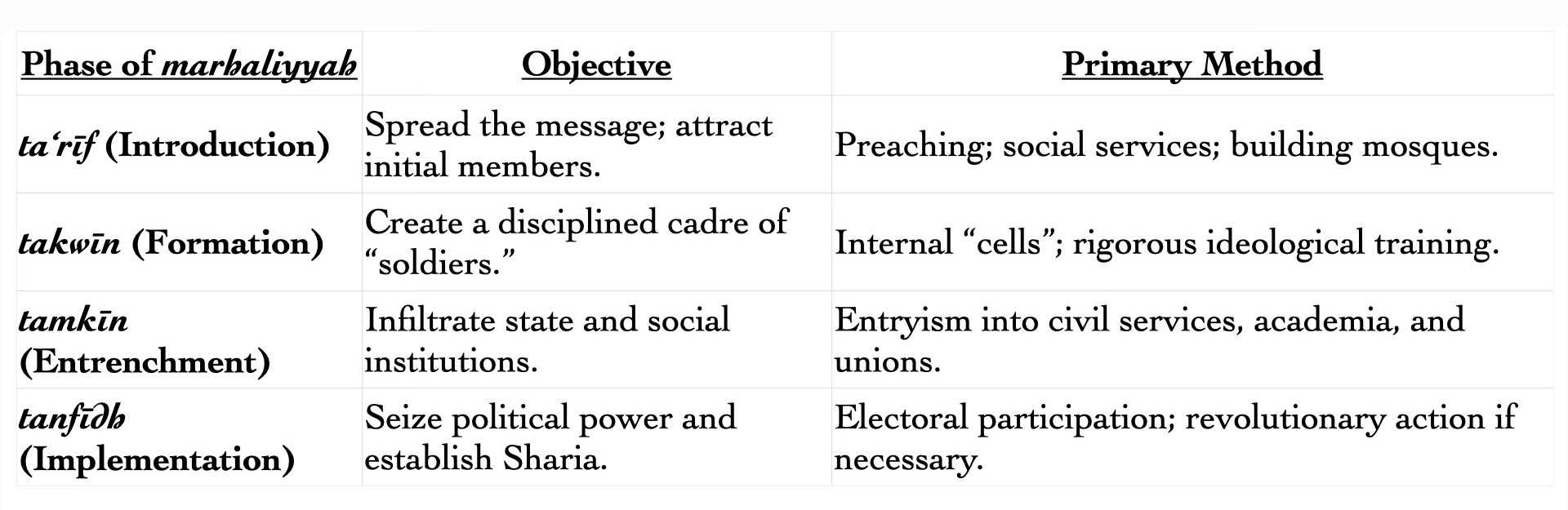
The Brothers’ transition from a local Egyptian movement to a globalized entity was accelerated by the 1967 Six-Day War, which discredited secular Arab nationalism and allowed the ideas of the Brothers to fill the vacuum. Supported by Saudi Arabia during the Cold War as a counter to communism and to undermine the country’s Western allies, the Brothers established a global presence that now spans over 70 to 90 countries.
Policy jihād and the Fabian Strategy of Permeation
The ikhwān’s “Policy jihād” is a non-kinetic form of struggle aimed at capturing the “ideological and social environments” of the West. This is not espionage in the traditional sense; it is a “slow, methodical, bureaucratic penetration” often referred to as “Civilization jihād.”
Academic Entryism and Narrative Control
A critical node in the ikhwān’s globalized deep state is Western academia. Through the “Follow the Money” initiative, researchers have documented how foreign regimes—principally Qatar in the three decades—funnel billions of dollars into prestigious universities. These funds are often tied to the promotion of Muslim narratives under the guise of “cultural exchange” or “Middle Eastern studies.” By establishing a presence in higher education, the Brothers:
- Protect their Ideological Integrity: They safeguard their specific narratives against critical inquiry by framing criticism as “Islamophobia.”
- Influence Future Elites: They ensure that the next generation of civil servants, journalists, and politicians views the Brothers as a “moderate” and “legitimate” civil society actor.
- Monopolize Representation: They position ikhwān-linked student groups, as the “default representatives” of all Muslim students, marginalizing apolitical or ordinary Muslim voices.
Infiltration of Civil Services: The UN and Western Bureaucracy
The Brothers have successfully embedded themselves within the administrative structures of both the West and the Arab world. In the United States, ikhwān-linked organizations have gained access to federal agencies, advising on “civil rights policy” and “counter-terrorism training.” This “strategic entryism” has led to the purging of training materials that identify the link between Muslim ideologies and jihādi violence, effectively blinding the state to the Brothers’ long-term objectives.
In Arab countries, the Brothers have utilized “cycles of repression” to refine their entryist tactics. Under Hosni Mubarak in Egypt, while technically illegal, the group successfully infiltrated student unions and professional syndicates, creating a “state-within-the-state” that provided social services—food, health, education—where the official bureaucracy was “inept.” This prepared them for their brief, yet significant, period of governance following the “Arab Spring,” where they attempted to use political maneuvers to change the nature of the state and society in Egypt, Tunisia, and Morocco.


