ikhwān: Deeper than the Deep State, II
5 March 2026
Discovering the Rule
The phrase “deep state” has become the modern person’s all-purpose superstition: whenever something confusing happens, blame a hidden cabal, add a sinister acronym, and feel briefly intelligent. This essay does something more bracing—and more dangerous to the lazy mind. It argues that we’ve been staring at the wrong creature.
In this account, the classic deep state—Turkey’s shadow networks, Washington’s permanent bureaucracy, Europe’s Cold War “stay-behind” wiring, even Israel’s security autonomy—is still fundamentally domestic, tethered to flags, borders, and the dull necessity of keeping a particular state alive. The provocation here is that the Muslim Brothers’ project is deeper than that: not merely clandestine, but transnational, not merely political, but theological—a system that treats open societies as hosts to be colonized from within.
Because the argument is long—and because it actually builds, rather than shouting—I am publishing it as a two-part series.
Part One: The deep state, then the “upgrade”
Part one begins in the original habitat of the deep state: Turkey’s derin devlet, with its state-saving mythology, intermittent scandals, and habit of surfacing only when the lights flicker. From there it “mirrors” outward—Europe’s Cold War networks and America’s regulatory-security continuity—showing how these systems, however ugly or self-protective, remain bounded by national sovereignty.
Then comes the pivot. The Muslim Brothers enter not as a mere faction, but as an organizational method: a phased strategy of entrenchment, an insistence on narrative dominance, and a preference for working through legal and academic institutions rather than against them. You’ll see how this is framed as a form of slow-motion conquest—administrative, cultural, and institutional—sold to the naïve as “participation.”
Part Two: Money, patronage, and the theology that eats borders
Part two moves from the visible to the bankable: the financial and patronage architecture—charities, business networks, sovereign sponsors—and the role of safe jurisdictions and media amplification. It also pulls the curtain back on the Brotherhood’s earlier kinetic lineage, not to linger on melodrama, but to explain how a movement can mature from force to influence without ever abandoning its final destination.
And then the essay raises its most unsettling claim: that the ultimate weapon isn’t a cell or a suitcase, but a set of theological binaries that delegitimize pluralism and treat the nation-state as an obstacle to be dissolved. The series ends where it should: with the uncomfortable implication that modern democracies are well-equipped to fight bombs, and oddly helpless against ideas wearing a suit and carrying a grant letter.
The Financial and Intelligence Nexus
The ikhwān’s deep state art is perfected through a financial and intelligence architecture that remains largely invisible to traditional security frameworks. While nationally bounded deep states rely on state budgets, the Brothers utilize a complex financial network of charities, private businesses, and sovereign patrons.
Londonistan
London has historically functioned as the nerve center for the International Organisation of the Muslim Brother. The Londonistan safe haven allows the Brothers to operate with a degree of extraterritoriality, hosting “Pure Brothers” from Middle Eastern branches who conduct fundraising, lobbying, and media operations aimed at challenging their home regimes. Organizations like the Muslim Association of Britain (MAB) and the Federation of Student Islamic Societies (FOSIS) serve as “affinity groups” that provide a veneer of grassroots legitimacy while maintaining deep ideological ties to the global leadership.
The Qatari Billionaire Patronage
Qatar serves as the primary ideological and financial patron of the global ikhwān. Doha’s role is multi-faceted:
- Media Empire: The state-owned al-Jazeera Media Network acts as a force multiplier, projecting pro-ikhwān and pro-Hamas narratives across the globe and whitewashing the extremism of its offshoots.
- Sanctuary for Terrorist Leaders: Doha provides a base for senior ikhwān figures and Hamas leadership, presenting itself as a “mediator” while simultaneously funding the very actors it purports to restrain.
- Financial Permeation: Qatari-based financiers, such as Abdul Rahman Bin Umair al-Nuaimi (designated by the US as a terrorist financier), have coordinated millions of dollars for al-Qaeda and ikhwān-linked insurgencies, often with the “toleration” of the Qatari state.
The Special Apparatus
Long before it mastered the “Policy jihād,” the Brothers developed the al-nizam al-khass (Special Apparatus), a paramilitary and intelligence wing. This secret bureau was tasked with political goals through violence and the protection of the organization’s leaders.
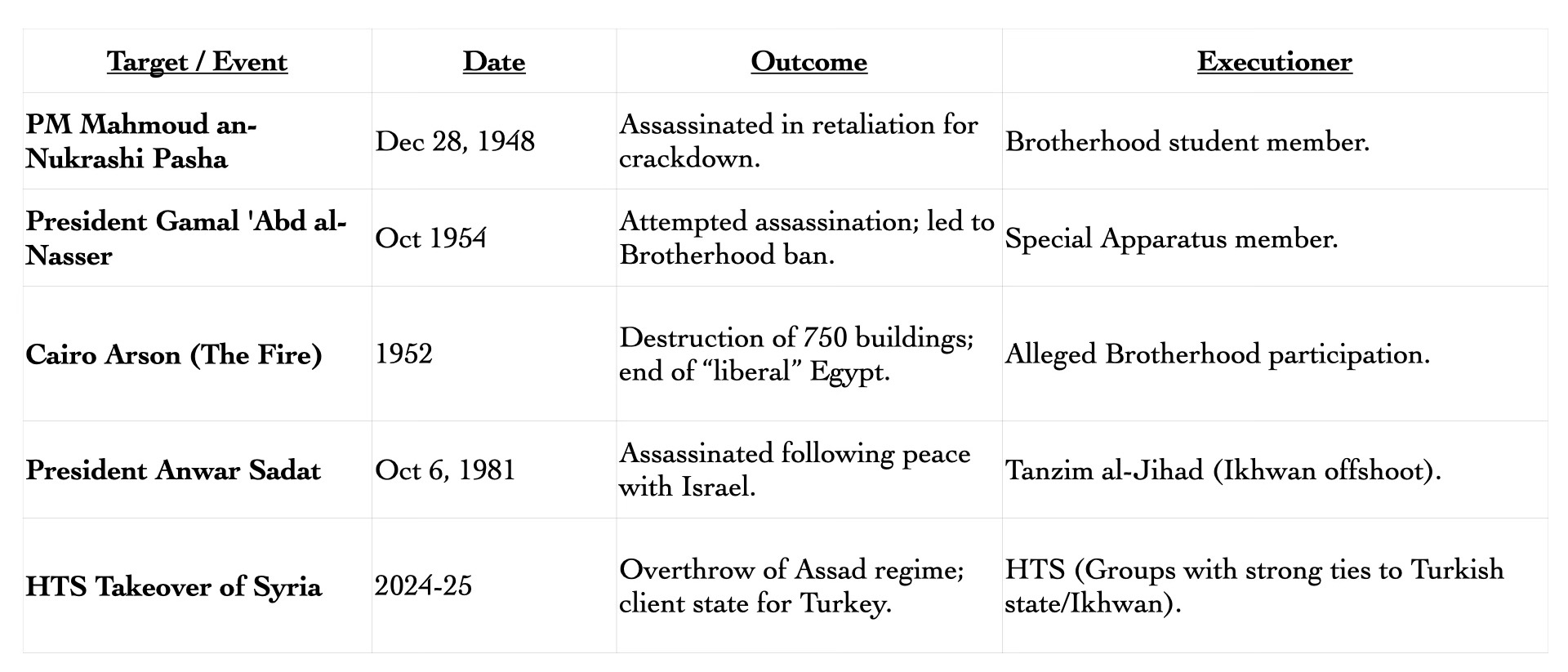
This Secret Apparatus represents the kinetic origin of the ikhwān’s deep state, a model that has now evolved into the transversal alliances seen in modern Western cities, where the movement works with leftist politicians and Stop the War coalitions to achieve its strategic ends.
Theological Weaponization
The most “pathogenic” aspect of the ikhwān model is its theological framework, which is designed to override state borders and render the Westphalian concept of sovereignty obsolete. Unlike the Turkish deep state, which is focused on the vatan (homeland), the Brothers are focused on the umma (the super-tribe).
Rejection of Westphalian Borders
The Brothers views the nation-state as a colonial imposition. Their fundamental goal is the establishment of a global Islamic caliphate characterized by “one umma under the rule of a single leader.” This vision is explicitly expansionist, asserting that the caliphate must expand in opposition to any government that embraces religious pluralism.
The jihādi Binaries
The ideology of the Brothers is built upon rigid binaries that function as an informational pathogen by dividing the world into two irreconcilable camps:
- The Sword Binary: The Brothers’ emblem—a qur’ān between two swords—symbolizes “Islam through the sword for believers, and Islam or the sword for nonbelievers.”
- tawhīd al-hakimiyya (Unity of Governance): This concept, popularized by Sayyid Qutb, argues that “the rule is for none but allāh,” without telling the world that the Brothers are the sole representatives of allāh himself. This renders all secular constitutions, democratic parliaments, and human rights frameworks illegitimate because they represent the “usurpation of allāh’s sovereignty” by the mortal man, provide we swallow the delusion that the Brothers are immortals.
- The Purity Pathogen: The organization seeks to purge “corrupt influences” from the West that “contaminate” the “true” Muslim thoughts, morals, judgments and feelings. This ideology promotes “separation, sedition, and hatred” by telling Muslims in the West that they are “superior” beings and must remain separate from non-believers, in countries and societies they voluntarily re-settle in. What could the purpose of such re-settlements be?
Sayyid Qutb and Genocidal Antisemitism
The Brothers’ art of the deep state was further radicalized by Sayyid Qutb, whose writings introduced a layer of genocidal antisemitism as a core tenet. Qutb promoted the theory—referencing the faked Protocols of the Elders of Zion—that Jews use the “accumulation of world wealth” to achieve global domination and destroy islām, as if Muslim have never advocated their religion out side of Mecca and Median, and they have not imposed domination on any other society. This narrative has been weaponized by ikhwān offshoots like Hamas and has even influenced the 1979 Islamic Revolution in Iran, creating a Sunni-Shia convergence on the goal of dismantling the Western-led international order.
The New Axis of Power
The evolution of the deep state has culminated in a new regional order where the lines between state and movement have blurred. The modern Turkey-Qatar-ikhwān axis represents a revisionist power bloc that utilizes the Deep State mechanisms of the past to advance the informational pathogen of the future.
The Turkish Synthesis
Under Recep Tayyip Erdogan, Turkey has transitioned from being a Kemalist protectorate to becoming the primary state-sponsor of the Ikhwan’s globalized vision. Erdogan has effectively vanquished the old secular deep state and replaced it with a new one that is expansive and revisionist. This new Turkish deep state:
- Hosts Hamas Leaders: It allows rallies that praise terrorist groups and attack Israel while using trade as a bargaining chip with the West.
- Projects Power into Syria: It seeks to shape Syria into a client state by supporting ikhwān-linked factions, alarming both Israel and the Arab Gulf.
- Leverages NATO Status: It utilizes its position in Western security architectures to shield its ikhwān-aligned activities from scrutiny.
The Impact on US and Israeli Security
This synthesis presents a unique challenge for the US and Israel. The traditional Deep State tools—military deterrence and intelligence cooperation—are less effective against a movement that operates through Policy jihād and academic indoctrination. While Israel has moved to counter the ikhwān’s “Blue Homeland” strategy in the Mediterranean through alliances with Greece and Cyprus, the US remains stuck in the middle, often forced into pragmatism by the Brothers’ successful infiltration of its own advisory bodies.
The Future of the Informational Pathogen
The Muslim Brothers have perfected the deep state art by evolving it from a state-bound bureaucratic phenomenon into a globalized, theological pathogen. While the traditional deep states of Turkey, the US, and Israel remain anchored to the preservation of national sovereignty, the ikhwān model views sovereignty as an obsolete obstacle.
The analysis of this evolution yields several critical insights:
- Sovereignty as a Tool, Not a Goal: The Brothers utilize sovereign patrons (Qatar) and hosts (the West) as platforms for their common mission. They do not seek to become a state at this stage; they seek to become the logic by which states are governed, while building up the critical mass for a future takeover under right circumstances, inshallah, they say.
- The Immunity Gap: Western democracies have a strategic vulnerability because their legal frameworks are designed to combat violent kinetic threats, not the slow, methodical subversion of Policy jihād.
- The Information-Theology Nexus: The Brothers’ power lies in their ability to weaponize information—through Jazeera, academic funding, and the Red-Green political alliance—to whitewash their theological binaries of conquest.
- The Institutional midpoint: As identified by ISGAP, we are currently at the “50-year midpoint of a 100-year plan.” The Brothers have successfully embedded themselves within the very institutions—academia and the civil service—that are responsible for identifying threats to national security.
In conclusion, the Deep State is no longer an Anatolian secret; it is a globalized, ideological software that has successfully hacked the operating systems of Western, Muslim and Arab governance. Addressing this informational pathogen requires a shift from kinetic counter-terrorism to a Battle of Ideas that confronts the ikhwān’s rejection of Westphalian pluralism and their commitment to a universal, exclusionary caliphate.


