History and the Open Future
A Philosophical Companion to Simon Sebag Montefiore’s The Cauldron
2 October 2026
A Note to Readers
Some books stay with you because they answer important questions.
A much smaller number stay with you because they leave you with a better question than the one you brought to them.
Simon Sebag Montefiore’s The Cauldron did exactly that for me.
I began reading it expecting to learn more about the history of the Middle East. I finished it thinking about a much larger problem: the relationship between history, explanation, and the open future.
This essay was never intended to be a conventional review. I found myself reconstructing the explanatory architecture of the book before I could even ask whether I agreed with its conclusions. Only after understanding what I believe Montefiore had accomplished did another question quietly emerge—one that eventually became this companion.
Writing it has also taught me something about criticism itself.
The best criticism does not begin by looking for weaknesses. It begins by trying to understand another person’s explanation so well that, if there is another step to take, it becomes visible almost by itself.
Whether I have succeeded is for readers to judge.
What I know with certainty is that this essay would not exist without The Cauldron. Whatever value it has, it owes an intellectual debt to the remarkable historical reconstruction that made its central question possible.
I hope you will read it in that spirit—not as an argument against a great book, but as an attempt to continue a conversation that the book itself inspired.
— Khaled Salih
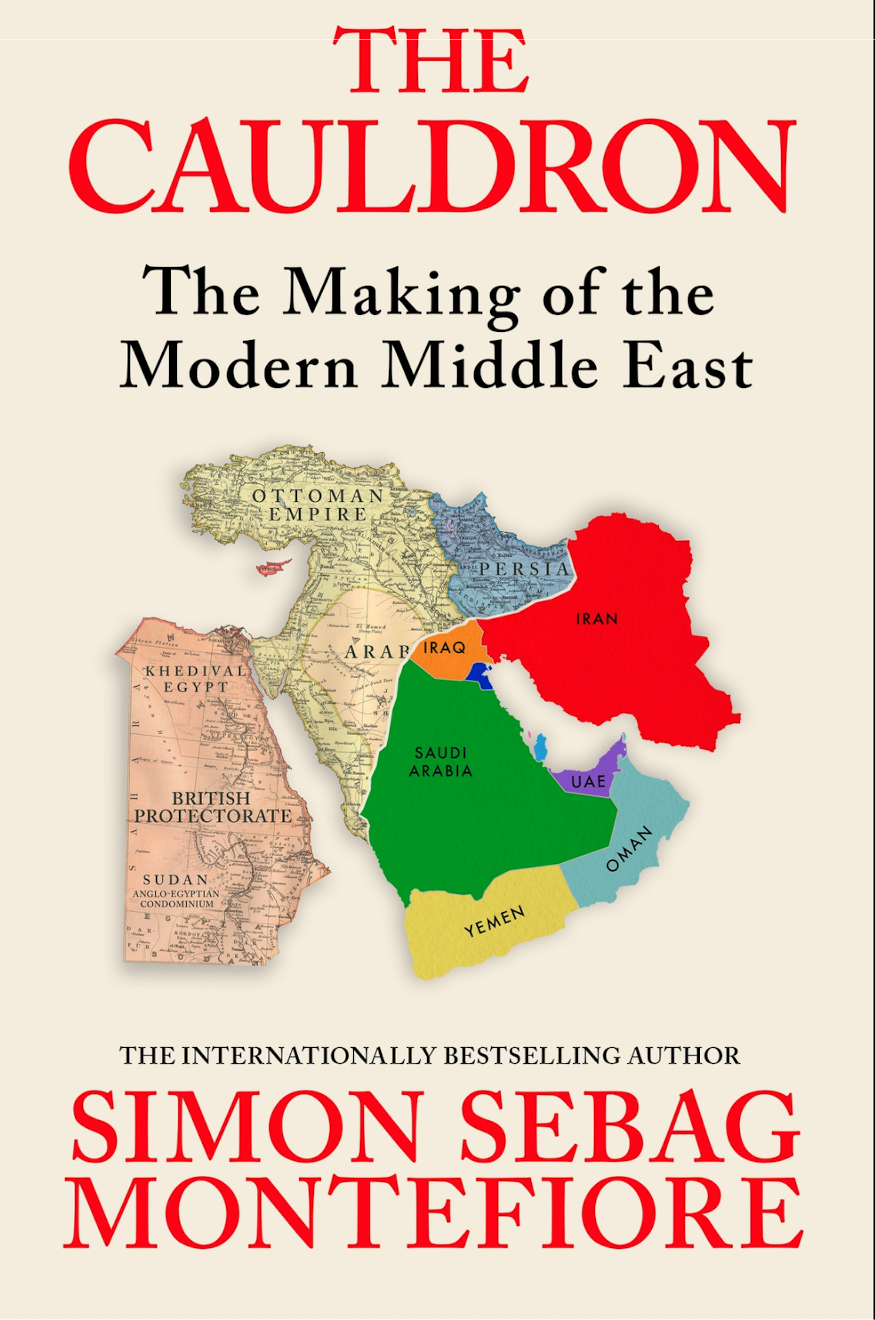
History and the Open Future
A Philosophical Companion to Simon Sebag Montefiore’s The Cauldron
Prologue
When a Great History Creates a New Question
Some books answer questions.
A few change the questions themselves.
Simon Sebag Montefiore’s The Cauldron belongs firmly to the latter category.
It is far more than a history of the Middle East. It is an ambitious reconstruction of the deep historical inheritance of one of the world’s most consequential regions. Across five millennia, Montefiore guides the reader through the intertwined histories of empires, religions, cities, dynasties, trade routes, conquests, and ideas with extraordinary narrative confidence. The result is a work that restores historical depth to public conversations too often imprisoned by the urgency of the present.
As I read The Cauldron, I gradually realized that I was asking the wrong question.
I had begun, as most readers do, by asking whether I agreed with Montefiore’s interpretations.
That question slowly gave way to another.
What problem is this remarkable book trying to solve?
Once I began reading through that lens, the book changed before my eyes.
I stopped evaluating individual arguments and started reconstructing the explanatory architecture that made the entire work possible. The chapters became less important than the underlying logic that connected them. Rather than asking whether a particular interpretation was persuasive, I found myself asking what kind of explanation could sustain a narrative spanning five thousand years without collapsing into either simplicity or determinism.
Only much later did another question quietly emerge.
Not because I had discovered a disagreement.
Because Montefiore’s own explanation seemed naturally to invite it.
If history explains with such extraordinary power how the present inherited the past, what explains the moments when human beings create futures that the past itself could not anticipate?
Everything that follows grows from that question.
It is therefore not written against The Cauldron.
It is written because of it.
Had Montefiore not reconstructed the architecture of historical inheritance with such depth and clarity, I do not believe this companion could have been written.
That is the intellectual debt I owe this remarkable book.
The Historian Who Restored Historical Depth
One of the quiet paradoxes of our age is that history has become simultaneously more accessible and less present.
Never before have we enjoyed such immediate access to historical information. Yet public conversation increasingly unfolds within an ever-shorter horizon of attention. Political debates begin with yesterday’s headlines. Wars are explained through last year’s decisions. Civilizations are compressed into election cycles. The deeper historical structures that shape the present gradually disappear beneath the urgency of current events.
The Cauldron moves decisively in the opposite direction.
Simon Sebag Montefiore asks us to recover a longer horizon. The Middle East, he argues through the architecture of his narrative, cannot be understood through the language of immediacy. Today’s conflicts, alliances, identities, and ambitions did not suddenly appear. They are the latest expressions of historical processes unfolding across thousands of years.
This is more than a difference of chronology.
It is a different way of explaining the world.
Montefiore invites the reader to exchange immediacy for continuity.
Individual events remain significant, but they become intelligible only when situated within much longer historical trajectories. A conquest becomes part of an imperial inheritance. A theological dispute becomes one chapter in centuries of religious development. A political boundary becomes another layer within an older geography of power, commerce, migration, and memory.
The effect is quietly transformative.
Events that initially appear isolated gradually reveal themselves as parts of a much longer historical conversation. Connections emerge where contemporary discourse often sees only fragmentation. The present acquires depth because it is placed within the accumulated experience of civilizations rather than the urgency of the latest crisis.
This, I believe, is one of the book’s greatest achievements.
It restores historical proportion.
Beyond the History of Events
Many historians reconstruct events.
Others reconstruct institutions.
Some concentrate on ideas, economics, military campaigns, diplomacy, or culture.
Montefiore attempts something considerably more ambitious.
He reconstructs relationships.
Empires do not simply rise and fall.
They inherit administrative traditions, political practices, and cultural assumptions from those they replace.
Religions do not emerge in isolation.
They absorb, reinterpret, and transform earlier beliefs, sacred places, languages, and symbols.
Cities become repositories of accumulated memory where conquest, commerce, scholarship, diplomacy, and faith continually reshape one another.
Even violence appears less as a succession of isolated eruptions than as part of longer historical processes whose origins often reach centuries into the past.
History therefore becomes something richer than chronology.
It becomes an evolving web of relationships.
Nothing exists entirely by itself.
Everything inherits.
Everything leaves an inheritance.
The Recovery of Historical Humility
One of the book’s most important contributions lies not only in the knowledge it offers but in the intellectual posture it encourages.
Historical depth cultivates humility.
The longer the historical horizon becomes, the more resistant reality proves to simple explanation.
Religious conflict reveals political dimensions.
Political conflict reveals economic dimensions.
Economic change reflects technological development.
Technology reshapes culture.
Culture reshapes institutions.
Institutions reshape belief.
The search for a single cause gradually gives way to an appreciation of interacting causes.
Complexity ceases to be an obstacle to explanation.
It becomes part of the explanation itself.
Montefiore never simplifies history in order to make it more persuasive.
Instead, he reconstructs enough of its complexity that the reader begins to understand why civilizations so often resist reduction to a single narrative.
A History of Inheritance
As I continued reading, one feature of The Cauldron became increasingly clear.
Its deepest subject is inheritance.
Every generation enters a world it did not create.
Borders already exist.
Sacred places already possess meaning.
Languages already carry memory.
Empires leave institutions.
Religions preserve traditions.
Victories shape confidence.
Defeats shape fear.
Political identities accumulate emotional and historical weight across centuries.
Each generation modifies this inheritance—sometimes deliberately, sometimes unintentionally—and then passes it forward.
History therefore appears neither as repetition nor as perpetual novelty.
It becomes a continuous process of inheritance and transformation.
The present is never independent of the past.
Nor is it merely a repetition of it.
Each generation reshapes what it inherits before becoming part of the inheritance received by those who follow.
This, to my mind, is the central explanatory insight of The Cauldron.
Reading Beyond the Middle East
At a certain point, I realized I was no longer reading The Cauldron simply as a history of the Middle East.
I had begun reading it as a meditation on civilization itself.
The Middle East remained the historical landscape.
The deeper subject became the ways civilizations endure across time.
How they remember.
How they transmit.
How they preserve.
How they adapt.
How they carry both achievement and tragedy across generations.
That realization changed my own reading.
The question was no longer whether a particular historical interpretation was convincing.
It became something larger.
What kind of explanation is capable of holding together five thousand years without collapsing into either simplicity or determinism?
I believe The Cauldron offers one of the strongest answers I have encountered.
Its achievement lies not simply in reconstructing the history of a region, but in revealing the architecture through which civilizations carry themselves across time.
It is precisely because that architecture is so compelling that another question eventually began to emerge.
Not a question about the past.
A question about the future.
Before asking it, however, I believe it is essential to understand fully the remarkable historical architecture Montefiore has constructed.
The Architecture of Historical Inheritance
Understanding The Cauldron requires more than following its chronology.
Its true achievement lies in the explanatory architecture that holds together five thousand years of history without reducing that history to a single cause or a single civilization.
The scholarship is immense.
The narrative is expansive.
Yet both serve something deeper.
Montefiore is not merely recounting the past.
He is explaining how the past remains present.
To appreciate that achievement, it is necessary to ask not simply what history he tells, but how his history explains.
History as an Inherited World
The first principle underlying The Cauldron is both simple and profound.
History is inherited before it is created.
No civilization begins from the beginning.
No generation enters an empty landscape.
Every society inherits a world already shaped by countless earlier decisions, migrations, conquests, beliefs, institutions, ambitions, failures, and achievements.
This inherited world is not merely historical background.
It actively structures the possibilities available to those who come later.
Sacred places already possess sacred meaning.
Trade routes already connect distant civilizations.
Religious traditions already define communities.
Empires leave administrative systems long after they disappear.
Languages preserve memories that outlive the people who first spoke them.
Political identities accumulate emotional force across centuries.
History therefore begins not with unlimited freedom but with inherited reality.
Human action becomes intelligible only when viewed within that inheritance.
The Middle East as a Civilizational Crossroads
Montefiore does not present the Middle East simply as one region among many.
He presents it as one of history’s great crossroads.
Empires converge there.
Religions converge there.
Trade routes converge there.
Ideas converge there.
Peoples converge there.
Military ambition converges there.
The region becomes less a geographical location than a meeting place where civilizations continually encounter, influence, compete with, and transform one another.
Its significance lies not only in what happened there, but in the remarkable density of historical interaction that repeatedly gave local events global consequences.
The Middle East becomes the stage upon which civilizations continually reshape one another.
History as Relationship
One of Montefiore’s most original achievements is his refusal to treat history as a succession of isolated events.
Empires do not simply replace one another.
They inherit institutions, administrative practices, political cultures, and systems of legitimacy.
Religions do not merely emerge.
They absorb earlier traditions, reinterpret sacred landscapes, and transform inherited beliefs.
Cities survive conquest not simply because walls endure but because memory, commerce, learning, and political authority continue accumulating within them.
Commerce reshapes power.
Power reshapes commerce.
Faith influences politics.
Politics reshapes faith.
Ideas travel with merchants, scholars, pilgrims, diplomats, and armies.
Nothing develops in isolation.
Everything exists in relationship to something that came before.
History therefore appears not as a chain of disconnected events but as an evolving web of interaction whose threads stretch across centuries.
Memory as Historical Agency
Among the book’s most striking achievements is its treatment of memory.
Memory is never reduced to nostalgia.
Nor is it presented merely as cultural identity.
It becomes one of history’s active forces.
Ancient victories continue shaping political confidence.
Ancient defeats continue shaping collective anxiety.
Sacred narratives remain politically significant long after the societies that first produced them have disappeared.
Historical memory becomes a living participant in contemporary events.
The past therefore never entirely disappears.
It survives through institutions, education, ritual, law, architecture, language, religious tradition, and collective imagination.
Memory is not history’s shadow.
It is one of history’s principal mechanisms of continuity.
Agency Within Inheritance
Despite the immense weight Montefiore assigns to inherited reality, his history never becomes deterministic.
Individuals matter.
Leaders matter.
Conquerors matter.
Reformers matter.
Religious innovators matter.
Diplomats matter.
Unexpected decisions repeatedly alter historical trajectories.
History is neither mechanical nor inevitable.
Yet neither are individuals portrayed as unconstrained creators of their world.
Every leader acts within inherited conditions.
Every reform encounters inherited institutions.
Every conquest enters an already existing civilization.
Every revolution inherits the language through which it seeks to transform society.
Agency therefore remains real, but it is always exercised within worlds created by others.
That balance between inheritance and human creativity gives The Cauldron much of its explanatory sophistication.
The Recursion of History
As I reflected on the architecture of the book, one idea gradually emerged with increasing clarity.
History is recursive.
Every historical outcome becomes part of the inheritance received by the next generation.
Each solution creates new problems.
Each conquest redraws political possibilities.
Each empire leaves institutions.
Each religious tradition inherits earlier traditions while reshaping them.
Nothing simply repeats.
Nothing begins entirely anew.
The present continually transforms what it has inherited before becoming part of someone else’s inheritance.
Seen in this light, history is neither cyclical nor linear.
It is recursive.
That recursive movement gives The Cauldron its remarkable coherence across five millennia.
The Architecture Revealed
By the time I reached the end of The Cauldron, the architecture that sustained the entire work had gradually come into focus.
History is not a collection of disconnected events.
It is an inherited world.
Civilizations do not simply replace one another.
They absorb, reinterpret, and transform what came before.
Human beings possess agency, but they exercise it within realities they did not choose.
The past remains continuously present—not because history endlessly repeats itself, but because every generation inherits a world already shaped by countless generations before it.
This, to my mind, is the enduring achievement of The Cauldron.
It restores historical depth without sacrificing historical complexity.
It demonstrates that understanding civilization requires patience, proportion, and intellectual humility.
It also leaves me with a question that the book itself quietly made possible.
If history explains with such extraordinary power how every generation inherits the past, what explains those moments when human beings create possibilities that no previous inheritance seemed capable of anticipating?
It is to that question that I now turn.
Where the Explanation Reaches Its Natural Limit
Every powerful explanation eventually reaches a point beyond which it cannot proceed without becoming a different kind of explanation.
Recognizing that point is not an act of criticism.
It is an acknowledgment of explanatory success.
The best explanations illuminate not only what they explain.
They also reveal the questions that remain.
By the time I reached the closing pages of The Cauldron, I found myself reflecting less on the immense historical journey behind me than on the nature of historical explanation itself.
What, precisely, had Montefiore demonstrated?
And what question had his remarkable reconstruction made newly visible?
Those are not the same question.
The Achievement of Historical Explanation
One conclusion emerged with increasing clarity as I read.
History matters.
Not as background.
Not as context.
As explanation.
Every generation inherits institutions, identities, loyalties, memories, beliefs, ambitions, conflicts, and political arrangements that it did not create.
The present becomes intelligible only because it carries within itself layer upon layer of inherited history.
Montefiore demonstrates this with extraordinary scholarship and narrative confidence.
His achievement is not simply to remind us that history matters.
It is to show how history continues acting upon the present long after the events themselves have passed.
History becomes visible as an active inheritance.
That, I believe, is one of the book’s enduring contributions.
When Another Question Appears
Precisely because I found Montefiore’s reconstruction so persuasive, another question gradually emerged.
Not as an objection.
As a continuation.
If every generation inherits the accumulated consequences of previous generations, how do genuinely new possibilities ever enter history?
This is not, strictly speaking, another historical question.
It is a philosophical one.
History explains inherited conditions.
The new question asks how inherited conditions themselves become transformed through explanations that did not previously exist.
The two questions are related.
But they are not identical.
Two Different Explanatory Questions
At this point it became helpful to distinguish between two kinds of explanation.
The first asks:
How did the present come to exist?
This is the historian’s question.
The second asks:
How do new futures become possible?
This is a different question.
The first draws upon inherited evidence.
The second concerns knowledge that, at the moment under consideration, may not yet exist.
History can reconstruct inherited reality with remarkable precision.
It cannot fully reconstruct explanations that future generations have not yet created.
Recognizing this distinction does not diminish historical explanation.
It clarifies its extraordinary strength.
The Boundary of Historical Explanation
Every discipline possesses a natural horizon.
Physics explains physical processes.
Economics explains economic behavior.
History explains historical inheritance.
Each gains its authority by remaining faithful to its proper subject.
The historian’s task is not to predict future knowledge.
It is to reconstruct the inherited world from which future knowledge must emerge.
That is precisely what Montefiore accomplishes.
His explanation reaches remarkable depth because it consistently remains within that explanatory horizon.
As I reflected upon his work, it gradually became clear that the question now before me belonged beyond that horizon.
Not beyond history.
Beyond history alone.
The Explanatory Continuity Test
While working through The Cauldron, I found myself formulating a question that I suspect applies far beyond this particular book.
Whenever I encounter an ambitious explanation, I now ask:
Does the conclusion arise from the same explanatory architecture that produced the argument itself?
I have come to think of this as the Explanatory Continuity Test.
Its purpose is not to challenge conclusions.
Its purpose is to preserve explanatory coherence.
Throughout The Cauldron, Montefiore explains the present through inheritance, memory, geography, religion, empire, institutions, and human agency operating within inherited conditions.
The explanatory architecture remains remarkably consistent.
Its coherence is one of the book’s greatest strengths.
The question that gradually emerged for me was therefore not whether that architecture succeeds.
It clearly does.
The question became whether explaining inherited reality is identical to explaining the range of futures that remain possible.
That seemed to me a different explanatory problem.
Historical Humility
One of the deepest lessons I take from The Cauldron is the importance of humility before history.
The more deeply one understands the past, the more resistant reality becomes to simple explanation.
Yet perhaps the same humility should accompany our thinking about the future.
The deeper our understanding of inherited conditions becomes, the more cautious we should become when speaking about explanations that future generations have not yet imagined.
Historical understanding expands our authority regarding inherited reality.
It cannot grant equivalent authority regarding knowledge that does not yet exist.
This is not a limitation of history.
It is one of history’s own lessons.
The Question That Remained
Far from diminishing my admiration for The Cauldron, this realization deepened it.
The book did not merely teach me more history.
It clarified the remarkable explanatory reach of historical inheritance.
At the same time, it revealed another question waiting quietly beyond it.
If history explains how civilizations inherit their worlds,
what explains those moments when civilizations transform what they have inherited through genuinely new understanding?
That question is not answered by The Cauldron.
Nor should it be.
It belongs to a different explanatory inquiry.
Yet it is precisely because Montefiore reconstructs inherited history with such depth that this further question becomes visible.
It is to that question that I now turn.
The Missing Mechanism
History explains how civilizations inherit their worlds.
That is one of the central achievements of The Cauldron.
Yet inheritance, by itself, cannot explain every historical transformation.
History repeatedly confronts us with moments when inherited realities acquire meanings that previous generations could not have anticipated.
Institutions change.
Political orders change.
Religious understanding changes.
Scientific revolutions reorganize civilization.
Entirely new forms of cooperation emerge.
The inherited world remains.
Yet something fundamental has changed.
The question is simple.
What accounts for that change?
If historical inheritance explains continuity, what explains transformation?
Inheritance Explains the Beginning
One of Montefiore’s lasting achievements is to remind us that no civilization begins from nothing.
Every society inherits languages, institutions, customs, laws, memories, symbols, and political arrangements created by countless earlier generations.
These inheritances are not passive.
They shape what appears possible.
They influence what people expect, fear, preserve, reject, or seek to change.
History therefore provides the starting conditions of civilization.
Every generation begins inside a world it did not choose.
Understanding that inherited world is the indispensable first task of historical explanation.
Transformation Requires Another Explanation
Yet history itself repeatedly demonstrates that inherited conditions are not the whole story.
At certain moments, human beings begin to understand inherited realities differently.
An institution once regarded as natural becomes questionable.
A political arrangement once thought permanent becomes reformable.
An accepted explanation gives way to another that explains more.
The inherited world has not disappeared.
Its meaning has changed.
Transformation therefore begins neither with forgetting history nor with escaping it.
It begins with explanation.
History explains what has been inherited.
Better explanations alter what that inheritance becomes.
Explanation Is Civilization’s Creative Force
The decisive mechanism, I believe, is neither technology nor power nor goodwill.
It is explanation.
Human beings continuously attempt to understand the realities they inherit.
Occasionally they produce explanations that survive criticism better than those they replace.
Those explanations gradually reshape institutions.
Institutions reshape expectations.
Expectations reshape political possibilities.
Political possibilities reshape the inheritance received by future generations.
Yet the underlying movement remains the same.
History provides the inherited world.
Explanation changes humanity’s relationship to that world.
Civilization Preserves and Creates
Seen in this light, every civilization performs two equally important tasks.
It preserves.
And it creates.
Preservation carries inherited knowledge across generations.
Creation allows those generations to solve problems their predecessors could not solve.
Neither capacity is sufficient alone.
A civilization devoted only to preservation eventually mistakes inheritance for permanence.
A civilization devoted only to novelty eventually severs itself from the accumulated wisdom of its own past.
Civilization flourishes when continuity and creativity remain partners rather than rivals.
Explanations Live Inside Institutions
Explanations do not survive because they are true.
They survive because civilizations build institutions capable of criticizing them.
Universities.
Scientific communities.
Independent courts.
A free press.
Open political debate.
Historical scholarship.
Schools willing to revise what they teach.
None guarantees better explanations.
Each preserves the possibility that better explanations may emerge.
The decisive political question therefore becomes something deeper than what a society believes.
Can it discover that it is mistaken?
A civilization’s future depends less upon the knowledge it already possesses than upon its willingness to improve that knowledge.
History and Explanation
The relationship between history and explanation is therefore reciprocal.
History provides the conditions within which explanations emerge.
Explanations gradually transform the historical conditions inherited by those who follow.
Neither precedes the other absolutely.
Each continually reshapes the other.
History without explanation becomes continuity without renewal.
Explanation without history becomes abstraction detached from reality.
Civilization depends upon both.
Toward a More Complete Explanation
At this point I found myself returning to Montefiore’s history with renewed admiration.
His reconstruction had revealed one indispensable dimension of civilization.
Inheritance.
The additional mechanism I had been searching for did not replace that achievement.
It completed it.
History explains how civilizations carry themselves across time.
Explanation accounts for how civilizations occasionally change the direction in which they are travelling.
History transmits.
Explanation transforms.
Neither diminishes the other.
Together they offer a more complete understanding of civilization than either can provide alone.
The Question That Follows
This realization left me with one final question.
If explanation transforms inherited reality, what allows explanation itself to continue improving?
Why do some civilizations repeatedly generate better explanations while others protect inherited ones from criticism?
The answer, I gradually realized, lies not only in history.
Nor only in explanation.
It lies in whether societies preserve the conditions under which explanations remain open to criticism, revision, and replacement.
That is the larger philosophical conversation to which The Cauldron ultimately led me.
History and the Open Future
Every explanation carries within it an image of the future.
Sometimes that image is explicit.
More often it remains implicit, embedded in the way an explanation understands change, continuity, and possibility.
As I reflected on The Cauldron, I gradually realized that the deepest question raised by the book was not historical.
It was philosophical.
What is the relationship between history and the future?
The answer to that question shapes how we understand civilization itself.
Beyond Two False Alternatives
Discussions about history often move between two equally unsatisfactory positions.
One treats history as destiny.
The past becomes an unavoidable script from which civilizations cannot escape. Every inherited conflict is expected to reproduce itself. Every historical pattern appears permanent.
The other treats history as little more than background.
The future is imagined as infinitely malleable, capable of being redesigned without serious regard for inherited institutions, memories, traditions, or accumulated experience.
Neither position does justice to reality.
The first underestimates human creativity.
The second underestimates historical inheritance.
Both mistake part of the explanation for the whole.
History Conditions; It Does Not Conclude
The alternative that gradually emerged for me is both simpler and, I believe, more faithful to history itself.
History neither determines the future nor becomes irrelevant to it.
History conditions the future.
It provides the inherited realities within which every generation begins its work.
It shapes the problems people inherit.
It influences the languages available to them.
It leaves behind institutions, loyalties, expectations, and memories that no generation simply chooses for itself.
History therefore matters profoundly.
But conditions are not conclusions.
A beginning is not a destiny.
To explain inherited reality is not yet to explain everything that inherited reality may become.
The Emergence of New Explanations
The future enters history whenever human beings produce explanations that previous generations did not possess.
Not every new idea transforms civilization.
Most disappear.
Some survive.
The ones that endure do so because they explain reality better than the explanations they replace.
Gradually those better explanations reshape institutions.
Institutions reshape expectations.
Expectations reshape political possibilities.
Political possibilities reshape the historical inheritance received by future generations.
Civilization changes because explanations change.
The Responsibility of Open Institutions
If better explanations are civilization’s creative force, another question naturally follows.
Under what conditions can better explanations continue to emerge?
History offers a consistent answer.
Civilizations flourish when they preserve institutions capable of exposing inherited explanations to criticism.
Universities.
Scientific inquiry.
Independent courts.
Free journalism.
Open political debate.
Historical scholarship.
Education willing to revise what it teaches.
None guarantees truth.
All preserve the possibility of discovering error.
That possibility may be civilization’s most precious achievement.
Every society inherits wisdom.
Every society also inherits mistakes.
Its future depends upon whether both remain open to criticism.
The Meaning of an Open Future
An open future is often misunderstood.
It does not mean that every future is equally possible.
History places real constraints upon every generation.
Nor does it promise inevitable progress.
Civilizations fail.
Institutions decay.
Knowledge can be suppressed.
Explanations can become protected from criticism.
An open future means something more demanding.
It means that no historical inheritance completely exhausts what future generations may yet understand.
As long as explanation remains open to criticism, civilization retains the capacity to surprise itself.
That possibility can never be guaranteed.
Neither can it be ruled out in advance.
Humility Before Both History and the Future
One lesson runs quietly through the whole of The Cauldron.
History deserves humility.
The deeper one enters the past, the more resistant it becomes to simple explanation.
I have come to believe that the same humility belongs to the future.
No generation knows the explanations its successors may yet create.
No civilization knows the questions future generations will ask.
No historian, however learned, can fully anticipate knowledge that does not yet exist.
That is not a weakness of historical understanding.
It is one of its deepest lessons.
History teaches humility not only toward the past, but toward the future as well.
A More Complete Explanation
If I were to summarize the conclusion toward which this companion has gradually moved, I would express it as simply as possible.
History explains inheritance.
Explanation makes transformation possible.
Open institutions preserve the conditions under which better explanations can replace weaker ones.
Civilization lives through the continual interaction of all three.
History tells us where we begin.
Better explanations allow us to move beyond where we began.
Open institutions determine whether that journey can continue.
That, I believe, is the more complete explanation.
The Debt
Every serious explanation begins with another explanation.
No important intellectual work emerges in isolation.
Every book inherits questions that earlier books made possible.
Every argument enters a conversation that was already underway long before its author arrived.
This companion is no exception.
Without The Cauldron, it would not exist.
That statement is more than an acknowledgment of influence.
It is an acknowledgment of dependence.
The question that has guided these reflections did not arise despite Montefiore’s work.
It arose because of it.
The Highest Achievement of a Book
Books can accomplish many things.
They can inform.
They can persuade.
They can challenge.
The greatest books do something rarer.
They change the questions their readers ask.
As I followed Montefiore across five thousand years of history, I gradually became less occupied with individual historical controversies.
Another question quietly took their place.
If history explains with such remarkable depth how civilizations inherit their worlds,
how do civilizations transform what they inherit?
That question was not present when I opened the book.
It emerged because the book itself made it visible.
For that, I owe The Cauldron an intellectual debt.
Understanding Before Extending
Throughout these pages I have tried to observe a discipline that I increasingly believe should guide every serious intellectual exchange.
Understand first.
Extend later.
Not because criticism is undesirable.
Because criticism that precedes understanding rarely contributes to knowledge.
Reconstructing another person’s explanation is not an act of generosity.
It is part of explanation itself.
Only after I believed I understood the architecture of Montefiore’s historical argument did I feel entitled to ask whether another explanatory mechanism might stand beside it.
Had I begun with disagreement, I doubt I would ever have discovered the question that eventually became the center of this companion.
Preserving Before Replacing
There is another reason this debt matters.
A better explanation should not begin by discarding a good one.
It should begin by preserving everything the earlier explanation already explains.
Montefiore’s reconstruction of historical inheritance remains indispensable to my own thinking.
Nothing I have proposed replaces it.
On the contrary, my argument depends upon it.
History remains the foundation.
The additional mechanism I have explored—better explanations emerging within institutions that preserve criticism—does not compete with historical inheritance.
It presupposes it.
History explains where civilization begins.
The additional mechanism asks how civilization sometimes changes direction without forgetting where it began.
That is not replacement.
It is extension.
Knowledge as Conversation
The longer I reflected upon The Cauldron, the less interested I became in deciding whose explanation was superior.
A more interesting question gradually emerged.
What explanation becomes possible only after reading this book?
Knowledge grows through conversations that no single participant controls.
One explanation reveals a problem.
Another attempts to address it.
In doing so, it reveals still another.
No explanation becomes final.
Each becomes part of a larger conversation that future generations will continue in ways none of us can fully anticipate.
That realization is both intellectually demanding and deeply liberating.
Why This Is a Companion
For that reason, I have resisted thinking of this essay as a review.
Reviews evaluate.
Companions accompany.
A review asks whether a book succeeds.
A companion asks what further questions the book has made possible.
That distinction has guided every page I have written.
My purpose has never been to revise Montefiore’s history.
It has been to remain within the conversation his history began.
Looking back, I no longer think the greatest gift The Cauldron gave me was historical knowledge.
It gave me something more enduring.
A better question.
The history itself remained where Montefiore had left it.
My understanding of the problem did not.
The deeper I entered his reconstruction of historical inheritance, the more clearly another explanatory question came into view.
That question became this companion.
For that gift, I remain grateful.
Not because I found a point of disagreement.
Because I found a point from which understanding could continue to grow.
An Unrepayable Debt
Some intellectual debts cannot be repaid because repayment would require denying the very source from which they arose.
This is one of them.
Without The Cauldron, I might never have asked the question that gradually became the center of these reflections.
The only repayment available is to continue the conversation with the same seriousness, intellectual generosity, and respect that made the original question possible.
If this companion succeeds, it will not be because it has corrected Simon Sebag Montefiore.
It will be because it demonstrates that one remarkable explanation can become the beginning of another.
That, I believe, is how knowledge grows.
And for making that growth possible, I remain deeply indebted to The Cauldron.
VII. History Is Not Destiny
Every civilization inhabits two worlds.
The first has already been made.
The second has not yet been imagined.
The inherited world surrounds us.
It lives in languages, institutions, borders, memories, religious traditions, cities, laws, customs, and political arrangements shaped by generations long gone.
We enter that world without having chosen it.
History is therefore never optional.
It accompanies every society from the beginning.
One of Simon Sebag Montefiore’s greatest achievements in The Cauldron is to remind us of this simple but easily forgotten truth.
Civilizations always arrive carrying the accumulated inheritance of earlier civilizations.
Nothing begins from nothing.
Yet there is another world.
Unlike the first, it cannot be inherited.
It must be created.
It consists of explanations that have not yet been discovered.
Questions that have not yet been asked.
Mistakes that have not yet been recognized.
Institutions that have not yet been built.
Forms of cooperation that have not yet been imagined.
Knowledge that does not yet exist.
History cannot show us this world.
By definition, it has not yet become history.
Civilization unfolds between these two realities.
It inherits.
It creates.
It remembers.
It discovers.
It preserves.
It revises.
It carries the past forward while continually transforming what that past makes possible.
Neither movement is sufficient by itself.
Inheritance without creation eventually becomes imprisonment.
Creation without inheritance becomes amnesia.
Civilization flourishes only when the two remain in conversation.
Perhaps that is history’s deepest lesson.
Not that the past determines the future.
Nor that the future escapes the past.
History teaches something both more demanding and more hopeful.
It teaches proportion.
It teaches humility.
It teaches gratitude toward those whose choices created the world we inherited.
It also teaches caution.
Again and again, civilizations have mistaken inherited arrangements for permanent realities.
Again and again, they have confused continuity with necessity.
Again and again, they have discovered that explanations once regarded as complete were merely stages in a longer conversation.
History itself reminds us that history is never finished.
That, ultimately, is the lesson I take from The Cauldron.
Not that history confines us.
Nor that it liberates us.
Rather, that human beings continually inhabit the space between what history has already made and what better explanations may yet make possible.
That space is fragile.
It cannot be preserved by memory alone.
Nor by optimism alone.
It survives only where civilizations remain willing to question inherited explanations without forgetting why those explanations arose in the first place.
Perhaps this is the quiet responsibility every generation inherits.
Not to defeat history.
Not to escape it.
But to understand it deeply enough that better explanations become possible without severing ourselves from the inheritance that made those explanations conceivable.
The future is not created by rejecting the past.
It is created by entering into conversation with it.
Every good explanation becomes part of that conversation.
Every civilization inherits it.
Every generation is free to continue it.
When I first opened The Cauldron, I expected to learn more about the history of the Middle East.
I did.
What I did not expect was to find myself thinking more deeply about the nature of historical explanation itself.
Montefiore’s remarkable history led me toward questions about explanation, institutions, criticism, and the conditions under which civilizations remain capable of renewal.
For that unexpected journey, I remain profoundly grateful.
Not because the book answered every question.
But because it illuminated one so clearly that another naturally emerged.
If this companion has achieved anything, I hope it has done no more than continue the conversation that The Cauldron so magnificently began.
That, to me, is the highest tribute one explanation can pay another.
Knowledge grows because no good explanation is ever the last word.
It becomes the starting point from which someone else is able to see a little further.
Perhaps that is the deepest lesson history can offer.
Not that the future has already been written.
But that every generation inherits both a world to understand and a conversation to continue.


