Gaza Warhead: The Politics of Corpses
Updated and edited version
3 January 2026
This is an updated version of “Gaza Warhead Failed,” revised in light of Khaled Mashal’s New Year speech.
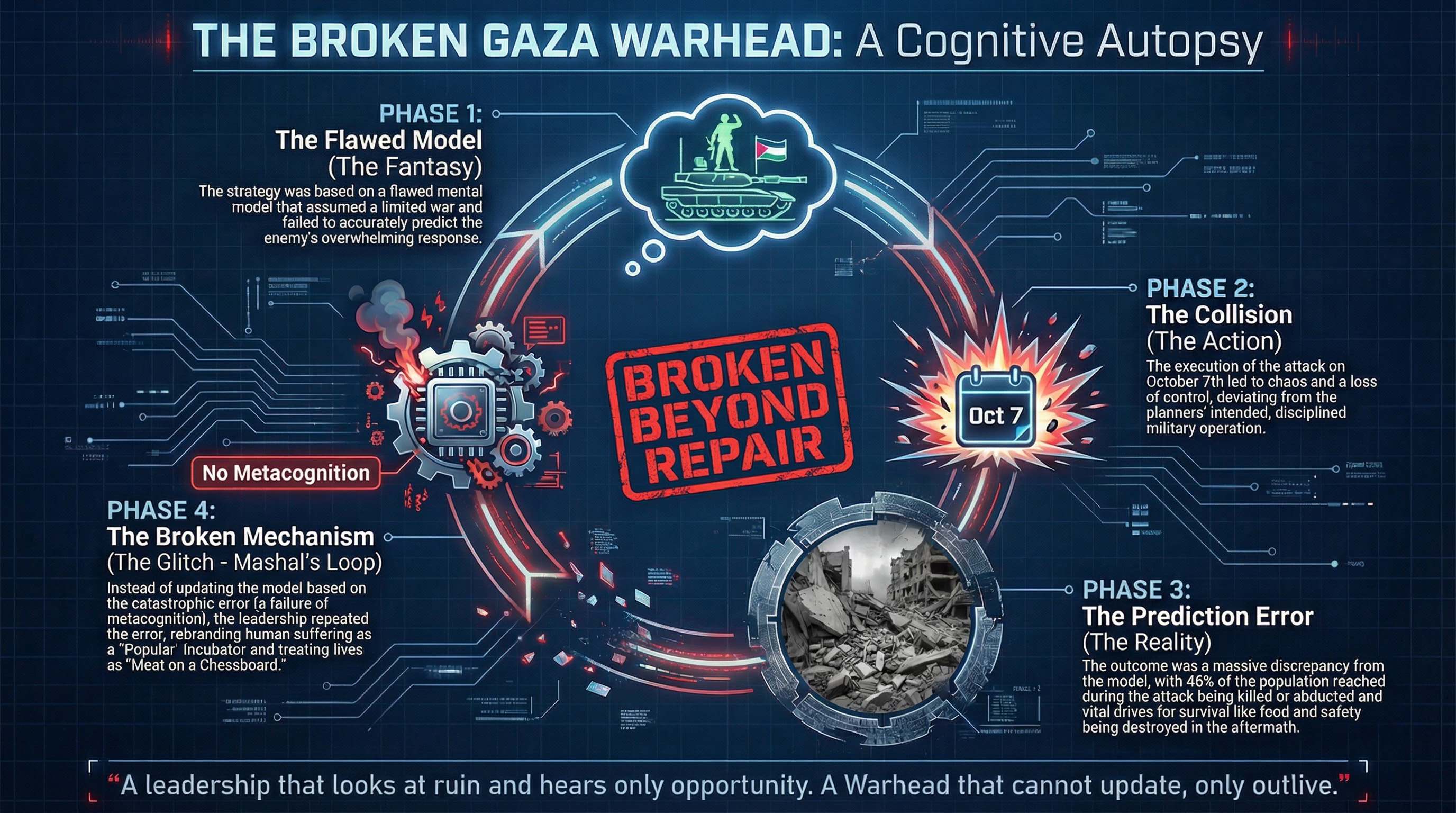
The Broken Gaza Warhead Beyond Repair
A Wish and a Prophecy
“A total war has become inevitable. We all consider it necessary. We want it. At the resistance axis, the Palestinian people, and our nation, we want this total war. … We will certainly defeat them. … [W]e are convinced that if a total conflict begins, the airspace and seaports of this entity [Israel] will be shut down, and they will not be able to live without electricity, water, and communications. In an open war, they will have a curfew and their economy will come to a standstill.”
— Saleh Arouri, 25 August 2023, a principle architect of the October 7, 2023, pogrom
“And also to support them with jihad with everything we can. This is our duty: to mobilize, light and heavy, for jihad with everything one can—with financial effort, with words, with action, with weapons, and with everything we can—until we all achieve victory.”
— Khaled Mashal, 1 January 2026, a top Hamas political leader in exile
The Collision of Fantasy and Fact
On New Year’s Day—when even professional ideologues affect a moment of reckoning—Khaled Mashal offered something rarer than propaganda: an unguarded self-portrait. Not the portrait he intended, of course. He meant to bless, to rally, to canonise ruin as “steadfastness.” Instead, he gave you the cleanest possible proof that the Gaza Warhead has not merely failed; it has become incapable of learning from failure.
Because Mashal speaks the way the insulated always speak: from a safe distance, in a voice polished by habit, while other people supply the consequences. He can acknowledge killing, displacement, and starvation as though reading weather reports—and then pivot, without a flicker of moral friction, into the same old demand for escalation. The dead are not a warning; they are a rhetorical resource.
Even his vocabulary betrays the condition. Gaza becomes a “popular incubator”—not a society of human beings whose first claim on leadership is protection, but a warm biological chamber for producing sacrifice on demand. The population is not mourned; it is metabolised. In that single image is the whole strategic and moral collapse: a leadership that has trained itself to treat its own civilians as material.
And then comes the operational tell—the line that turns the entire year of devastation into an argument for more of the same: the summons to jihad “with weapons,” “with everything we can.” If this is what a movement sounds like after seeing Gaza reduced to rubble, then the problem is not a miscalculation. It is a broken instrument: a Warhead that cannot update, cannot self-correct, and therefore cannot be repaired—only outlived. The New Year speech is the evidence. The rest of this essay is simply the diagnosis.
It is time for Hamas to publish yet another document, far removed from the reality of the destruction and calamity they have inflicted upon a people they claim to love and want to protect. In their latest report—pompously titled Our Narrative… Al-Aqsa Flood: Two Years of Steadfastness and the Will for Liberation—October 7 is chemically scrubbed into a “glorious crossing,” civilian blood is dismissed with sanctimonious denials, and then, with the moral composure of arsonists authoring fire-safety pamphlets, the authors coolly inventory the consequences: mass death, engineered starvation, shattered schools and hospitals, obliterated housing, and a society reduced to statistics and rubble—only to rebrand it all as a catalogue of “achievements” and a victory in “global awareness.” One is invited to admire this as statesmanship rather than self-exculpation, to accept that the appropriate response to a devastated homeland is neither accountability nor protection, but yet more epic verse about “steadfastness”—because when a movement’s politics consist of wagering other people’s lives. In such conditions, propaganda becomes the only currency it can still print, and every catastrophe must be renamed a triumph lest the simplest and most terrible truth intrude: that no movement which genuinely loved its people would so readily spend them.
A Tale of Two Images
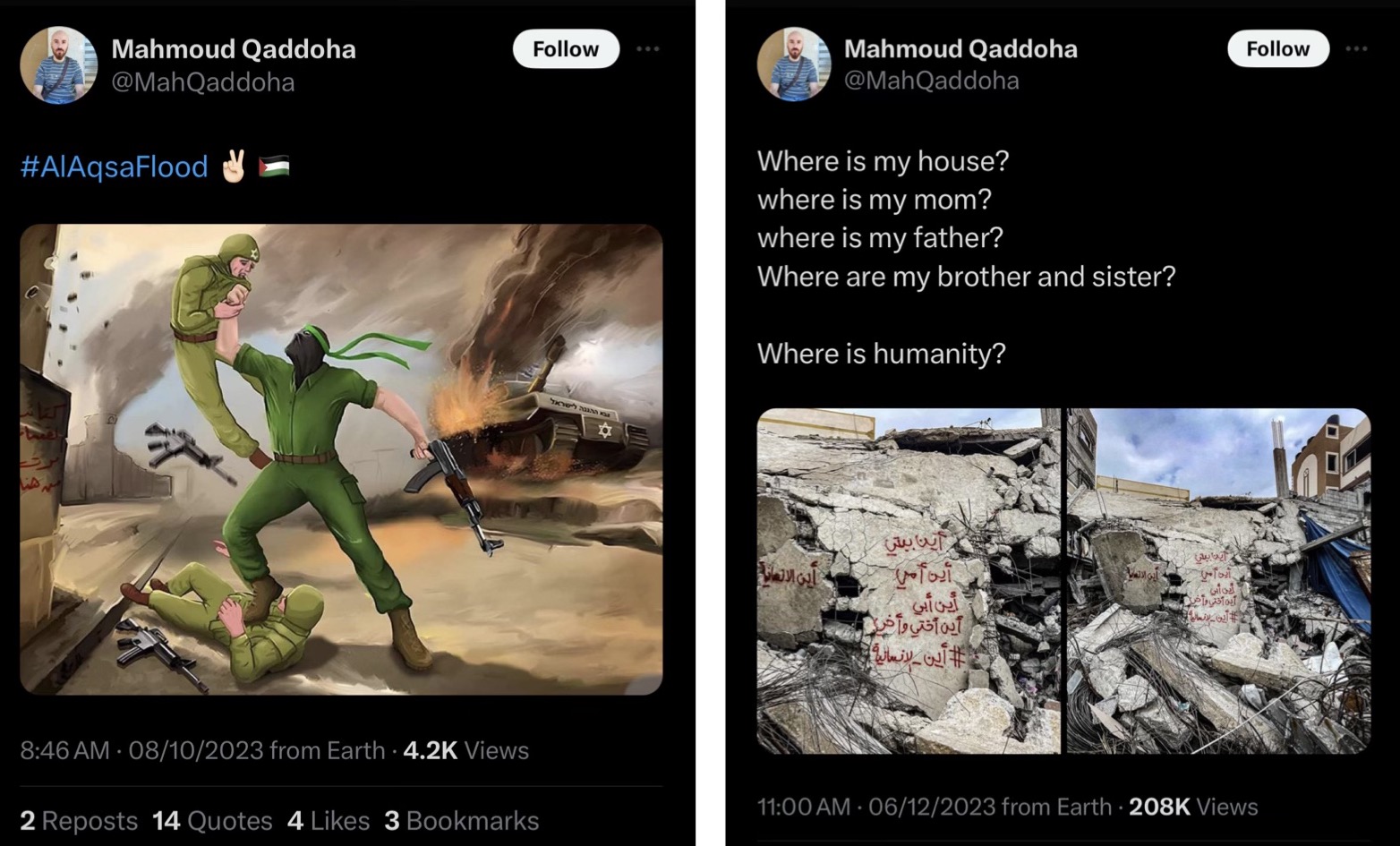
On 8 October 2023, Mahmoud Qaddoha posted a stylised, heroic image on social media. It depicted a towering Palestinian fighter, clad in green, vanquishing Israeli soldiers amidst the wreckage of a tank. Above the scene of triumphant violence was the banner: #AlAqsaFlood. The image was a potent distillation of an expected outcome—a glorious, decisive, and celebrated act of resistance. It was the visual representation of a specific theory of victory.
Less than two months later, on 6 December 2023, Qaddoha posted again. This time, there was no heroic artwork. The image was a photograph of utter devastation: a mountain of rubble and twisted rebar where a building once stood. The accompanying text was not a triumphant slogan but a desperate lament: “Where is my house? where is my mom? where is my father? Where are my brother and sister? Where is humanity?”
The stark contrast between these two posts captures a profound case of collective cognitive dissonance. It is the chasm between a glorious expectation and a brutal, ruinous reality. The 7 October attack, and the broader project it represents, can be understood as a catastrophic failure of its guiding Warhead—a term borrowed from Nicholas Wright’s neuroscientific analysis of the brain and conflict. A Warhead is the internal mental Model of the world that guides all action. The Palestinian Warhead Model, which predicted the heroic outcome of the first image, was fundamentally flawed. Its collision with reality produced a massive and devastating “prediction error”—the apocalyptic aftermath of the second image.
This essay will perform a clinical autopsy on this strategic failure. It will first deconstruct the Palestinian leadership’s guiding Model, then contrast it with the violent reality of the attack and its consequences, and finally use the cognitive framework of the Warhead to diagnose precisely why the entire project failed so catastrophically. What follows is not polemic but pathology: a clinical autopsy of a Model that converts human life into expendable proof of loyalty.
The Strategic Model
Before any strategic action is taken, a guiding mental model exists. This internal framework is composed of objectives, critical assumptions, and a theory of victory that connects actions to desired ends. To understand the failure of October 7th, we must first reverse-engineer the Palestinian leadership’s Warhead by examining their stated goals and, more importantly, the unstated and deeply flawed assumptions that underpinned their plan.
The Stated Objectives of “al-aqsa flood”
In a document titled “Our Narrative… Operation Al-Aqsa Flood,” Hamas’s media office laid out its official justifications for the attack. Synthesised from this text, the core objectives were:
- A claimed defensive act: The operation was framed as a “necessary step and a normal response” to decades of occupation, the crippling 17-year blockade of Gaza, and the “disastrous results of the so-called peace process.”
- Protecting sanctities: A primary goal was to confront “Israeli Judaisation plans to the blessed Al-Aqsa Mosque,” including incursions by settlers and attempts at temporal and spatial division of the holy site.
- Liberating prisoners: A key military objective was to “arrest the enemy’s soldiers to pressure the Israeli authorities to release the thousands of Palestinians held in Israeli jails through a prisoners exchange deal.”
- Military aims: The document states that the operation’s focus was on “destroying the Israeli army’s Gaza Division” and other military sites near the settlements around Gaza.
The Unstated Assumptions of Victory
Beneath these stated goals lay a set of critical assumptions that formed the true foundation of the Palestinian Model. The analysis of Ahmed Abu Sohayb in his work Al-Aqsa Flood: Contexts and Outcomes reveals these assumptions to be fatally flawed.
- The miscalculation of time: Abu Sohayb argues that the leadership believed delaying a major confrontation was a strategic error. The technological and power gap with Israel was widening, and there was a fear that new capabilities like the Iron Dome and emerging laser systems would soon render their rocket arsenal obsolete. The Model dictated that acting now was imperative before the window of opportunity closed for good.
- The Failure of Response: This was the “fundamental flaw” in the entire project. Abu Sohayb explains that the leadership’s Model anticipated a limited, contained war, something akin to the 2014 conflict. It did not predict an overwhelming response executed with extensive international political cover. The nature of Israel’s reaction, which Abu Sohayb describes as an overwhelming and unprecedented use of force, was completely outside their predictive Model—a catastrophic failure of what cognitive science calls “mentalising,” the ability to model an opponent’s intentions and likely reactions.
- The Blind spot of Control: The official Hamas narrative speaks of a disciplined military operation. Yet, both Hamas’s own document and Abu Sohayb’s analysis admit that the “rapid collapse of the Israeli security and military system” led to “chaos.” This represents a second, distinct failure in the planners’ Model: it did not account for its own spectacular success. This failure generated a “prediction error” on the day of the attack, and the resulting loss of control directly produced the population-level violence that, in turn, created the much larger strategic prediction error for Israel.
This theoretical Model, built on a foundation of errors, was about to collide with a brutal and unforgiving reality.
Population-Scale Destruction
To grasp the strategic consequences of October 7th, one must understand the true nature of the pogrom. On the ground, this was not a contained military engagement but a geographically-limited, yet intensely destructive, assault on the population the attackers could physically reach. The reality of this violence created a “prediction error” of immense proportions for Israel, which in turn shaped its devastating response. The scale of the attack must be measured not against the entire population of Israel, but against the denominator of those who were actually exposed to it.
Measuring Impact by Proximity
When measured against the approximately 15,000 people physically reached by pogrom-ready-attackers in overrun communities, at the Nova Music Festival, and on military bases, the impact was staggering. When disaggregated, the figures show:
Total Affected: Approx. 46% were killed, kidnapped, or injured.
Killed or Abducted: Nearly 1 in 10 were removed through murder or abduction.
Killed: Roughly 1 in 12 were killed.
Annihilation in the Communities
The phrase “population-level annihilation wherever access existed” is borne out by the statistics from specific communities. In Nir Oz, a community of roughly 400 residents, 46 people were murdered and at least 71 were kidnapped, meaning approximately 29% of the entire community was killed or taken hostage in a single morning. In Be’eri, with a pre-October 7 population of approximately 1,000 residents, about 132 civilians were murdered and around 32 were kidnapped, meaning roughly 16% of the community was killed or abducted. In Kfar Aza, a community of about 950 residents, more than 60 civilians were murdered and at least 19 were abducted, meaning over 8% of the population was killed or taken hostage. This was not collateral damage; it was a systematic assault constrained only by geography and time.
Refuting the Official Narrative
This documented reality stands in stark contrast to the official Hamas claim that “the Palestinian fighters only targeted the occupation soldiers and those who carried weapons.” Hamas’s narrative includes a crucial caveat: “if there was any case of targeting civilians; it happened accidentally and in the course of the confrontation with the occupation forces.” However, the sheer scale of civilian casualties, as documented in the source data, fundamentally challenges this narrative of accidental harm and suggests the “chaos” that ensued from the collapse of Israeli defences produced an outcome far more horrific than the planners’ Model intended or their public statements will admit.
This brutal reality ensured that the consequences to follow would be equally catastrophic, shattering the attackers’ strategic assumptions.
A Catastrophic Response
The most significant outcome of the 7 October attack was the “prediction error” it generated—not for the attackers, but for Israel and the world international system. The chasm between what Israel’s own Models predicted and what actually occurred was so vast that it unlocked a response of unprecedented determination and re-orientation. The consequences of this response demonstrate a horrifying mismatch with the Palestinian leadership’s mentalised Model, which had banked on a limited, manageable conflict.
Activating Israel’s Strategic Plan
According to Abu Sohayb’s analysis, the attack did not provoke a new Israeli strategy but rather triggered a pre-existing one. Israel, he argues, has long operated under a grand strategic plan of “zeroing out the dangers,” aimed at sequentially neutralising threats from Gaza, then Lebanon, and ultimately Iran. The sheer shock and brutality of October 7th gave Israel the political and international license to execute the Gaza phase of this plan with a force and scope that was previously unimaginable. The attackers did not create a new Israeli objective; they handed their adversary the justification to achieve an old one.
The Unforeseen Aftermath
The strategic outcomes of the ensuing war, as assessed by Abu Sohayb, reveal a landscape of Pyrrhic survival and strategic failure.
- 4: While Israel has achieved immense tactical success in devastating Gaza’s infrastructure and population, it has so far failed in its primary strategic objective of eliminating the resistance as a viable threat. The enemy remains undefeated, even if its capacity is severely degraded.
- The Resistance’s Pyrrhic Survival: For the Palestinian side, Abu Sohayb reframes the central question. It is not “did we win?” but rather, “have we been defeated?” By this metric, the resistance has survived. But it has done so at an unimaginable cost to the people and the place it purports to govern, a cost perfectly and tragically encapsulated by Mahmoud Qaddoha’s lament for his home and his family.
The Price of Miscalculation
Abu Sohayb offers a final, sobering reflection on the “correct question” Palestinians should have been asking all along: it is not whether they desire liberation, but whether they are willing and able to pay the price for it. The events following October 7th have provided a brutal and definitive answer regarding the true cost of acting on a flawed strategic Model.
The scale of this miscalculation can only be fully understood by dissecting the cognitive architecture that produced it.
The charge against Hamas is moral, but the failure it reveals is structural. All strategic action begins with an internal Model of reality, and in this case that Model placed the survival of the movement above the survival of the people it claimed to represent. Within this framework, the destruction of Gaza could be absorbed—even rationalised—so long as the organisation itself endured and could declare persistence as victory. Responsibility was displaced, suffering was reclassified as steadfastness, and resistance was redefined from the protection of human life to the mere continuation of the cause. Such outcomes were not aberrations but logical products of a Model fundamentally detached from the world it sought to change.
To understand this failure, therefore, it is not enough to condemn intentions or enumerate consequences; it is necessary to examine the Warhead itself—the flawed cognitive architecture that made catastrophe appear, to its architects, as strategy.
A Warhead Autopsy of Strategic Failure
To truly understand why the “al-aqsa flood” operation failed so catastrophically, it is necessary to go beyond conventional political or military analysis. We must unmask the cognitive failures at the heart of the Palestinian strategy. By applying the neuroscientific framework from Nicholas Wright’s Warhead, we can perform an autopsy on the mental machinery that drove this disaster.
Principle 1
A Flawed Foundational Model. All human action stems from an internal Model of reality. The Palestinian Warhead was built on a Model that was fundamentally detached from the world it sought to change. It failed the critical test of “mentalising”—accurately modelling the purported enemy’s intentions, will, and capabilities. By grossly underestimating Israel’s capacity and political license for a devastating response, the Palestinian Warhead built its entire strategy on a fantasy.
Principle 2
The Ultimate Prediction Error. Progress, learning, and adaptation are driven by “prediction error”—the signal of surprise generated when reality violates our Model. The entire war, from the collapse of Gaza to the ruin of its population, can be framed as a prediction error of unparalleled historic proportions. The heroic narrative envisioned in the Palestinian Warhead’s Model collapsed upon first contact with the reality of Israel’s reaction, leaving only the devastation signalled by Qaddoha, and documented by later reports. The surprise was not a learning opportunity; it was a systemic failure.
Principle 3.
Ignoring the Full Stack of Human Needs. The Palestinian Warhead framework emphasises the non-negotiable power of “our vital drives” (governed by the hypothalamus)—the need for food, water, warmth, and sleep. The Palestinian strategy demonstrated a catastrophic disregard for these survival-grade needs of the Gazan population it claimed to represent, protect and love. The Warhead’s Model failed to account for the physical reality that willpower and ideological commitment are no match for overwhelming military force and the systematic deprivation of the absolute necessities for life.
Principle 4.
A Failure of Wisdom (Metacognition). Wright distinguishes between being Clever (a function of the prefrontal cortex) and being Wise (a function of the frontal pole). The tactical planning and execution of the October 7th pogrom were undeniably “clever.” However, the overall strategy represented a total failure of Wisdom and metacognition—the ability to “think about our thinking.” The Palestinian Warhead was unable to step back, critically assess the quality and coherence of their own Model, question their core assumptions, and anticipate the obvious second and third-order consequences of their actions.
As if compelled to provide a living confirmation of the thesis that the Gaza Warhead has failed, Khaled Mashal’s “One Year of the Flood” address serves not as a rebuttal, but as a clinical exhibit of the very pathology described here. Far from demonstrating the metacognition required to learn from the catastrophic “prediction error” of the last two years, Mashal’s cognitive architecture remains trapped in a closed loop, repeating the identical, anti-rational memeplex that precipitated the October 7th pogrom. His rhetoric reveals a mind incapable of Level 3 counterfactual reasoning; he lacks the capacity to ask, “What would have happened had we not launched the attack?,” and instead blindly associates the resulting devastation with “victory” while demanding intensified jihād. This is the output of a malfunctioning machine: a mind trapped in the Left Hemisphere, constructing a worldview from rigid, abstract categories such as “the ummah” and “the enemy,” completely detached from the biological reality of the suffering they has unleashed.
Mashal’s New Year address is the Warhead speaking in its own voice: not chastened by a “prediction error,” but fortified by it; not corrected by catastrophe, but fed by catastrophe. If you want the shortest definition of “broken beyond repair,” it is a leadership that can look at ruin and hear only opportunity.
The moral vacancy of this broken Warhead is most chillingly evident in Mashal’s dehumanisation of the very population he claims to lead. To him, the civilians of Gaza—currently enduring what the Warhead autopsy identified as a violation of their “vital drives” for food and safety—are not human beings deserving of sorrow, but are chemically scrubbed into a “popular incubator,” mere biological resources to be consumed to maintain his ideological structure. He shows no remorse for the lives lost in their game; rather, from the safety of his exile, he treats the ruins of Gaza as a kindergarten for his failed finite game, urging those surviving in the rubble to offer further costly signalling through blood and sacrifice to prove their loyalty to their delusions. By framing the total destruction of his society as a “badge of honour,” Mashal confirms that their Warhead view their own people not as lives to be protected, but as pieces of meat on a chessboard, expendable assets in a game played for the theatrical acquisition of power and money rather than the preservation of human life.
This cascading series of cognitive failures—a broken Model, an overwhelming prediction error, a disregard for physical reality, and a profound lack of wisdom—guaranteed a disastrous outcome.
Lessons from a Broken Palestinian Warhead
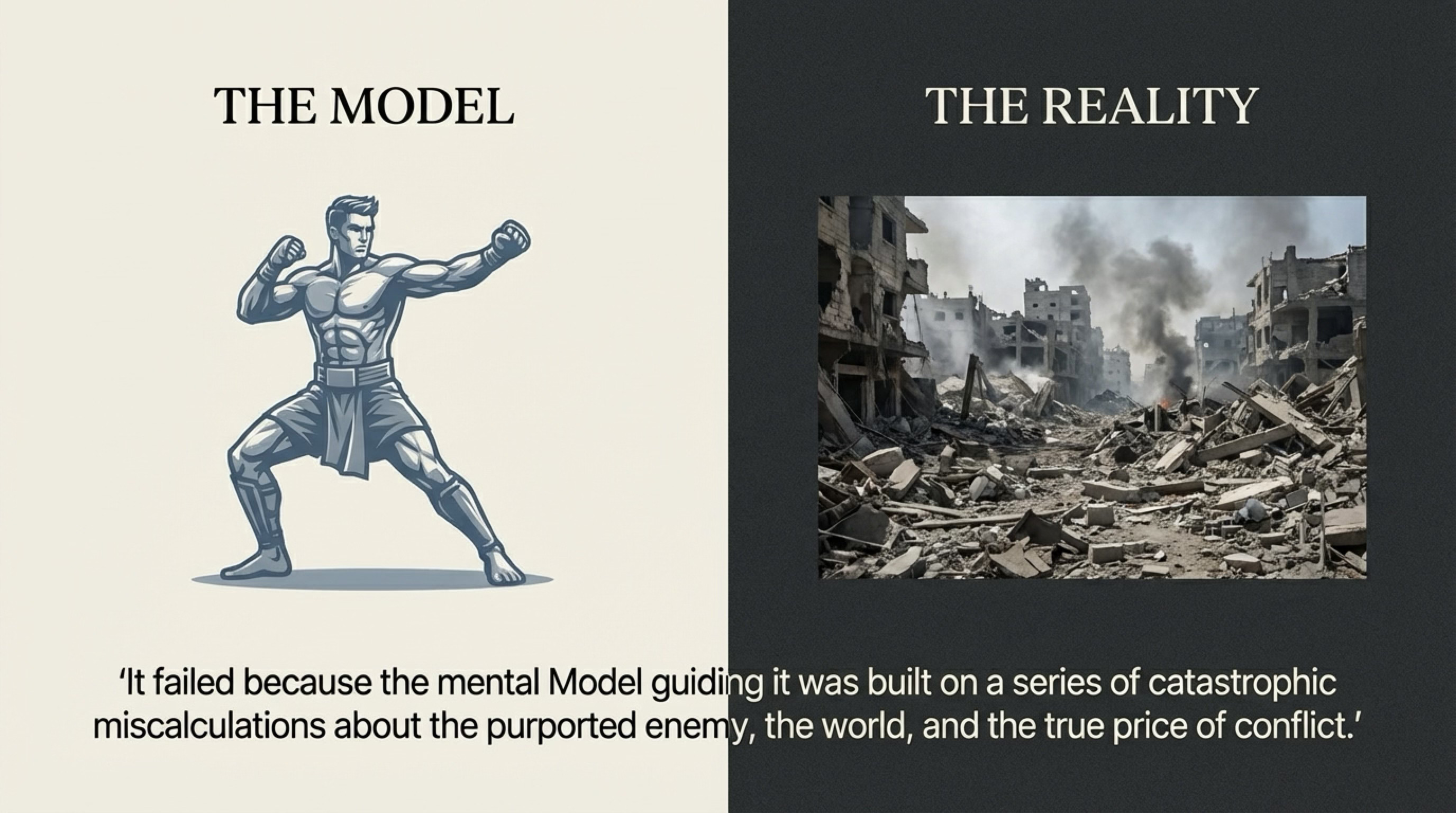
The Gaza Warhead failed. It did not fail for a lack of tactical destructive ingenuity, ideological fervour, or a willingness to sacrifice civilians. It failed because the mental Model guiding it was built on a series of catastrophic miscalculations about the purported enemy, the world, and the true price of conflict. The “heroic image” of October 8th was an illusion; the ruin of December 6th was the reality it produced.
In the final analysis, Abu Sohayb’s argument that survival itself is a form of victory holds a grim truth. The “resistance” was not annihilated. But we must ask: survival at what cost? The legacy of this failed Warhead is a landscape of ruin, a strategic setback of generational proportions, and a depth of human trauma that is difficult to comprehend and for which the Palestinian Warhead is neither prepared to take responsibility and learn from.
For the rest of us, the greatest lesson from this tragedy is a timeless one, grounded in the cognitive framework of the Warhead. In strategy, as in all human endeavours, cleverness is not enough. The ultimate premium is on wisdom, metacognition, and self-knowledge. The failure to rigorously, ruthlessly examine one’s own assumptions and Models—to think about our thinking—does not lead to “glorious” victory. It leads to a devastating and self-inflicted “prediction error” from which there may be no recovery.
Sources:
Dean Shmuel Elmas, 20260101, posting Khaled Mashal’s speech on X.
Globaldisconnect, 20251222, “On October 7, Approximately 46% of those reached were killed, kidnapped, or injured.”

Hamas Media Office, 20251225, Our Narrative… Al-Aqsa Flood: Two Years of Steadfastness and the Will for Liberation. https://palinfo.com/wp-content/uploads/2025/12/OurNarrative.pdf?utm_source=chatgpt.com
Memri, 20230825, “Senior Hamas Official Saleh Al-Arouri: We Want War With Israel, Will Shut Down Israel’s Airspace, Seaports, Electricity, Water Supply, And Communications, Bringing Its Economy To A Standstill.” https://www.memri.org/tv/hamas-deputy-chairman-arouri-we-want-total-war-with-israel-shut-down-everything
أحمد أبو صهيب، 2025، طوفان الأقصى: سياقات ومآلات. غزة
Nicholas D. Wright, 2025, Warhead: How the Brain Shapes War and War Shapes the Brain. New York: St. Martin’s Press.


