From Text to Territory: The 2025 US National Security Strategy
14 January 2026
From Theory to Action
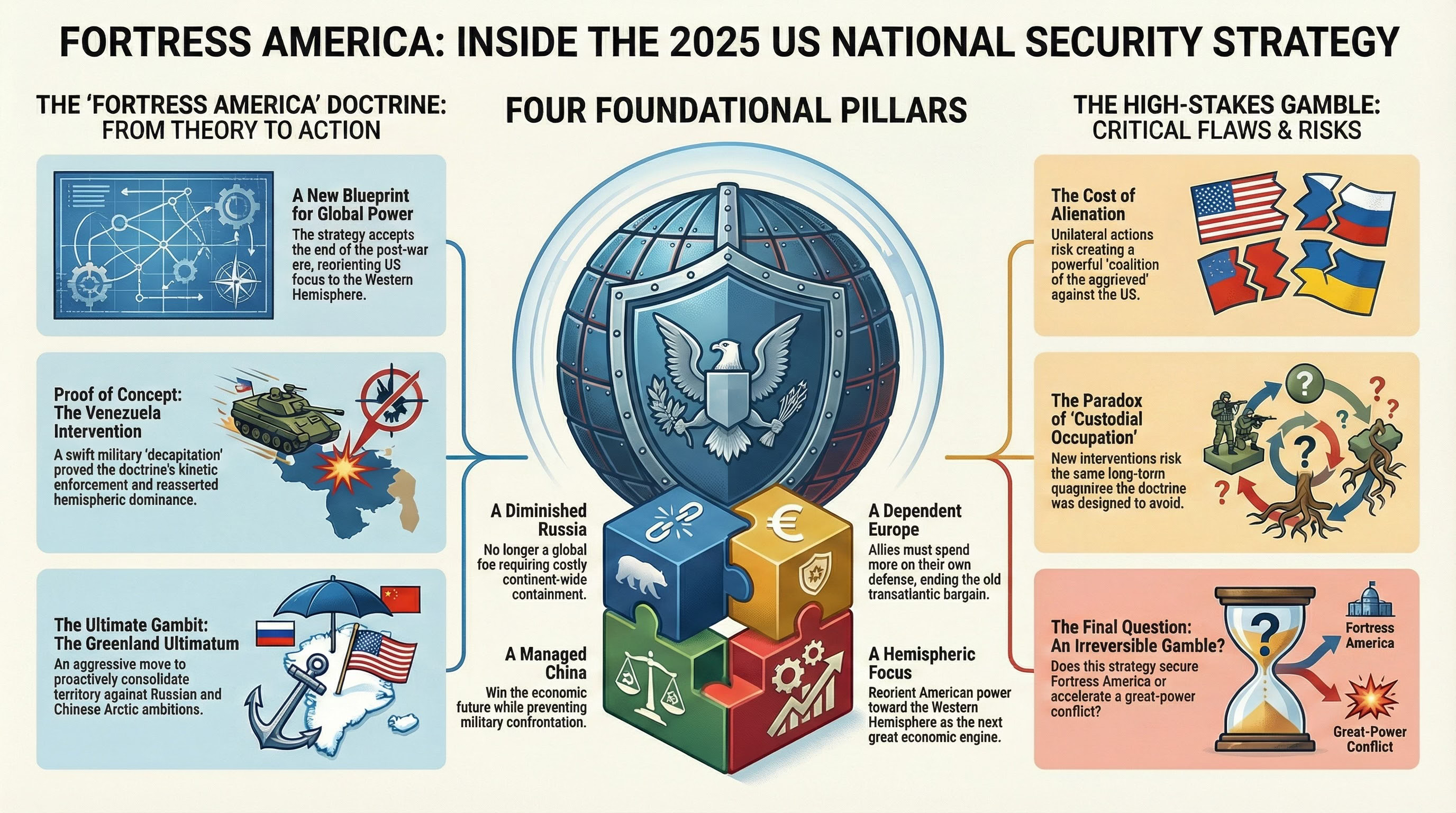
In this analysis, I will synthesise a series of my recent works that have tracked the evolution of the 2025 US National Security Strategy (NSS) from a foundational document into a guiding principle for overt action. My central thesis is that this strategy represents nothing less than an irreversible shift in American foreign policy—a deliberate, unapologetic return to the stark realities of 19th-century power politics and a formal dismantling of the post-war consensus.
I will trace a compelling narrative arc that follows the NSS’s progression through five distinct phases: its initial codification as a new geopolitical reality; its public validation through diplomatic rhetoric; its forceful application in the military intervention in Venezuela; its subsequent consolidation through overwhelming economic leverage; and its ultimate escalation in the territorial ultimatum delivered to Denmark over Greenland.
While I have chronicled the doctrine’s implementation with analytical rigour, my purpose here is also to act as a “devil’s advocate.” Having laid out the evidence for my thesis, I will then stress-test my own argument. This analysis will therefore not only synthesise my previous articles but will also probe the unexamined costs, potential points of failure, and inherent fragilities in a strategy of such unapologetic unilateralism. To critique this new doctrine, however, we must first understand the foundational principles upon which it is built.
The Blueprint
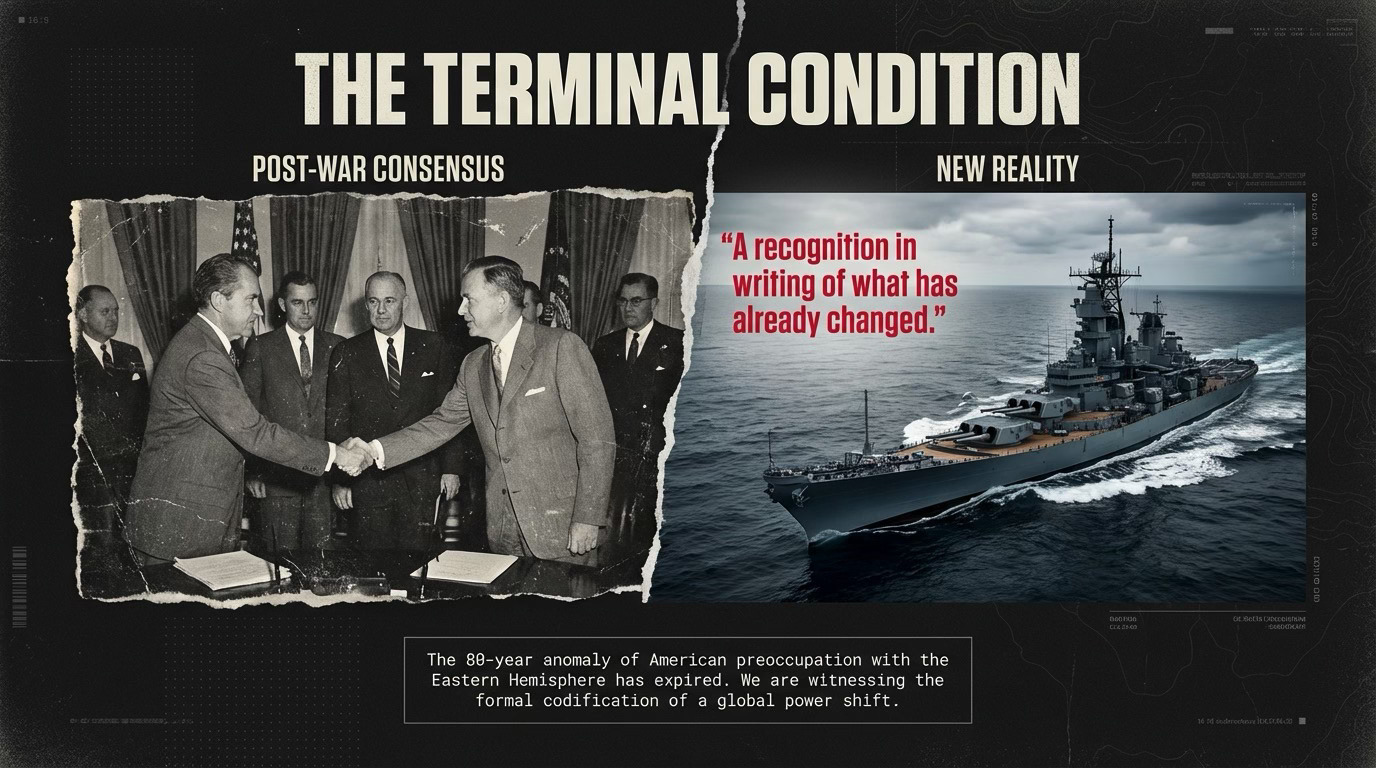
Before the 2025 National Security Strategy became a plan of action, it was an explicit, almost brutal, acknowledgement of a changed world. In a previous analysis, I argued that its strategic importance lies not in what it creates, but in what it accepts as a terminal condition: the end of the 80-year post-war anomaly of American preoccupation with the Eastern Hemisphere. The NSS is not an invention of new policy but a “recognition in writing of what has already changed,” a formal codification of a global power shift that has been decades in the making. The document is built upon four foundational pillars, each a model of unsentimental logic.
- A Diminished Russia: The conflict in Ukraine revealed Russia to be a regional power that no longer requires a “European continent-wide American guarantee.” Washington’s new posture is one of strategic stability with Moscow, not the costly containment of a global ideological foe.
- A Dependent Europe: The old transatlantic bargain is formally over. The NSS, through the institutionalized “Hage Commitment,” demands that prosperous allies “spend far more of their national Gross Domestic Product (GDP) on their own defence.” This forces Europe into an existential choice: unite to become a major power in its own right or remain a fragmented continent—a “victim” to be manipulated by other powers.
- A Managed China: The strategy adopts a pragmatic, dual-track approach to China, encapsulated by the phrase “Win the Economic Future, Prevent Military Confrontation.” I assess this as a rational framework built on the fundamental leverage that China’s economic challenges can only be solved “with the United States.”
- A Hemispheric Focus: The concepts of “Fortress America” and the “Trump Corollary to the Monroe Doctrine” formally reorient American power towards the Western Hemisphere, which Washington now seeks to cultivate as the world’s next great economic engine.
This doctrinal shift was first validated when Secretary of State Marco Rubio called for a “complete recalibration” of foreign policy, anchoring all future actions to the hard, unsentimental metric of the “national interest.” With this, the new strategic blueprint was established, and it would soon find its first major kinetic application.
The Proof
The military intervention in Venezuela marked the pivotal moment when the 2025 NSS transitioned from abstract text into undeniable, physical reality. It was the doctrine’s “kinetic proof” demonstrating that Washington was prepared to enforce its new worldview with overwhelming and decisive force. In my view, the operation was a masterclass in the ancient wisdom of Sun Tzu, who taught that the highest form of victory is to foil an enemy’s plots without resorting to a costly siege. The swift seizure of the regime’s leadership was a modern “decapitation,” deliberately contrasted with the ruinous, decades-long nation-building projects of the past.
The intervention served two primary doctrinal purposes I have identified:
- The Fortress America Mandate: The operation was justified as a defensive necessity to stop Nicolás Maduro’s “campaign of deadly naroterrorism” and eliminate a regime that had invited “Hizbollah and Iran to operate from their territory,” thus removing a proximate threat to the U.S. homeland.
- The Trump Corollary: The intervention was a muscular reassertion of hemispheric dominance, a principle underscored by President Trump’s declaration that “American dominance in the Western Hemisphere will never be questioned again.”
The subsequent White House summit with American oil executives represented the immediate monetisation of this kinetic victory, establishing a template for economic suzerainty. The administration’s public justifications were a study in this new realism. It framed the intervention as a corrective action—“taking back what was taken from us”—while simultaneously informing energy firms, “You’re dealing with us directly. You’re not dealing with Venezuela at all.” By promising “total safely, total security,” the U.S. removed all commercial risk, establishing itself as the sole arbiter of Venezuela’s assets. This move was not just about gain, but also about strategic denial, explicitly designed to prevent wealth that would “benefit adversaries such as Iran.”
This fusion of overwhelming force and immediate economic consolidation was not merely an outcome; it was a deliberate and broadcasted demonstration. It was the essential prerequisite for the doctrine’s next phase, transforming the subsequent ultimatum over Greenland from a hypothetical threat into a credible statement of intent.
The Gambit
The ultimatum delivered to Denmark over Greenland represents the doctrine’s logical culmination. This move progresses beyond removing existing threats to the proactive, territorial consolidation of America’s sphere of influence. The strategic imperative is clear: Greenland is a “strategic lynchpin” against Russian and Chinese encroachment in the Arctic, a vast repository of rare earth minerals, and the site of the critical “Púfįk Space Base.”
My assessment of this strategic focus was transformed from speculative to existential by recent intelligence from the Danish Defence Intelligence Service (DDIS). The DDIS Intelligence Outlook 2025 confirms that:
- China is actively seeking to deploy ballistic missile submarines beneath the Arctic ice to achieve a “nuclear second-strike capability” comparable to that of the United States and Russia.
- Russia is utilising civilian vessels to map the GIUK Gap—the maritime gateway between Greenland, Iceland, and the UK—in preparation for sabotaging transatlantic supply lines in a future conflict.
This intelligence recasts Greenland in Washington’s eyes, not merely as a mineral repository, but as the only shield against a developing nuclear siege on its northern border. The ultimatum itself—“the easy way, or … the hard way”—has been established as a repeatable doctrinal tool, with President Trump having used identical language regarding Hamas. As analyst Pippa Malmgren notes, this tactic is a “grenade... designed to get everybody off balance,” seizing control of the diplomatic landscape through chaos. This gambit forces a confrontation over the very meaning of sovereignty itself.
Competing Views on Sovereignty
Denmark’s Position: Grounded in the 1916 legal agreement, a frank reliance on allies for defense, and Greenland’s constitutional path towards eventual secession.
The U.S. Rebuttal: A brutalist redefinition of sovereignty, stripped of legalistic and historical foundations. It reduces sovereignty to a raw calculation of deliverable military power and the ability “to provide for your own security,” while dismissing historical claims with contempt: “That fact that they had a boat land there 500 years ago, doesn’t mean that they own the land”.
Crucially, as I have argued, this American logic is inadvertently validated by Copenhagen’s own spies. The DDIS report admits that the Kingdom is already being penetrated by a Russian “hybrid war,” proving it cannot secure its own cognitive and political territory. The “Hard Way” is therefore not framed as a conquest, but as a necessary remediation of a security vacuum that Denmark has admitted it cannot fill.
This aggressive posture is creating significant international friction, exemplified by China’s condemnation of the Venezuela intervention as a “hegemonic act.” Having documented the doctrine’s power, we must now turn to a critical examination of its potential flaws.
Devil’s Advocate
I have compellingly documented the implementation of this new American strategy. A mentor’s role, however, is to stress-test an argument—to probe for the unexamined costs, blind spots, and inherent risks of the doctrine. While the strategy has proven ruthlessly effective in its initial stages, its long-term viability is far from certain. Three critical flaws demand examination.
The Uncalculated Cost of Alienation
My narrative has focused on the successful application of American power, but it has not fully weighed the strategic fallout. A foreign policy that treats a NATO ally like Denmark with a coercive ultimatum and provokes a peer competitor like China into condemning “hegemonic acts” is systematically alienating both partners and rivals. It risks creating a powerful “coalition of the aggrieved,” where shared resentment of American unilateralism becomes the primary organising principle. Fortress America may find itself a very isolated fortress indeed.
The Paradox of “Custodial Occupation”
The administration’s distinction between “custodial occupation” and “nation-building” is, I contend, a semantic illusion. The former is merely the latter stripped of its ideological pretences—a more extractive form of long-term entanglement that risks the same quagmires for purely commercial ends. President Trump’s declaration on Venezuela—“we’re there now, but we’re going to stay”—reveals this core paradox. By taking ownership of another nation’s stability for resource extraction, the United States may find itself mired in the very kind of conflict this doctrine was designed to avoid.
The Echo Chamber of Analysis?
My own reliance on the frameworks of strategists like George Friedman and Sun Tzu, while providing a coherent narrative, risks creating a self-reinforcing analytical echo chamber. By fitting every event into this pre-determined structure, one can inadvertently ignore contradictory evidence. It is entirely possible that we are not witnessing a masterclass in ancient strategy, but a series of opportunistic power grabs being retrospectively fitted to a grand theory.
However, the DDIS Intelligence Outlook 2025 complicates this critique. The fact that an allied intelligence agency explicitly validates the American perception of a “two-front challenge” from Chinese nuclear ambition and Russian sabotage in the Arctic suggests the threat is grounded in empirical reality. The danger of the echo chamber, therefore, may lie not in the diagnosis of the problem, but in the monomaniacal nature of the solution.
An Enduring Doctrine or a Generational Gamble?
My core thesis remains undeniably strong: the 2025 National Security Strategy has been methodically and ruthlessly translated from text to territory with startling speed. From the codification of a new reality to the ultimatum over Greenland, the doctrine has been made manifest, representing a profound shift in American statecraft.
Yet, I must now reframe my own conclusion. This is not merely an “irreversible shift”; it is an irreversible gamble.
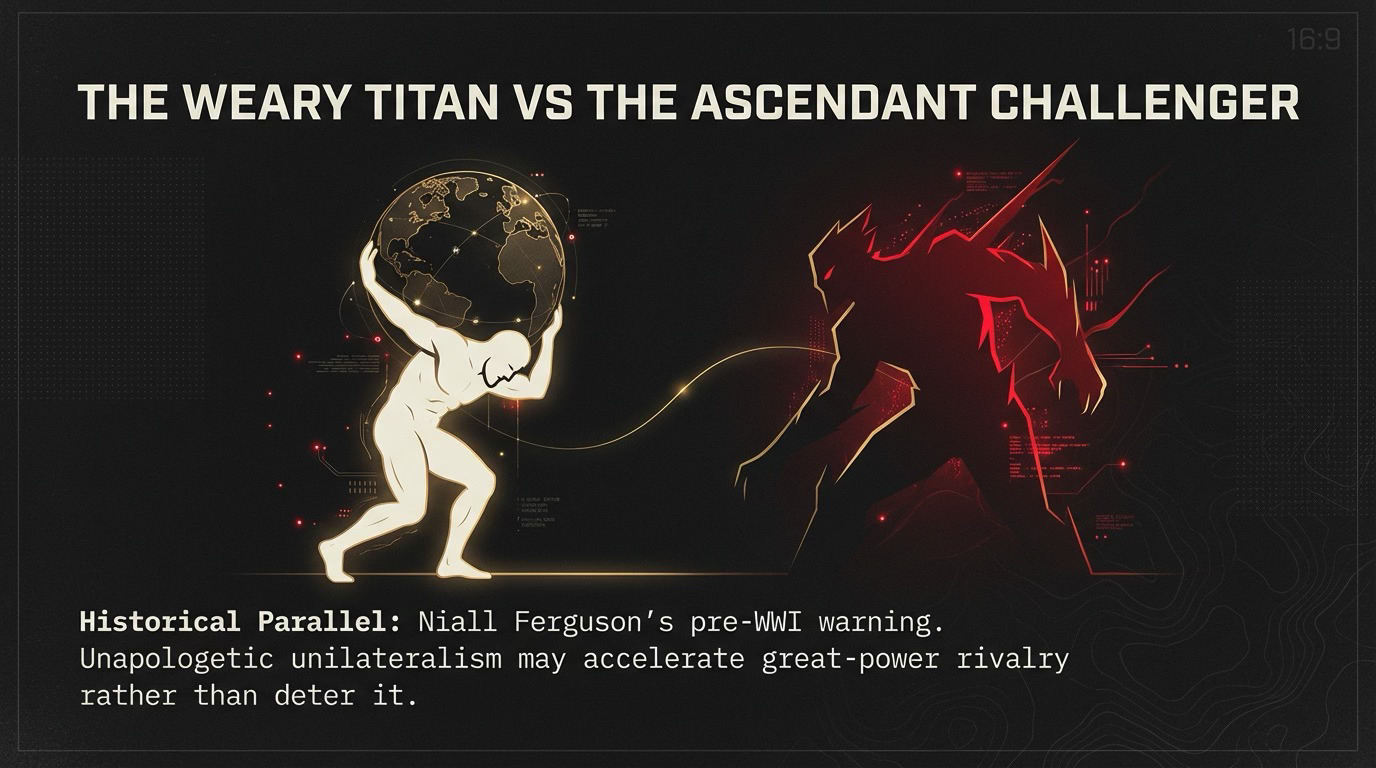
The risks are immense. They include the diplomatic blowback from alienated allies, the potential for new quagmires under the guise of “custodial occupation,” and the hardening of international resistance against perceived American hegemony. I am reminded of historian Niall Ferguson’s warning of a pre-WWI parallel, with the United States as the “weary Titan” and China as the “ascendant challenger.” The ultimate test of this new, unapologetic doctrine will be whether it truly secures Fortress America or whether, by its very nature, it accelerates great-power rivalry—making a future conflict a question of “when, not if.”
References:
Khaled Salih, 20260113, “An Unprecedented Confluence: Why the Islamic Republic’s Final Chapter May Have Begun.” https://khaledsalih.substack.com/p/an-unprecedented-confluence-why-the
—, 20260111, “The Easy Way or the Hard Way: Greenland and the Consolidation of Fortress America.” https://khaledsalih.substack.com/p/easy-way-or-the-hard-way-greenland
—, 20260110, “Fortress America, Art of War: Trump’s NSS and the Venezuela Oil Gambit.” https://khaledsalih.substack.com/p/fortress-america-art-of-war-trumps
—, 20260104, “Operation Venezuela: The Doctrine Removes Its Gloves. https://khaledsalih.substack.com/p/operation-venezuela-the-doctrine
—, 20251222, “Doctrine in Action: Validation of the 2025 National Security Strategy.” https://khaledsalih.substack.com/p/doctrine-in-action-validation-of


