From Kurdistan to Civilization
How an Interview with Ofra Bengio Took Kurdistanî Azad Beyond the Kurdish Question
5 August 2026
Every serious inquiry begins with a problem.
The fortunate inquiries end by revealing that the original problem was too small.
This essay began when I read an interview with my friend Ofra Bengio, the Israeli historian who has spent decades studying Iraq, Turkey, Kurdish history, and the geopolitical position of the Kurds. Bengio heads the Kurdish Studies Program at Tel Aviv University’s Moshe Dayan Center and has written extensively on Kurdish state-building, fragmented national identity, and the changing regional order.
Her interview offered a severe diagnosis. The Kurds, she argued, are not entering a new age of opportunity. They are experiencing regression across all four parts of Kurdistan. Turkey has sought to block Kurdish self-determination; the United States has facilitated regional arrangements that weaken Kurdish leverage; the new authorities in Syria and the regime in Iran have acted against Kurdish gains; the PKK has dissolved without first securing a clear political settlement; the institutions built in Rojava are being eroded; and the KDP and PUK remain unable to overcome their rivalry and form an effective government in the Kurdistan Region.
Her principal warning was directed inward as much as outward:
The Kurds’ greatest enemy is their own internal division.
Much of that analysis is compelling. Bengio understands the Kurdish geopolitical field exceptionally well: the surrounding states, the asymmetry of power, the limits of external alliances, the consequences of a century of territorial division, and the vulnerability of Kurdish achievements when regional conditions change.
Yet as I read her answers, I found myself asking a different question.
Not simply:
Is Ofra right?
But:
What problem does her explanation solve—and what problem remains unexplained?
That question became the beginning of another journey.
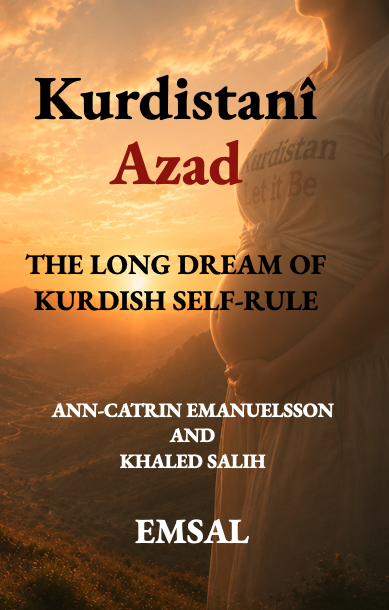
Kurdistanî Azad had started as a book about the Kurdish struggle for self-rule. But the book had already taught us that the familiar Kurdish question—How can the Kurds become free?—was incomplete.
The deeper question is:
How can any political community remain capable of discovering and correcting its own mistakes before catastrophe performs the correction for it?
That is no longer merely a Kurdish question.
It is a civilizational one.
What Bengio Explains
Bengio’s account belongs, broadly speaking, to the realist tradition.
It asks who possesses power.
Who is gaining ground?
Who is losing it?
Which state is setting the agenda?
Which Kurdish movement has weakened?
Which international actor can be trusted?
Which alliance is possible?
Which territorial achievement can still be preserved?
These are indispensable questions.
The Kurds do not live in a philosophical seminar. They live among powerful and aggressive states that have repeatedly denied, fragmented, assimilated, attacked, manipulated, or contained them. Kurdish political openings have often appeared when those states weakened and narrowed again when they recovered. Bengio’s own scholarship has long emphasized both the rivalry and the interdependence among the Kurdish movements in the four parts of Kurdistan.
Her warning about the Kurdistan Region is therefore serious. The KRG remains the most durable institutional achievement of modern Kurdish politics. Whatever its deficiencies, it possesses a parliament, presidency, government, universities, diplomatic relationships, security institutions, and a recognized constitutional position in Iraq. Its weakening would not be a routine political setback. It would represent a contraction of the largest sustained arena of Kurdish self-government.
Her diagnosis of fragmentation is also difficult to dismiss. A century inside four different states has produced different Kurdish political experiences, languages of resistance, organizational cultures, alliances, fears, and strategic expectations. The KDP, PUK, PKK, SDF, Kurdish National Council, Kurdish organizations from Rojhelat, and diaspora networks do not merely disagree over tactics. They emerged from different institutional worlds.
This is where Bengio’s historical realism remains valuable.
But description is not yet explanation.
To say that Kurdish division is dangerous is true.
To say it is the Kurds’ greatest enemy may also be true.
But why has it become so durable?
And what kind of political architecture could correct it?
From Moral Appeal to Institutional Explanation
“Kurds must unite” is one of the most repeated sentences in Kurdish political life.
It is also among the least explanatory.
It treats division as though it were principally a defect of character: leaders are selfish, parties are tribal, movements are ideological, personalities are jealous, and outside powers exploit the weakness.
All these things may occur.
But division is not simply a Kurdish psychological disorder.
It has a history.
Kurds lived under different imperial arrangements before they were enclosed within four different nation-states. Each state then built its own educational system, bureaucracy, military structure, legal vocabulary, economic incentives, security apparatus, national ideology, and definition of legitimate Kurdish behavior.
The border did not merely divide Kurdish territory.
It divided Kurdish political experience.
A Kurd in Turkey confronted a state project of Turkish national unity and a particular history of insurgency, repression, negotiation, and securitization.
A Kurd in Iraq encountered revolt, genocide, international protection, federalism, regional government, constitutional negotiation, and party administration.
A Kurd in Syria faced denial of citizenship, Ba‘thist centralism, civil war, ISIS, autonomous administration, American partnership, and Turkish intervention.
A Kurd in Iran inherited another cycle: central weakness, political opening, negotiation, recovery of state power, and repression.
Different institutions produce different political imaginations.
The Kurdish people did not simply become less Kurdish.
It became politically plural.
That plurality need not be eliminated. It must be made governable.
This distinction matters because moral appeals produce conferences, declarations, and temporary alignments. Institutional explanations point toward rules, shared bodies, dispute-resolution mechanisms, constitutional arrangements, independent media, negotiated spheres of authority, and procedures through which no single party can convert national unity into its own monopoly.
The central question is therefore not:
Why will Kurdish leaders not unite?
It is:
Which institutions would allow Kurdish movements to disagree without making disagreement collectively destructive?
That is the question realism alone does not fully answer.
The KRG Must Survive—but What Must Survive Within It?
Bengio urges Kurds everywhere to unite in defence of the Kurdistan Region because it is in grave danger.
We should take that warning seriously.
But “support the KRG” is not yet a complete political program.
- Which KRG are we being asked to preserve?
- The constitutional region belonging to its citizens?
- The divided territorial administrations of the KDP and PUK?
- The public institutions?
- The party security structures?
- The elected parliament?
- The informal leadership centers that operate above ministries and law?
- The patronage system?
- The achievement of self-rule?
The answer cannot be: all of it, without discrimination.
A society may be threatened from outside while still requiring correction from within.
Indeed, external danger often makes internal correction more urgent, because weak institutions provide enemies with the openings they need.
The survival of the Kurdistan Region must therefore mean more than keeping the existing political class in place. It must mean preserving and improving the Kurdish capacity for self-government.
That requires asking questions that expressions of national solidarity often suppress:
Can the government be formed and changed through institutions rather than superior party bargaining?
Can parliament exercise authority independently?
Can public finance be scrutinized?
Can journalists investigate those who govern?
Can the security forces become public institutions rather than extensions of party history?
Can political power be transferred peacefully?
Can leaders be criticized without criticism being reclassified as hostility to Kurdistan?
Can the KDP and PUK accept that the Region must become institutionally larger than both?
The KRG deserves preservation because it contains the possibility of Kurdish political responsibility.
But that possibility is not identical to every arrangement currently operating inside it.
Supporting Kurdistan must include supporting Kurdistan’s capacity to correct itself.
Otherwise, external threat becomes the permanent excuse through which internal weakness is protected.
From Power to Civilization
This is where Kurdistanî Azad moved beyond the question Bengio was answering.
Her interview is principally about survival.
The book increasingly became about civilization.
Survival asks:
Can the people endure?
Can the territory be defended?
Can the institution remain?
Can the enemy be deterred?
Can alliances be maintained?
Civilization asks another set of questions:
Can criticism reach the top?
Can failed explanations be abandoned?
Can institutions learn?
Can leaders be replaced?
Can yesterday’s liberation movement become tomorrow’s accountable government?
Can a people preserve its memory without making memory immune from examination?
Can it distinguish national loyalty from obedience to those who claim to embody the nation?
A political community may survive externally while becoming epistemologically closed internally.
It may retain its flag, army, territory, parties, and rhetoric while losing the ability to discover that its assumptions are failing.
That is why the deepest distinction in politics is not between societies that make errors and societies that do not.
Every society makes errors.
The distinction is between societies that expose error to criticism and societies that protect it until reality imposes correction through defeat, collapse, invasion, massacre, or civil war.
The Error Before the Catastrophe
Catastrophes rarely arrive without preceding errors.
Warnings are ignored.
Evidence is filtered through doctrine.
Officials know privately what cannot be said publicly.
Leaders surround themselves with agreement.
Institutions possess information but lack channels through which uncomfortable knowledge can travel upward.
Criticism is interpreted as betrayal.
Past success becomes proof of continuing wisdom.
National danger becomes the reason inquiry must wait.
Then the error becomes protected.
Protected error is not merely a false belief. It is a false or inadequate explanation surrounded by mechanisms that make correction costly.
Its signs recur across political systems:
The leader becomes the source of truth.
The party becomes indistinguishable from the nation.
The armed movement becomes larger than the civilians in whose name it acts.
Past sacrifice becomes present immunity.
Failure is attributed entirely to enemies.
Every setback proves that more loyalty is needed.
No possible evidence can falsify the governing explanation.
At that point, the society has not ceased thinking. It has organized thought around the preservation of a conclusion.
Catastrophe does not create the failure.
It reveals the cost of having protected it.
Israel After October 7
The Hamas-led attack of October 7, 2023 exposed not only the murderous intentions and capacities of Hamas, but grave failures in Israeli intelligence assumptions, military preparedness, border security, political judgment, institutional coordination, and strategic doctrine.
Israel’s public struggle over how those failures should be investigated has continued for years. In July 2026, the Knesset advanced legislation in first reading to establish a commission examining the massacre and the circumstances that led to it; the very design and independence of the proposed inquiry remained politically contested.
This illustrates an essential point.
A democracy does not correct itself automatically.
- It can delay inquiry.
- Politicize responsibility.
- Protect leaders.
- Fragment investigation.
- Turn criticism into factional ammunition.
Possessing a Backspace Key is not the same as pressing it.
Israel’s advantage is not that it has completed its reckoning. It is that families, journalists, soldiers, former officials, opposition movements, investigators, courts, and citizens continue demanding one.
That demand should not be treated as a threat to Israel.
It is part of Israel’s defence.
A state that cannot scrutinize the assumptions governing its security will eventually become less secure.
The patriotic question after catastrophe is therefore not:
How can we defend the state from criticism?
It is:
How can we defend the state from errors that criticism alone can expose?
But Israel’s duty to correct its failures does not erase the ideology that produced the attack against it.
This is where my earlier engagement with Einat Wilf becomes central.
Palestinianism as Protected Error
In my review of Wilf’s Wartime Writings, “When Return Becomes a War,” I described her bold conjecture: October 7 was not an isolated eruption, nor merely the product of economic deprivation, occupation, settlement policy, or Hamas as an aberration. It was, in her account, the latest and most violent expression of a century-long refusal to accept sovereign Jewish political life in any part of the land.
Wilf calls the ideological structure organizing that refusal Palestinianism.
The term is morally useful only if a rigorous distinction is maintained:
A Palestinian is a person.
Palestinianism is a doctrine.
The person must be protected.
The doctrine must remain criticizable.
In Wilf’s explanation, the political “right of return,” permanent refugeehood, the international role of UNRWA, the rejection of Jewish sovereignty, and the recurring refusal to convert Palestinian nationalism into a state-building project beside Israel form one explanatory architecture. The original Palestinian refugee population registered with UNRWA has, through eligibility extended to descendants, become a population of millions still classified within the refugee system pending a political solution.
Wilf’s argument is that “return” is not simply memory.
It is a preserved political mechanism through which the outcome of 1948 remains imagined as reversible.
In my language, Palestinianism is an error-driven ideology because each catastrophe is interpreted not as evidence against the governing explanation, but as proof that the struggle must continue.
- Defeat does not falsify the doctrine.
- It deepens grievance.
- Failed war does not alter the goal.
- It renews the mythology.
- The inability to destroy Israel is not interpreted as a reason to build beside it.
- It becomes evidence of betrayal, insufficient sacrifice, hostile conspiracy, or the need for a future generation to continue.
This is how an ideology can lead a people from catastrophe to catastrophe without losing authority.
The error survives because the human cost is incorporated into the explanation.
Suffering becomes proof of righteousness.
Martyrdom becomes political capital.
Refugeehood becomes inherited identity.
Rejection becomes resistance.
Failure becomes unfinished history.
The Backspace Key is removed.
Palestinian Agency and Palestinian Suffering
To criticize Palestinianism is not to deny Palestinian suffering.
Nor is it to absolve Israel of its own errors, injustices, or responsibilities.
The Palestinian person must not disappear behind either Israeli security language or Palestinian revolutionary mythology.
Palestinians have endured displacement, military occupation, failed leadership, authoritarian rule, regional manipulation, economic dependency, violence, and the absence of a sovereign and accountable political system.
But acknowledging suffering must not become another mechanism for denying agency.
What problem was October 7 intended to solve?
What political outcome did Hamas expect?
What assumptions were made about Israel’s response?
Did the attack bring Palestinians closer to national freedom?
Did it protect Gaza?
Did it create a viable political future?
Who authorized the sacrifice imposed upon millions?
What would count as failure?
These are not anti-Palestinian questions.
They are questions that treat Palestinians as adults.
A movement cannot claim to represent a people while placing its own doctrine beyond examination by that people.
A people cannot acquire political maturity if every catastrophic decision is explained entirely through the crimes, policies, or power of its enemy.
External oppression constrains agency.
It does not abolish it.
The absence of a functioning Palestinian system of correction is therefore one of the great tragedies of the conflict. Hamas possesses arms and ideological authority. The Palestinian Authority has suffered profound institutional decay and loss of legitimacy. Palestinian society is territorially divided, and regional powers have repeatedly incorporated the Palestinian cause into wider strategic agendas.
Palestinians suffer consequences without possessing institutions capable of authoritatively investigating the decisions made in their name.
That is not only statelessness.
It is epistemological dispossession.
Hezbollah, the Houthis, and the Iranian System
The same architecture appears elsewhere in the region.
Hezbollah’s legitimacy was built partly through resistance to Israeli occupation. But a movement born from a real historical struggle can turn its founding legitimacy into permanent immunity.
Weapons become untouchable.
Strategy moves beyond public control.
The organization gains authority greater than the state.
Critics are asked not whether the strategy still serves Lebanon, but whether they support “resistance.”
The underlying question disappears:
Does Hezbollah exist to protect Lebanon, or has Lebanon become an instrument of Hezbollah’s regional role?
The Houthis similarly converted armed action against Israel and Red Sea shipping into a claim of solidarity with Gaza and resistance to Western power. Iranian support enabled attacks that threatened commercial navigation and widened the regional conflict.
Iran assembled these movements into a wider architecture of proxy and partner warfare. The U.S. State Department’s 2024 terrorism report described Iran’s support for Hezbollah, Hamas, the Houthis, and aligned militias as a central feature of its regional strategy.
For years, that strategy appeared successful.
Iran projected power outside its borders.
Israel faced threats from several fronts.
Regional partners gained weapons and financing.
Tehran could claim strategic depth without paying the full cost of direct war.
But the architecture also embedded error.
Did it make Iran safer?
Did it make Lebanon sovereign and prosperous?
Did it advance Palestinian freedom?
Did it protect Yemen?
Did it create flourishing societies?
Or did it construct armed organizations whose governing theories could not be corrected by the populations made to bear their consequences?
Military pressure from Israel and the United States may force changes in tactics, command, financing, deployments, and calculations.
But forced adaptation is not yet error-correction.
A movement has corrected itself only when it can ask whether its underlying explanation was wrong.
Did permanent war strengthen the people?
Did the doctrine protect the country?
Did ideological fidelity improve human life?
Can the leaders who made the decisions be held responsible?
Can the society replace the explanation without being accused of surrender?
Without those questions, military defeat may alter behavior while preserving the mythology.
The structure adapts.
The protected error survives.
Correction From Outside
Germany and Japan after 1945 show another path.
Neither Nazi Germany nor imperial Japan voluntarily discovered its foundational errors and peacefully reformed itself.
Defeat came first.
Occupation followed.
Outside powers dismantled institutions, disarmed military structures, imposed reforms, and forced discontinuity. Allied denazification in Germany removed Nazi influence from political, educational, cultural, and public institutions. In Japan, the U.S.-led occupation introduced extensive political, economic, military, and social reforms between 1945 and 1952.
Yet force alone does not explain the democratic development that followed.
Outside powers could break the structures protecting catastrophic error.
They could not by themselves create a durable culture of correction.
That required constitutions, schools, courts, political parties, public debate, journalists, civic institutions, and later generations capable of internalizing what had initially been imposed from outside. Japan’s postwar constitutional transformation, although carried out under occupation, also became the subject of extensive domestic political and public debate.
The distinction is crucial:
External power can impose correction.
Only internal institutions can create corrigibility.
A military can destroy an enemy doctrine’s capacity to act.
- It cannot guarantee that the doctrine dies.
An occupation can dismantle a regime.
- It cannot ensure that citizens learn.
A defeat can discredit an explanation.
- It cannot manufacture a better one.
The democratic achievements of postwar Germany and Japan emerged because imposed rupture was gradually converted into internal political learning.
Forced Correction Is Not Civilizational Learning
This is why we should distinguish three conditions.
First, a society may deny error.
Second, catastrophe or an outside power may force correction upon it.
Third, the society may develop the permanent capacity to correct itself.
These are not the same.
Hamas may be militarily defeated without Palestinianism being intellectually defeated.
Hezbollah may lose commanders and weapons while the mythology of armed autonomy survives.
The Houthis may suspend attacks while retaining the doctrine that produced them.
Iran may adjust its regional network without abandoning the ideology around which the network was built.
Israel may investigate individual failures without confronting the deeper assumptions that shaped its policy before October 7.
The KRG may survive external pressure while preserving the party structures that weaken its government.
Correction can be partial.
Tactical.
Imposed.
Temporary.
Corrigibility is something else.
It is the institutional capacity to search for error before catastrophe makes searching unavoidable.
The Kurdish Case
Kurdistan has repeatedly depended on outside intervention.
After the 1991 uprising in Iraq and the mass flight of Kurdish civilians toward the mountains and borders, international action helped create the protected space in which Kurdish self-government could emerge.
But the outside world did not determine what Kurds would build inside that space.
Kurds established a parliament, government, universities, political parties, media institutions, security forces, and international relationships.
They also produced civil war, divided administrations, patronage, censorship, corruption, institutional duplication, and political paralysis.
The opening was externally enabled.
The errors became internally Kurdish.
This is why the Kurdish case must be freed from both fatalism and innocence.
Kurds are not merely victims of Turkey, Iraq, Iran, and Syria.
Nor are Kurdish institutions automatically just because Kurdish history contains injustice.
Kurds are persons capable of knowledge, creativity, government, responsibility, and error.
The Kurdish claim should therefore not be:
Let us govern ourselves because we will govern perfectly.
No people governs perfectly.
The claim should be:
Let us become responsible for our own errors—and let us build institutions capable of correcting them.
That is a universal moral claim.
Two Forms of Survival
Every political community requires physical survival.
The people must endure.
Territory must be defended.
Citizens must be protected.
Enemies must be deterred.
Institutions must continue functioning.
But there is another form of survival.
A society must survive its own certainties.
It must preserve the ability to revise its beliefs.
It must refuse to make sacrifice into immunity.
It must distinguish memory from mythology.
It must protect the critic before the warning becomes treason.
It must permit one generation to correct what the previous generation made sacred.
Without this second form, political survival can preserve a society that has lost the capacity to learn.
It remains alive.
But it becomes imprisoned inside its own explanations.
A Civilizational Ladder
The cases considered here suggest a ladder.
- At the lowest level, error is denied.
- At the next, it is acknowledged only after catastrophe.
- Then it is altered under external coercion.
- At a higher level, institutions investigate failure after it occurs.
- Higher still, criticism identifies error before catastrophe.
At the highest level, the political culture actively searches for error—including error embedded in its own heroes, victories, doctrines, identities, and foundational arrangements.
This is the difference between correction and corrigibility.
Correction can be imposed.
Corrigibility must be cultivated.
A missile can force adaptation.
It cannot create an Open Society.
A defeat can remove a government.
It cannot guarantee political learning.
A foreign power can press the Backspace Key once.
A civilization must learn to keep it working.
Let Kurdistanî Azad Go Universal
This reflection began with Ofra Bengio’s interview.
She warned that Kurdistan is in danger and that Kurdish fragmentation may destroy what generations struggled to build.
Her warning must be heard.
But the journey of the question cannot stop there.
The survival of Kurdistan depends not only on unity, power, alliances, military strength, or the preservation of the Kurdistan Region.
It depends on whether Kurdish institutions can recognize and correct their own errors.
The same is true everywhere.
- The Palestinian case teaches that suffering does not remove the need for agency and accountability. Palestinianism teaches how a doctrine can transform repeated catastrophe into renewed justification.
- Israel teaches that even a powerful democracy can become captive to failed assumptions—and that possessing mechanisms of inquiry does not guarantee that leaders will permit them to work.
- Hezbollah teaches how the legitimacy of resistance can become immunity from national control.
- The Houthis teach how sacrificial prestige can be purchased with the lives and welfare of people unable to correct the strategy.
- Iran teaches how a regional architecture can survive ideologically even when it is being dismantled militarily.
- Germany and Japan teach that outside powers can break institutions protecting catastrophic error, but only internal institutions can convert defeat into civilization.
These histories are not morally identical.
They must not be flattened into equivalence.
But each reveals one aspect of the same universal problem:
What happens when a political community makes criticism more dangerous than error?
That is the question Kurdistanî Azad can carry beyond Kurdistan.
Not as a Kurdish doctrine.
Not as another national claim to civilizational superiority.
Not as a teleology promising that history must end in a particular way.
Its universal lesson is more modest—and more demanding.
Every people is fallible.
Every national story contains error.
Every state must remain corrigible.
Every movement must remain smaller than the persons in whose name it acts.
Every leader must remain smaller than the institutions that should survive him.
Every political explanation must retain a Backspace Key.
The beginning of freedom is self-rule.
The beginning of civilization is self-correction.
And the beginning of wisdom is to correct ourselves before catastrophe, defeat, occupation, or outside force does it for us.


