Fortress America, Art of War: Trump’s NSS and the Venezuela Oil Gambit
10 January 2026
Sun Tzu in Washington?
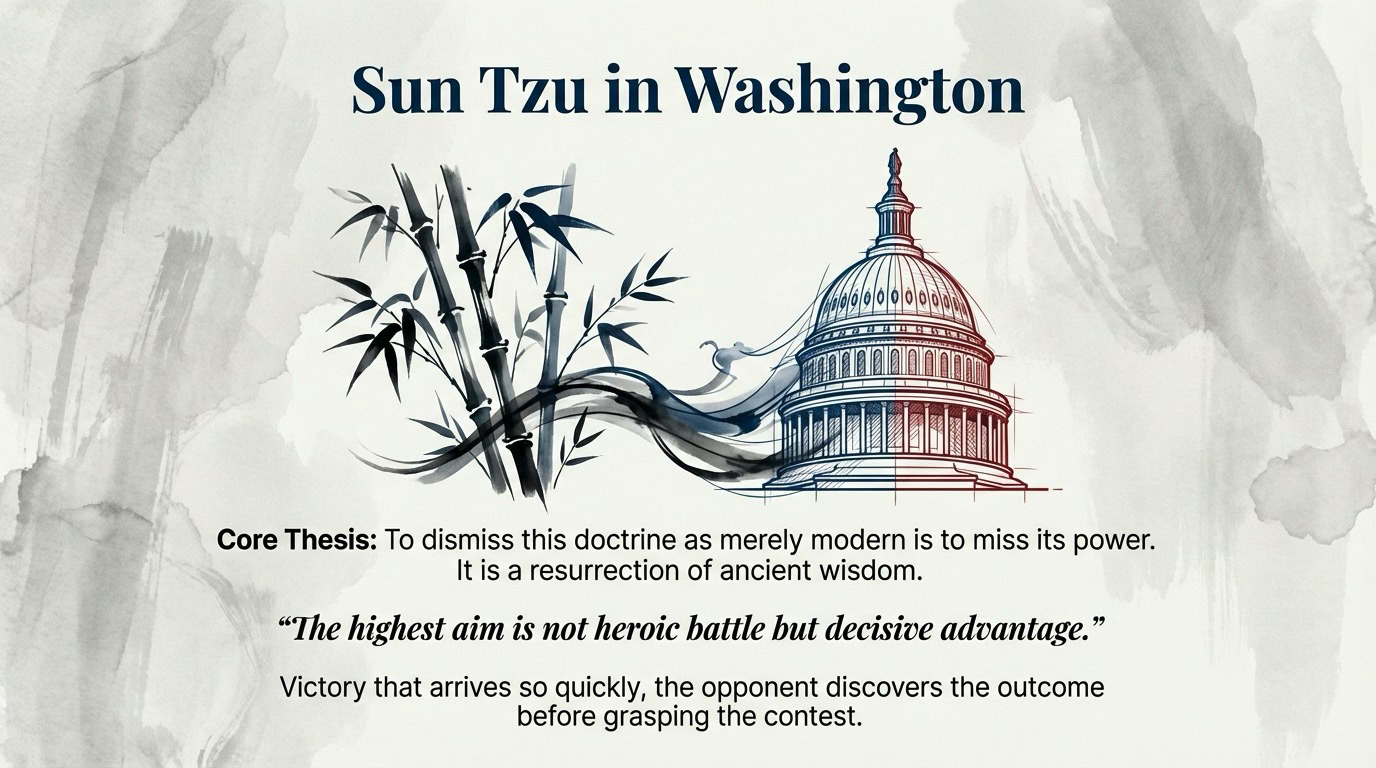
This is my fourth article on this journey (see: 1, 2, and 3 ), and by now one has to resist the lazy temptation to treat each new episode—an NSS here, a coup there, a summit with oil executives somewhere else—as if it were merely another flash on the ticker, a sequence of disconnected scenes in the endless soap opera of “foreign policy.” In fact, the point is precisely the opposite: this is doctrine learning how to walk, and then learning how to collect rent. The 2025 National Security Strategy is not a brochure of intentions; it is a choreography of leverage—strategy translated into action, action into control, and control into a durable rearrangement of the board. And if you want a historical analogue for what is being attempted here, do not reach first for the grand sentimental myths of liberation; reach for Sun Tzu, who understood that the highest aim is not heroic battle but decisive advantage—victory that arrives so quickly, and with such grim economy, that the opponent discovers the outcome before he has fully grasped the contest. A “surgical removal” of a hostile actor; a public insistence that the operation was clean and efficient; and then, almost immediately, the conversion of force into terms—commercial, strategic, irreversible—so that the real benefit is not the spectacle of action but the architecture of what follows: an American claim to set the rules of the hemisphere’s assets, to deny adversaries their access, and to make power felt not as an occupation but as an arrangement. This is the Sun Tzu move modernised: don’t merely defeat your enemy—rewrite the conditions under which he can ever recover.
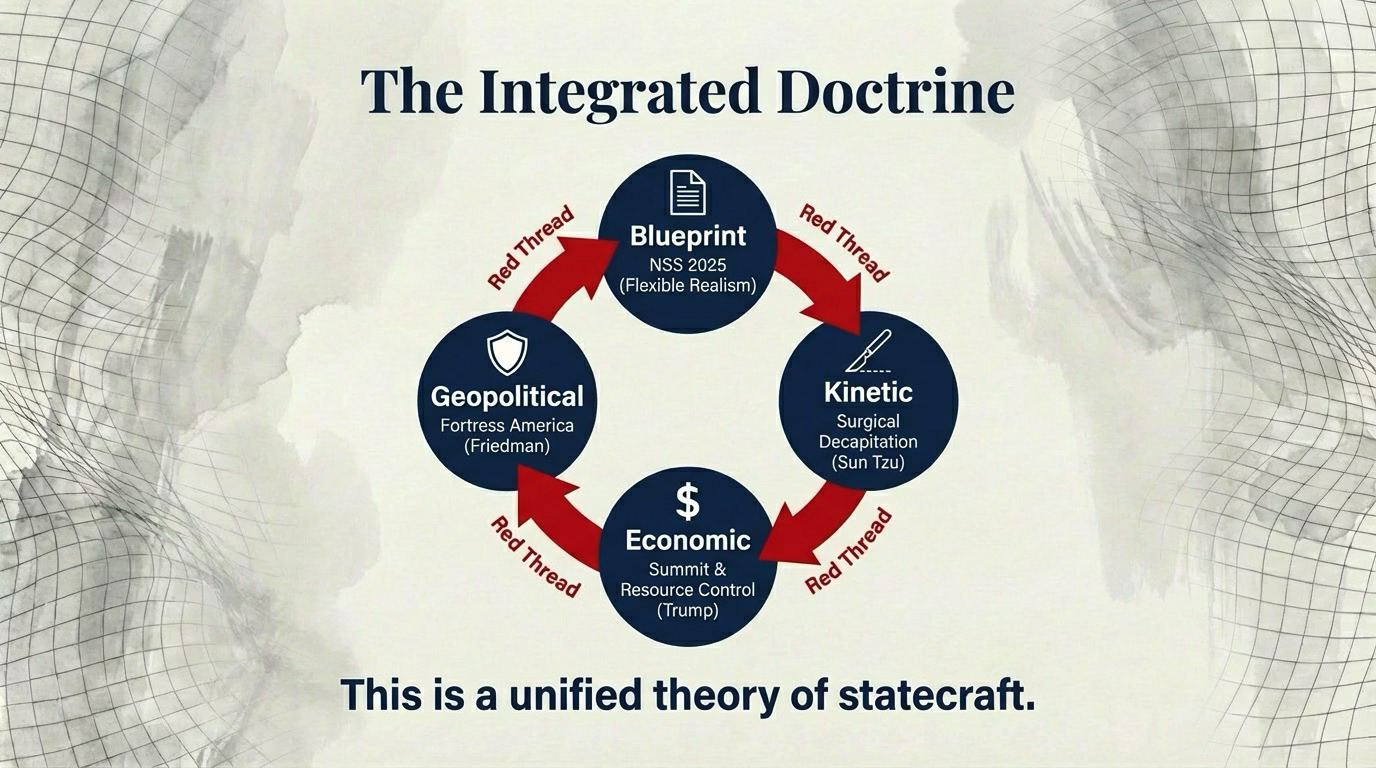
To view the recent White House summit with oil executives as a standalone event is to fundamentally misread the geopolitical moment. This was not merely a meeting; it was the calculated and final proof of a new American grand strategy in action. It represents the culmination of a clear doctrinal sequence that I have been tracking for some time: from the strategic text of the 2025 National Security Strategy (NSS), to the diplomatic rhetoric of Secretary Rubio, to the decisive military action that removed Maduro from power, and now, finally, to the economic consolidation of that victory. This is the moment the doctrine has moved from theory to tangible, resource-driven reality.
In this article, therefore, I will be discussing the Venezuela oil deal as a masterclass in this new, unsentimental American statecraft. I shall analyse how this sequence of events connects directly to the foundational principles of Fortress America, how its global implications are illuminated by the realpolitik insights of George Friedman, and how its execution echoes the ancient strategic wisdom of Sun Tzu.
The Blueprint in Action
To analyse the economic outcomes of the Venezuela operation without first understanding the strategic blueprint that made them possible is an exercise in futility. The recent military seizure of Nicolás Maduro was not an act of impulse, but the direct and kinetic application of the America First doctrine, which, as I have argued previously, prioritises hemispheric security above all else. This was the doctrine’s first test, and it was executed with an efficiency designed to send an unambiguous message.
The core principles of the 2025 NSS, (see: “An Inevitable Strategy”), codify a strategy of Flexible Realism and enact a Trump Corollary to the Monroe Doctrine. This doctrine abandons the post-Cold War project of global interventionism in favour of securing America’s own backyard. The operation in Caracas was the first manifestation of this principle. President Trump himself lauded its precision, describing it as “pretty amazing” with “no deaths and the loss of no equipment.” This was not a prelude to a costly occupation, but a surgical removal of a hostile actor.
The strategic goal was the elimination of adversary influence, a point made with stark clarity by the administration. As noted in a previous analysis, Secretary of State Marco Rubio identified the Maduro regime’s chief transgression as its decision to “openly cooperate with terrorist and criminal elements” and its specific invitation for “Hizbollah and Iran to operate from their territory.” This elevates the intervention from a mere regional policing action to a core component of great-power competition.
Military action, therefore, was not the end game; it was merely the brutal but necessary act of clearing the board to allow for the real prize: the complete rewriting of the hemisphere’s economic and geopolitical rules.
The Fruits of Decisive Action
The White House summit with oil executives was the pivotal moment where military victory was converted into long-term economic and geopolitical influence. It showcased a new American model that eschews the ruinous costs of nation-building in favour of direct resource control and strategic denial to its adversaries. The President’s points during the summit were not one of liberation, but of restoration and commercial opportunity, justified by a clear, interest-based logic.
His key justifications can be summarised as follows:
A Corrective Action: The intervention was framed as righting a historical wrong. President Trump repeatedly described it as “taking back what was taken from us,” asserting that the United States “built that entire oil industry” before it was “stolen by socialists and communists.”
A U.S.-Brokered Reality: The new power dynamic was made explicit. The oil executives were instructed in no uncertain terms: “You’re dealing with us directly. You’re not dealing with Venezuela at all.” This removes any pretence of dealing with a sovereign partner, establishing Washington as the sole arbiter of the country’s most valuable asset.
Guaranteed Security: The primary obstacle to investment under the previous regime—risk—was declared nullified. The President promised “total safety, total security” for American companies, a stark contrast to the environment previously described by an ExxonMobil executive as fundamentally “uninvestable.”
A Dividend for the Homeland: The ultimate outcome was presented in populist, America First terms. The deal, he promised, would lead directly to lower energy prices for American consumers, with gasoline for as low as “$1.92.”
Critically, the overriding geopolitical objective was reinforced by Secretary Rubio, who stated that Maduro’s ouster stops the flow of wealth that would “benefit adversaries such as Iran.” This is the doctrine’s core logic laid bare: military action creates the opportunity for economic arrangements that simultaneously enrich the United States and deny resources to its global competitors.
This establishment of “economic suzerainty” is not an isolated regional policy. It is, in fact, the clearest battlefield expression of the global reordering described by analyst George Friedman, whose macro-level framework provides the essential context for this new American imperium.
A World Reordered
This regional manoeuvre must be understood within the global reordering that analysts like George Friedman are only now beginning to grasp. Friedman’s work provides essential context, explaining these specific actions as logical consequences of a fundamental shift in American priorities. He argues, correctly, that the United States is deliberately ending its “80-year adventure” in the Eastern Hemisphere to return its primary focus to its own. The actions in Venezuela are the first concrete evidence of this pivot.
Friedman correctly identifies the Venezuela operation as a mere “preface” to the more fundamental strategic issue of Cuba. He pinpoints Cuba’s geographic position as a latent threat to the Florida Straits, a vital artery through which “well over 50% of American exports and imports come.” By removing Maduro, the United States not only isolates Cuba but also signals its intent to resolve this long-standing strategic vulnerability with a cold and final logic.
Yet, the most sophisticated element of this new strategy, as identified by Friedman, lies in its pragmatic accommodation of China. Herein lies a seeming contradiction: Washington blocks Venezuelan oil shipments to rivals like Cuba while, as Friedman notes, letting the “ships to China” pass unmolested. This is not a weakness but a ruthlessly calculated decision. It is a signal to a declining China, which is in desperate need of American markets, that a “mutual understanding” is possible. By accommodating China’s energy needs, the United States achieves a grander strategic objective: it secures a stable relationship with its primary economic competitor, thereby isolating other adversaries, particularly a weakened Russia.
This unemotional, interest-driven approach to statecraft—prioritising hemispheric dominance, managing peer competitors, and isolating lesser rivals—is not without precedent. Indeed, its efficiency and pragmatism find echoes in the most ancient and revered texts on strategy.
The Art of the Un-War
To dismiss this new American doctrine as merely modern is to miss its true power. Its logic is not new at all; it is a chillingly effective resurrection of the ancient wisdom found in Sun Tzu’s The Art of War. The Venezuela strategy, stripped of rhetoric, is a masterclass in the classic text’s highest ideal: to win decisively while avoiding the ruinous costs of a protracted, full-scale conflict.
Sun Tzu outlines a clear hierarchy of strategy, and the United States chose a superior path. It avoided the “lowest” and most costly option—a direct siege of a city or a full-scale occupation of Venezuela. Instead, the swift seizure of the regime’s leadership aligns perfectly with the higher principles of foiling an enemy’s plots and achieving victory without a major battle. As the classic text states: “one who is good at martial arts overcomes others’ forces without battle, conquers others’ cities without siege.” The operation was designed to decapitate, not to conquer.
Furthermore, the emphasis on speed and decisiveness is a direct reflection of Sun Tzu’s warnings against prolonged campaigns. President Trump’s focus on a swift, clean operation demonstrates an understanding that “the important thing in a military operation is victory, not persistence.” A protracted conflict exhausts a country’s resources and political will. As the master strategist warned, “An army is like fire—if you don’t put it out, it will burn itself out.” The Venezuela operation was designed to be a flash, not a wildfire.
Ultimately, this new doctrine embodies the unemotional pragmatism that Sun Tzu prized above all else. His teachings are devoid of sentiment, focusing only on what is effective. As the classic text advises: “A government should not mobilize an army out of anger, military leaders should not provoke war out of wrath. Act when it is beneficial to do so, desist if not.” The White House oil summit, convened just days after the military strike, is the ultimate expression of this principle: it was the immediate and tangible realisation of the benefit for which the action was taken.
A New and Enduring Reality
The events in Venezuela, culminating in the White House summit, are the ultimate validation of the “irreversible shift” in American foreign policy that has been underway for years. This is not a fleeting adjustment but the codification of a new and enduring reality. The strategy aligns perfectly with the Fortress America doctrine, prioritising homeland security and hemispheric dominance above all else. Its global context is illuminated by George Friedman’s analysis of a world reordering, where the United States pragmatically manages China to isolate its other rivals. Finally, its execution is a model of ruthless efficiency, a modern stratagem worthy of Sun Tzu. The world must now contend with this new American power—unflinchingly direct, unapologetically interest-driven, and demonstrably effective.