Ey Iranī Khudāʾī, Lick My Wounds, Chant for Me
Khamenei’s Attempt to Transform Military Defeat into Theological Triumph
By Khaled Salih
Sonic shield offered by eulogist Ḥājj Maḥmūd Karimi.
In July 1988, when Ayatollah Ruhollah Khomeini accepted UN Resolution 598 to end the Iran–Iraq War, he did so not with triumph but with the metaphor of martyrdom on his lips — calling it “drinking from a poisoned chalice.” For a man who had vowed to fight until Saddam’s regime fell, it was a profound admission: preserving the Islamic regime required shelving a revolutionary ideal. This was not an act of weakness but sacrifice — a deliberate renunciation of maximalist dreams for the sake of survival.
In that moment, Khomeini transformed ideological retreat into sanctified self-sacrifice, cloaking strategic failure in the moral grandeur of leadership. The poisoned chalice became an enduring symbol of the burden of command — the only moment in the Islamic Republic’s history when its founder acknowledged, without euphemism, that to lead sometimes means bleeding internally, abandoning the impossible for the sake of the real.
His successor, Ayatollah Khamenei, however, has never acknowledged strategic loss in such terms. Even after the catastrophic 2025 operations Rising Lion and Midnight Hammer, he repackaged retreat in euphemisms like “heroic flexibility” or obscured it through ritualized spectacle.
A Strategic Setback: The 2025 Strikes
The June 2025 Israeli and American strikes marked a decisive setback for Iran. Carried out between June 21–22 with U.S. support, the attacks devastated critical components of Iran’s nuclear and missile infrastructure, including Fordow, Natanz, and Isfahan. Several IRGC and nuclear program personnel were killed. U.S. officials claimed the strikes “obliterated” Iran’s nuclear ambitions or caused “extremely severe damage,” potentially setting the program back months or even years.
Faced with this vulnerability and humiliation, the regime staged the Ey Iranī Khudāʾī performance — a ritual of resilience meant to reframe material loss as moral triumph by fusing Shi‘ite symbolism with nationalistic fervor. It was a calculated act of psychological warfare, internal and external. Let’s examine how this performance worked as strategic communication — converting military defeat into theological narrative.
The Blow
To grasp the ritual’s meaning, one must understand the scale of the blow. Operation Midnight Hammer capped an escalating campaign. On June 13, Israel launched Operation Rising Lion, targeting nuclear facilities, missile factories, and high-level personnel, including IRGC chief and generals.
The IAEA’s May 2025 report warned of Iran’s increasing capabilities, noting 408.6 kg of 60% enriched uranium — enough for nine nuclear weapons if further enriched. Iran could have produced its first weapon-grade uranium in Fordow within two to three days. The withdrawal of experienced IAEA inspectors and surveillance tools left a dangerous knowledge gap.
On June 22, the U.S. struck with 14 Massive Ordnance Penetrators from B-2 stealth bombers, targeting Fordow and Natanz. Isfahan was hit with Tomahawk cruise missiles from an Ohio-class submarine. The coordinated operation involved over 125 aircraft, including decoy flights.
Damage assessments confirmed catastrophic impact. Even as Trump boasted Iran’s nuclear ambitions were “obliterated,” later evaluations suggested a months-long setback. Iranian officials, including FM Abbas Araghchi, admitted to “serious” damage. IAEA chief Rafael Grossi confirmed it.
Iran retaliated symbolically — striking a U.S. base in Qatar and pushing parliament to pass a motion to close the Strait of Hormuz. Khamenei, reportedly relocated to a bunker, re-emerged declaring “victory” and vowing future retaliation. Amidst devastation, the regime turned to ritual — Ey Iranī Khudāʾī was born.
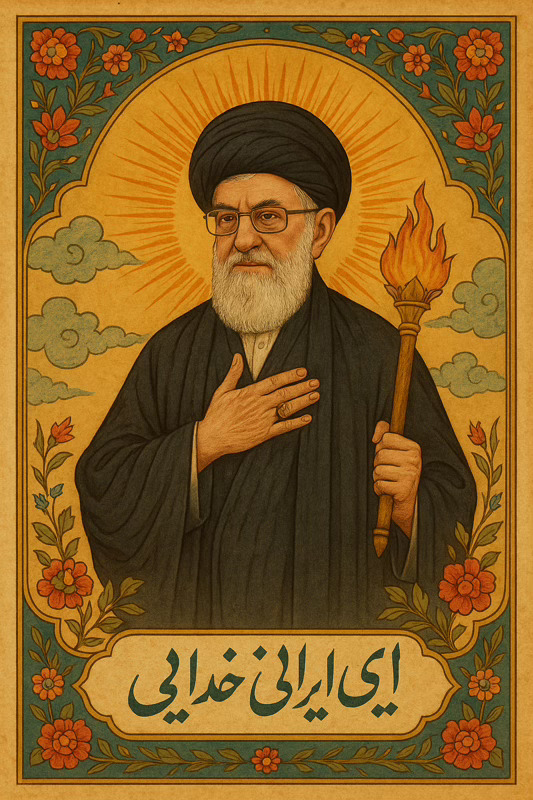
Ey Iranī Khudāʾī
Ey Iranī Khudāʾī: Reframing Defeat Through Ritual
The chant was performed on the eve of Ashura (July 5, 2025) in the Imam Khomeini Ḥusayniyya — a venue charged with Shi‘ite gravity. The date was no coincidence. Ashura, the commemoration of Imam Ḥusayn’s martyrdom, symbolizes unjust defeat turned spiritual victory.
Led by famed eulogist Ḥājj Maḥmūd Karimi, the chant’s political weight lay in Khamenei’s personal request. This was no spontaneous mourning. It was state-managed spectacle, aimed at reconsecrating leadership under siege. Khamenei’s visible participation signaled humility, yet reasserted control. His presence blurred faith and nationhood: the Rahbar became the “home.”
The chant’s cadence — slow, building to a militant refrain — fostered collective emotion. Chest-beating and crowd repetition (“Ey Irān — Irān!”) merged mourning with mobilization. Black garments, Ashura banners, and Khamenei’s modest chair underscored solemnity while anchoring authority.
Theological Alchemy: From Wound to Wonder
The ritual’s genius lay in fusing traditional Shi‘ite motifs with state nationalism, reinterpreting a crushing military defeat as moral ascendancy.
- Sanctifying the Homeland: Iran was declared Harām (sacred), its soil elevated to the status of Karbala. Territorial loss was rendered unthinkable — not because of force, but sanctity.
- Ashura Parallels: Invocations of Iranī Karbalāʾī and Iranī ʿĀshūrāʾī”likened the nation to Imam Ḥusayn’s doomed but righteous band. This rebranded strategic failure as redemptive martyrdom — spiritual triumph through worldly suffering.
- Zulfiqār & Vengeance: The legendary sword of Imam Ali — Zulfiqār — was invoked to spiritually re-arm Iran. Despite destroyed missile stockpiles (over 1,000 missiles and 250 launchers), the chant proclaimed divine retribution still imminent.
- Personalized Devotion: Loyalty shifted from Imam to Leader: “We would die for you, O Master, by the oath of ʿAlī.” In the wake of strategic miscalculation, Khamenei sought renewed legitimacy through theological absorption.
- Cultural Bridging: By modifying the iconic secular anthem Ey Irān into a devotional lament, the chant extended beyond mourning-house audiences, tapping into national memory and seeking unity across secular-religious lines.

Standard depiction of Ali's sword Zulfiqār in Islam (Wikipedia)
Strategic Messaging: At Home and Abroad
The ritual had layered goals:
Domestic:
- Re-legitimize Leadership: Khamenei’s request for the chant signaled responsive, not dogmatic, authority.
- Reframe the Loss: Ashura’s martyrdom paradigm cast the military blow as moral proof of steadfastness.
- Contain Internal Dissent: Amid criticism of IRGC failures, images of a packed hall pledging loyalty helped drown out discontent and project cohesion.
- Mixed Reception: While the IRGC and Basij drew strength from the chant, many middle-class Iranians viewed it as hollow pageantry. Opposition voices mocked its dissonance — Iranī Karbalāʾī, GDP Nāvāʾī.”
International:
- Spiritual Retaliation as Threat: The chant’s imagery of Zulfiqār warned adversaries: spiritual resolve may yet regenerate force.
- Dual-Track Propaganda: IRIB swiftly released a polished three-minute video with subtitles in Arabic and English — contrasting slick piety with viral footage of bombed facilities.
- Regional Signal: While foreign analysts saw the ritual as familiar theatrics, it reaffirmed Iran’s capacity for ritual mobilization — a signal not easily dismissed.
Post-Ritual Strategy: The Next Act
Ey Iranī Khudāʾī was not the endpoint. It was the “spiritualisation” phase in a recurring regime cycle: denial → minimisation → sacralisation → retaliatory narrative.
In the days that followed:
- Iran struck al-Udeid base in Qatar (reportedly intercepted).
- Parliament passed a motion to close the Strait of Hormuz.
- Iran laid naval mines in the Gulf — a warning to oil markets.
- On July 2, cooperation with the IAEA was suspended, compounding verification concerns.
This ritualized resilience operates within the framework of Khamenei’s fatwa against nuclear weapons, dating to the 1990s and reaffirmed multiple times. He described nukes as forbidden under both sharʿi and ʿaqli (divine law and rational) reasoning. Yet, critics question its immutability. Pressure from IRGC leaders in February 2025, and public statements by Ali Larijani and Intelligence Minister Khatib, suggest the fatwa might bend under existential threat.
The performance, then, must be read alongside this ambiguity. While invoking spiritual boundaries, it leaves open the threat of nuclear escalation — another tool in the regime’s asymmetrical toolkit.
Conclusion: Licking My Wounds
In the shadow of military calamity, Ey Iranī Khudāʾī became the Republic’s sonic shield — absorbing the shocks of Midnight Hammer and Rising Lion preparing the faithful for the next act. It was not just lament, but transmutation: from wound to wonder, from failure to faith.
By fusing Ashura’s sacrificial motif with a modified national anthem and veiled threats of Zulfiqār, the ritual turned strategic disaster into symbolic defiance. Khamenei, bruised but unbowed, reasserted his claim to leadership through performance.
Reception was fractured — applause, indifference, mockery — yet the regime’s intent was clear: to survive the blow, reweave the myth, and ready the people. In the Islamic Republic, even in strategic retreat, ritual becomes a weapon. And in the end, when all else is stripped away, what remains is this: licking the wound, chanting Ey Irān.
Text of the Chant
Text within this block will maintain its original spacing when publishedای ایران خداییText within this block will maintain its original spacing when published( حضرت آقا خودشون فرمودند اینو برامون بخون، اگە خستە نمیشی. ما برات میمیریم آقا، قسم به علی اونایی کە دروغ میگن نامردن، ما جونمون و برات میدیم)Text within this block will maintain its original spacing when publishedای ایران خدایی ؛ ایران کربلاییText within this block will maintain its original spacing when publishedایران ذوالفقار و ایران عاشوراییText within this block will maintain its original spacing when publishedدرروح و جان من ؛ می مانی ای وطنText within this block will maintain its original spacing when publishedتویی تو هستی حرم ؛ تویی تو خانه ی من..Text within this block will maintain its original spacing when publishedای ایران خدایی! ایران کربلاییText within this block will maintain its original spacing when publishedایران ذوالفقار و ایران عاشوراییText within this block will maintain its original spacing when publishedدر روح و جان من!Text within this block will maintain its original spacing when publishedمیمانی ای وطن!Text within this block will maintain its original spacing when publishedتویی تویی تو هستی حرمText within this block will maintain its original spacing when publishedتویی تو خانه منText within this block will maintain its original spacing when publishedای ایران ایران!Text within this block will maintain its original spacing when publishedدور از دامان پاکت دست دگرانText within this block will maintain its original spacing when publishedبد گهران!Text within this block will maintain its original spacing when publishedای مهر رخشان!Text within this block will maintain its original spacing when publishedزیر سایه حیدر باشی در امان
English rendering
Text within this block will maintain its original spacing when publishedO Divine IranText within this block will maintain its original spacing when published(The Master himself said: “Please recite this for us, if you’re not tired.” We would die for you, Master. I swear by Ali, those who lie are dishonorable—we would give our lives for you.)Text within this block will maintain its original spacing when published⸻Text within this block will maintain its original spacing when published
O Divine Iran, O Karbala-like Iran,Text within this block will maintain its original spacing when published
Iran of Zulfiqār, Iran of ‘Ashura,Text within this block will maintain its original spacing when published
In the spirit and soul of mine —Text within this block will maintain its original spacing when published
You shall forever remain, O homeland.Text within this block will maintain its original spacing when published
You — you are the sanctuary,Text within this block will maintain its original spacing when published
You — you are my home.Text within this block will maintain its original spacing when published
O Divine Iran! O Karbala-like Iran!Text within this block will maintain its original spacing when published
Iran of Zulfiqar and Iran of ‘Ashura!Text within this block will maintain its original spacing when published
In the spirit and soul of mine!Text within this block will maintain its original spacing when published
You shall remain, O homeland!Text within this block will maintain its original spacing when published
You — you are the sanctuary,Text within this block will maintain its original spacing when published
You — you are my home.Text within this block will maintain its original spacing when published
O Iran, Iran!Text within this block will maintain its original spacing when published
Far from your pure bosomText within this block will maintain its original spacing when published
May the hands of strangersText within this block will maintain its original spacing when published
And the corrupt never reach!Text within this block will maintain its original spacing when published
O radiant love!Text within this block will maintain its original spacing when published
May you forever be underText within this block will maintain its original spacing when published
The protection of Haidar (Imam ‘Ali),Text within this block will maintain its original spacing when published
And remain in peace.Text within this block will maintain its original spacing when published
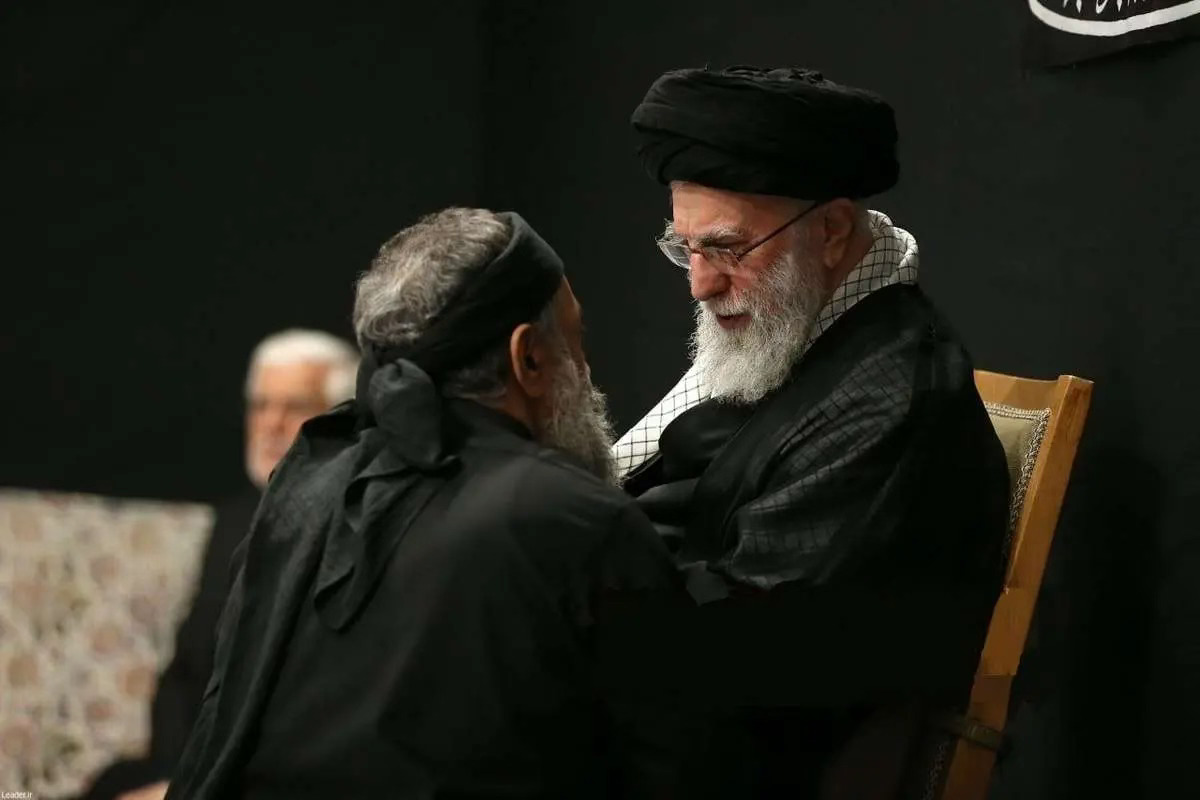
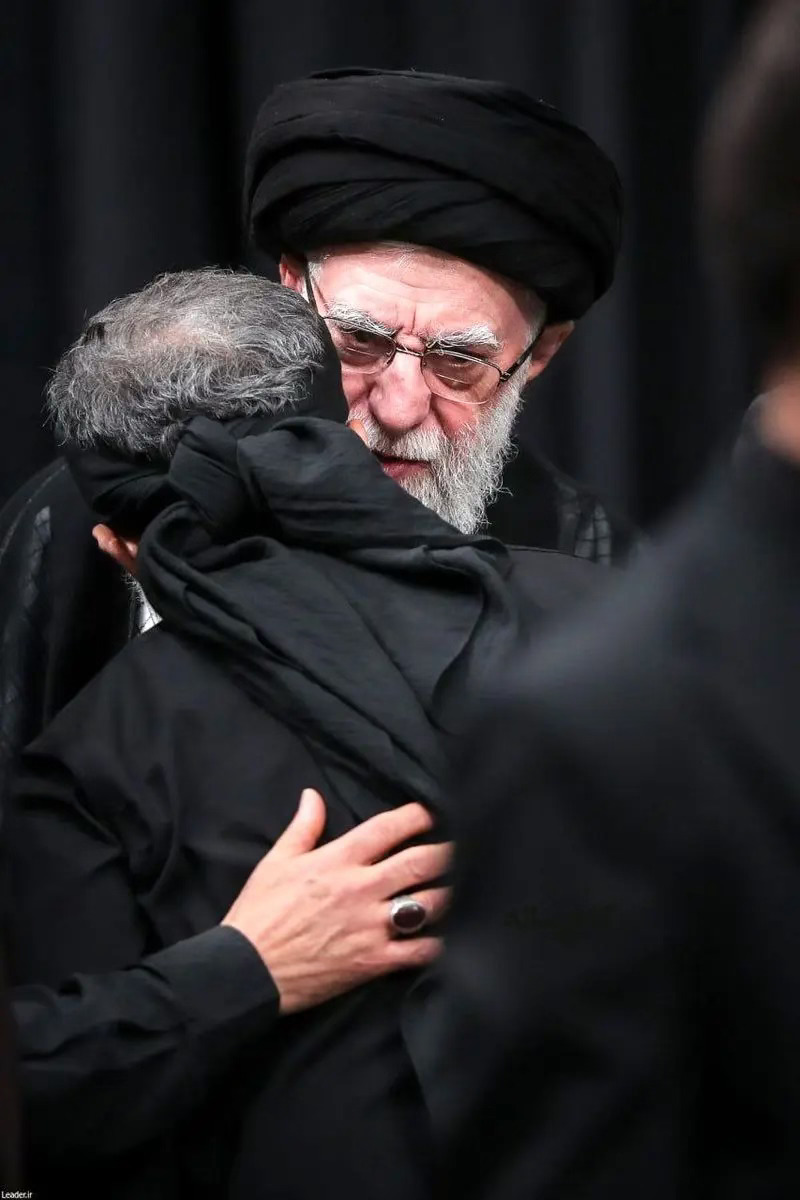
Khamenei with Ḥājj Maḥmūd Karimi after offering him sonic shield.


