Ember Revival: A Nephew’s Chronicle of a People’s Will to Survive
23 November 2025
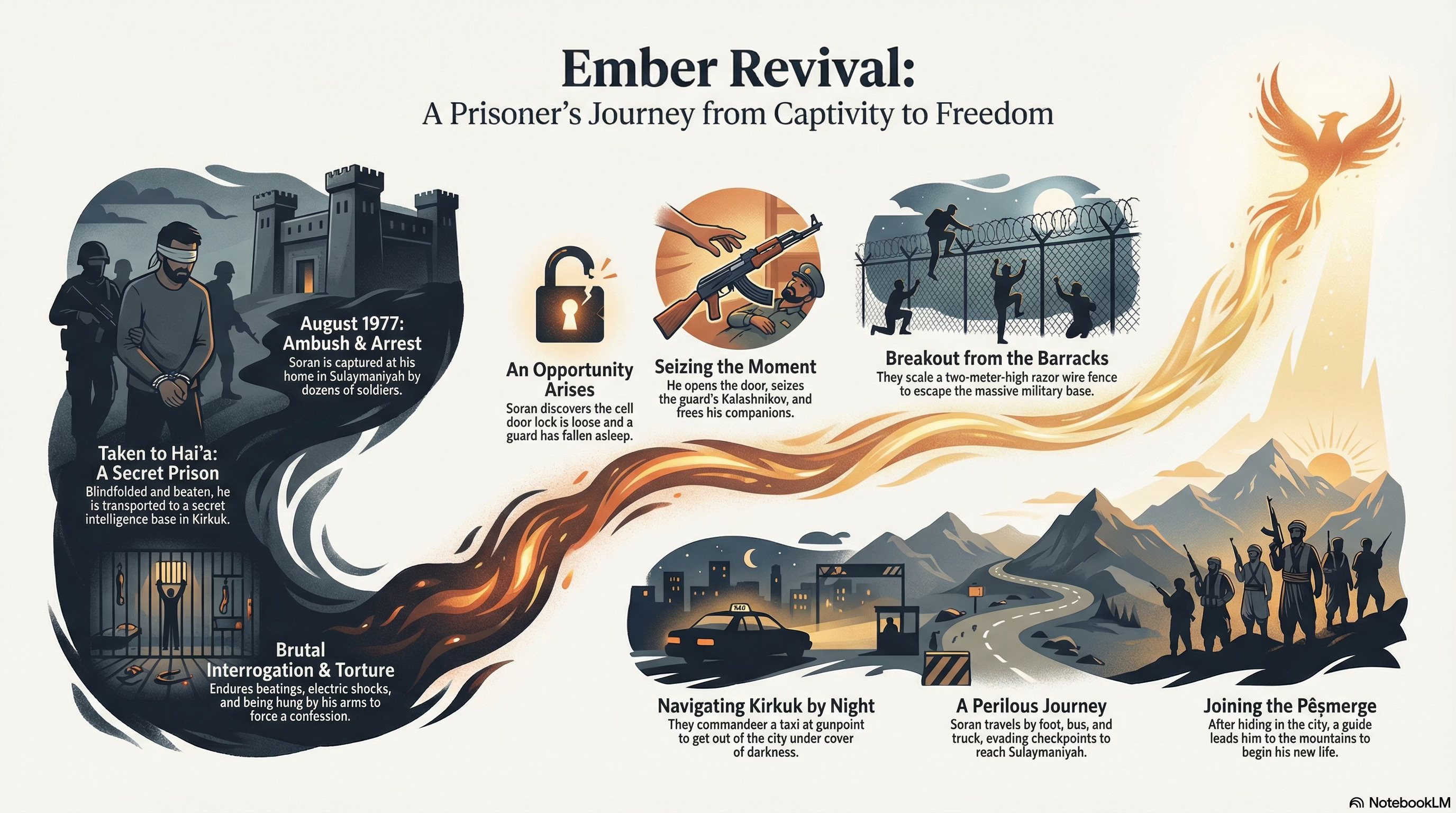
The novel begins instantly with the protagonist’s sudden, brutal arrest at his home by soldiers, marking the immediate descent into tragedy. Dragged blindfolded to the Sulaymaniyah intelligence “Black Site,” he endures isolation, severe heat torture, and harsh interrogation, made worse by the revelation that a captured friend had betrayed him to his captors. This ordeal culminates in his transfer to the secret Hai’a military prison in Kirkuk, a site of certain execution for political prisoners. Recognising the finality of his predicament, he orchestrates a daring breakout, rallying fellow condemned prisoners, securing smuggled arms, and successfully fighting his way out of the massive military base to join the Peshmerga forces in the mountains. This newfound freedom is marked by grueling missions across treacherous, snow-covered terrain, where he witnesses the ultimate sacrifice: the suicidal martyrdom of his comrade, Khasraw, who dies to protect the group’s secrets from Iranian intelligence. Seeking medical treatment abroad for severe, untreated injuries sustained during his initial imprisonment, he is subsequently ambushed and captured by Turkish gendarmeries near Gavar. Despite facing only minor charges of illegal entry, the Turkish court orders his deportation back to Iraq, effectively condemning him to certain death. In a final, desperate struggle during transit through Cizre, he breaks free from his military escorts, aided by the local populace, and escapes—unarmed and without papers—to Syria, cementing his existence as a lifelong fugitive dedicated to the resistance.
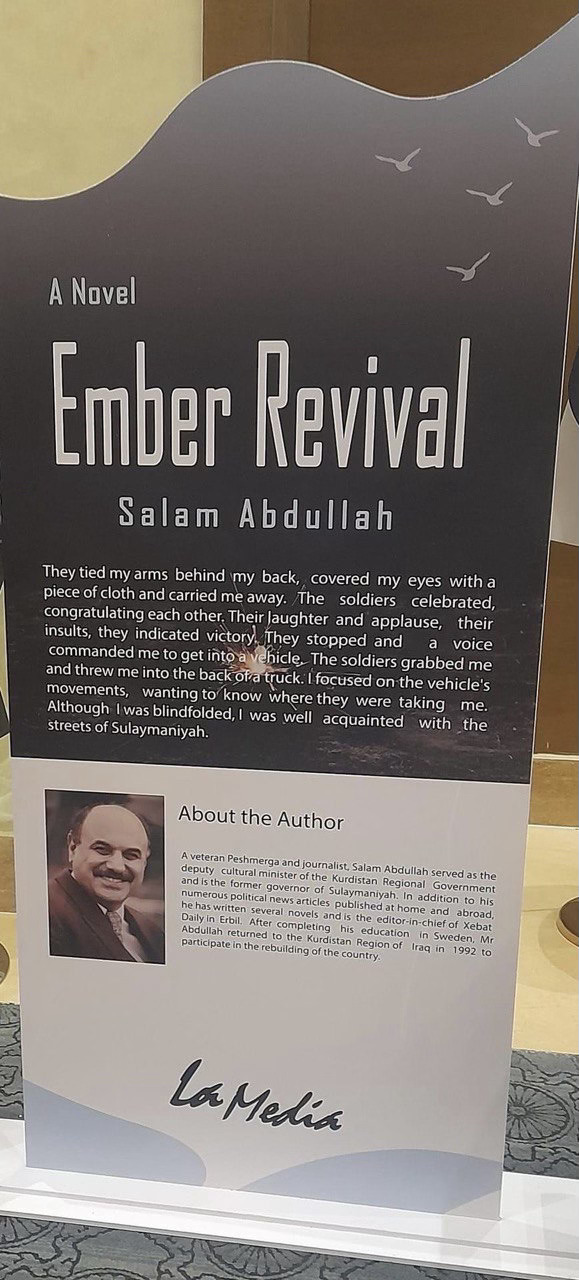
I was in the house with my maternal uncle, Salam Abdullah, on that night in August 1977. The memory is not a coherent narrative but a collage of sensory shocks: the screech of car tyres on the Sulaymaniyah asphalt, a violent, percussive banging on the front gate that seemed to shake the very foundations of our home, and then the shouting. Soldiers flooded the lower courtyard and swarmed the roof where my uncle had been sleeping. From my young boy’s perspective, it was a terrifying and incomprehensible invasion, a maelstrom of noise and menace that ended with my uncle being bound, blindfolded, and carried away into the darkness. For years, that night was followed by a profound and heavy silence. It is a silence now broken by his book, Ember Revival, the harrowing chronicle of all that followed.
The central purpose of this review is to explore how my uncle’s account masterfully documents not just one man’s ordeal, but the collective struggle of the Kurdish people for dignity and survival against the brutal machinery of an oppressive state. Through the literary lens of his protagonist, Soran Ahmad, my uncle exposes the architecture of terror employed by the Ba‘thist regime and, in doing so, reveals the anatomy of a resistance that refused to be extinguished. The book is a forensic examination of both the methods of state-sanctioned cruelty and the myriad forms of human resilience required to withstand them.
Ultimately, Ember Revival is a testament to the indomitable strength of the human spirit when pushed to its absolute limits. It is a story of profound suffering, but also one of defiant hope, unbreakable camaraderie, and the unquenchable desire for freedom. For me, it is the answer to the questions that began with the terrifying sound of soldiers banging on our gate, a sound that marked the end of one life and the beginning of a brutal, transformative trial by fire.
The Crucible of the Cell
For years, I could not imagine what my uncle endured after being taken from us. Reading his clinical description of the Hai’a black site, I now understand it was not chaotic violence, but a systematic process of dehumanisation. The book’s initial sections, detailing the protagonist Soran’s arrest and torture, are not merely a catalogue of suffering, but a clinical dissection of a methodical science designed to dismantle a person’s identity. The infamous prison becomes a laboratory where the raw materials of human endurance are tested against the refined instruments of state terror.
The regime’s tactics, as chronicled by Soran, move beyond simple brutality to encompass a sophisticated assault on both body and mind. It is a process designed to strip away every vestige of control and dignity, establishing the absolute dominance of the captor.
- Environmental Torture. The first stage of this process was often environmental. Soran describes being bound and pushed onto thorns in the prison yard, left exposed to the “unparalleled August heat.” This was not incidental cruelty; it was a deliberate tactic to degrade a prisoner’s cognitive function through dehydration and heat exhaustion, softening them up before an interrogation even began. It transformed the natural world into an instrument of pain.
- Psychological Whiplash. The regime masterfully weaponised relief. Soran recounts being dragged from the searing courtyard into a cool, air-conditioned room. This sudden shift was not mercy but a “calculated assault on his senses.” By turning the body’s own human need for comfort into a tool of disorientation, the regime’s thugs asserted that nothing, not even a moment of coolness, was outside its control. It shattered his mental equilibrium more effectively than constant pain ever could.
- Systematic Brutality. The physical tortures were methodical and precise. Being “hung by his tied arms” over a table was designed to inflict excruciating joint pain, asserting control by threatening to tear the body apart. Vicious beatings with a hose, particularly the practice of falanqa—beating the soles of the feet—established absolute dominance, while the use of electric shocks was a technological escalation, a direct assault on the nervous system intended to make the brain feel as if it were “ready to explode.”
Soran’s own account captures the disorienting nature of this psychological warfare, his mind racing to understand why he had been moved from a furnace to a cool sanctuary, questioning whether this, too, was simply a torture chamber in disguise. Paradoxically, this intense and systematic effort to destroy a man’s will became the very forge in which his resilience was hardened. The crucible of the cell, intended as a tomb for his spirit, became the birthplace of a hardened fighter, compelling him to seek not just survival, but liberation alongside his comrades.
The Inhumanity of Artificial Borders
A central and recurring theme in Ember Revival is the strategic significance of borders. For the Kurdish people, these lines drawn on a map by distant colonial powers are not neutral geographical markers. My uncle portrays them as artificial, inhuman and unjust instruments of division and oppression. They are wounds carved into the body of a single homeland, transforming every journey—whether for safety, medical aid, or military logistics—into a life-or-death gamble. Soran is forced to navigate this fractured landscape repeatedly, where the simple act of crossing from one part of Kurdistan to another means confronting the hostile apparatus of a different state.
The constant peril of these crossings is illustrated through a series of harrowing journeys, each exposing a different facet of the regional geopolitical trap in which the Kurds are caught.
- Iraq to Iran. The initial escape from the Ba‘thist regime necessitates a crossing into Iran. While reaching Iranian territory brings the immediate “pleasure” of being out of reach of Iraqi soldiers, it introduces a new danger. Under an agreement between the two states, the Shah’s forces could hand Kurdish fighters back to the Iraqi government. This threat is tragically realised when the group is detained by Iranian intelligence. Fearing he will break under torture and reveal vital secrets, a respected Peshmerga named Khasraw commits suicide—a stark illustration of the impossible choices faced by those caught between two oppressive regimes.
- Into Turkey. Later in the narrative, a journey to seek medical treatment requires crossing into Turkey. This is not a simple transit but a descent into another hostile environment. The group is intercepted not by a routine patrol but in a “meticulously planned military ambush” by Turkish gendarmeries. The moment his Iraqi passport is discovered, the interrogation immediately shifts. He is no longer just an illegal entrant but is accused of being a “rebel” against the Turkish state, demonstrating that for a Kurd, existence itself is often treated as an act of subversion.
- Turkey to Syria. After being sentenced to deportation back to Iraq—a certain death sentence—Soran stages a final, desperate escape. This culminates in a crossing into Syrian Kurdistan, a feat made possible only through a network of local contacts who had paid off the soldiers guarding the border. He is forced to crawl under razor-sharp barbed wire to reach the final part of his homeland, a visceral metaphor for the painful and humiliating reality of navigating these artificial divisions.
As a scholar, I analyse these borders as geopolitical constructs. As a nephew, I now see them as the razor wire and mountain passes that stood between my uncle and death, a landscape he had to navigate not with a map, but with sheer will. These physical borders, designed to atomise the Kurdish nation, find their grim parallel in the psychological walls the regime sought to erect between its prisoners.
The Collective Will
It is this part of my uncle’s account that finally answers the deepest question left by his absence: how did he survive? Ember revival powerfully argues that he did not survive alone. Survival, it contends, is not a solitary act but a communal one, forged in the shared suffering of prison cells and the windswept solidarity of the mountains. Individual resilience is magnified, sustained, and given meaning by the unwavering bonds of a people united by a common purpose.
Just as the Peshmerga fight to erase the physical borders imposed by states, the prisoners in Hai’a fight to dismantle the psychological borders the regime attempts to build between them through isolation and suspicion. They refuse to be atomised by their captors, secretly aligning their stories after interrogations to create a unified front of denial. This ethos is perhaps best captured in the “profound tradition of care” where, after a prisoner was returned from a torture session, his cellmates would gather to gently rub his beaten feet, a simple act of shared humanity that defied the regime’s efforts at dehumanisation. This ethic of collective responsibility is powerfully illustrated when an older prisoner named Sharif convinces the others to abandon a violent uprising. His argument transforms an anecdote into a profound meditation on revolutionary ethics: is it better to die in a blaze of defiant glory, or to live and protect the flicker of hope in others?
This powerful camaraderie is contrasted with the insidious and ever-present threat of betrayal. The regime actively exploited internal fissures to maintain control, most notably through the use of the jash, Kurdish mercenaries who fought alongside the Iraqi army. The narrative also highlights the devastating impact of informants, like the “boy who snitched,” whose actions led to the capture of Soran’s cell. This internal threat made trust the most valuable and fragile currency of the resistance.
It is in the depiction of the Peshmerga that this collective will finds its ultimate embodiment. My uncle portrays them not as a simple guerrilla army, but as the manifestation of a national promise. The fight is described as a “holy path,” one undertaken by ordinary people prepared to “fight and sacrifice for freedom.” Ember Revival brilliantly illustrates a core truth of the Kurdish struggle: that while the state can capture, torture, and kill an individual, it cannot extinguish a collective ideal.
More Than a Story, A Testimony
Ember Revival transcends the genre of memoir to become a vital historical and human document. My uncle has crafted a narrative that is both unflinchingly brutal in its detail and deeply humane in its focus. The book posits that the Ba‘thist regime’s methods—from the sensory assault in the cell to the barbed wire at the border—were all part of a single, coherent project of atomisation. His chronicle is therefore a testament to the equal and opposite force: a collective will that rebuilt human connection in the cell and affirmed a borderless national identity in the mountains.
Reading this account has provided a brutal, yet deeply necessary, context to the traumatic events I witnessed as a child. For decades, the night the soldiers came for my uncle was a scar in my memory, a moment of violent intrusion followed by an aching silence. His book has finally given a voice to that silence, chronicling the unimaginable suffering and extraordinary resilience that lay on the other side of that closed gate. It has transformed a personal trauma into a shared testimony.
The book’s ultimate achievement, however, is its relentless focus on the preservation of dignity and mutual respect in the face of absolute inhumanity. In the darkest cells of Hai’a and on the most treacherous mountain passes, the characters’ fight is not just for physical survival, but for the survival of their own humanity. This is what makes Ember Revival more than a story. It is a testament to the enduring power of the Kurdish spirit and a universal declaration of the human will to survive, not merely as a body that breathes, but as a soul that remains free.
————
Salam Abdullah, 2023, Ember Revival. Erbil: Khaney Culture
———