Driving The Pattern: From Qatar to the New York Declaration
By Khaled Salih
David Deutsch’s concept of The Pattern refers to a deeply ingrained and irrational phenomenon, primarily associated with antisemitism. He describes it not merely as anti-Semitism (violence, incitement, persecution of Jews), but as an underlying phenomenon, a “pattern of moral derangement.” At its core, The Pattern is a moral perversion, manifesting as a compulsion to preserve the legitimacy of hurting Jews, simply for being Jews. This need to establish the legitimacy of harm is often more significant than the actual performance of harmful acts.
Deutsch stresses that The Pattern is unique to Jews, having no close parallels in other irrationalities or immoralities. It represents an underlying cultural predisposition that has existed with “amazing fidelity” across diverse societies and civilizations for over 2,500 years, predating Christianity. Its mechanism involves the urge to scapegoat Jews emerging first, with justifications being invented later. When old reasons for hostility lose their relevance, new ones are continuously created to take their place, ensuring its persistence. This makes scapegoating Jews the “path of least resistance” when societies face difficulties. Once this moral perversion takes hold in individuals or cultures, “it overrides everything else,” potentially becoming a dominant moral framework. Deutsch notes that this derangement is “very common” and “affects people who would not dream of thinking of themselves as anti-Semitic or racist,” impacting Jews and non-Jews alike. While the underlying pattern changes very slowly and does not have “outbreaks,” it “occasionally... gives rise to actual anti-Semitism.” Such outbreaks tend to happen when the legitimacy of hurting Jews is challenged.
Qatar’s October 7, 2023 statement: An immediate manifestation of The Pattern
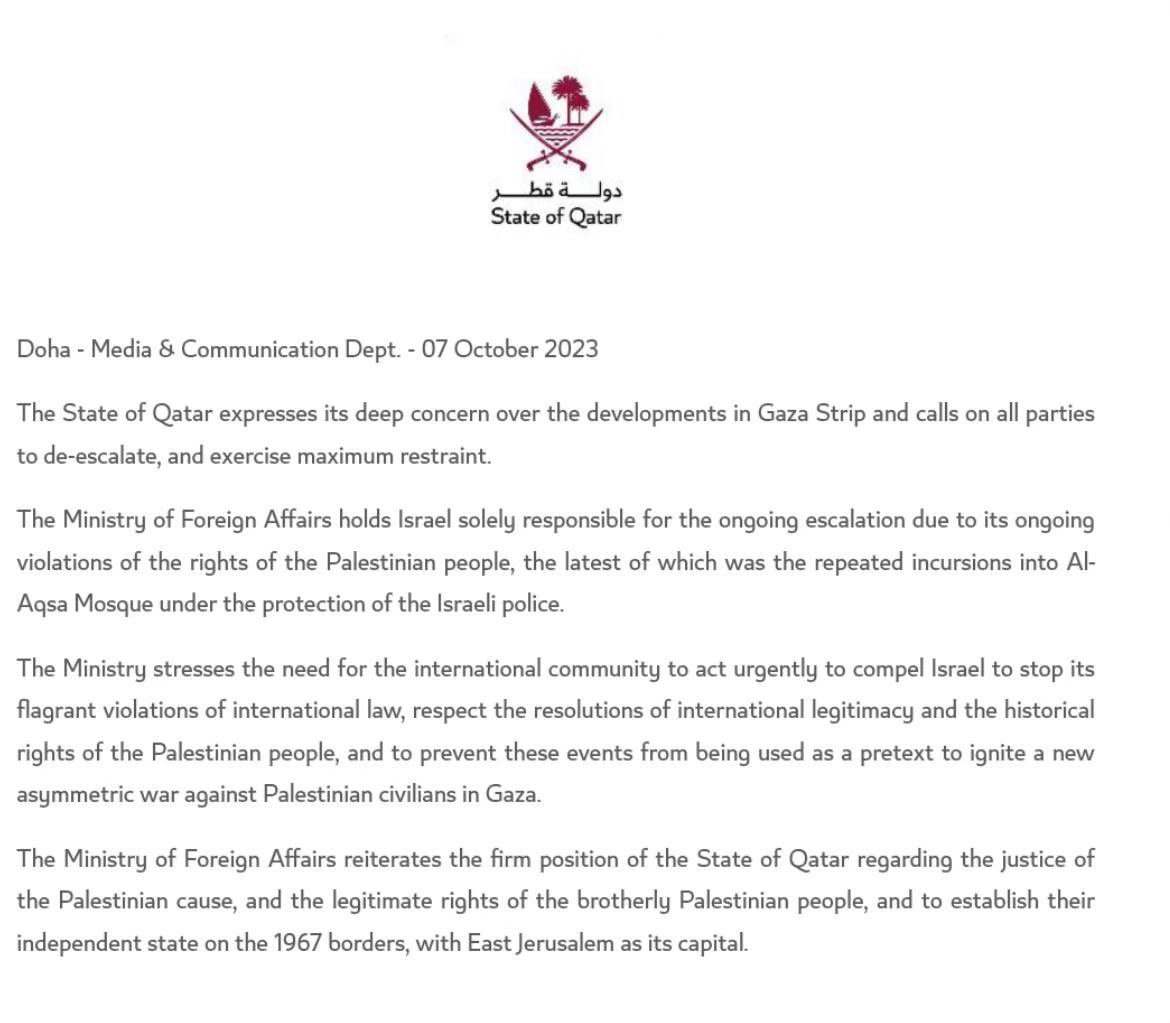
On October 7, 2023, the very day Hamas launched a massive and brutal attack on Israel, the State of Qatar’s Ministry of Foreign Affairs issued a statement that provided an immediate and stark illustration of The Pattern. While expressing “deep concern” and calling for “all parties to de-escalate,” Qatar’s statement simultaneously and immediately declared that its Ministry of Foreign Affairs “holds Israel solely responsible for the ongoing escalation.” This unilateral attribution of sole responsibility to Israel, conspicuously omitting any condemnation of Hamas’ atrocities, is a hallmark of The Pattern. From Deutsch’s perspective, this functions to legitimize any action against Israel by framing it as a justifiable response to Israel’s purported violations, aligning with the “compulsion to preserve the legitimacy of hurting Jews” by presenting Israel as the instigator and sole culpable party.
Qatar’s statement offered specific post-hoc justifications for this blame, including “ongoing violations of the rights of the Palestinian people” and, significantly, “the repeated incursions into al-aqsa mosque under the protection of the Israeli police.” These grievances, particularly the invocation of al-aqsa mosque, can be seen as contemporary “invented reasons” or traditional tropes used to fuel hostility, tapping into historical narratives of Jews desecrating holy sites to justify aggression within The Pattern. The deliberate focus on these actions, without acknowledging a broader context of conflict or reciprocal violence, allows Israel to be unequivocally cast as the oppressor. This exemplifies how the urge to scapegoat Jews emerges first, and justifications are then invented.
The statement further demonstrates the characteristic uniqueness and double standards of The Pattern. Qatar selectively condemned only Israel’s actions, calling for the international community to “compel Israel to stop its flagrant violations of international law.” This singular focus on October 7, 2023, while remaining silent on the severe atrocities committed by Hamas, exemplifies the double standard. As Deutsch’s analysis suggests, only Israel is told to show restraint when it confronts terrorists. This double standard stems from the “atavistic idea that the Jews somehow deserve it.” The omission of any call for Palestinian actors, including Hamas, to “de-escalate” further highlights this asymmetry and the selective blame inherent in The Pattern. Qatar’s “firm position... regarding the justice of the Palestinian cause” further integrates this stance into its national identity and political philosophy, reinforcing a narrative where the Jewish state is consistently framed as the primary malefactor.
The New York Declaration: Evidence of The Pattern supported by 142 States
The UN’ New York Declaration serves as stark evidence of The Pattern gaining widespread, institutionalized support on a global scale. Israel's delegate explicitly rejected the declaration as a “carefully staged performance for headlines,” perceiving it as an act designed to undermine its legitimacy. This aligns with The Pattern’s goal of preserving the justification for harm. Deutsch notes that “The very existence of Israel from 1948 has been a red rag to the bull of the pattern, because Israel is the one place where by definition, it’s not legitimate to hurt Jews for being Jews.” The declaration, therefore, acts as a global challenge to Israel's legitimacy, which, ironically, causes the pattern to “break out into anti-Semitism sometimes.”
Statements from various delegates within the declaration powerfully illustrate the manifestation of The Pattern.
South Africa’s delegate warned against distraction from “urgent efforts... to ensure an immediate ceasefire and an end to Israel’s genocidal war against the Palestinian people.” This extreme accusation serves to legitimize any opposition or punitive action against Israel, fulfilling the “compulsion to preserve the legitimacy of hurting Jews.”
Namibia’s representative condemned “terrifying attacks by the Israeli apartheid regime against the civilians in Gaza, the deliberate starvation, stressing there was no justification for the grave violations of the international law.” Branding Israel an “apartheid regime” and accusing it of “deliberate starvation” functions to strip Israel of its legitimacy as a normal nation-state, thereby justifying actions and narratives that could lead to its isolation and ultimate harm. The assertion of “no justification” for Israel’s actions explicitly denies its inherent right to self-defence, a key characteristic of The Pattern.
These severe accusations, framed in the language of human rights and international law, are contemporary “invented reasons” to rationalise intense criticism and hostility directed at Israel. Deutsch argues that “when old justifications for hating Jews lose their relevance, new ones are invented to take their place.” These new justifications serve to maintain the narrative of Israel as inherently wrongful. As Deutsch explains, “the pattern is a moral perversion, and morality trumps logic. So... they feel compelled to legitimize things.”
The declaration also demonstrates the characteristic uniqueness and double standards of The Pattern. The overwhelming vote in favour of the declaration (142 nations voting in favour vs. 10 against), with many delegates focusing almost exclusively on condemning Israeli actions in extreme terms, potentially exemplifies this double standard. Deutsch notes that this is “very unique to Israel" as “You don’t hear people saying North Korea needs to be dismantled or really evil regimes.” The Algerian delegate’s rejection of “any wording that gives a false equivalence between the wanton aggression and a people under occupation” further highlights this, establishing a pre-determined moral framework where Israeli actions are inherently malicious, while Palestinian actions are justified, denying any equivalency of culpability.
Furthermore, the strong, emotive, and seemingly non-negotiable language used by certain delegates suggests that their stance against Israel is deeply integrated into their national and political identities. This aligns with The Pattern playing a role “ranging from minor to decisive in moral identity formation” and being “woven into the fabric of many religions, political philosophies, and national identities.” Deutsch observes that “in some cultures, it has become the dominant morality,” and its influence is “ubiquitous.”
The Pattern as a Global Derangement
The immediate and uncritical response from Qatar on October 7, 2023, coupled with the overwhelming support for the UN’ New York Declaration by 142 states in the UN General Assembly, demonstrates that The Pattern is no longer confined to isolated pockets but has achieved the status of a global derangement. The collective action of such a vast number of nations, adopting a discourse that so closely aligns with Deutsch’s definition, exhibiting a compulsion to legitimize harm against the Jewish state, employing varied post-hoc justifications, applying egregious double standards, and integrating this narrative into national identities, signifies a profound and widespread irrationality.
Deutsch states that “the pattern is woven into the culture” and that “no one is immune.” The institutional endorsement of this narrative by the UN General Assembly reflects how The Pattern can become integral to the morality of societies and countries, making it ubiquitous. While Deutsch believes the underlying pattern itself might not have increased, the “flood of accusations against Israel” and the unprecedented scale of anti-Israel protests indicate a globalised “outbreak" of “ordinary anti-Semitism” that is now openly and institutionally expressed. This global endorsement, particularly in the immediate aftermath of an act of terror against Israel, suggests that The Pattern has indeed reached “escape velocity” in global culture, overriding other moralities and becoming a dominant, albeit perverse, moral framework for much of the “international” community. Should global violence or economic dislocation occur, Deutsch notes, “Israel will be blamed … the Jews will be blamed,” further underscoring the potential for this global derangement to intensify.
Sources:
The Daily Objective, 20232323, “Antisemitism in Britain - An Interview With David Deutsch #928,”
Deutsch, David. “A Short History of Israel.” https://www.daviddeutsch.org.uk/papersarticles/a-short-history-of-israel/
Khaled Salih, 20250914, “The New York Declaration’s obvious design: A road to two Arab states,” https://khaledsalih.substack.com/p/the-new-york-declarations-obvious
Amit Segal, 20250914, https://x.com/AmitSegal/status/1967282701750157576
Slantwild, 20250709, “David Deutsch Explains The Pattern - Legitimacy of Harming Jews,” www.youtube.com/watch?v=VJENZ4zVGHo


