Does Your Enemy Exist in Your Future?
A Postscript to Two Doors Are Not Enough
13 September 2026
Note
I thought I had finished this series.
Then I watched the Oxford debate for a third time.
And another problem appeared.
I had spent seven articles asking whether two doors are enough: Who built the choice-space? What happens when Proposition defeats Opposition? Where does the error go? Can criticism create a Third Door?
But on the third viewing, I began listening for something else.
Not who had the better explanation of the past.
I listened for the future.
And a disturbing question emerged:
Does the political future you are proposing still contain a legitimate place for the people whose present explanations, leaders or institutions you oppose?
Some explanations leave the opponent wrong but corrigible.
Others gradually make the opponent’s very political existence part of the error.
That distinction led me to what I call the Asymmetric Choice-Space Conjecture and a new diagnostic tool: the Future-Opponent Test.
It also forced me to press Backspace on my own conclusion.
Perhaps that is how a series about error correction should end: not with a final answer, but with a problem I could not see when I began.
Postscript — Does Your Enemy Exist in Your Future?
The third viewing did not give me a third answer.
It gave me another question.
Does Your Enemy Exist in Your Future?
A Postscript to Two Doors Are Not Enough
I thought I had finished thinking through this series.
The Introduction and the seven articles had taken me from the Oxford Binary Trap through Popper, intelligence and rationality, the routing of error, the Backspace Key, and finally the possibility of building a Third Door. I had even reached what I thought was the concluding problem.
Then I watched the Oxford debate for a third time.
Something I had noticed before became harder to ignore.
The deepest asymmetry between Proposition and Opposition may not have concerned their competing explanations of the past at all.
It may have concerned the futures their explanations left possible.
That required another conjecture.
And because this series argues that no conclusion should become protected merely because I have reached it, I could hardly protect my own conclusion from a problem that appeared before I had finished publishing it.
So consider this a Postscript—or, more appropriately, another press of the Backspace Key.
Listen for the Future
On my third viewing, I listened differently.
I listened for the future.
What political world remained possible after each speaker had explained the past?
Proposition and Opposition disagreed about settlements, Zionism, partition, Oslo, Camp David, Gaza, Palestinian rejection, occupation, violence and responsibility. But beneath those disagreements I began to hear another distinction.
Some explanations left the opponent wrong but correctable.
Others appeared to make the opponent’s political existence part of the error.
That may be the more consequential difference.
An explanation does not merely organize our understanding of what happened yesterday. It can also determine which futures we continue to regard as legitimate possibilities tomorrow.
“It Is Not a Debate”
Ghada Karmi provided the clearest example.
She began by suggesting that the proposition was not really open to adjudication. It was a statement of fact.
Confidence is not itself an error. But there is a difference between saying:
I think this explanation is true and will defend it against criticism.
and saying, in effect:
This is not really a matter for debate.
The second formulation risks closing the procedure through which error could be discovered.
Karmi then offered a foundational explanation: Zionism as a colonial project whose territorial ambitions made genuine peace incompatible with its underlying purpose.
Once that explanation is accepted, negotiations, offers, withdrawals, Israeli peace movements and changes of government need not count as evidence against it. They can all be interpreted through the deeper explanation.
The crucial Popperian question is therefore not simply whether Karmi is right or wrong.
It is:
What could show that explanation to be wrong?
If every apparent counterexample can be redescribed as camouflage for the underlying project, the explanation is becoming protected.
Karmi eventually moved beyond criticism of Israeli governments, policies and institutions toward questioning Israel’s continuing legitimacy in the community of nations.
At that point, the choice-space changes.
The object requiring correction is no longer clearly a policy, government, ideology or institution.
It may be Israel itself.
That is where my new question begins.
What Exactly Must Disappear?
This question has followed me through much of my recent work:
Where does the error go?
Suppose a government makes a terrible decision.
The error might belong in:
the decision;
the explanation behind it;
the leader;
the government;
the institution;
the doctrine;
the constitutional architecture.
All of these can, at least in principle, be criticized and changed.
But political reasoning often allows the error to travel further:
Decision
→ Government
→ Movement
→ Nation
→ Civilization
→ People.
At some point, criticism of something people have done becomes an explanation of what those people supposedly are.
My third viewing of Oxford revealed a temporal extension of the same problem.
Error can travel not only from a decision into a people.
It can travel from the present into the future.
A present conflict is explained in such a way that the opponent gradually loses authorization to participate in whatever comes next.
The question therefore becomes:
What exactly does my proposed correction require to disappear?
A policy?
A government?
An institution?
A doctrine?
A constitutional arrangement?
A state?
A political identity?
Or the legitimate political presence of a people?
Those are not morally equivalent propositions.
And they should never be allowed to blur into one another.
The “Right Side of History”
Ilan Pappé offered another form of closure when he appealed to being on the “right side of history.”
History has no mind.
It has no predetermined destination.
And it does not possess knowledge of future knowledge.
No one in the Oxford chamber knows what Israelis, Palestinians, or anyone else will discover, create, abandon or understand fifty years from now.
To invoke the “right side of history” therefore risks borrowing authority from a future that cannot speak.
It turns:
This is my conjecture about justice.
into:
History has already rendered its verdict.
That closes Backspace.
The future becomes evidence for a conclusion held in the present.
But the future contains knowledge that does not yet exist.
No one owns it.
Now Compare the Opposition
The contrast became clearer on my third viewing.
Yonathan Bin Mahim questioned the categories themselves. What is “Israel”? A government, population, political movement, or millions of people holding conflicting views? He applied similar scrutiny to “Palestine” and objected to formulations that risked depriving Palestinians of political agency.
Hen Mazigg made the plurality explicit:
Israel is not one thing.
Emily Schrader, while making strong claims about Palestinian rejectionism, nevertheless affirmed Palestinian peoplehood and framed peace around mutual acceptance of national existence.
Avi Mayer acknowledged Israeli mistakes and missed opportunities while ending with two peoples possessing deep attachments to the same land and requiring reconciliation.
A pattern began to emerge.
The Opposition more often described a world in which the opponent could be wrong and still remain.
Israelis remained.
Palestinians remained.
Two peoples remained.
Negotiation, political change and reconciliation remained possible.
The future choice-space was comparatively more open.
But the Opposition Does Not Escape My Test
This distinction must not become another binary.
Proposition cannot simply become the Closed Team and Opposition the Open Team. That would reproduce precisely the intellectual failure this series has criticized.
The Opposition also produced closure.
Schrader sometimes moved too quickly from decisions by particular Palestinian leaders or organizations toward generalized Palestinian rejectionism.
Wilf’s insistence that there was “no excuse” for rejecting particular proposals risks ending investigation precisely where explanation should begin: Why were those choices made?
Mayer, after resisting claims about an enduring Israeli collective soul, invoked a peaceful Jewish national soul of his own.
That is the same category error with a more attractive conclusion.
If:
Israel has an eternal expansionist soul
is a bad explanation, then:
Israel has an eternal peaceful soul
does not become a good explanation merely because I prefer its conclusion.
The criticism must travel in every direction.
Otherwise it is advocacy, not rationality.
The Asymmetry Nevertheless Matters
After making those corrections, I think an asymmetry survives.
It is not:
Proposition bad; Opposition good.
Nor is it necessarily:
Proposition false; Opposition true.
My conjecture is narrower.
The Proposition more frequently compressed historical variation into a foundational account of Zionism or Israel and, in its strongest forms, made Israel’s continuing political legitimacy part of the problem. The Opposition, despite its own generalizations and closure errors, more often preserved Israeli and Palestinian plurality, historical contingency, mutual political existence and the possibility of reconciliation.
The important difference is not simply how the teams explained yesterday.
It is how much tomorrow remained available after their explanations were accepted.
I call this the Asymmetric Choice-Space Conjecture.
An explanation therefore has consequences not only for how we understand the past, but for which futures we continue to regard as legitimate possibilities.
That is the new problem I had not formulated clearly enough during my first two viewings.
An Unexpected Connection to When Parochial Error Goes Global
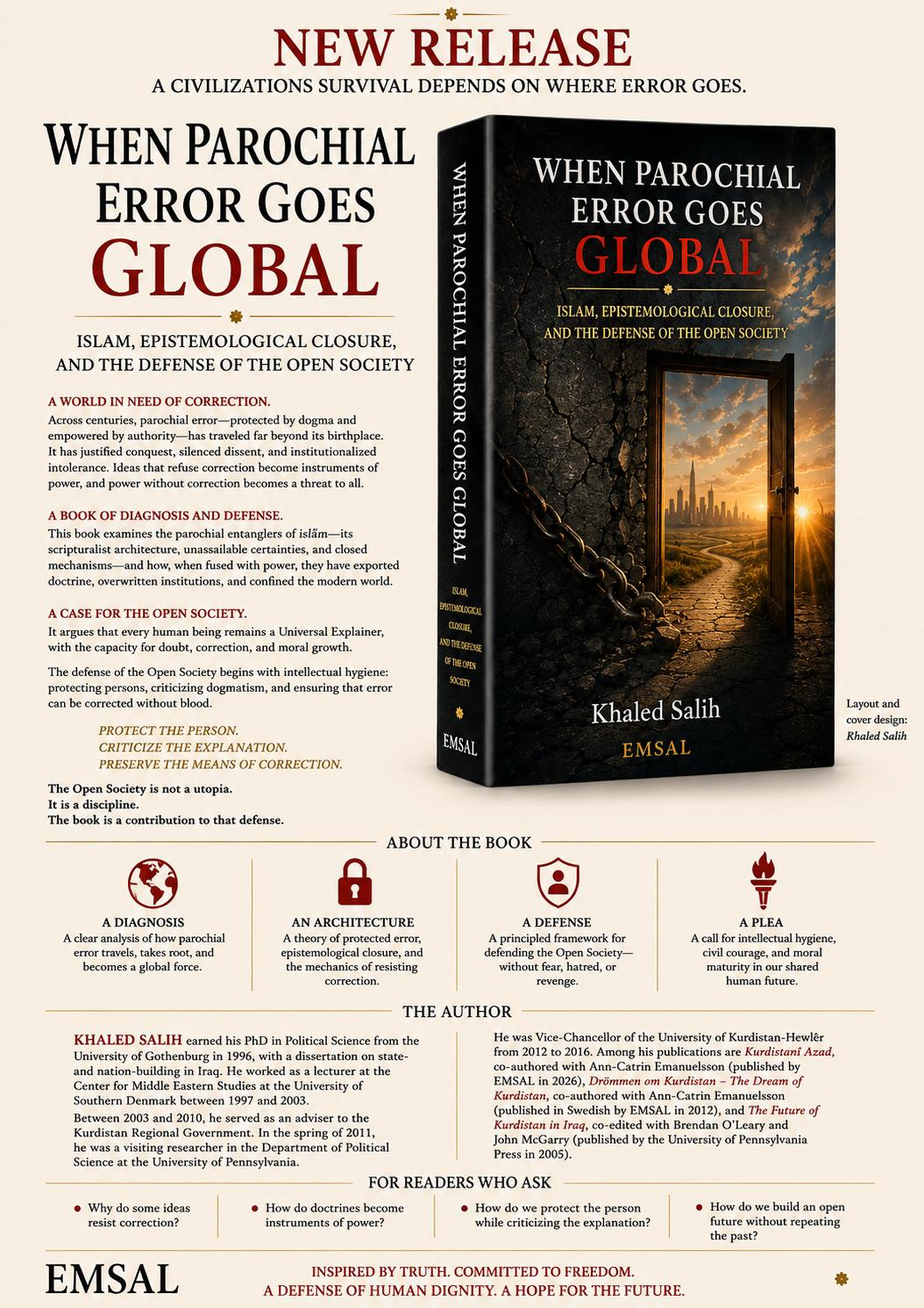
This discovery reminded me of the problem I analyze in my recently published book, When Parochial Error Goes Global.
I need to be precise here.
I am not saying that Proposition speakers are Muslims.
I am not saying Palestinian advocacy is islām.
I am not saying anti-Zionism is Islamic theology.
And I am certainly not saying that criticism of Israel is inherently anti-rational.
The resemblance I am interested in is architectural.
In When Parochial Error Goes Global, islām is a restricted technical term for a closure mechanism in which foundational authority is protected from correction. It does not mean Muslims, Muslim civilization, or the totality of Islamic history and experience.
The mechanism is:
Protected premise → restricted criticism → rival explanations morally downgraded → legitimate alternatives narrowed → future choice-space constrained.
Watching parts of the Oxford Proposition, I recognized something structurally similar—not Islamic or theological, but epistemological.
A foundational explanation is established.
Zionism is assigned an underlying essence.
Historical events are interpreted through it.
Counterexamples become difficult to make consequential.
The rival narrative becomes morally suspect.
Eventually, the rival’s political legitimacy may itself become conditional.
The range of acceptable futures narrows.
That is precisely why the method in When Parochial Error Goes Global must detect closure wherever it appears: among religious movements, secular intellectuals, anti-colonial movements, nationalists, Israelis, Palestinians—and in my own arguments.
Otherwise I have constructed a weapon, not a method.
Supremacy Can Return Wearing the Clothes of Anti-Supremacy
A movement may oppose supremacy and still construct a closed future.
Suppose its argument becomes:
One people’s historical claim is inherently legitimate; the other’s is inherently colonial.
One people’s political existence is unconditional; the other’s depends upon moral approval.
One identity belongs naturally to the future; the other must continually justify its continued presence.
An anti-supremacy argument can then create its own hierarchy of legitimate existence.
This does not prove that every one-state proposal, anti-Zionist argument or Palestinian liberation project does so.
It means they must answer the question.
So must Zionism.
So must Kurdish nationalism.
Arab nationalism.
Turkish nationalism.
Political islām.
And every political project claiming authority over the future.
No exemption.
The Future-Opponent Test
I therefore propose another test:
Does the political future I am proposing still contain a legitimate place for the people whose present explanations, leaders or institutions I oppose?
If yes, specify what must change.
The decision?
The government?
The institution?
The doctrine?
The constitutional architecture?
Then ask:
What mechanisms allow correction?
What protects people after the correction?
What preserves their ability to criticize the new arrangement?
If the answer is no, greater precision becomes morally indispensable.
What exactly must disappear?
The policy?
The ideology?
The organization?
The regime?
The state?
The political identity?
The population?
These are not morally interchangeable propositions.
The farther correction travels from replaceable decisions and criticizable institutions toward permanent collective exclusion, the greater the burden of explanation becomes.
This is Where Does the Error Go? applied to the future.
But one safeguard is indispensable.
The Future-Opponent Test does not require preserving every doctrine, organization, regime, institution or political project. Some doctrines should lose authority. Some organizations should be defeated. Some regimes should disappear. Some institutions should be abolished.
The test concerns the people carried by those explanations.
A corrigible future must distinguish between defeating an explanation and permanently subordinating, politically erasing, or eliminating the human beings who presently carry it.
That is why one of the simplest principles in my work remains so important:
Protect the person. Criticize the explanation.
Corrected Opponents
The Open Society asks us to imagine a future containing people who are presently wrong.
Not protected errors.
Not unreformed institutions.
Not doctrines immune from criticism.
People.
Their governments may change.
Their institutions may be rebuilt.
Their explanations and historical narratives may be criticized.
Their doctrines may lose authority.
Their political arrangements may be transformed.
Yet the people themselves retain human and political standing.
That produces a different conception of victory:
The error disappears while the person remains.
Not:
The person disappears because the error was attached to them.
Perhaps this is one of the deepest political implications of Popper’s epistemology.
Popper wanted theories to die instead of people.
The political extension is that institutions, policies and explanations must remain mortal precisely so that people do not have to pay the price for making them immortal.
Israel and Palestine Need This Question
Apply the Future-Opponent Test to Israel.
Can an Israeli conception of security imagine Palestinians possessing genuine political agency, dignity and a future not permanently subordinated to Israeli fear?
If not, the Israeli choice-space is closed.
Now apply the same test to Palestine.
Can a Palestinian conception of liberation imagine Israeli Jews remaining as a legitimate political community rather than as a temporary colonial population whose future depends upon ideological surrender?
If not, the Palestinian choice-space is closed.
These questions do not decide borders.
They do not decide Jerusalem.
Settlements.
Refugees.
Security arrangements.
One state.
Two states.
Federation.
Confederation.
Or some arrangement that has not yet been invented.
Those are problems for negotiation, criticism, institution-building and future knowledge.
The prior question is whether both peoples remain authorized participants in creating that future.
This Is Not Moral Equivalence
Nothing here requires pretending that power is equal, responsibility symmetrical, or particular crimes morally equivalent.
An Open Society analysis must be capable of saying simultaneously:
This actor possessed greater power.
This decision caused greater harm.
This institution carries greater responsibility.
This atrocity was worse.
This policy was unjust.
And:
No present injustice grants anyone knowledge of the final legitimate human arrangement of the future.
Justice requires judgment.
Fallibilism requires Backspace.
We need both.
Causal interaction is not moral equivalence.
And preserving the opponent’s human standing is not absolving the opponent of responsibility.
The Third Door Has Become Clearer
My third viewing has also clarified something about the Third Door.
The Third Door is not Israel.
It is not Palestine.
It is not one state.
It is not two states.
It is not federation or confederation.
Those are possible answers.
The Third Door is prior to all of them.
It is the preservation of the capacity to create arrangements that present knowledge has not yet made possible.
Neither Israelis nor Palestinians own the complete future choice-space.
Neither do their present leaders.
Neither do their enemies.
Neither does Oxford.
Neither do I.
No present generation possesses the knowledge required to specify every political possibility available to future generations.
That is why:
The absence of a known solution is not evidence that no solution can exist.
And it is why the deepest political closure may occur before a particular solution is prohibited.
It occurs when someone claims authority over which solutions future people will even be permitted to discover.
One More Door
I thought I had finished thinking through this series.
Then I watched the debate again.
That seems appropriate.
A series about error correction should itself remain correctable.
My first question was:
Which Oxford door is right?
Then:
Who built the two doors?
Then:
Can we build a third?
After the third viewing, another question appeared:
Does the future behind your door contain your opponent?
Every political doctrine should have to answer it.
Every nationalism.
Every liberation movement.
Every religion.
Every state.
Every ideology.
Every theory of justice.
And every argument I make myself.
An explanation that imagines justice only after permanently excluding the people it opposes may have stopped explaining how fallible human beings can share a future.
It may instead be explaining why only one side deserves one.
That is where the Backspace Key must be pressed hardest.
A genuinely open political explanation must preserve a future not only for its friends, but for corrected opponents.
That does not mean preserving every existing institution or state exactly as it is.
It does not mean preserving injustice.
It does not mean that every doctrine deserves survival.
The error may have to disappear.
So may the policy.
The government.
The institution.
The organization.
The doctrine.
Even an inherited political architecture.
What must remain is something more fundamental:
people, criticism, correction, and the possibility of creating arrangements better than the ones we presently know.
That is also why this Postscript belongs after the Concluding Remark.
The conclusion was not false because another problem appeared.
It was provisional.
That is what a conclusion should be.
I had reached the best explanation I could formulate.
Then criticism—this time generated by another viewing of the same evidence—created a new problem situation.
Popper would recognize the sequence:
Problem → Conjecture → Criticism → New Problem.
Deutsch adds the crucial consequence:
The new problem may require knowledge that did not exist when the original choices were formulated.
And Brett Hall’s Preservation Principle tells us what must survive while we search:
Do not destroy the means of error correction.
So there is an unexpected symmetry in how this series ends.
Oxford gave me two doors.
I went looking for a third.
But the third viewing did not give me a third answer.
It gave me another question.
And perhaps that is the more important discovery.
Does your enemy exist in your future?
If the answer is no, press Backspace.
Find out exactly what you believe must disappear.
Then ask whether you are correcting an error—
or protecting an explanation in which only your side is permitted to inherit the future.
There is no final menu.
There is no final door.
And, appropriately, there is no final Postscript.
Only another problem.
And the freedom to conjecture again.