Did Israel do a Khaybar against Iran?
A 12-day battle that redefined a decades-long conflict
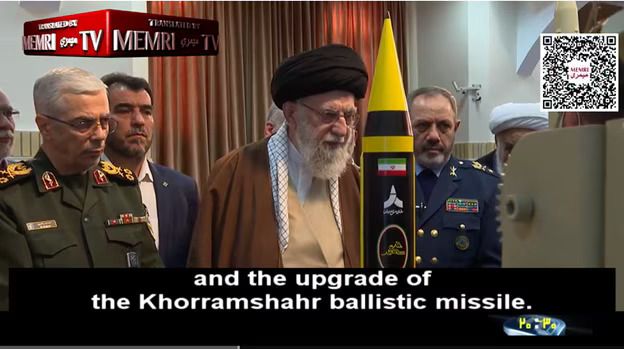
Ayatollah Ali Khamenei, the Supreme Leader (Rahbar in Farsi, Führer in German) and the Commander-in-Chief of the Armed Forces of the Islamic Republic of Iran inspects the latest achievements of a new warhead and the upgrade of the Khorramshahr ballistic missile.
Ali Shamkhani, chairman of the Majlis Supreme National Security Committee, tweeted on April 30, 2022, after Quds Day:
“Great Khomeini’s call for freedom and oppression [sic] has penetrated deeper than ever into the hearts of the lovers of [the] #Islamic Revolution, and the sound of [the] breaking of the bones of international Zionism can be heard louder.”
“Nothing broke their hearts like Imam Khamenei making the Khaybar reference because they know who had tried, failed and fled before the banner was given to Imam Ali (a) - and now, his grandson is exposing their modern-day leaders in the same way! May they die in their disgrace… “ Waleed Ismail
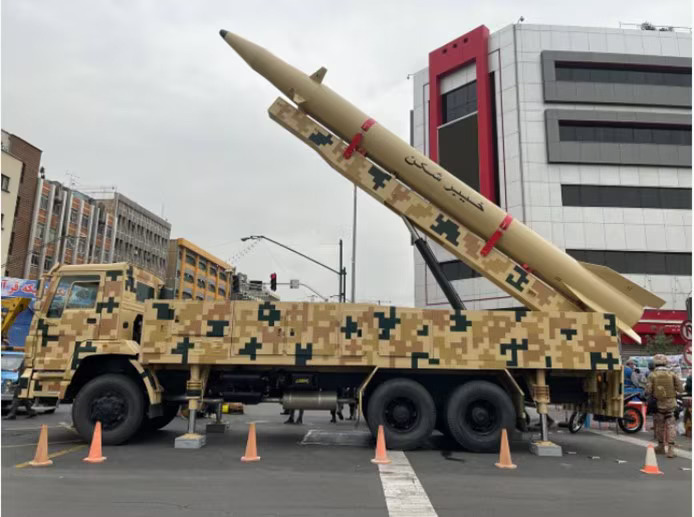
The Kheibar Shekan missile (Source: YJC, Iran, April 29, 2022)
June 2025: A 12-day battle redefined a decades-long conflict. Here’s how Israel flipped the script on Iran’s ambitions, using the symbolic weight of “Kheibar” [Persian transliteration] to deliver a historic blow.
The Weight of a Name
In June 2025, a 12-day military confrontation between Israel and Iran ended with a ceasefire, marking a seismic shift in a decades-long shadow war. At the heart of this conflict lies a single word: Khayber. To understand Israel’s stunning victory, we need to unpack this term—its history, its menace, and how Israel turned it into a weapon of its own.
Khayber harks back to an imagined 7th-century battle where Muhammad’s forces, supposedly, defeated Jewish tribes in an oasis north of Medina. For Iran, naming its ballistic missile “Khaybar” was no accident. With a 1.5-ton warhead capable of catastrophic destruction, the missile was a blunt declaration of intent: to crush modern Israel as its namesake did centuries ago. But in a profound twist, Israel wielded its own metaphorical “Khayber”—a blend of unmatched intelligence, air power, and sheer resolve—to dismantle Iran’s military might, turning the aggressor’s symbol of conquest into one of defeat.
This is the story of how Israel flipped the script, leaving Iran reeling and its ambitions in ruins.
The Battle of Symbols
Let’s start with Khayber itself. Iran’s choice to name its missile after a 7th-century conquest wasn’t just a nod to history—it was a psychological jab, a reminder of Jewish defeat meant to haunt Israel. The Khaybar missile, with its massive payload, was built to make that threat real, capable of leveling cities if mass-produced.
But Israel rewrote the story. In Operation Rising Lion, launched on June 13, 2025, Israel’s air force and intelligence agencies struck with surgical precision. They didn’t just neutralize the Khaybar missile—they obliterated Iran’s ability to wield it. Nuclear facilities, missile arsenals, and key leadership were decimated in a campaign that turned Iran’s symbol of dominance into a monument of its failure. Israel’s “Khayber” wasn’t a missile but a masterclass in strategy, proving that brains and precision can outmatch brute force.
Intelligence and Air Power: Israel’s Lethal Edge
Israel’s victory wasn’t just about firepower—it was about outsmarting the adversary. The Mossad and military intelligence had penetrated Iran’s nuclear and missile programs to an astonishing degree. They knew where the facilities were, who ran them, and how to hit them. When the operation began, Israel’s air force executed thousands of sorties over 12 days, striking nuclear sites like Fordow and Natanz, centrifuge workshops, and missile production facilities. Not a single Israeli plane was endangered—a testament to air superiority bordering on the miraculous.
The results were devastating for Iran. Two-thirds to three-quarters of its nuclear program was wiped out. The Khaybar missile stockpile plummeted from 3,000 to under 500, with production facilities reduced to rubble. Key IRGC commanders, including Hussein Salami and Sedi Zadi of the Palestine Corps, were eliminated, gutting Iran’s command structure. Israel’s intelligence and air power didn’t just win battles—they reshaped the strategic landscape, leaving Iran defenseless against the very weapon it had named to inspire fear.
Iran, the Puppet Master, Becomes Its Own Proxy
Iran’s strategy has long relied on proxies like Hezbollah, Hamas, the Houthis to fight its battles, sacrificing them to shield its homeland while projecting power. Hezbollah was Iran’s “shield and sword,” meant to keep Israel at bay. But in this war, Israel turned the tables.
By destroying Iran’s air defenses and establishing constant surveillance, Israel forced Iran to live in fear of its own skies—just as its proxies do. The ceasefire, mirroring Israel’s agreements with Hezbollah, allows Israel to strike Iranian nuclear and missile sites preemptively. When Iran tested this with post-ceasefire missile launches, Israel responded swiftly, hitting an unmanned radar site to set the terms: comply, or face consequences. Iran, once the puppet master, now finds itself paralyzed, living under the same constraints it imposed on others. In a bitter irony, “Iran has become its own proxy.”
A Regional Power, Humbled
Iran’s defeat wasn’t just military—it was diplomatic and strategic. The Arab world stood silent during the war, with Saudi Arabia and the UAE issuing pleas to avoid spillover, not support for Iran. Hezbollah, despite billions in Iranian funding, publicly refused to join the fight, leaving Iran isolated. It reportedly informed Tehran via email that it cannot engage Israel when Iran needed them like never before. The destruction of Iran’s nuclear program, missile arsenal, and leadership has crippled its ability to project power or deter Israel.
Rebuilding will take years, if not decades. Fear of Israel’s intelligence will force Iran into smaller, compartmentalized operations, much like Hamas after October 7. Economic sanctions, unlikely to ease under U.S. policies favoring energy dominance, will further choke Iran’s recovery. The “Khayber” missile, meant to cement Iran’s regional dominance, now symbolizes its collapse.
A New Chapter, Not an Ending
The 12-day war of June 2025 didn’t end the Israel-Iran conflict, but it transformed it. Israel took Iran’s symbol of conquest and made it a marker of its own triumph. Through intelligence, air power, and unrelenting resolve, Israel dismantled Iran’s nuclear ambitions, missile stockpiles, and leadership, forcing Iran to live under the constant threat it once wielded.
The silence of Iran’s allies and the wreckage of its capabilities paint a stark picture: a regional power brought low. Israel’s “Khayber” didn’t just kill Iran’s missile—it killed its aspirations. However, the conflict endures, demanding vigilance to sustain this victory. For now, Israel stands stronger, its people safer, and its adversary weakened for years to come.
What did you think of this piece? Share your thoughts below, and let’s keep the conversation going.


