Denuding Orientalism: Time to Scrutinise Edward Said’s Vision
By Khaled Salih
Let us begin where the fever actually lies: not in a point‑scoring quarrel with “Orientalism,” but in the high‑voltage room where its foundational arguments are subjected to a battery of powerful analytical frameworks, and its gears and pulleys laid bare as the thing they are—an elaborate machine for producing a bad explanation. This paper refuses the joust and goes straight for the armoury: it identifies Said’s adoption of Sowell’s Unconstrained Vision—complete with crisis, culprit, cure and a priesthood exempt from error—and then shows how the apparatus is kept running by insulation from evidence. Hence the melodramatic opening move (“a formidable structure of cultural domination”), the coy demurral (“not some nefarious ‘Western’ imperialist plot”), the stage‑managed villains (“political polemicists pretending to knowledge”), and the self‑canonisation of the critic as emancipator (“critical thought [that] does not submit to state power”). When contradicted, the hedgehog rolls tighter: Lewis is recast as exhibit someone who “helped the American hawks to think about such preposterous phenomena as the Arab mind,” and dissent itself becomes proof of the prosecution. This is not the open‑ended game of inquiry; it is the finite gamer’s board—your type with an unconstrained vision—on which the outcome is fixed and the scoreboard labelled “Reality” is only a mirror facing another mirror: a “self‑referential ‘hall of mirrors’ … insulated from reality.”
Beyond the Polemic
In this analysis I do not seek to engage in a point-for-point debate with Edward Said’s Orientalism. To do so would be to accept the terms of engagement set by the work itself, a concession no one should be prepared to make. Instead, my objective is strategic: to subject the foundational arguments and methodological integrity of Said’s influential thesis to a battery of powerful analytical frameworks. This shall serve as an intellectual stress-testing, employing the integrated lenses of political philosophy, cognitive science, operational methodology, and evolutionary theory to reveal the critical vulnerabilities in what is often considered a monolithic work. I shall not argue with the conclusions, but to lay bare the intellectual machinery that produced them.
The central thesis of my analysis is that Edward Said’s Orientalism, while presented as a scholarly critique, is itself a textbook example of a methodologically unsound, cognitively biased, and ultimately bad explanation that fails the most basic tests of analytical rigour. It is a structure built on a flawed vision, assembled through a failed process, and animated by a pathological cognitive style that wilfully ignores the foundational realities of the human condition.
I shall proceed by first diagnosing the ideological vision that underpins Said’s work, revealing its predictable intellectual architecture. From there, I will critique his analytical process, exposing a catastrophic failure in the assessment phase. Next, I will explicate his cognitive style, demonstrating how it creates a self-referential hall of mirrors that is insulated from reality. Subsequently, I will expose the fallacies in his core explanation and, finally, outline the crucial, universal dimensions of human reality his framework entirely excludes.
I shall begin, as any rigorous analysis must, not with the argument’s intricate details, but with the unstated worldview that animates the entire project.
Said and the Architecture of the Anointed
Before analysing the particulars of his argument, it is strategically crucial to identify its core vision—the foundational, often unstated, intellectual and moral architecture upon which it rests. As Thomas Sowell’s work makes clear, this underlying vision dictates the questions asked, the evidence considered, and the conclusions drawn. To understand Said’s project, we must first expose its operating system: what Sowell terms the Vision of the Anointed, a specific subset of the more general Unconstrained Vision. Said’s entire intellectual edifice maps perfectly onto its four-stage narrative structure.
- The Crisis Identified. The vision begins by identifying a pervasive crisis, a state of affairs deemed not merely suboptimal but morally unacceptable. Said accomplishes this by declaring the existence of “a formidable structure of cultural domination” (Said 1997, p. 25) which he names “Orientalism.” This is not presented as a complex historical phenomenon with multiple causes, but as a malignant force imposing its will upon the world.
- The Assignment of Cause and Blame. The crisis is then attributed not to systemic factors or tragic trade-offs inherent in the human condition, but to the malign actions of a specific group. Said is explicit that Orientalism is not “some nefarious ‘Western’ imperialist plot” (Said 1997, p. 12), yet his analysis functions by attributing the crisis to the collective intellectual and political projects of a monolithic “West.” The problem originates with “political polemicists pretending to knowledge” and “experts who have supposedly penetrated to the heart of these strange Oriental peoples” (Said 1997, p. xv). This rhetorical manoeuvre disclaims a simple conspiracy only to replace it with a more diffuse but equally totalising system of blame, simplifying a complex reality into a moral melodrama of heroes and villains.
- The Proffered Solution. The vision presents a solution which invariably involves vesting greater power and discretion in surrogate decision-makers—intellectuals and planners—who possess the superior wisdom needed to rectify the crisis (Analyst Master Framework). Said’s solution is his own critical work, a call for “critical thought [that] does not submit to state power” (Said 1997, p. xxii). This positions the secular, critical intellectual (such as himself) as the agent uniquely equipped to diagnose and oppose the crisis, perfectly aligning with the tenets of the Unconstrained Vision.
- The Insulation from Evidence. Finally, the vision is insulated from empirical falsification. When the proffered solution fails or is challenged, the failure is not attributed to a flawed premise. Instead, critics are dismissed as being part of the problem. Said’s response to his chief critic, Bernard Lewis, exemplifies this tactic. Lewis is not engaged as a scholarly peer with a competing interpretation of evidence; rather, he is framed as a key actor in the very crisis Said describes, an expert who “helped the American hawks to think about such preposterous phenomena as the Arab mind” (Said 1997, p. xv). Any critique is thus absorbed as further proof of the original diagnosis, a tactic that renders the vision a closed logical loop, impervious to contradictory evidence (Sowell 1995).
Having identified the flawed vision, we must now dissect the flawed process by which it was constructed.
The Failure to Assess
In any high-stakes analysis, proper assessment is not a recommendation; it is a non-negotiable prerequisite for a credible outcome. The ACE Helix framework—Assess, Choose, Execute—codifies this reality, establishing that a flawed assessment guarantees a flawed result, regardless of the brilliance with which subsequent steps are executed (Lee 2023). A methodological audit of Said’s work reveals a catastrophic failure at this foundational stage.
The crash of Air France 447 serves as a stark analogy. The root cause of the disaster was not a technical malfunction but a human one: the pilot, Bonin, skipped the Assess phase and immediately acted on a flawed assumption, creating a terminal crisis from a recoverable problem (Lee 2023). Said commits the same fundamental error. He begins with a desired conclusion—the essential culpability of a monolithic “West”—and bypasses the rigorous, dispassionate investigation required. He fixates on his instruments, which point to a crisis of his own making, and pulls back on the stick, stalling the entire intellectual enterprise.
A rigorous assessment would have required, at a minimum, the following actions, none of which Said undertakes:
- Define Every Term. The Socratic imperative to define all key terms is the first principle of analytical rigour, as manipulation thrives where meaning becomes ambiguous. Said’s central categories—“The West” and “The Orient”—are precisely the kind of broad, emotionally resonant but analytically hollow constructs that defy clear definition. He builds his entire argument upon them while simultaneously, and without any sense of irony, condemning the use of “falsely unifying rubrics like ‘America,’ ‘The West’ or ‘Islam’” (Said 1997, p. xxii), exposing a fatal internal contradiction.
- Consider Counter-Examples. A core tenet of sound analysis is the systematic search for contradictory evidence. If a principle is claimed to be universal, “a single significant counter-example can be enough to question its validity as an automatic explanation” (Sowell 2023). Said’s method is the opposite; he amasses a body of confirmatory texts while failing to search actively for cases where his thesis does not apply. He does not seek out Western scholars who offered non-dominating views of the East, nor does he examine non-Western cultures (such as the Ottoman Empire) that exhibited their own forms of imperial and cultural domination. This is not scholarship; it is confirmation bias elevated to a methodology.
- Disaggregate Monolithic Groups. The analytical method of disaggregation—breaking down monolithic blocks to uncover crucial internal variations—is essential to preventing sweeping and misleading conclusions (Sowell 2023). Said’s treatment of “the West” and “Orientalism” as monolithic entities is a profound analytical failure. He ignores vast internal dissent and chronological variation, lumping together disparate figures who read and cited each other across centuries—from “Nerval, Flaubert, and Richard Burton” reading Lane (Said 1997, p. 23)—into a single, unified agent driven by a single, unchanging will.
This comprehensive failure in analytical process is not accidental. It stems from a fundamentally flawed cognitive style, which operates like a self-referential hall of mirrors.
Cognitive Style Analysis
A truly deep analysis interrogates not just what an author argues, but how their cognitive style shapes their perception of reality. Using Iain McGilchrist’s framework of the Master and his Emissary, we can diagnose the underlying intellectual pathology of Said’s work. Orientalism is a quintessential product of what McGilchrist calls Left Hemisphere Capture—a state in which the brain’s abstracting, categorising, and utility-focused functions usurp the holistic, contextual awareness of the whole.
Said’s work is the Emissary’s “map” of reality—abstract, fragmented, decontextualised, and focused on political utility. His very definition of Orientalism as a “discourse” and “a distribution of geopolitical awareness into aesthetic, scholarly, economic, sociological, historical, and philological texts” (Said 1997, p. 12) reveals this abstracting tendency. It is a theory about texts, categories, and representations, not about the lived, complex reality of human interaction.
The pathology of this cognitive capture is profound. As in the fable, the Emissary, having created his own map, comes to believe it is superior to the territory itself. Said’s framework becomes a “self-referential system of control—a hall of mirrors”. Once the rigid, binary opposition of “Orient/Occident” is established as the primary reality, every text becomes merely a reflection confirming the map’s internal logic. The system is cut off from the lived reality it was meant to serve. Said provides definitive proof of this closed loop in his own argument that “Orientalism” as a political-intellectual culture has less to do with the “Orient” than it does with “our” world (Said 1997). This is the Emissary’s triumphant declaration of independence from the Master—and from reality itself.
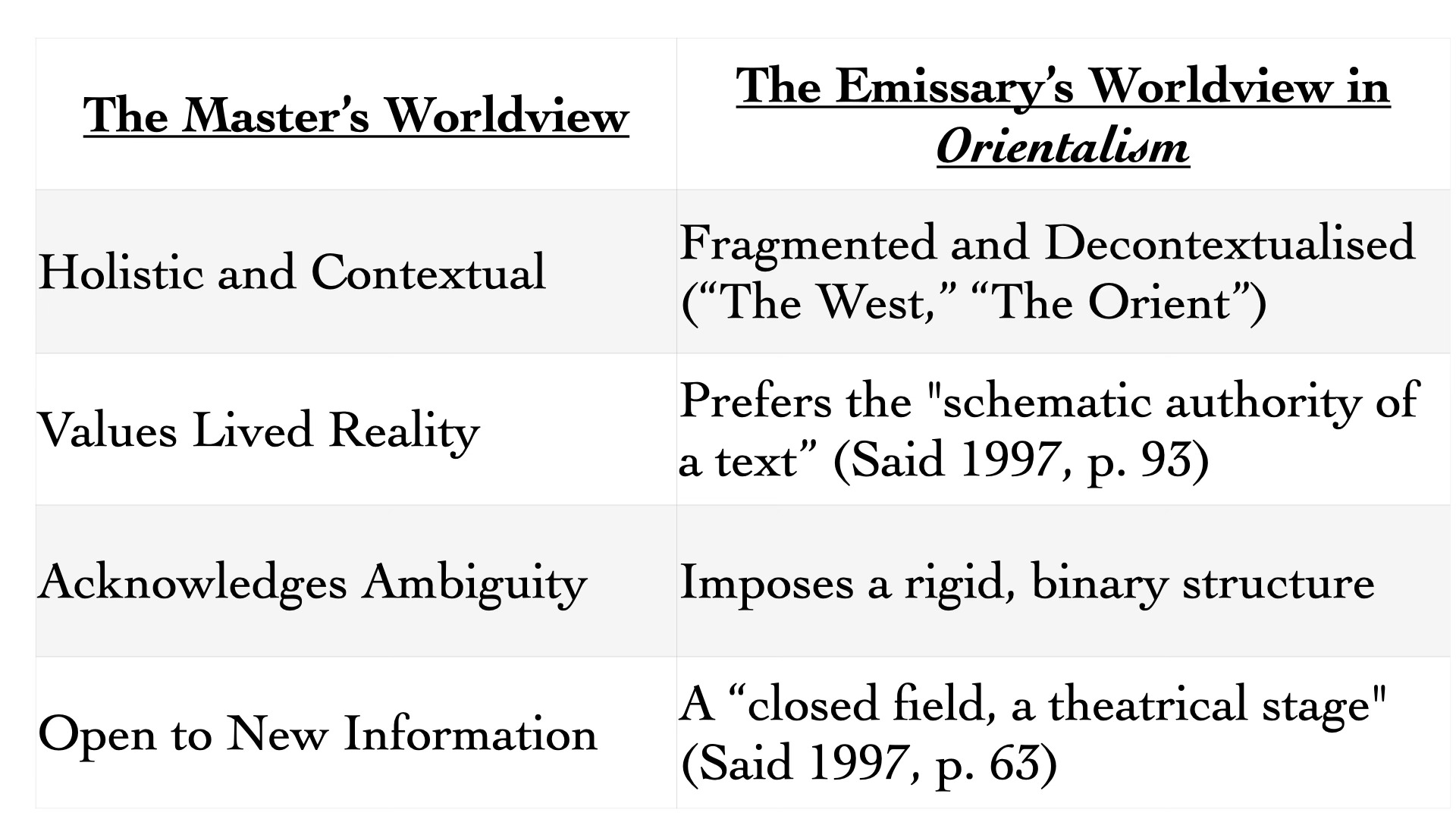
A theory born of this cognitive style—a theory that explicitly elevates its own internal consistency above any correspondence with the real world—is inevitably a Bad Explanation when judged against objective criteria.
The Missing Universals
Any socio-political theory that ignores or denies the foundational discoveries of modern biology and evolutionary science is not merely incomplete; it is fatally crippled. An analysis of Edward Said’s work reveals a profound and deliberate void at its core: the complete absence of any conception of a universal human nature. This omission is not a minor oversight but a critical methodological failure that invalidates his entire explanatory framework.
Applying the “Pathogen Screener” from our analytical toolkit, we can diagnose Said’s framework as suffering from Ostrich Parasitic Syndrome (OPS). This is a “malady of disordered thinking that robs people of their ability to recognize truths that are as obvious as the existence of the sun.” Its key symptom is on full display in “Orientalism”: biophobia—the deep-seated fear and rejection of biology in explaining human phenomena. By operating on an implicit “blank slate” model of humanity, Said’s work completely ignores the immense explanatory power of evolutionary psychology, offering instead a simplistic, single-cause theory of cultural power dynamics.
- Universal Human Nature vs. Cultural Blank Slate. Said’s framework mistakes the culturally specific expressions of human behaviour for a uniquely Western pathology. For instance, he details Lord Cromer’s rigid distinction between the logical “European” and the illogical “Oriental” (Said 1997) as a pure ideological construct of imperial power. An evolutionary perspective offers a more parsimonious explanation: such rigid in-group/out-group distinctions are surface-level expressions of a universal, evolved coalitional psychology (Stewart-Williams 2018). While Said’s lens sees a uniquely Western will-to-power, a biological lens reveals a familiar pattern of human tribalism, found in varying forms across all cultures and eras. Said describes the symptom; he fails to diagnose the disease.
- Parental Investment Theory vs. Patriarchal Domination. Said masterfully dissects Western representations of “Oriental” women, such as Flaubert’s depiction of the Egyptian courtesan Kuchuk Hanem as a figure of pure, mute sensuality (Said 1997). He attributes this objectification to a uniquely Western, male, colonial gaze. Yet this explains only the specific cultural flavour of the depiction, not its fundamental psychological structure. Robert Trivers’s parental investment theory provides a more fundamental explanation for the near-universal pattern of male mating psychology being highly attuned to female youth and sexuality (Stewart-Williams 2018). The imperial power dynamic Said identifies undoubtedly shaped Flaubert’s opportunity and expression, but the underlying psychological focus is a manifestation of a species-typical pattern, not a colonial invention.
By rejecting the biological, Said’s framework becomes an exercise in explaining everything and nothing. It is incapable of distinguishing between the expressions of a universal human nature and the unique products of a specific culture. The framework itself, however, can be analysed through a modern evolutionary lens. Orientalism can be seen as a highly successful “meme,” or “memeplex”—a unit of culture that spreads not because it is true, but because it is fit (Stewart-Williams 2018). Its memetic fitness is derived from several key attributes:
- It provides a simple, morally satisfying narrative (oppressor vs. oppressed).
- It exploits powerful psychological buttons, particularly grievance and guilt.
- It contains powerful “memetic firewalls” against criticism. Much like the concept of “faith” in a religion (Stewart-Williams 2018, p. 265), the theory frames any critique not as a scholarly disagreement but as proof of the critic’s own “Orientalist” bias, thereby neutralising dissent.
By replacing Said’s flawed, single-cause explanation with a multi-causal, co-evolutionary framework that integrates both biological and cultural evolution, we can construct a far more robust and useful understanding of human history.
Escaping the Emissary’s Trap
When subjected to rigorous, multi-disciplinary analysis, Edward Said’s Orientalism is revealed not as a work of liberation, but as an intellectual trap. It is a product of the Unconstrained Vision, constructed via a profoundly flawed analytical process rooted in a failure to Assess, and is characterised by a pathological cognitive style—Left Hemisphere Capture—that severs its connection to reality.
His central thesis must be classified as a Bad Explanation precisely because it is easy-to-vary. This is not a matter of opinion, but a direct consequence of his failed analytical process. Because his core categories of “Orient” and “Occident” are ill-defined and monolithic, and because his method wilfully ignores counter-examples and the universals of human nature, his narrative of domination can be applied indiscriminately, explaining too much, too easily, and therefore explaining nothing with rigour. In contrast, the hard-to-vary explanation constructed through the disciplined application of our frameworks is a more robust analytical product derived from a superior process. It does not deny conflict or domination, but sees history as a complex co-evolutionary process shaped by the hard constraints of geography (Sowell 2023); by the universal grammar of an evolved human biology (Stewart-Williams 2018); and by the differential success of competing ideas, or memes, in the unforgiving marketplace of human culture (Stewart-Williams 2018).
This analysis was never intended as a mere demolition of a single, flawed work. It was a demonstration of a method. The denuding of Orientalism is simply the consequence of applying a higher standard of thought—one that rejects easy answers, ideological comfort, and the seductive simplicity of a hall of mirrors. The fundamental responsibility of the serious analyst is not to confirm a preferred vision, but to ask the harder questions that dismantle them.
What survives the stress‑test is therefore not much of Said’s explanatory engine: its master categories are falsely unifying rubrics like “America,” “The West” or “Islam,” its method prefers the schematic authority of a text, and its theatre—Said’s word—is a closed field, a theatrical stage in which the audience is told the “Orient” matters less than “our” world. The consequence is an easy‑to‑vary story—one that must be classified as a Bad Explanation—made possible by skipping the Assess in any respectable Assess, Choose, Execute discipline, by ignoring counter‑examples, and by mistaking memetic success for truth while leaving universal human nature out of the ledger. The superior alternative on offer is not a consoling slogan but a harder‑edged standard: define your terms, disaggregate your blocs, hunt contradictions, and keep your map answerable to the territory. Or, as a closing remark—less a benediction than a dare—
We can save the world by asking the right questions. What questions are you going to ask?
Be that analyst: eyes on the horizon, fingers on the footnotes.
References:
Mats Alvesson & André Spicer, 2016, The stupidity paradox: The power and pitfalls of functional stupidity at work. London: PROFILE BOOKS LTD.
James P. Carse, 1986, Finite and Infinite Games: A Vision of Life as Play and Possibility. New York, NY: The Free Press, A Division of Macmillan, Inc..
David Deutsch, 2011, The Beginning of Infinity: Explanations that Transform the World. New York, New York: VIKING (Published by the Penguin Group).
The Duke Report, 20250807, “A User’s Guide to Neuro-Linguistic Defense. Defending Yourself From Word Magic.”

Hussein Aboubakr Mansour, 20251112, “The Age of Moral Sadism Nazis, Tarantino, Israel, Negative Morality, and the Pleasure of Punishment.”
Iain McGilchrist, 2019, The Master and His Emissary: The Divided Brain and the Making of the Western World. New Expanded Edition. New Haven and London: YALE UNIVERSITY PRESS.
—, 2021, The Matter With Things: Our Brains, Our Delusions and the Unmaking of the World. London: Perspectiva Press.
Thomas Sowell, 2007, A conflict of visions: ideological origins of political struggles. New York, NY: Basic Books.


