Britain Bombed Kurdistan. A Century Later, It Still Wants to Decide Its Future.
From the Royal Air Force to the Home Office: a century of British double standards toward Kurdish political agency
9 October 2026
There is something remarkable about reading a British government report on Kurdistan.
Not because Britain has no right to examine the conditions facing people who seek asylum. It has a responsibility to establish the facts and assess protection claims fairly. The remarkable thing is the historical position from which Britain conducts the examination.
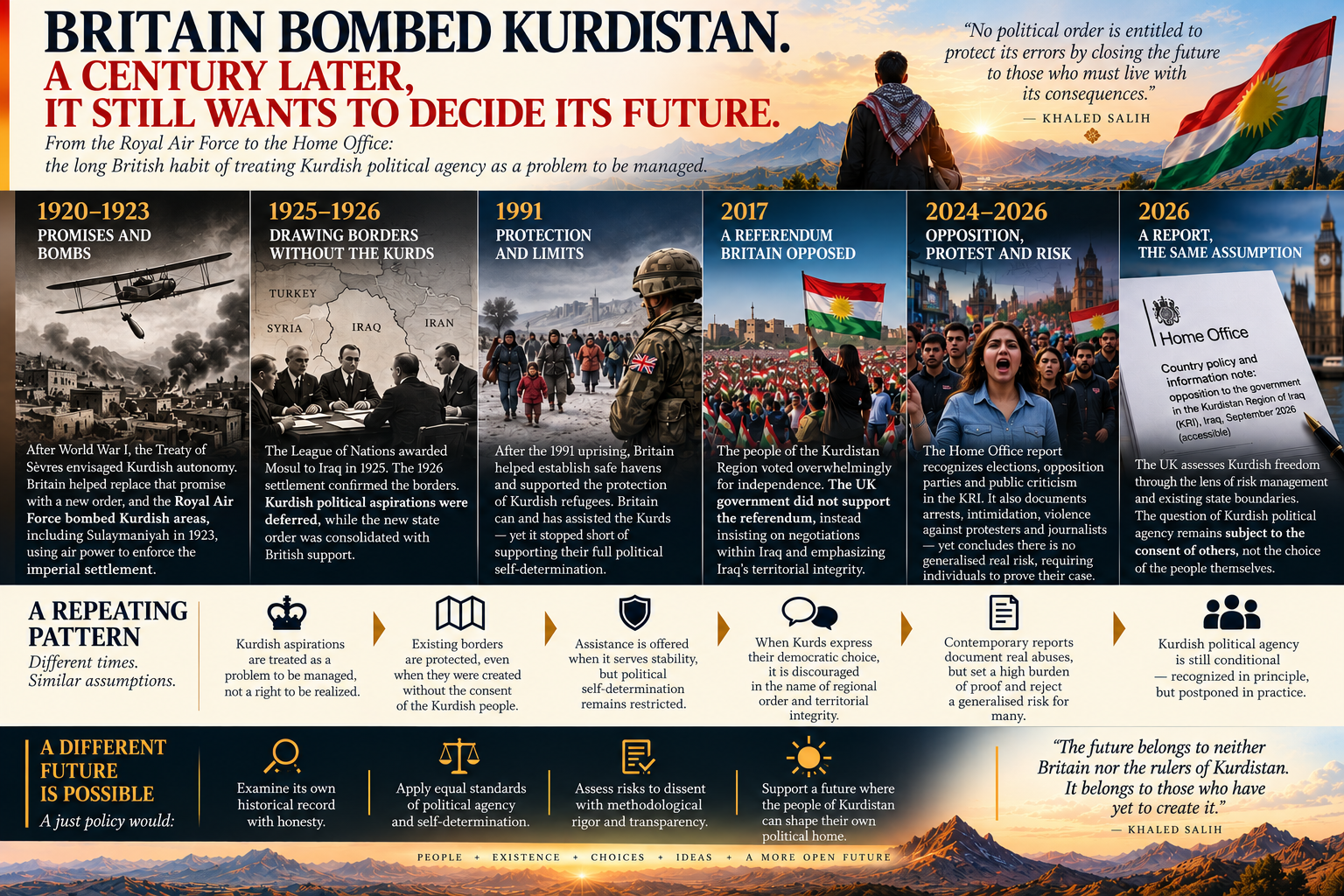
A century ago, British aircraft were used to enforce an imperial settlement in Kurdish-inhabited territory. In 2017, Britain opposed the referendum through which people in the Kurdistan Region expressed their wish for independence. In October 2026, the British Home Office again speaks with the authority of an established state, assessing Kurdish political life through categories devised in London.
These are different actions with different immediate purposes. They do not prove a single, uninterrupted intention. But they expose a question Britain has repeatedly struggled to answer: When are Kurds entitled to become authors of their own political future, rather than subjects of arrangements approved by others?
I have spent much of my intellectual life examining explanations that acquire protection against criticism. Britain’s relationship with Kurdistan offers a test of that problem. The troubling issue is not whether every British policy has been hostile. It has not. The issue is why Kurdish political agency so often becomes negotiable while the sovereignty of the states surrounding Kurdistan is treated as the starting point beyond which discussion should not proceed.
The Aircraft Came First
The history begins with the settlement that followed the First World War. The Treaty of Sèvres in 1920 contemplated Kurdish autonomy and a conditional route toward independence. That settlement did not take effect. The Treaty of Lausanne in 1923 contained no equivalent provision. Britain was one of the principal powers shaping the new regional order, and its decisions had enduring consequences for Kurdish political possibilities.
Britain did not merely participate in conferences and negotiations. It used aircraft to enforce authority. The Royal Air Force’s historical chronology records operations in Southern Kurdistan (in what later became part of newly created Iraq) in 1922, including air attacks around Koye, and the RAF’s assumption of military control in Iraq that October. RAF operations also targeted Sheikh Mahmud’s movement and Sulaymaniyah during the following years. The historical details of individual operations must be distinguished; not every mission had the same target or purpose. Yet the underlying political fact is unmistakable: British air power helped sustain an order whose legitimacy Kurdish inhabitants had not been allowed to determine.
The image is difficult to forget. An imperial government claiming the right to organize a territory from above was also able to strike it from above.
What made a people who sought political self-government into a security question within an arrangement they had not designed? And why did the coercive enforcement of the arrangement count as order, while challenges to it were so readily described as instability?
This is not a demand that today’s Britain inherit personal guilt for every imperial decision. It is a demand that Britain inherit the obligation to examine the political assumptions those decisions helped establish.
The State Was Recognized. The Kurdish Future Was Deferred.
In 1925, the League of Nations recommended that the Mosul wilayet remain within Iraq under specified conditions. The territorial outcome was consolidated through the 1926 settlement involving Britain, Iraq, and Turkey. The political map became more definite. The Kurdish future did not.
Britain had strategic interests. Turkey had territorial claims. Oil, imperial communications, and the stability of the new state in Iraq mattered to decision-makers. Historical explanation requires acknowledging these considerations. Moral and political judgment requires asking why their importance repeatedly outweighed the political agency of the population whose future was being arranged.
Here is the asymmetry.
Established states have interests; Kurds are said to have aspirations. Established states possess territorial integrity; Kurds are said to have grievances. Established states negotiate security; Kurds are asked to understand the security requirements of their neighbors. The political existence of one actor is assumed, while the political existence of another becomes a proposition that must continually justify itself.
A state may change its institutions, revise its constitution, or survive decades of political error without its entitlement to exist being placed in question. Kurdish self-government, by contrast, has often been judged against standards that the surrounding states were not asked to satisfy before being recognized.
This is the offense of existing: not an actual offense committed by Kurds, but the extraordinary requirement that their political existence itself must be defended as though it were an exception to the normal rules of political life.
The Referendum Britain Would Not Support
On September 25, 2017, voters in the Kurdistan Region and participating disputed areas overwhelmingly supported independence in a referendum. The British government opposed the vote. Foreign Secretary Boris Johnson stated that the United Kingdom did not support the referendum and reaffirmed its commitment to Iraq’s sovereignty and territorial integrity.
Britain recommended negotiations between Baghdad and Erbil, with international engagement, as the preferred route to resolving outstanding disputes. Negotiation can be valuable. The problem is what happens when it becomes the only acceptable route and one of the parties is able to withhold agreement indefinitely.
What would Britain do if Baghdad refused a meaningful settlement? What would count as sufficient evidence that existing constitutional arrangements had failed to resolve the question? What remedy was available if commitments remained unimplemented? At what point would a policy of postponement become an effective veto over a people’s future?
Britain participated in the coalition that overthrew Saddam Hussein and helped shape Iraq’s post-2003 political order. Article 140 of Iraq’s 2005 Constitution required a process addressing the status of Kirkuk and other disputed territories, with a deadline of December 31, 2007.
What concrete diplomatic, political, or institutional measures did successive British governments take to press successive Iraqi governments to fulfill that constitutional commitment after the deadline passed—and, nearly two decades later, what evidence can Britain offer that its insistence on Iraq’s territorial integrity was matched by an equally sustained insistence on implementing Iraq’s own Constitution?
Britain’s position did not supply a convincing answer. Its insistence on Iraq’s territorial integrity operated as a firm premise, while Kurdish self-determination remained conditional.
The contradiction was not invisible inside Britain itself. In 2015, the House of Commons Foreign Affairs Committee described Kurdish independence as a rational aspiration and urged readiness to respect a clear expression of support for it on reasonable terms. British parliamentarians could see that the future of Kurdistan was a legitimate political question, not merely an administrative difficulty.
The British government’s 2017 response therefore cannot be defended as the only position available to a serious observer. A more open position was already available within Britain’s own institutions.
Britain did not have to promise automatic recognition of a new state. It did have to explain what evidence, what process, and what conditions would lead it to reconsider the territorial status quo. Without such an answer, the language of caution risks functioning as a permanent refusal disguised as temporary advice.
The Home Office and the Appearance of Neutrality
The latest Home Office document, Country Policy and Information Note: Opposition to the Government in the Kurdistan Region of Iraq, version 4.0, dated September 2026 and updated October 6, is an asylum-policy document. It is not a manifesto against Kurdish statehood, and it would be misleading to pretend otherwise.
But its institutional position is revealing. The British state presents itself as the assessor: it determines what counts as relevant evidence, which political experiences fit legal categories, and how much risk an individual must establish to obtain protection. The right to assess asylum claims is real. So is the obligation to examine the assumptions embedded in that assessment.
The report distinguishes ordinary opposition supporters from people with particular profiles who may face greater risks. It cites protest-event statistics, including 510 recorded protests between August 2024 and August 2026: 498 classified as peaceful without intervention, nine involving intervention, and three involving excessive force. The report uses these figures as part of its evaluation of risk.
The numbers may accurately describe the events recorded. But the methodological question remains: do they measure the phenomenon the Home Office claims to assess? Recorded events are not the same as the full universe of political choices available to people. A dataset of protests cannot by itself reveal how many people chose silence because of anticipated consequences. Nor can events addressing very different subjects automatically be treated as equivalent tests of the safety of politically consequential dissent.
The Home Office must show the bridge between observation and conclusion. Which events are comparable? What is the relevant denominator? How are deterrence and underreporting considered? What evidence could change the assessment? How does it distinguish a legal category from the lived political circumstances it is intended to capture?
These questions concern the rigor of British reasoning. They do not require me to make a judgment here about Kurdish parties, leaders, or institutions. That is not the subject of this essay. My subject is the long British habit of evaluating Kurdish political life while leaving the inherited framework of Kurdish political subordination insufficiently examined.
There is an especially uncomfortable historical irony. The power that helped consolidate the state structure within which Kurdistan was placed now evaluates Kurdish political experiences as though that structure were simply a neutral background fact. Britain’s own role in making the background disappears from the foreground of its analysis.
A Home Office country note cannot be expected to settle a century of international politics. But Britain can be expected to recognize that administrative neutrality is not achieved merely by omitting the history of the assumptions under which administration takes place.
The British Double Standard
The double standard is not that Britain always refuses to help Kurds. In 1991, Britain participated in international efforts that helped protect Kurdish refugees following mass displacement. Britain later contributed to the campaign against ISIS and supported Peshmerga forces. British parliamentarians, journalists, scholars, and citizens have advocated Kurdish rights. These are real and consequential facts.
They make the deeper contradiction clearer, not weaker.
Britain can help protect Kurds while withholding support for the political future they choose. It can assist their security while insisting that their constitutional possibilities remain subordinate to the territorial integrity of an existing state. It can acknowledge legitimate aspirations while leaving no credible route by which those aspirations might alter its policy.
Protection is not political authorship. Humanitarian assistance is not self-determination. Military cooperation is not a guarantee that a people will be treated as an equal participant in deciding its future.
The question is not whether Britain has ever done anything good for Kurds. It has. The question is whether the governing premise has changed: that the existing territorial arrangement is entitled to presumptive permanence, while Kurdish alternatives carry a burden of justification from which the status quo is exempt.
This asymmetry can survive changes of government, diplomatic language, and historical circumstance. It does not need a conspiracy to persist. It needs only an assumption that is repeatedly inherited and rarely subjected to a serious test.
If British policy is genuinely open to correction, it should be able to state the conditions under which its position would change. If no imaginable Kurdish political achievement, no constitutional deadlock, and no peaceful democratic expression could lead to reconsideration, then the policy is not simply prudent. It has become insulated against evidence.
What Britain Owes the Future
Britain cannot reverse the treaties of the 1920s or undo the RAF operations. It can examine their consequences without euphemism. It can distinguish the legitimate interests of neighboring states from an unlimited right to determine Kurdish political possibilities. It can stop treating the inherited map as a conclusion that must be preserved before any evidence is heard.
A serious British reassessment would ask four questions.
First, what principles justify the sovereignty and self-determination of established states, and why should the same principles not be applied consistently to Kurds?
Second, what peaceful and democratic process could make Britain reconsider its position on an internationally recognized Kurdish state? If Britain cannot describe such a process, its claim to favor an open political future is difficult to sustain.
Third, how can British assessments of asylum risk be made more transparent about evidence, selection effects, and the limits of statistical inference?
Fourth, how should Britain publicly account for its historical role in constructing the territorial order it now invokes as a reason to constrain alternatives?
These are not requests for British permission to imagine a Kurdish future. They are requests for Britain to explain the standards by which it grants established states a political presumption it has so often withheld from Kurds.
In 2005, I co-edited The Future of Kurdistan in Iraq. Twenty-one years later, the word future returns to me with greater force. The question is no longer only what political arrangement Kurdistan may achieve. It is whether any external power is entitled to close off arrangements that future generations may discover, criticize, and create.
I do not claim that a particular constitutional outcome is inevitable. I claim something more fundamental: Kurdish political agency must not remain permanently dependent on the approval of the states that benefit from the existing arrangement.
The Future Britain Did Not Create
I began with aircraft. I will end with something aircraft cannot command.
The future.
Aircraft can destroy buildings. Governments can enforce borders. Treaties can allocate territory. Diplomats can delay decisions. Administrations can classify people. Reports can assess risk.
None of these instruments can determine what knowledge future generations will create.
That is why Britain’s century-long relationship with Kurdistan matters beyond the historical record. It reveals a recurring temptation of power: to mistake an inherited arrangement for a necessary one, and to treat challenges to that arrangement as dangers rather than possible sources of political discovery.
Britain once helped decide where Kurdistan would be placed on the political map. A century later, it continues to influence how Kurdish political claims are assessed, supported, or resisted. The least it owes the future is an explanation of why its own historical preferences should retain authority over possibilities not yet imagined.
No political order is entitled to protect its errors by closing the future to those who must live with their consequences.
The aircraft belonged to the past. The responsibility to correct the explanations that justified the arrangements belongs to the present.
The future belongs neither to Britain nor to any external authority claiming the power to approve it.
It belongs to those who have yet to create it.