Bear witness to cages of ideology: Nadia Murad and Eli Sharabi
By Khaled Salih
This text might be difficult for some people to read.
Two Testaments to Human Endurance
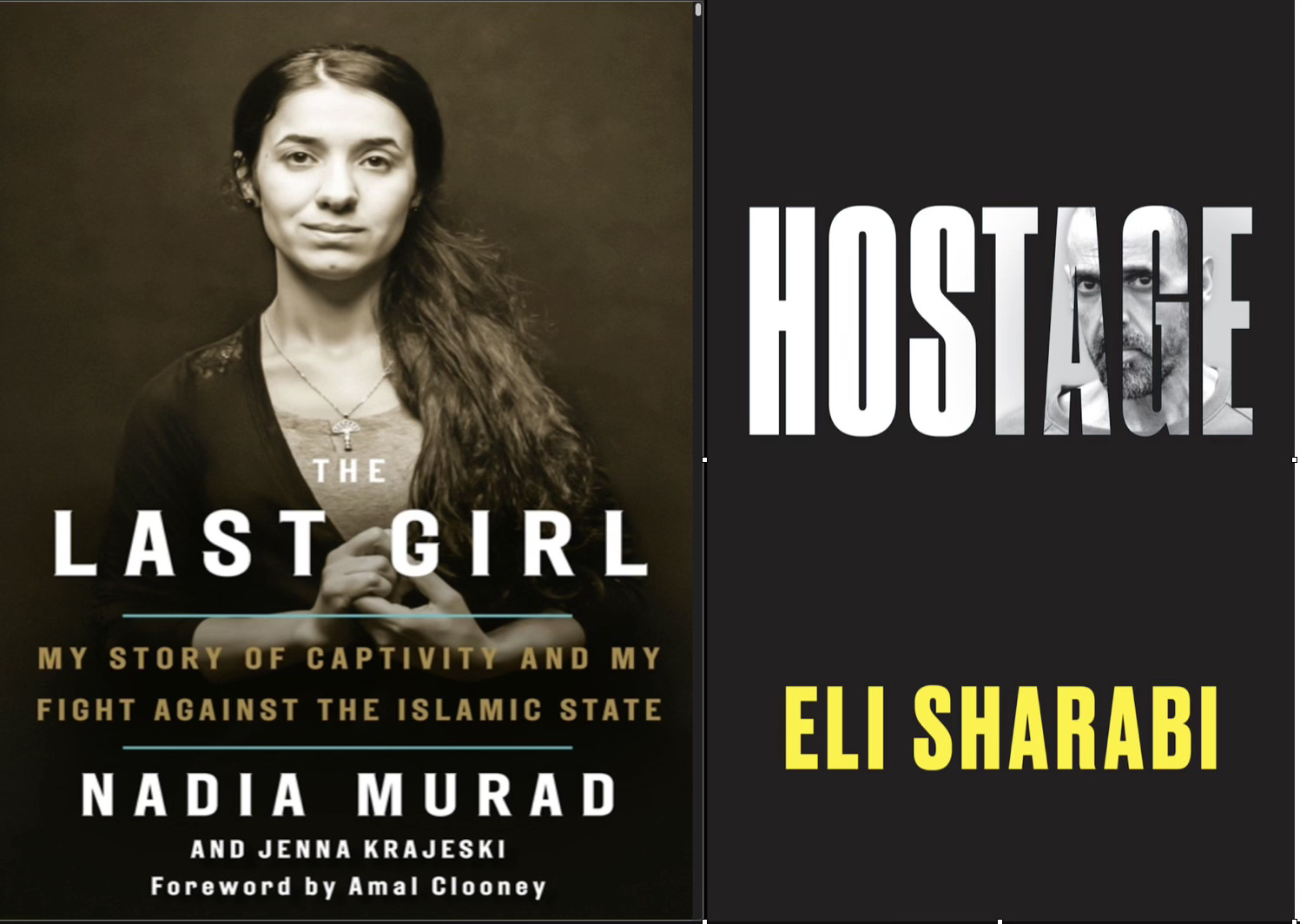
Survivor memoirs hold a profound and unsettling place in the landscape of human literature. They are not merely records of suffering but acts of profound moral courage, forcing readers to confront the methods of atrocity and the depths of human endurance. In the contemporary canon of such works, Nadia Murad’s The Last Girl and Eli Sharabi’s Hostage stand as two critical individual testaments to ideology-driven violence in the 21st century. Each narrative emerges from a distinct cataclysm: Nadia’s abduction occurred during the 2014 ISIS genocide against the Yazidi people in Sinjar, Kurdistan (Iraq), while Eli was taken captive during the Hamas-led attack on Israel on October 7, 2023. They were separated from their families, stripped of their identities, and subjected to the absolute power of captors who viewed them not as human beings, but as property or political assets.
I argue that despite the distinct geopolitical contexts and the different forms of brutality they endured, Nadia’ and Eli’ stories converge to reveal the shared brutalities of ideologically-driven terror, the complex psychology of the captor-captive relationship, and the extraordinary resilience of the human spirit in the face of absolute de-humanisation. By placing their experiences in dialogue, we can trace the chilling parallels between terrorist organizations that, though geographically and operationally distinct, draw from a common wellspring of violent dogma. I will first examine the architects of this terror — ISIS and Hamas — as portrayed through the eyes of their victims. I will then compare the specific worlds of pain each author was forced to inhabit, dissecting the methods and goals of their captivity. Finally, I will explore the internal reservoirs of strength they summoned to survive and the profound sense of mission that drove them to bear witness after their return to a fractured world.
The Architects of Terror
To comprehend the full scope of the survivors’ experiences, one must first attempt understand the perpetrators. Terrorist organizations are not monolithic entities driven by simple chaos; they are structured, calculating, and ideologically sophisticated. Analysing the methodologies and belief systems of ISIS and Hamas, as detailed in these memoirs, is crucial for understanding the systematised nature of the violence they inflict. Nadia and Eli’s accounts provide an invaluable ground-level view of these organizations, moving beyond abstract analysis to reveal the inhuman face of a bureaucratic and meticulously planned form of evil.
ISIS and the Bureaucracy of Genocide
Nadia Murad’s testimony reveals ISIS not as a disorganised band of militants, but as a chillingly effective bureaucracy with a clear, genocidal agenda. Their approach to the enslavement of Yazidi women and girls was systematic, codified, and justified by a rigid interpretation of Islamic law. This is most horrifically illustrated by their distribution of a pamphlet entitled Questions and Answers on Taking Captives and Slaves, which laid out the legalistic framework for sexual violence. The pamphlet answered questions with cold, administrative finality: “It is permissible to buy, sell, or gift female captives and slaves, for they are merely property.” This language of commerce and regulation exposes an industrial scale of evil, transforming human beings into commodities within a state-sanctioned system.
Their ideology was built upon the designation of Yazidis as kafirs (infidels), a label that sanctioned their extermination and enslavement. Yet, this ideology was not imposed from a vacuum. Nadia’s account is a vital historical document, detailing how ISIS masterfully weaponised specific, pre-existing local tensions. After the 2003 U.S. invasion, Sunni Arabs, who had dominated the region under Saddam Hussein, lost their authority in Sinjar. They were replaced by Kurdish political parties, primarily the KDP, which filled the power void. This shift left local Sunni Arabs feeling disenfranchised, isolated, and resentful. ISIS exploited this specific grievance with surgical precision, recruiting from neighbouring villages and turning former neighbours into perpetrators. The kidnappings that preceded the full-scale invasion were not random acts but, as a militant later explained, symbolic messages of intent: a stolen ram represented the tribal leaders they would kill, and a young lamb, “she was your girl.” This demonstrates a calculated psychological campaign rooted in the concrete political and social conditions that enable genocide.
Hamas and the Logic of Abduction
Eli Sharabi’s testimony similarly portrays his Hamas captors as part of a highly organised and disciplined operation. The October 7th attack was not a spontaneous rampage but a meticulously planned military action. Eli observes “skilled, careful operatives,” a “commander barking orders,” and even an “administrator” at the kibbutz fence who, like a “taxi dispatcher,” directed the traffic of stolen vehicles carrying hostages into Gaza. This evidence points to a clear command structure and a high degree of logistical coordination. Their operational security was also paramount; they deliberately moved Eli and another hostage through four different locations, switching “teams, locations, and vehicles on purpose so the IDF can’t track them.”
The ideological motivation of the Hamas captors was equally clear, though different in its immediate objective. Eli, who understood their Arabic, listened as they expressed their core belief that “This land is theirs.” They viewed the Israelis not for genocidal annihilation in the same manner ISIS viewed the Yazidis, but as occupiers and, crucially, as valuable assets. The cry of “They’re millionaires, these Jews!” reveals a calculus in which hostages are both symbols of a conquered enemy and priceless bargaining chips. This logic of abduction, designed for political leverage rather than the systematic enslavement detailed by Nadia, shaped every aspect of Eli’s captivity.
Synthesis of Ideological Violence
A comparative reading reveals that both ISIS and Hamas function as highly organised entities that deploy a rigid ideology to justify and systematise extreme violence against a designated “other.” ISIS constructed a theological and bureaucratic framework for genocide and sexual slavery, while Hamas executed a sophisticated military operation centred on the strategic value of hostages. Both groups weaponised their belief systems to de-humanise their victims, transforming them into infidels, property, or political commodities.
Within these overarching structures of cruelty, an unsettling paradox emerges, particularly in Eli’s account. He describes moments of mundane human interaction with his captors — playing rummy, being offered a Coke by “the Mask” — that coexist with the inhuman framework of his captivity. These instances do not signify kindness, but rather illustrate the terrifying capacity for moral compartmentalisation, a concept that echoes Hannah Arendt’s “banality of evil.” This framework allows individuals to perform small acts of normalcy while simultaneously participating in a system of absolute, calculated brutality. The captors in both narratives are not abstract monsters from a different planet; they are men who have subordinated their individual morality to an ideology, allowing them to inflict unimaginable suffering. This synthesis underscores a vital lesson: the architecture of terror is built not only on grand ideology but also on the chillingly ordinary individuals who choose to carry it out.
Worlds of Pain
While all captivity is defined by the violent negation of freedom, the specific methods of brutality are calibrated to the captors’ ultimate goals — be it extermination, political leverage, or terror for its own sake. The experiences of Nadia Murad and Eli Sharabi represent two distinct paradigms of suffering, shaped by the divergent ideologies of their captors. Nadia was plunged into a system of sexual enslavement designed to shatter the Yazidi people, while Eli was preserved as a hidden asset in a grim economy of human exchange. Let me dissect and compare the distinct worlds of pain they were forced to inhabit.
The ISIS System of Sexual Enslavement
For Nadia, captivity was synonymous with being a sabiyya — a sex slave. Her value was purely corporal, her existence defined by her status as “merely property” to be bought, sold, and systematically raped. She describes the chilling bureaucracy of the slave markets, the repeated sales to different men, and the constant, soul-destroying sexual violence. This was not random or opportunistic abuse; it was a calculated tool of genocide. The rapes were designed to destroy not just individual women, but the very fabric of the Yazidi community — its honour, its religious purity, and its future. As Nadia notes, ISIS knew how devastating it was for Yazidi culture for an unmarried girl to lose her virginity, and they weaponised this knowledge with surgical precision.
This primary form of brutality was compounded by other calculated cruelties. Nadia was beaten, burned with cigarettes, and psychologically tormented. In a profoundly symbolic act of erasure, her captors burned her family photographs and identity documents. This was more than just an attack on her past; it was a calculated assault on memory itself, an attempt by ISIS to seize control of the historical and personal record. As her mother declared while throwing the photos into the fire, “I won’t have them seeing who we were... Now they can’t touch them.” This battle over narrative is one Nadia’s memoir is designed to win back.
The Hamas Doctrine of Concealed Hostages
Eli Sharabi’s world of pain was one of prolonged psychological torment and physical deprivation, dictated by his status as a high-value, hidden political asset. His ordeal began in a house but soon descended into the oppressive, suffocating environment of Gaza’s underground tunnels. Unlike Nadia, whose body was the site of constant, overt violence, the primary brutalities inflict on Eli were designed to break his spirit while preserving his life for a potential exchange.
He endured the terror of being held in an active war-zone, listening to the deafening sound of Israeli air strikes and the launching of Hamas rockets nearby. He was subjected to deliberate starvation, shackled for days on end, and suffered constant humiliation, such as being forced to shave all his body hair while his captors watched. This regimen of psychological abuse — compounded by the physical misery of hunger, darkness, and confinement — was a calculated strategy to maintain control and inflict suffering without destroying the “asset.” His captors’ goal was not to annihilate him physically but to keep him alive in a state of perpetual terror and helplessness.
A Comparative Calculus of Cruelty
The suffering endured by Nadia and Eli, while equally de-humanising, operated on different principles. Nadia was subjected to a public, market-based system of sexual violence intended as an end in itself — a core component of a genocidal project. Eli, by contrast, endured a hidden, calculated regimen of psychological and physical torture intended as a means to an end — preserving a bargaining chip for political gain.
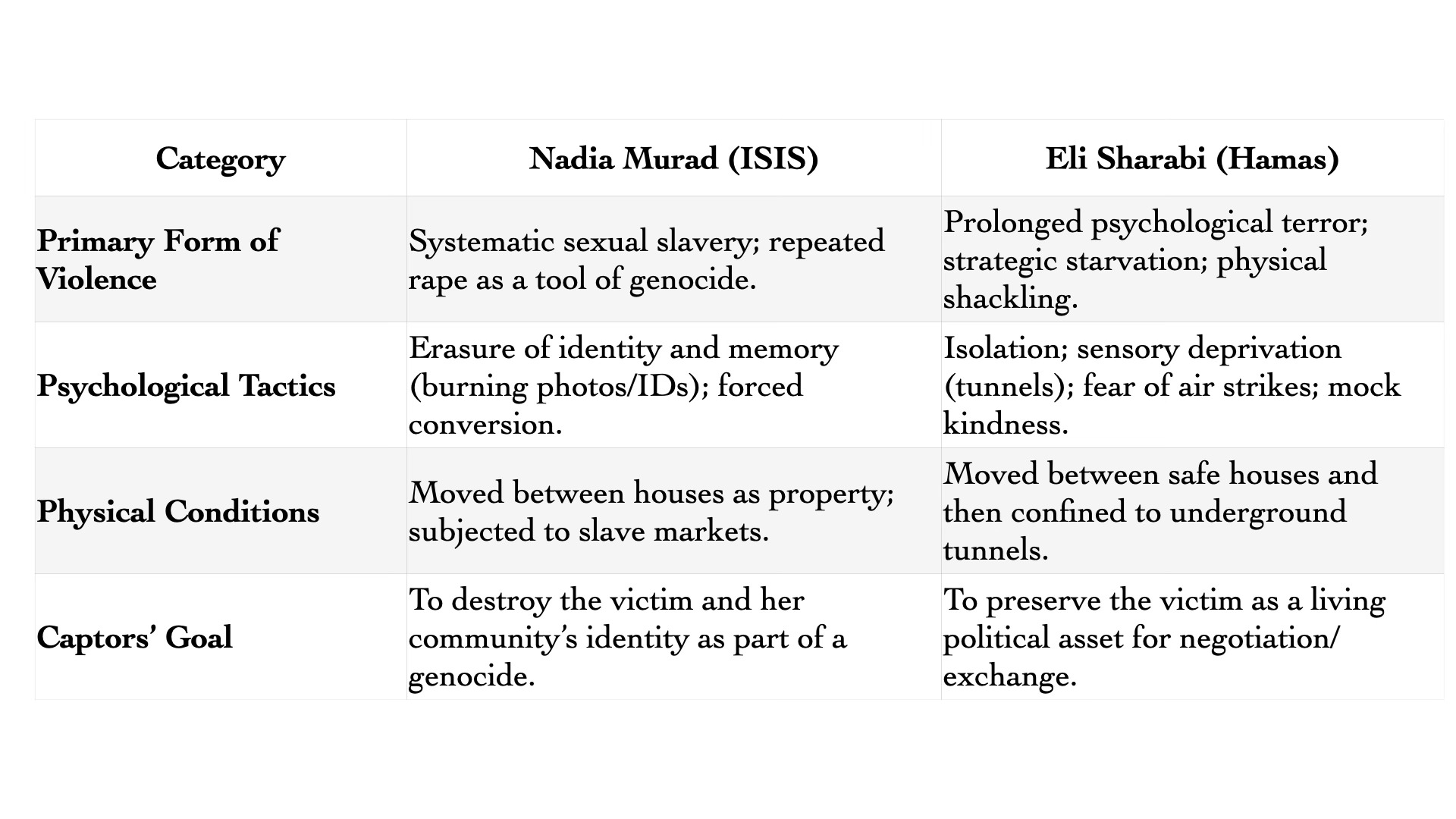
This comparison reveals a chilling calculus of cruelty. ISIS sought to destroy Nadia’s soul through the violation of her body, making her suffering a public spectacle within their caliphate. Hamas sought to break Eli’s spirit through the slow grind of terror and deprivation, keeping his suffering a closely guarded secret. Both, however, are rooted in the same fundamental act: the absolute negation of their victim’s humanity.
The Will to Endure
In the face of total de-humanisation, where captors seek to reduce a person to an object, the simple act of survival becomes a form of profound resistance. It is a testament to the indestructible core of the human spirit. Both Nadia Murad and Eli Sharabi, though subjected to vastly different forms of torment, demonstrated extra-ordinary resilience. Their memoirs are not just chronicles of pain but powerful portraits of the internal strategies and defiant acts — some explosive, some quiet — that allowed them to endure the unimaginable and maintain their essential humanity.
Nadia Murad’s Defiance and Hope
Nadia Murad’s resilience manifested in fierce, spontaneous acts of “agency reclamation” — primal performances of personhood against objectification. When she ran toward a militant on a rooftop and spat at him, or when she screamed at her abuser on the bus, she was refusing to be a passive object of their cruelty. These acts, which invited brutal punishment, were affirmations that a person, not a piece of property, was being violated. “If he kills me, I don’t care,” she thought. This was not a death wish but a declaration that her dignity was more valuable than her life under their terms.
Her internal strength was anchored in her memories and identity. She clung fiercely to the thought of her mother, Shami, and the love-filled life she had lost in Kocho. These memories were not an escape but a source of power, a reminder of the person she was before ISIS tried to erase her. This internal anchor fuelled her ultimate act of strength: the meticulous planning of her escape. Her determination was not merely to save her own life, but to transform her trauma into a public testimony, ensuring that the crimes against her people would “not go unanswered.”
Eli Sharabi’s Conscious Mission of Survival
Eli Sharabi’s resilience was a deliberate, conscious, and strategic choice. From the first moments of his abduction, he performed a deliberate “cognitive reframing” to impose an internal narrative of survival over the external reality of victimhood. “There is no more regular Eli,” he declared to himself. “From now on, I am Eli the survivor.” This was not a passive hope but an active mission. Survival became his profession, and he approached it with focused logic, using observation as a tool to meticulously study his captors’ routines, personalities, and relationships. This knowledge allowed him to “manage the situation,” to read the room, and to protect himself and others.
Eli’s strength was profoundly relational. He immediately assumed the role of a father figure to the younger hostages. He provided comfort, instilled hope in his conversations with Alon, and even faked a collapse from hunger as a calculated risk to secure more food for the group. His strength was rooted in his sense of responsibility for others, a continuation of the parental role that was so violently stripped from him.
The Bedrock of Human Strength
Synthesising their experiences, we find a bedrock of shared human strength. Both Nadia and Eli demonstrate a profound capacity for empathy, which, in a context designed to atomise and de-humanise, functions as a political act of re-humanisation. Eli’s leadership in the tunnels and Nadia’s solidarity with the other captive girls are not just personality traits; they are active re-constructions of the social bonds the terrorists sought to sever. Both are anchored by an unshakable love for their families; their memories serve as a constant source of strength and a reason to live. And most fundamentally, both possess a powerful will to live that transcends their torment. Whether expressed through Nadia’s fiery defiance or Eli’s calculated mission, their resilience proves that while captors can imprison the body, they cannot extinguish the determined will of the human spirit.
The Aftermath
For a survivor of extreme trauma, the moment of liberation is not an end to suffering but the beginning of a new and bewildering struggle. Freedom means confronting a world that has moved on, grappling with immeasurable loss, and finding a way to reintegrate into a life that has been irrevocably fractured. The return is a complex passage, and for Nadia Murad and Eli Sharabi, it unfolded in starkly different contexts. Nadia returned to a people shattered and displaced, while Eli returned to a nation mobilised and still at war.
Nadia’s Return to a Shattered Community
Nadia Murad’s return was not to a home, but to the sprawling, makeshift reality of refugee camps where her surviving Yazidi community was gathered. She re-entered a world of collective trauma, where every family was grieving and the social fabric had been torn apart. Her personal struggle was deeply intertwined with a communal one, particularly concerning the cultural taboos surrounding rape and forced conversion. The fear that she and other sabaya would be ostracised was a profound source of anxiety.
In this context, the role of communal leadership was paramount. The dictum issued by the Baba Sheikh, the Yazidi spiritual leader, welcoming the captured women back into the faith was a critical act of collective healing. It was a declaration that the community would not allow ISIS to succeed in its goal of destroying them from within. This religious and communal reception stood in sharp contrast to the profound sense of betrayal Nadia felt from their local Sunni Arab neighbours, many of whom had collaborated with ISIS. She returned to a complex social landscape of both profound solidarity and devastating treachery.
Eli’s Return to a Nation at War
Eli Sharabi’s return was met with the formal apparatus of a nation-state. He was received by established institutions — the Red Cross and the Israel Defense Forces (IDF). His first reunion at Camp Reim was with his mother and his sister, Osnat; it was Osnat who had to confirm the devastating news that his wife and daughters had been murdered. His first moments of freedom were marked by an immediate assumption of responsibility that was a direct continuation of the leadership role he had adopted in captivity. His first calls were not only to his own family but to the parents of Alon, the young hostage he had mentored in the tunnels. “I’ll fight for you, Alon. I won’t forget you,” he promised, immediately transforming his personal survival into a public mission.
Crucially, Eli did not return to a post-conflict society. He returned to a nation still actively at war, collectively traumatised by the events of October 7th, and mobilised around the singular cause of freeing the remaining hostages. His individual story immediately became part of a larger national narrative of grief, resilience, and ongoing conflict.
A Tale of Two Receptions
The contrast between their receptions is telling. Eli received a formal, state-level reception, facilitated by military and international organizations. His return was a national event, a moment of relief and symbol of hope for a grieving country. For Nadia, the most critical reception was at the communal and religious level. Without the Baba Sheikh’s edict, her reintegration would have been fraught with cultural and social peril. The state of Iraq was largely absent; her healing was dependent on the resilience of her own shattered people.
Ultimately, Nadia returned as an individual survivor to a fractured, stateless, and displaced community that had been the target of a genocide. Eli returned as a national symbol to a mobilised and grieving nation-state that was itself a party to an ongoing war. Both, however, shared the immense burden of being a survivor — a weight that would soon transform into a powerful purpose.
The Mission to Witness
For survivors of profound atrocity, the act of telling one’s story is rarely just a process of personal catharsis. It is a transformation from victim to witness, a conscious decision to give meaning to meaningless suffering by turning memory into a moral and political mission. For both Nadia Murad and Eli Sharabi, writing their memoirs was a profound act of responsibility — an obligation to the dead, a plea for the living, and a demand for justice from the world.
Nadia Murad’s motivation is explicitly one of activism and accountability. She views her testimony as a weapon against her tormentors, a way to reclaim power from those who sought to strip her of everything. “Every time I tell my story, I feel that I am taking some power away from the terrorists,” she states. Her struggle is a defiant refusal to let the perpetrators control the historical record. By speaking out, she ensures that their deeds are not forgotten or denied. “We defy them by not letting their crimes go unanswered,” she writes. Her testimony is not just a personal account; it is a meticulously documented call for international justice and a powerful instrument in the fight for recognition of the Yazidi genocide.
Eli Sharabi’s motivation is articulated as a sacred and deeply personal duty. The dedication of his memoir— “In memory of Lianne, Noiya, and Yahel... In my heart forevermore” — frames his testimony as a tribute to his murdered wife and daughters. Writing is an act of remembrance, a way of honouring their lives and ensuring they are not reduced to statistics of a massacre. This personal duty extends outward into a powerful public mission. As described in the “About the Author” section, Eli has become a “global advocate for the remaining hostages,” using his story as a vehicle for his tireless campaign. His book is both a memorial and a platform, driven by an obligation to those he lost and to those still held captive.
In synthesising their motivations, it is clear that both Nadia and Eli are driven by a powerful sense of obligation that transcends their personal trauma. They write not for themselves, but for us. Their memoirs are acts of profound resistance, aimed at ensuring remembrance for the dead, demanding accountability for the perpetrators, and, most importantly, reclaiming the narrative from those who used violence to silence them. They write to transform the world’s passive gaze into active moral engagement.
The Enduring Power of Testimony
This comparative analysis of Nadia Murad’s The Last Girl and Eli Sharabi’s Hostage reveals the chillingly coherent logic of modern, ideologically-driven terror. Through their eyes, we see how highly organised groups like ISIS and Hamas systematise violence, whether through the genocidal bureaucracy of sexual slavery or the cold calculus of hostage-taking. We witness two distinct but equally dehumanising forms of brutality, one designed to annihilate a people and the other to leverage human lives as political currency. Yet, from these depths of suffering, we also witness the emergence of profound reservoirs of human resilience — the defiant spirit of Nadia and the strategic mission of Eli — proving that the will to endure can survive even the most absolute forms of degradation. Finally, we see how the solitary struggle of the survivor is transformed into a shared mission of advocacy upon their return to the world.
Reiterating this essay’s central idea, these two memoirs, when read together, provide an unparalleled education in the mechanics of contemporary atrocity. They demand that we look beyond headlines and geopolitical abstractions to understand the human cost of extremist and annihilationist ideologies. Nadia Murad and Eli Sharabi’s stories are therefore not just records of suffering; they are acts of defiance that challenge the world to confront evil, demand justice, and affirm the indestructible value of human life and dignity. Their testimonies are a final, defiant reclamation of their humanity, proving that even from the darkest of cages, the human spirit finds the strength not only to survive, but to bear witness: transforming silence into demand for justice and memory into a sacred obligation. We must not forgive. We must not forget.


