Answering Why with Finger Paint: A Causal Indictment of Larsson & Mattsson (2024)
18 January 2026
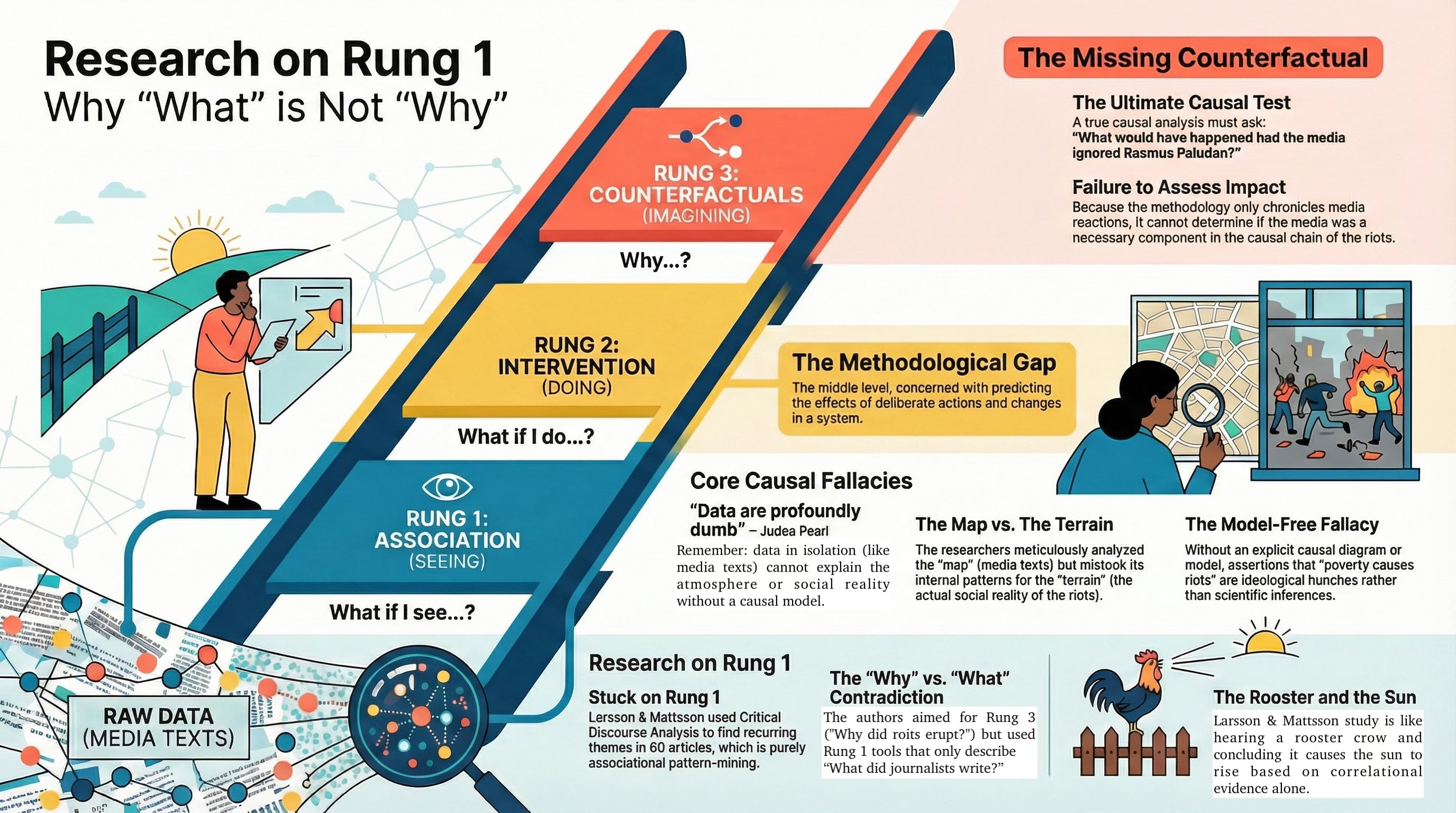
This article is not a gentle peer review; it is an indictment. Larsson & Mattsson (2024) set out to explain why riots erupted in Sweden and end up mistaking a bag of textual anecdotes for a theory of reality. They promise root causes and deliver word counts, announce an inquiry into “why” and then spend their time staring at “what” on the safest, lowest rung of Judea Pearl’s Ladder of Causation. My purpose here is to show, with all the politeness their methodology deserves, that they have confused pattern-spotting with explanation, discourse with causality, and their own ideological hunches with scientific inference. Using Pearl’s framework as a scalpel rather than a slogan, I will dissect their work until the central problem is unmistakable: this is not causal analysis gone slightly astray, but bad philosophy in statistical drag—incapable of answering the very questions it so grandly claims to confront.
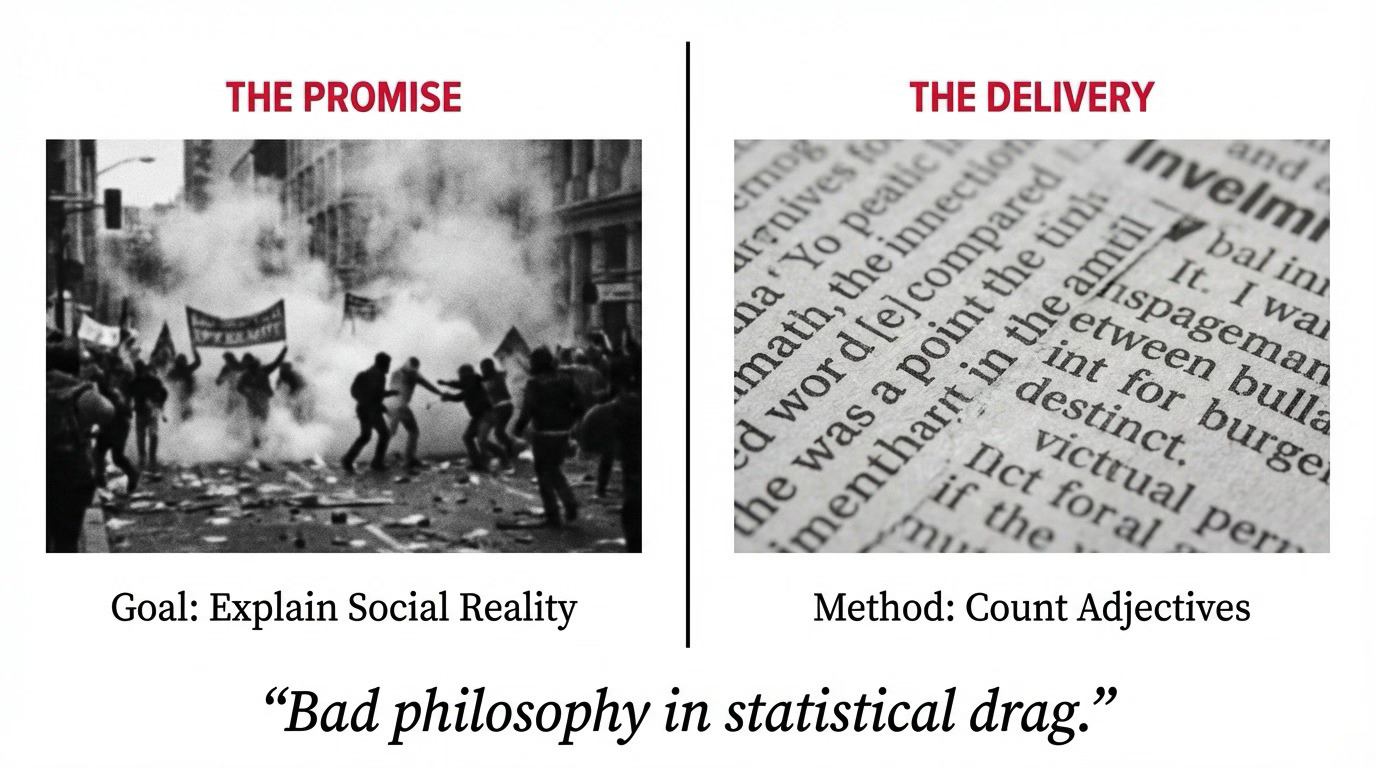
This review is not concerned with the political dimensions of Larsson & Mattsson’s (2024) paper, nor with its stylistic merits. It serves instead as a methodological lesson. The authors’ work provides a perfect exemplar of a profound and increasingly common error in the social sciences: the confusion of analysing data—in this case, a corpus of media texts—with explaining reality, namely, the causal process that generated the social unrest they seek to understand. Let us untangle their confusion as the primary purpose of this critique.
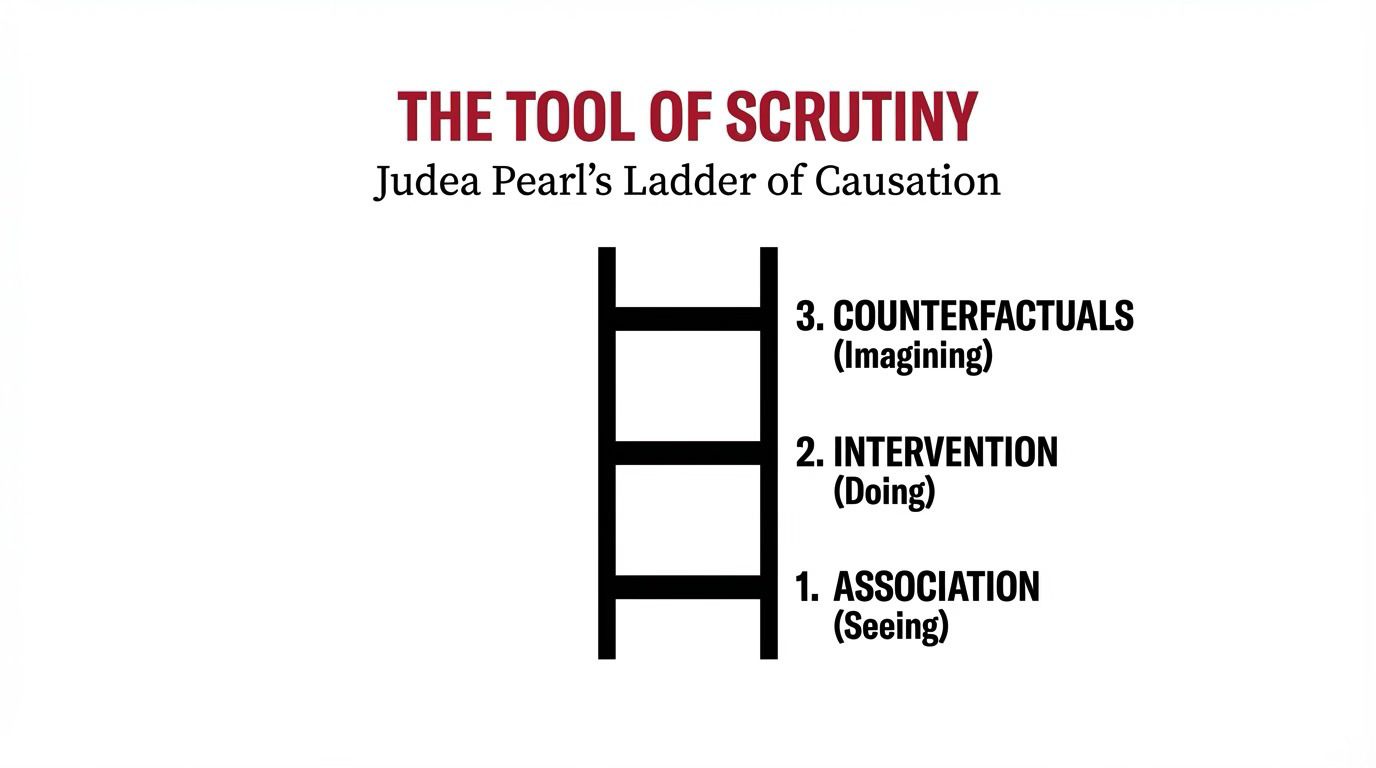
The analytical framework for this exercise is the Ladder of Causation, as articulated in The Book of Why. This hierarchy delineates three distinct levels of reasoning: the first rung, Association, deals with passively observing regularities. The second, Intervention, involves predicting the effects of deliberate actions. The third and highest rung, Counterfactuals, requires imagining worlds that do not exist to answer questions of “Why?” Larsson & Mattsson’s work, I will argue, remains firmly stuck on the first rung, despite their ambition to explain phenomena that belong on the third. This is not merely a new analytical tool; it is a fundamental re-orientation of the scientific enterprise, away from the data-centric obsession of the past century and back toward the model-based reasoning that has always been the engine of human understanding.
The initial step in this scrutiny, therefore, is to situate the authors’ methodology precisely on this Ladder of Causation, and in so doing, reveal the fundamental mismatch between their analytical tools and their explanatory claims.
The Ladder of Causation Assessment
The Ladder of Causation is not merely a metaphor; it is an indispensable tool for classifying the power of scientific queries. It provides a formal hierarchy of reasoning that separates the simple act of seeing patterns from the profound act of understanding them. Any claim to an “explanation” must, by definition, ascend beyond the mere observation of associations. It is against this standard that one must first assess the authors’ work.
Rung 1 (Association): Locating the Authors’ Methodology
The first rung of the ladder is the level of Association, which corresponds to “Seeing.” This level is concerned exclusively with detecting patterns, correlations, and regularities within a given set of data. It answers questions of the form, “What if I see...?” Most of machine learning, and indeed the bulk of traditional statistical analysis, operates at this level.
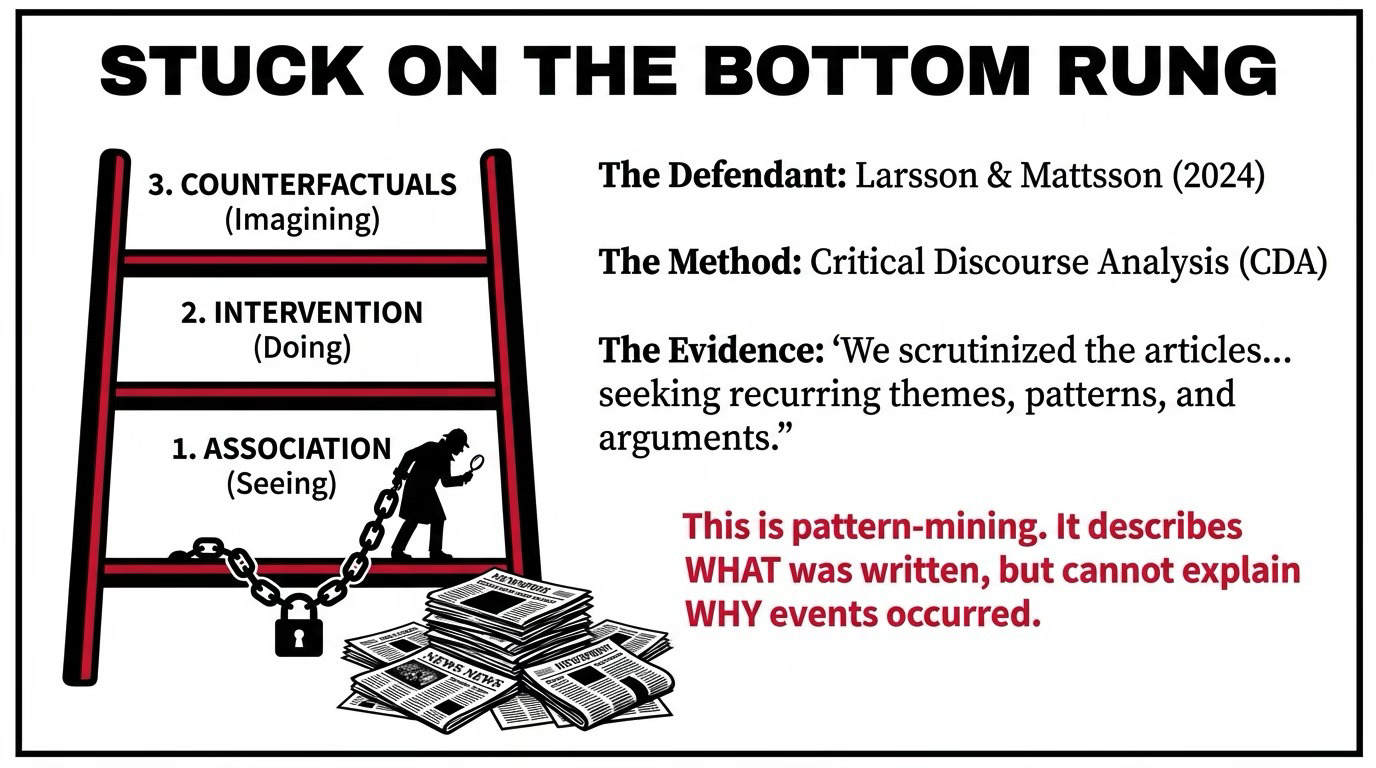
Larsson & Mattsson’s methodology—Critical Discourse Analysis (CDA) as they have applied it—functions exclusively on this rung. Their own description of their analytical process confirms this placement with unambiguous clarity:
“In the first step of the analysis, we scrutinized the articles to learn about the manifest textual content... seeking recurring themes, patterns, and arguments.” (Larsson & Mattsson, 2024, p. 137).
This process is a sophisticated form of pattern-mining. It meticulously identifies correlations between words and themes within a closed dataset of 60 opinion pieces. While valuable as a descriptive summary of what was written, this is the very definition of an associational analysis. It documents the statistical regularities of a particular dataset but is structurally incapable of moving beyond it to make claims about the data-generating process itself.
The Cardinal Sin: Answering Why with What
The cardinal sin of causal inference is attempting to answer a question from a higher rung using only the tools of a lower rung. This is the methodological equivalent of listening to a rooster crow every morning and concluding, from the overwhelming correlational evidence, that its crowing causes the sun to rise.
Larsson & Mattsson commit this transgression by stating their objective is to understand “why the riots erupted in the first place” (Larsson & Mattsson, 2024, p. 131) and to discuss their “root causes” (Larsson & Mattsson, 2024, pp. 149, 151). These are Rung 3 questions. They belong to the realm of counterfactuals, of explanation, of “Why.” Yet, the authors attempt to answer them using a Rung 1 methodology that can only describe “What.” This creates a stark contradiction between their ambition and their method. We are forced to ask sharp, rhetorical questions:
How can a frequency analysis of words in newspaper columns provide a causal explanation for a physical event like a riot? Is this not attempting to answer “Why did the riots happen?” using only the answer to “What did journalists write?”
A genuine causal inquiry would begin not with the text, but with a hypothetical model of the social dynamics—a causal diagram—where “poverty” and “media narratives” are variables whose relationships can be formally articulated and tested against data. This fundamental confusion of rungs is a direct consequence of a more foundational error:
the belief that data, if scrutinised with sufficient care, can speak for themselves.
The Fallacy of an Atheoretical Claim
A central axiom of modern causal inference is that data, in isolation, are devoid of causal meaning. As Pearl makes it clear, “Data are profoundly dumb” (Pearl, 2018, p. 6). Data can tell us that a falling barometer is an excellent predictor of a storm, but they cannot tell us that smashing the barometer will prevent the storm. The authors’ analysis of media texts is an analysis of the barometer, not the atmosphere. To get from correlation to causation, one must supply a causal model—an artefact of human knowledge, not of data.
Scrutinising the Omission Claim
The authors’ central claim is that “Material reasons – poverty, unemployment, and racism – are largely omitted from the debate” (Larsson & Mattsson, 2024, pp. 131, 151). On the surface, this appears to be a descriptive, Rung 1 observation about their dataset. However, embedded within it is a powerful causal assertion about reality. By framing this omission as a failing, the authors implicitly argue that poverty, unemployment, and racism are relevant causes of the riots and therefore should have been included in the debate. This is a causal claim, not a statistical one.
The Query: Where is the Causal Model?
This brings me to the pivotal query that exposes the methodological vacuum at the heart of their paper. The authors’ implicit causal model is a simple one:
Poverty → Riots.
Their claim that the media’s omission is a failure rests on the untested assumption that this link is not confounded by other factors (e.g., political disenfranchisement, policing strategies, historical grievances) which might be the true drivers of both the material conditions and the unrest. We must therefore challenge the foundation of their claim:
On what causal model do the authors rely to assert that poverty is a relevant cause that the media ought to have debated?
Have Larsson & Mattsson presented a Causal Diagram that specifies a formal, testable pathway from poverty to the riots? Or is their assertion that “poverty causes riots” simply another unverified Rung 1 association, imported from their own convictions?
Without a model that accounts for potential confounders, their assertion is not a scientific claim but an ideological one.
The absence of an explicit causal model leads directly to the next methodological failure: the belief that a vaguely defined “discursive order” can serve as a substitute for a genuine causal mechanism.
The Model-Free Fallacy
Any attempt to answer causal questions with a “model-free” approach is doomed. Sewall Wright, the inventor of causal diagrams, understood this nearly a century ago, stating, “There can be no such analysis without a model” (Wright, cited in Pearl, 2018, p. 88). Any claim about regulation, causation, or the relative importance of causes requires an explicit model of the data-generating process.
As a researcher in artificial intelligence, Pearl’s work on Bayesian networks taught him a crucial lesson: a machine can process probabilities with flawless precision but possess no intelligence whatsoever. Intelligence begins when the machine, or the researcher, can build a model of reality—a model of the causal process that generates the data.
The Charade of Discursive Order
The authors claim that their CDA method allows them to observe “discursive orders that regulated the debate” (Larsson & Mattsson, 2024, p. 131). We must challenge the scientific meaning of this term. From a formal perspective, a “discursive order” that is merely a collection of correlations in text is observationally equivalent to a simple topic model. It provides no means to distinguish between a causal chain (e.g., Political Ideology → Discursive Order → Media Content) and a causal fork (e.g., Political Ideology → Discursive Order; Political Ideology → Media Content). Without a model that makes this distinction, the term “regulated” is scientifically vacuous. The authors have simply given a new name to the patterns they observe and asserted, without proof, that these patterns are causal.
The Map vs. The Terrain
The authors’ error can be framed perfectly with the map-terrain analogy. They have meticulously analysed the map (the 60 media texts) and are now making definitive claims about the terrain (the complex social reality of the riots). However, they possess no key or legend—no causal model—to connect the features on the map to the phenomena in the territory. Their analysis remains an elaborate description of the map itself, mistaking its internal patterns for the external forces that shaped it.
This model-free fallacy means that the most powerful tool for exploring the terrain of “what if”—the counterfactual—is entirely absent from, and inaccessible to, their analysis.
The Missing Counterfactual
Counterfactuals reside on the third and highest rung of the Ladder of Causation. They are the building blocks of scientific explanation and moral reasoning. To truly understand the causal impact of any variable, one must be able to ask what would have happened in its absence. As the philosopher David Lewis noted,
“We think of a cause as something that makes a difference, and the difference it makes must be a difference from what would have happened without it” (Lewis, cited in Pearl, 2018, p. 20).
Identifying the Core Counterfactual
For the subject of this paper, the single most important and revealing counterfactual question is this:
“What would have happened had the media ignored Rasmus Paludan?”
The authors themselves note that Paludan’s explicit goal was to “create ‘chaos’” (Larsson & Mattsson, 2024, p. 141). This observation cries out for a counterfactual inquiry into the media’s role. Was the media’s coverage a necessary component in the causal chain that led to the riots?
Evaluating the Analytical Gap
A true causal analysis would attempt to model the media’s role in amplifying this chaos. It would seek to provide a principled, evidence-based answer to our counterfactual question. Larsson & Mattsson do not do this. Their methodology is restricted to describing the media’s reaction as a passive chronicle of events. They document the content of the coverage but cannot assess its causal impact.
If a methodology cannot provide a principled answer to the question, “What if the media had remained silent?,” then it has not explained the media’s causal role in the event. It has merely documented the associational patterns present in its textual output. This brings us to a final, inescapable verdict.
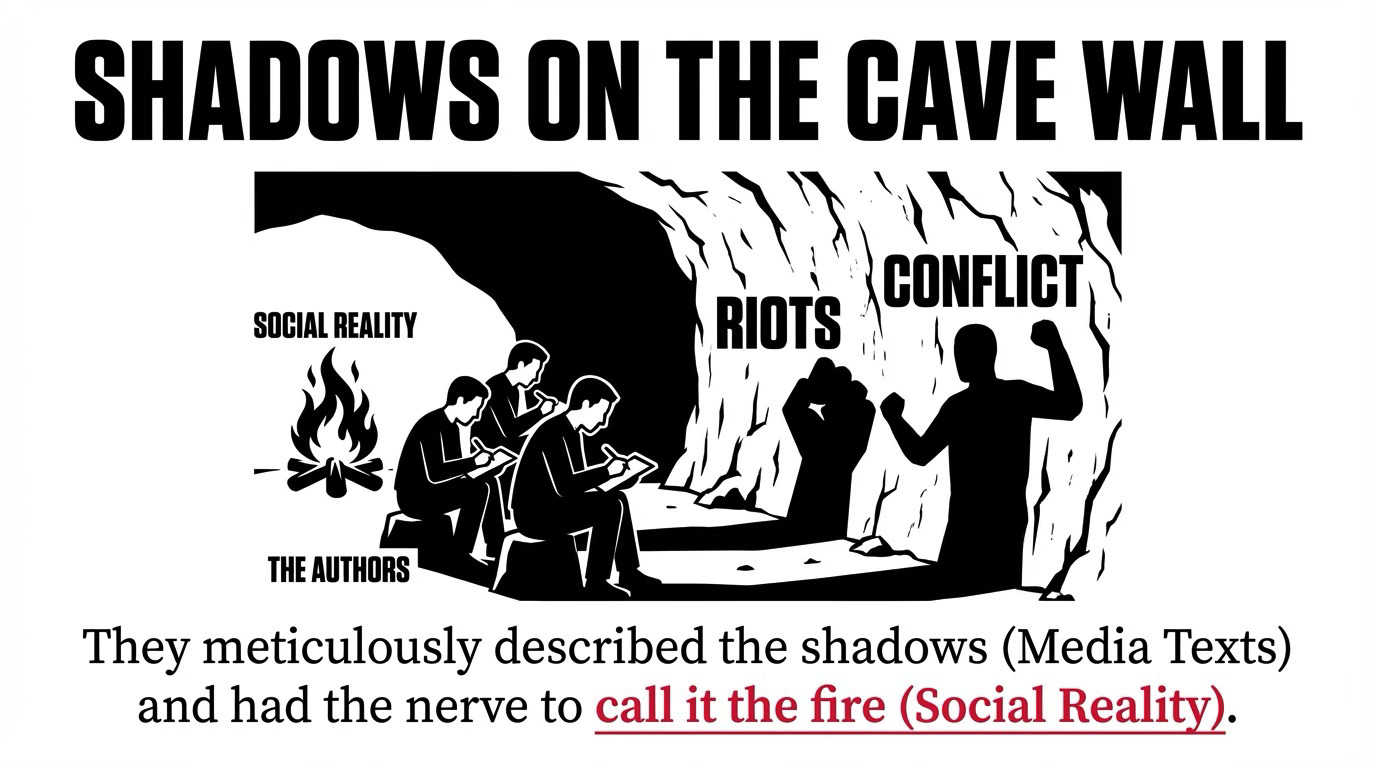
Verdict: Shadows on the Cave Wall
In summary, the epistemological architecture of Larsson & Mattsson’s paper is fundamentally flawed. They set out to answer a Rung 3 question (“Why did the riots happen?”) using a Rung 1 methodology (discourse analysis of texts). They posit the causal relevance of certain “omitted” factors without providing a causal model to substantiate the claim. They mistake a description of the map (media texts) for an explanation of the terrain (social reality). And finally, their analysis is structurally incapable of engaging with the essential counterfactual questions that lie at the heart of any causal explanation.
The authors’ analysis, while potentially a valid description of media content, fails completely in its stated ambition to provide a causal explanation. My verdict is therefore as follows:
Larsson & Mattsson have not successfully climbed the Ladder of Causation. They have remained on the lowest rung, meticulously describing the shadows of discourse on the cave wall while claiming to explain the reality of the fire that cast them.
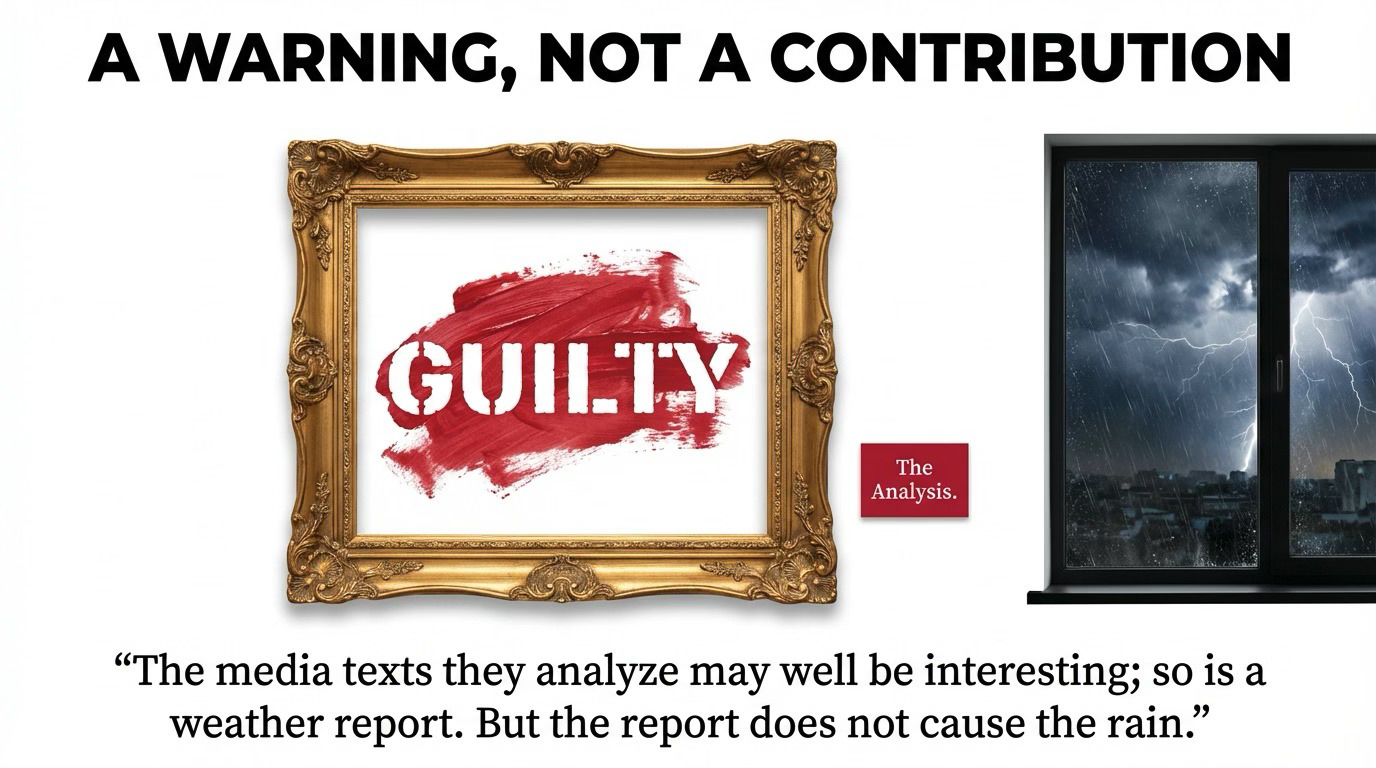
In the end, the verdict could not be clearer if it were written in burning letters across the title page: Larsson & Mattsson have produced a meticulous description of shadows and then had the nerve to call it sunlight. They plant their flag on the highest rung of the Ladder of Causation, talking gravely of “root causes” and “why the riots erupted,” while never once leaving the safe, padded cell of association. No causal model, no counterfactuals, no attempt to distinguish barometer from storm—only a discursive fog in which their own assumptions stroll about dressed as conclusions. The media texts they analyse may well be interesting; so is a weather report, but it does not cause the rain. What they offer, finally, is not an explanation of reality but a projection of their convictions onto a small dataset and a hope that no one will notice the trick. This article has had one simple task: to notice. And once seen, the failure is terminal. Their paper stands as a warning, not a contribution: a case study in how not to answer Why.
Sources:
Göran Larsson & Christer Mattsson, 2024, “Rasmus Paludan, Burning of the Qur’an and Swedish Media: A Critical Discourse Analysis.” Temenos Nordic Journal for the Study of Religion, Vol. 60, No. 1, pp. 131–156.
Judea Pearl and Dana Mackenzie, 2018, The Book of Why: The New Science of Cause and Effect. New York: Basic Books.


