An Unprecedented Confluence: Why the Islamic Republic’s Final Chapter May Have Begun
13 January 2026
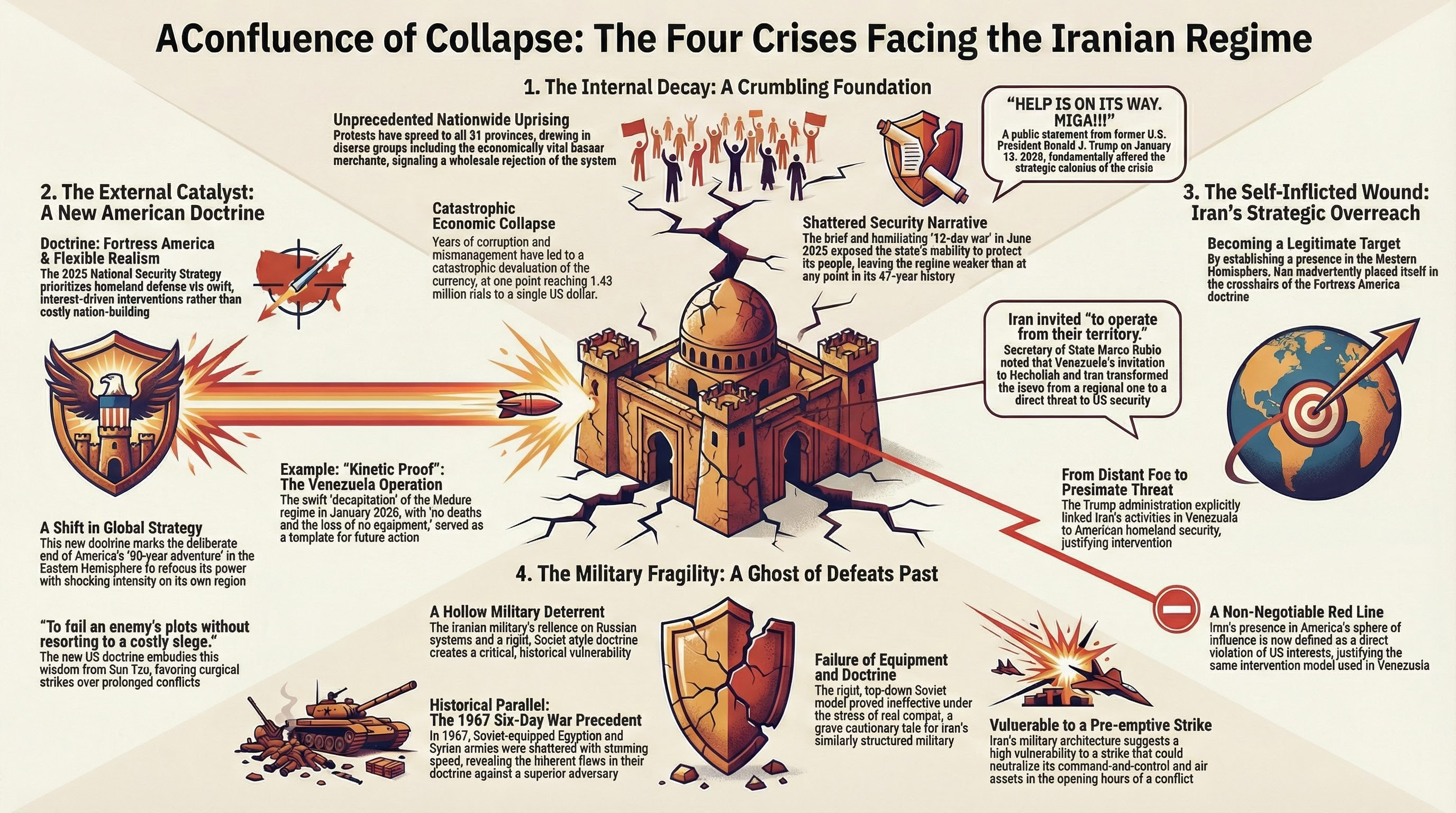
A Promise That Is Also a Warning
In the volatile crucible of a country convulsed by protest, the words of world leaders carry extraordinary weight. As millions of Iranians take to the streets in a country-wide uprising against the Islamic Republic, every statement from abroad is scrutinised for meaning, for intent, and for the promise of action. In this supercharged environment, a single, unambiguous declaration from U.S. President Donald J. Trump has fundamentally altered the strategic calculus, transforming a domestic crisis into a potential geopolitical inflection point.
On 13 January 2026, President Trump issued the following public statement:
Iranian Patriots, KEEP PROTESTING - TAKE OVER YOUR INSTITUTIONS!!! Save the names of the killers and abusers. They will pay a big price. I have cancelled all meetings with Iranian Officials until the senseless killing of protesters STOPS. HELP IS ON ITS WAY. MIGA!!! PRESIDENT DONALD J. TRUMP (Truth Social, 13 Jan 2026)
This is not mere rhetoric. To dismiss it as such is to fundamentally misread the character of its author and the new doctrine of American power he has unleashed. This is a credible declaration of intent from a leader with a documented, visceral aversion to his threats being ignored. One need only recall how Venezuelan President Nicolás Maduro’s taunts to “Come and get me” preceded his capture and subsequent appearance in a New York courtroom. When this president makes a threat, he intends to act.
This confluence of two powerful, simultaneous developments has created a historic, and possibly fleeting, opportunity to bring about the collapse of the Iranian regime. The first is the unprecedented internal fragility of the Islamic Republic, which is now facing its most severe crisis of legitimacy in nearly five decades. The second is a seismic shift in American foreign policy, which has abandoned the costly ambiguities of the post-Cold War era for a doctrine of swift, decisive, and interest-driven action. Trump’s message is the public expression of this new reality. To understand why this moment is unique, one must first appreciate the depth of the decay within the regime itself.
The Rot Within
Before any external pressure can be effective, the target must first be sufficiently brittle. The strategic importance of a regime’s internal stability cannot be overstated; it is the foundation upon which its power rests. For the Islamic Republic, that foundation is crumbling. A series of interlocking crises—political, economic, and ideological—have brought the regime to its most vulnerable point in decades, creating the first element of the perfect storm that now threatens its existence.
The current country-wide protests are unlike any that have come before. They have spread to all 31 of Iran’s provinces, drawing in a diverse cross-section of society that now includes the economically vital bazaar merchants, a class whose acquiescence has historically been a pillar of the regime’s stability. Across the country, in scenes unthinkable just a few years ago, protesters are pulling down regime flags and toppling statues, a potent symbol of their wholesale rejection of the system. This is not a cry for reform; it is a demand for revolution.
Underpinning this social eruption is a state of near-total economic dysfunction. Years of endemic government corruption and mismanagement have hollowed out the economy, culminating in the “catastrophic devaluation of the rial,” which at one point reached 1.43 million rials to a single US dollar . Popular anger has been further inflamed by the regime’s squandering of the country’s wealth on foreign proxies like Hezbollah and Hamas, vanity projects that do nothing to improve the daily lives of ordinary Iranians.
The final pillar of the regime’s authority—its claim to provide security—was shattered by the June war of 2025. This brief but humiliating conflict, also known as the 12-day war, exposed the state’s inability to protect its own people, leaving it, in the words of one analyst, “weaker than it’s been in its past 47 years.” Stripped of its economic credibility and its security narrative, the regime is now sustained by little more than brute force. This profound internal decay has rendered it uniquely susceptible to the new form of external pressure now being projected by the United States.
The External Catalyst
A state’s internal vulnerabilities, however severe, are often insufficient on their own to topple an entrenched authoritarian regime. They require an external catalyst. In this instance, the catalyst has arrived in the form of a fundamental recalibration of American grand strategy, one codified in the 2025 National Security Strategy (NSS) that provides a new and potent template for intervention—the second critical element in this unprecedented confluence of threats.
This new doctrine is a deliberate and unsentimental departure from 80 years of American foreign policy. At its heart is the defensive mandate of Fortress America, which prioritises the homeland by aggressively enforcing the Trump Corollary in the Western Hemisphere, using the swift, unsentimental interventions of Flexible Realism as its primary tool. This integrated system abandons the costly project of nation-building in favour of decisive, interest-driven interventions designed to achieve specific, tangible outcomes.
The January 2026 operation in Venezuela served as the definitive “kinetic proof” of this new doctrine in action. The swift, surgical “decapitation” of the Maduro regime was a masterclass in Sun Tzu’s wisdom “to foil an enemy’s plots without resorting to a costly siege.” Lauded by President Trump as “pretty amazing” with “no deaths and the loss of no equipment,” it was a demonstration of Washington’s willingness to use “overwhelming American military power” to enforce its worldview. As the geopolitical strategist George Friedman astutely observed, this action marks the deliberate end of America’s “80-year adventure” in the Eastern Hemisphere, allowing it to refocus its formidable power with a new and shocking intensity on its own region. This new doctrine, however, is not geographically constrained; it is a template aimed at any adversary, like Iran, that threatens core U.S. interests within its designated sphere of influence.
A Self-Inflicted Wound
How a threat is defined determines how it is confronted. In a decisive strategic move, the Trump administration has explicitly linked Iran’s activities directly to American homeland security via its foothold in the Western Hemisphere. This re-framing is not a matter of semantics; it is a formal justification for making Iran a legitimate target under the new Fortress America doctrine. In a historic miscalculation, Iran’s foreign policy overreach has been its strategic undoing; by establishing a presence in America’s sphere of influence, the Islamic Republic inadvertently placed itself directly in the crosshairs of the one doctrine specifically designed to eradicate such proximate threats.
The connection was articulated with precision by Secretary of State Marco Rubio, who noted that the Maduro regime had gone so far as to “invite Hizbollah and Iran to operate from their territory.” As I have observed, this statement “elevates the intervention from a regional policing action to a core component of great-power competition.” It collapses the geographic distance between Tehran and Washington, transforming Iran from a distant Middle Eastern problem into a direct violator of a non-negotiable American red line. Consequently, Iran’s presence in Venezuela justifies the application of the same decisive, interest-driven intervention model that proved so effective against Maduro.
This logic was reinforced by President Trump himself during a White House summit with oil executives following the Venezuela operation. He framed the entire venture not only as an economic opportunity but as a crucial act of national security designed to “keep rivals like Russia and Iran out of the Western Hemisphere.” By establishing this direct threat nexus, Washington has laid the doctrinal groundwork to act against the Iranian regime not as a distant ideological foe, but as a hostile actor that has trespassed into America’s own backyard. Just as the regime’s strategic overreach has created this new geopolitical vulnerability, its military posture rests on a historically fragile foundation.
A Ghost of Defeats Past
A regime’s ultimate survival rests upon the credibility of its military power. For all its bellicose rhetoric, the Islamic Republic’s military posture contains a critical, historical vulnerability rooted in its reliance on Russian military systems and a Soviet-style doctrine that has failed catastrophically in the past. This latent military fragility is the third and final element that completes the perfect storm now gathering over Tehran.
The 1967 Six-Day War offers a powerful and sobering historical parallel. In that conflict, the Soviet-equipped and trained armies of Egypt and Syria, which on paper appeared formidable, were shattered with a speed and completeness that stunned the world. Soviet military advisers in Egypt watched the near-instantaneous destruction of the Egyptian air force on the ground with “horror and disbelief.” The psychological shock induced by such a swift and overwhelming assault is precisely the intended effect of the new American doctrine. The speed of the Venezuela operation was designed to induce a similar paralysis and doctrinal collapse in modern adversaries who, like the Arab armies of 1967, rely on Russian systems and the false comfort of their own propaganda.
The catastrophic failure was not merely one of equipment, but of doctrine. The rigid, top-down Soviet military model proved completely ineffective when faced with the stress of actual combat against a technologically and doctrinally superior adversary. The Israeli victory was a devastating indictment of the Soviet approach, demonstrating that “military effectiveness required more than just following Soviet procedures and using Soviet equipment.” This historical precedent serves as a grave cautionary tale for the current Iranian regime. Its military architecture mirrors that of the Arab armies of 1967, suggesting a similar vulnerability to a pre-emptive strike that could neutralise its command-and-control and air assets in the opening hours of a conflict.
6. The Confluence of Opportunity and Will
The argument is stark and its logic is relentless. The Islamic Republic of Iran is facing an unprecedented confluence of internal decay and external pressure that may well herald its final chapter. The core pillars of this historic vulnerability can be summarised as follows:
- First, the regime is at its weakest and most illegitimate point in nearly five decades. It is besieged by mass protests fuelled by economic collapse, and its core narrative of providing security was delegitimised at its centre by the disastrous June 2025 war.
- Second, the United States has simultaneously adopted and proven a new, aggressive foreign policy doctrine of Flexible Realism. The swift and decisive removal of the Maduro regime in Venezuela was not an outlier but a statement of intent—a new template for action.
- Third, Washington has explicitly defined Iran’s presence in the Western Hemisphere as a direct threat to American national security. Through its own strategic overreach, the regime has made itself a legitimate target under this new, muscular doctrine.
- Finally, the regime’s military deterrent is likely a hollow shield, its foundations built upon a Soviet-style military doctrine that has historically proven brittle and ineffective when confronted with a superior and more agile adversary.
In this context, President Trump’s declaration that “HELP IS ON ITS WAY” cannot be dismissed. It is not an empty promise but the public announcement of a new strategic reality. This moment represents a rare and perhaps unrepeatable alignment of factors: a teetering regime, a revolutionary populace, and an external power with both the doctrine and the demonstrated will to act. For those who seek a fundamental change in Iran, this represents the definitive window to provide the decisive push needed to send a rotting edifice off the cliff.


